Best Recovery Practices When You Train Alone and Have No Therapist
Quick Answer
When you train alone without a therapist, effective recovery centres on sleep, progressive training loads, protein intake, simple mobility and soft-tissue work, symptom monitoring, and planned deloads. Prioritise 7–9 hours of quality sleep, keep most sets 1–3 repetitions short of failure, eat sufficient protein, use controlled ranges and tempos, and reduce volume by 40–60 % every 4–8 weeks. Track how joints and energy feel 24–48 hours after sessions and regress immediately if symptoms increase. These practices prevent most overuse issues and support long-term progress without professional oversight.
Why Solo Trainees Need a Deliberate Recovery System
Training alone removes external feedback. There is no coach to notice form breakdown, no therapist to catch early tissue irritation, and no training partners to enforce rest days. Responsibility for recovery therefore falls entirely on the individual. The good news is that the highest-impact recovery tools are simple, low-cost, and fully under your control. Consistency with these fundamentals outperforms sporadic advanced modalities.
Core Pillars of Solo Recovery
- Sleep – The foundation of tissue repair, hormone regulation, and performance.
- Load management – Matching training stress to current recovery capacity.
- Nutrition support – Especially protein and overall energy intake.
- Symptom awareness – Early detection of accumulating fatigue or irritation.
- Active recovery methods – Low-level movement, mobility, and soft-tissue work.
- Planned unloading – Regular deloads before symptoms force them.
Sleep: The Highest-Leverage Recovery Tool
Aim for 7–9 hours of quality sleep most nights. Practical steps that improve sleep without specialised equipment:
- Fixed sleep and wake times, even on weekends
- Dark, cool, quiet room
- No screens for 30–60 minutes before bed
- Caffeine cut-off 8–10 hours before sleep
- Light evening meal and minimal alcohol
Chronic short sleep elevates injury risk and blunts strength and muscle gains more than almost any other factor. Treat sleep as a non-negotiable training requirement.
Load Management for Solo Trainees
| Variable | Building Phase | Recovery-Focused Approach | Warning Signs to Regress |
|---|---|---|---|
| Weekly volume | Progressive increase | Hold or reduce when fatigue rises | Persistent joint ache, performance drop |
| Proximity to failure | 1–3 RIR most sets | 2–4 RIR on higher-risk movements | Form breakdown, lingering soreness |
| Frequency | 2–4 sessions per pattern | Keep frequency, cut sets first | Sleep disturbance, motivation crash |
| Exercise selection | Include variety | Prefer controlled, joint-friendly variations | Sharp or radiating pain |
| Progression speed | Steady | Slower when recovery feels incomplete | Increased resting discomfort |
Reduce volume before intensity. Keeping loads relatively high on fewer sets usually maintains strength better than dropping weights across high volume.
Nutrition Basics That Support Recovery
- Target a protein intake of roughly 1.6–2.2 g per kg of body weight per day, distributed across meals.
- Maintain overall energy intake sufficient to support training; chronic deficits impair recovery.
- Stay hydrated; even mild dehydration increases perceived effort and can affect tissue resilience.
- Include fruits, vegetables, and micronutrient-rich foods for general health.
Supplements are secondary. Creatine monohydrate has the strongest evidence for strength and recovery support in most populations; everything else is optional.
Simple Mobility and Soft-Tissue Practices
Daily or near-daily low-intensity work improves tissue tolerance without adding fatigue:
- 5–10 minutes of controlled joint circles and dynamic mobility for hips, thoracic spine, and shoulders
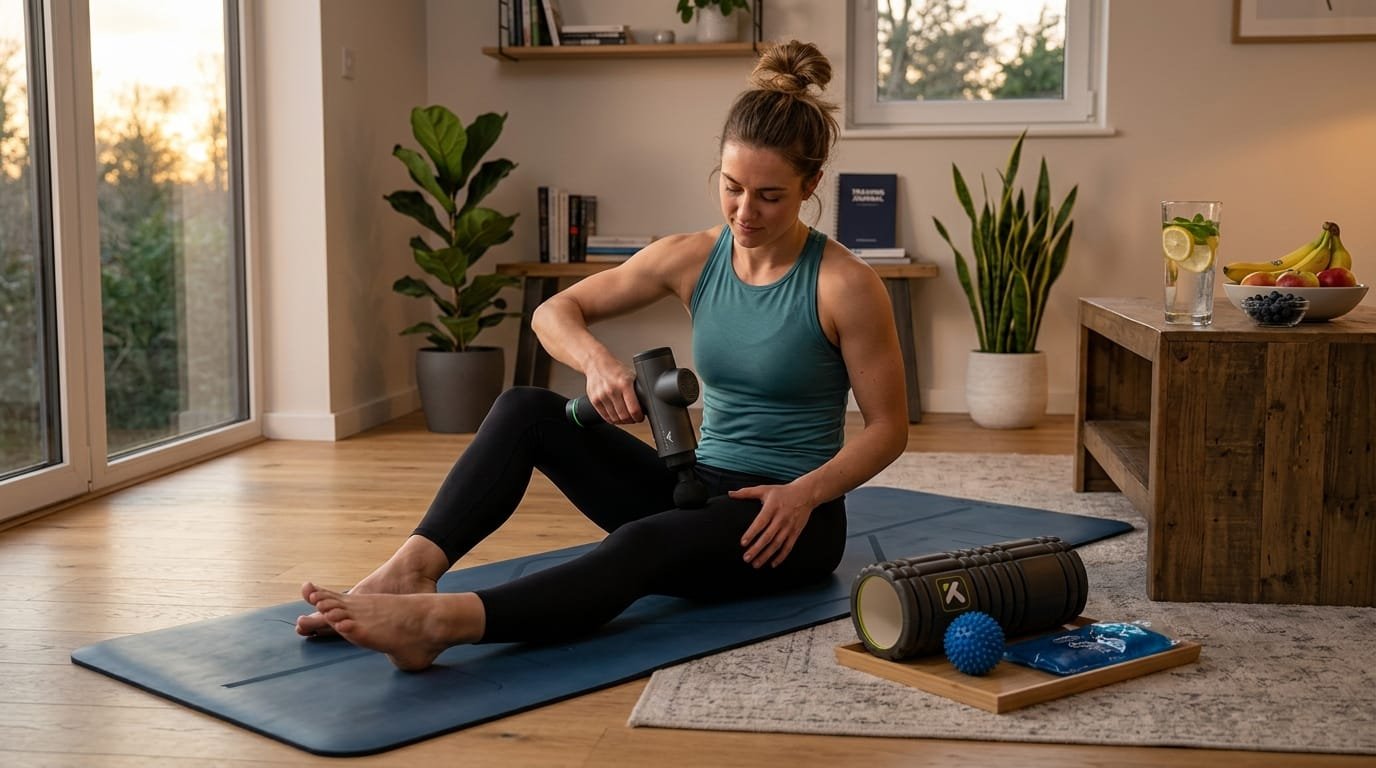
- Light foam rolling or massage-ball work on tight areas (stop short of pain)
- End-range isometrics or gentle contract-relax stretches if they feel beneficial
- Short walks on off days to promote blood flow
Avoid aggressive stretching into painful ranges or lengthy soft-tissue sessions that leave you sore.
Symptom Monitoring System
Create a simple daily or post-session check:
- Joint pain score (0–10) at rest and with movement
- Muscle soreness location and severity
- Energy and motivation level
- Sleep quality the previous night
If joint pain rises, performance drops for more than two consecutive sessions, or sleep deteriorates, reduce volume or take an extra rest day. Solo trainees who ignore these signals accumulate problems that eventually force longer layoffs.
Planned Deloads
Every 4–8 weeks of hard training, insert a deload week:
- Reduce total sets by 40–60 %
- Keep loads moderate to high on the remaining sets
- Maintain movement patterns so skill is not lost
- Use the extra time for sleep and mild mobility
Deloads are proactive recovery, not a sign of weakness. They allow adaptation to consolidate and reduce the risk of overuse injuries.
Step-by-Step Solo Recovery Routine
- Set a consistent sleep schedule and protect it.
- Track training volume and how joints feel 24–48 hours later.
- Keep most sets 1–3 repetitions short of failure.
- Eat sufficient protein and overall calories.
- Perform 5–10 minutes of daily mobility or light soft-tissue work.
- Schedule a deload every 4–8 weeks.
- Use controlled tempos and full pain-free ranges on all lifts.
- Regress immediately when warning signs appear.
- Reassess the programme every 4–6 weeks.
- Maintain grip and shoulder health with low-volume, high-quality work (Do Hand Grippers Really Work?, Bent Arms vs. Straight Arms in Lateral Raises, The Hidden Mistake in Lateral Raises, and 3 Lateral Raise Modifications).
Recovery Practices Ranked by Impact for Solo Trainees
| Practice | Impact Level | Cost | Time Required | Notes |
|---|---|---|---|---|
| Sleep optimisation | Very high | Free | Ongoing | Highest leverage |
| Volume management | Very high | Free | Planning | Prevents most overuse issues |
| Protein intake | High | Low | Daily | Supports repair |
| Planned deloads | High | Free | 1 week every 4–8 weeks | Proactive |
| Daily mobility | Moderate | Free | 5–10 min | Improves tolerance |
| Soft-tissue work | Moderate | Low | 5–10 min | Symptom relief |
| Advanced modalities (ice, etc.) | Low–moderate | Variable | Variable | Secondary |
Common Solo-Training Recovery Mistakes
| Mistake | Result | Better Approach |
|---|---|---|
| Ignoring early joint discomfort | Escalation to injury | Regress volume or range immediately |
| Training to failure too often | Excess fatigue, slower recovery | Leave 1–3 reps in reserve |
| Skipping deloads | Accumulated residual fatigue | Schedule them in advance |
| Poor sleep hygiene | Blunted gains, higher injury risk | Treat sleep as training |
| Chasing soreness | Confusion of fatigue with progress | Focus on performance and symptoms |
| Complete rest for minor issues | Unnecessary deconditioning | Active recovery and load reduction |
Strength training itself is one of the best long-term recovery and resilience tools when programmed intelligently (strength training guidance). Practical home-gym approaches emphasise sustainable systems that include recovery as a core component (home gym equipment prioritisation and budget home gym principles).
Frequently Asked Questions
How do I know if I need a deload?
Persistent joint ache, dropped performance for several sessions, declining sleep quality, or reduced motivation are reliable signals.
Is foam rolling necessary?
No, but light soft-tissue work can help some people feel better. It is optional and should never replace sleep or load management.
Can I recover well with only bodyweight training?
Yes. The same principles apply: control volume, leave repetitions in reserve, sleep well, and deload periodically.
How much protein do I actually need?
Most trainees do well with 1.6–2.2 g per kg of body weight per day. Older adults or those in a deficit may benefit from the higher end.
Should I use ice or anti-inflammatories routinely?
Not for general recovery. These tools are for specific acute situations and should not mask ongoing training stress.
How long should a deload last?
Usually 5–7 days. Some people feel recovered sooner; others need a full week.
What is the biggest recovery mistake solo trainees make?
Continuing to push volume or intensity when early warning signs appear. Early regression prevents long layoffs.
Can I still make progress while emphasising recovery?
Yes. Proper recovery allows more productive training over months and years. Short-term restraint produces better long-term results.
Final Recommendation
When you train alone without a therapist, recovery success depends on mastering the fundamentals: prioritise sleep, manage training volume before intensity, eat enough protein, monitor symptoms daily, perform simple mobility work, and schedule regular deloads. These practices cost little or nothing yet prevent the majority of overuse problems and support continuous progress.
Set a consistent sleep schedule tonight, write your current weekly volume down, and plan the next deload. Track joint feeling and energy for the next two weeks and adjust volume as needed. Solo training rewards those who treat recovery as seriously as the workouts themselves. Start with the highest-leverage habits—sleep and load management—and build from there. Long-term strength and resilience are built on the days you recover as much as the days you train.