Safe Home Strength Training While Recovering from Injury
Quick Answer
Safe home strength training during injury recovery focuses on pain-free movement, reduced load and volume, controlled tempos, and gradual reintroduction of the injured area under professional guidance. Prioritise unmodified healthy tissues, use isometric and limited-range variations for the recovering region, maintain overall fitness with full-body patterns that avoid aggravation, and progress only when symptoms remain stable or improve. Always obtain clearance from a qualified healthcare provider before resuming or modifying training.
Important Medical Disclaimer
This article provides general educational information only. It is not medical advice, diagnosis, or treatment. Injury recovery varies widely by diagnosis, severity, tissue involved, and individual factors. Consult a physician, physical therapist, or other qualified professional before beginning or modifying any exercise programme while recovering from injury. Stop immediately if pain, swelling, or other symptoms increase.
Core Principles of Training During Recovery
- Pain-free first – Distinguish between general training discomfort and injury-specific pain. Do not push through sharp, radiating, or worsening pain.
- Protect the healing tissue – Respect tissue-healing timelines and any range-of-motion or loading restrictions given by your clinician.
- Maintain what is healthy – Train non-injured areas to limit overall deconditioning.
- Controlled loading – Prefer isometrics, slow tempos, and partial ranges before full dynamic loading.
- Gradual exposure – Increase volume, range, or load only when the current level is symptom-stable.
- Monitor and document – Track symptoms before, during, and after sessions to guide decisions.
- Professional oversight – Regular check-ins with a physical therapist or sports-medicine provider improve outcomes.
Understanding Tissue Healing and Training Implications
Different tissues recover on different timelines. Muscle strains often allow earlier controlled loading than ligament, tendon, or cartilage injuries. Bone stress injuries and post-surgical cases frequently require longer protection phases. Your clinician’s specific guidelines override any general recommendations. Home training should operate inside those boundaries, never outside them.
Safe Exercise Selection Framework
| Goal | Recommended Approach | Avoid |
|---|---|---|
| Maintain systemic fitness | Train healthy limbs and trunk with full-body patterns that do not stress the injured area | Any movement that reproduces injury pain |
| Early reintroduction of injured area | Isometrics, limited-range controlled movements, very light resistance | Stretching into pain, ballistic loading, heavy eccentric stress |
| Progressing the injured area | Gradual increase in range, then load, then speed, guided by symptoms | Sudden jumps in volume or intensity |
| Upper-body injury | Lower-body and core focus, unilateral work on healthy side | Bilateral loading that forces compensation |
| Lower-body injury | Upper-body focus, seated or supported variations, swimming or cycling if cleared | Impact, deep loaded flexion/extension if restricted |
Step-by-Step Return-to-Training Process
- Obtain medical clearance and specific restrictions
Know exactly which movements, ranges, and loads are currently permitted. - Establish a symptom baseline
Note resting pain, pain with daily activities, swelling, and functional limitations. - Begin with non-aggravating full-body work
Train healthy tissues with controlled compound patterns. Keep sessions shorter than normal. - Introduce isometrics for the injured region (when cleared)
Isometric holds at multiple comfortable angles often provide early, safe loading. - Progress to limited-range dynamic movements
Stay well inside the pain-free range. Use slow tempos and light resistance. - Monitor response for 24–48 hours
Symptoms should remain stable or improve. Increased pain, swelling, or dysfunction signals the need to regress. - Gradually expand range of motion
Only after the current range is fully comfortable under load. - Increase load after range is restored
Small increments, prioritising control over intensity. - Reintroduce sport- or lift-specific demands last
Speed, complexity, and higher loads come after foundational strength and tolerance are rebuilt. - Maintain open communication with your clinician
Share training logs and symptom responses so the plan can be adjusted.
Practical Home Modifications by Body Region
Shoulder or Upper-Limb Injury
- Emphasise lower-body hinges, squats, and single-leg work.
- Use supported or isometric variations for the upper body when cleared.
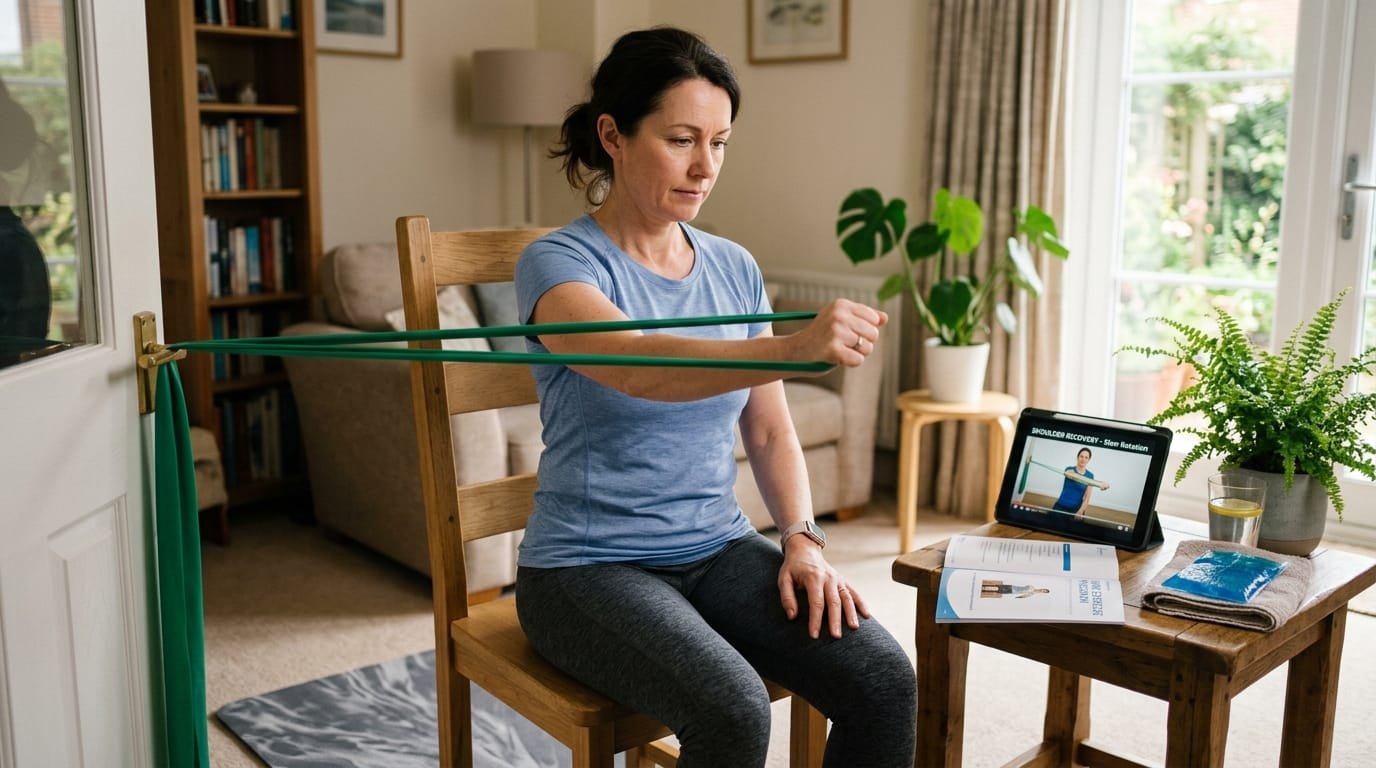
- Band pull-aparts and external-rotation isometrics are often early options.
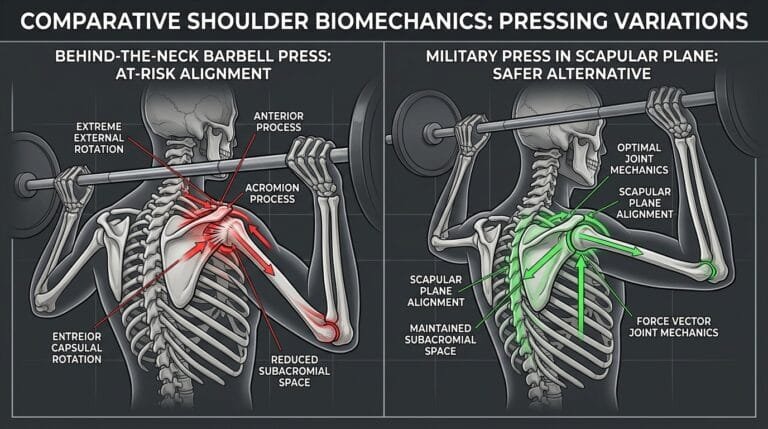
- Avoid overhead loading and end-range stretching until cleared.
Controlled technique remains essential even with light loads (Bent Arms vs. Straight Arms in Lateral Raises, The Hidden Mistake in Lateral Raises, and 3 Lateral Raise Modifications).
Lower-Back or Hip Injury
- Prioritise upper-body pushing and pulling while maintaining a neutral spine.
- Use short-range or supported hinges when cleared.
- Core work focuses on anti-extension and anti-rotation in pain-free ranges.
- Avoid loaded spinal flexion or end-range rotation until approved.
Knee or Ankle Injury
- Emphasise upper-body training and hip-dominant movements that do not stress the knee or ankle.
- Pool work or cycling may be appropriate if cleared.
- Progressive loading of the injured joint begins with isometrics and partial-range closed-chain movements.
General Deconditioning Prevention
Even when the injured area is protected, training the rest of the body 2–3 times per week with moderate effort helps limit systemic losses in strength and metabolic health.
Programming Guidelines During Recovery
- Frequency: 2–4 shorter sessions per week rather than long, exhaustive workouts.
- Volume: Start well below normal and increase only when symptoms allow.
- Intensity: Light to moderate loads with excellent control. Reserve higher intensities for healthy tissues.
- Tempo: Slow eccentrics and pauses improve control and reduce peak forces.
- Progression: One variable at a time—range, then load, then volume, then speed.
- Deloads: Built-in easier weeks help manage residual inflammation and fatigue.
Monitoring Tools for Home Trainees
- Daily symptom score (0–10) for pain, stiffness, and swelling
- Session RPE and notes on any compensation or form breakdown
- Simple functional tests recommended by your clinician (e.g., single-leg stance time, pain-free range)
- Weekly review of trends rather than single-session reactions
Grip strength can be maintained with light, pain-free work if the upper limb is unaffected (Do Hand Grippers Really Work?).
Common Mistakes That Delay Recovery
| Mistake | Risk | Better Approach |
|---|---|---|
| Training through injury-specific pain | Re-injury or prolonged healing | Stay strictly pain-free |
| Returning to previous loads too soon | Setback | Rebuild range → load → volume → speed |
| Complete rest of the entire body | Unnecessary deconditioning | Train healthy tissues |
| Ignoring clinician restrictions | Complications | Follow professional guidelines precisely |
| Comparing to pre-injury performance | Frustration and over-reaching | Measure progress against current capacity |
| Neglecting sleep and nutrition | Impaired healing | Prioritise recovery basics |
Strength training principles still apply during recovery, but the dose and exercise selection must be adapted (strength training guidance). Practical home-gym approaches emphasise controlled, adaptable systems that support long-term training through setbacks (home gym equipment prioritisation and budget home gym principles).
Frequently Asked Questions
When can I start training again after injury?
Only after clearance from a qualified healthcare provider. Timelines vary widely by injury type and severity.
Is some discomfort normal?
General muscle fatigue is different from injury-site pain. Sharp, worsening, or radiating pain is a signal to stop and regress.
Can I train every day while recovering?
Usually no. Most recovery programmes benefit from recovery days between sessions that load the injured area.
Should I use pain-relief medication to train?
Do not use medication to mask pain so you can train harder. This can delay healing and increase re-injury risk. Follow your clinician’s advice on medication.
How do I know if I am progressing too fast?
Increased resting pain, swelling, or functional decline in the 24–48 hours after a session indicates the need to reduce load, range, or volume.
Is bodyweight training safer than loaded training?
Not necessarily. Bodyweight can still overload injured tissue if range or volume is excessive. Load is only one variable; control and symptom response matter more.
Can I maintain muscle while injured?
Yes, to a meaningful degree, by training healthy tissues and introducing appropriate early loading to the injured area when cleared.
What equipment is most useful during recovery?
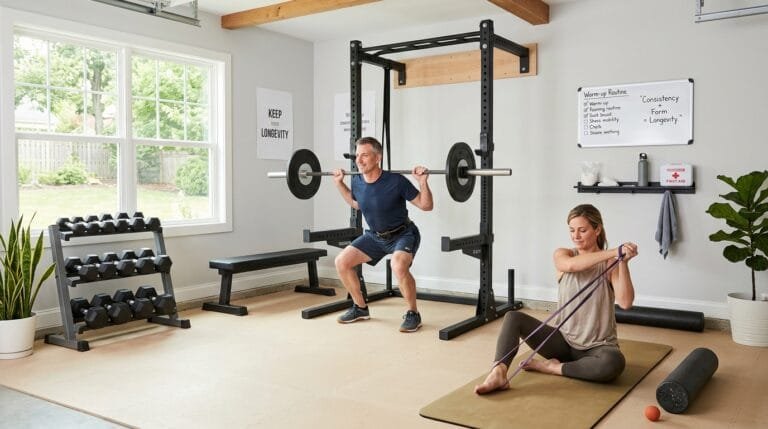
Resistance bands, light dumbbells, a mat, and items that allow isometric and supported variations. Avoid anything that encourages uncontrolled or high-impact loading.
Final Recommendation
Safe home strength training while recovering from injury is built on professional guidance, strict respect for pain-free boundaries, protection of healing tissue, and continued training of healthy areas. Begin only after medical clearance, start with non-aggravating full-body work, introduce isometrics and limited-range movements when approved, and progress one variable at a time while monitoring symptoms closely. Keep sessions shorter, prioritise control over intensity, and maintain open communication with your healthcare provider.
Document your baseline, write a conservative training plan inside your current restrictions, and treat symptom stability as the primary progression criterion. When recovery is managed this way, home training supports healing rather than interfering with it, and the transition back to full training becomes smoother and safer. Start only with professional clearance, progress patiently, and let symptom response guide every decision.