Storage Solutions So Your Home Gym Doesn’t Take Over the Room
Quick Answer
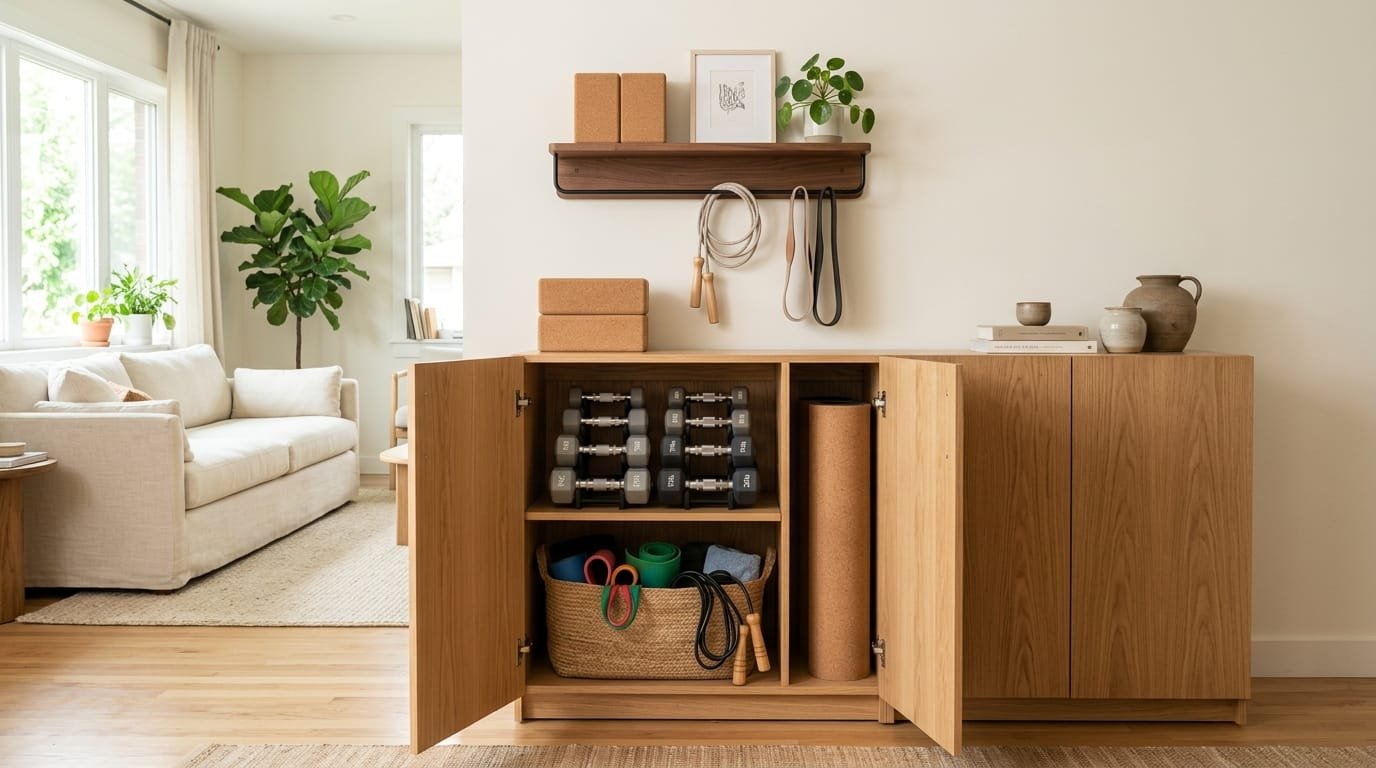
Keep your home gym from taking over the room by prioritising vertical storage, multi-use equipment, under-furniture solutions, and a strict setup/teardown routine. Use wall-mounted racks, over-door hooks, under-bed containers, and a single “gym basket” or rolling cart so everything disappears in under two minutes. Choose compact tools (bands, adjustable dumbbells, suspension trainers) that justify their footprint, and design every session so the living space returns to normal use immediately afterward.
Why Storage Determines Whether a Home Gym Survives
The most common reason home gyms fail is not lack of motivation—it is spatial conflict. When equipment permanently occupies living space, visual clutter rises, family friction increases, and the psychological barrier to training grows. Effective storage reverses this dynamic: the gym appears only when needed and vanishes afterward. The result is higher adherence and a living environment that still feels like a home.
Core Storage Principles
- Vertical first – Walls and doors hold more than floors.
- One-trip rule – Everything required for a session should move in a single trip or two.
- Multi-use equipment only – Items that serve several movement patterns earn their storage cost.
- Teardown under two minutes – If putting the gym away is slow, it will eventually stay out.
- Protect living aesthetics – Storage solutions should look intentional, not like a permanent gym takeover.
- Quiet and safe – Stored items must be stable and produce no noise or tripping hazards.
Space-Efficient Storage Options Ranked
| Storage Method | Best For | Space Saved | Cost Level | Notes |
|---|---|---|---|---|
| Wall-mounted racks / pegboards | Dumbbells, bands, straps, mats | High | Low–moderate | Keep weight within wall capacity |
| Over-door hooks and organisers | Bands, jump ropes, suspension trainers | High | Very low | No drilling required |
| Under-bed containers | Dumbbells, foldable benches, mats | High | Low | Measure clearance first |
| Vertical corner racks | Adjustable dumbbells, kettlebells | Moderate–high | Moderate | Look for slim profiles |
| Rolling cart or basket | Complete “grab-and-go” kit | Moderate | Low | Ideal for studio or multi-use rooms |
| Closet shelving | Mixed equipment | High | Low–moderate | Dedicate one shelf or section |
| Ceiling-mounted options | Rarely needed | High | Higher | Only if floor and wall space are exhausted |
Equipment Choices That Simplify Storage
Resistance bands
Occupy almost no space, store in a drawer or on hooks, and cover rows, presses, squats, and pull-aparts.
Adjustable dumbbells or a single pair of fixed dumbbells
One compact set replaces an entire rack of weights. Store under the bed or on a vertical stand.
Suspension trainer
Folds into a small bag and anchors to a door. Enables rows, face pulls, and assisted movements.
Foldable or compact bench
Only if it stores completely flat under a bed or vertically in a closet. Otherwise, floor-based variations are sufficient.
Thick mat that rolls tightly
Choose one that stands in a closet or corner without unrolling.
Avoid large barbell sets, bulky machines, and anything that cannot be stored vertically or under existing furniture.
Step-by-Step Storage System Setup
- Measure available vertical surfaces, under-bed clearance, and closet space.
- Select only the equipment that covers the main movement patterns and fits the measured storage.
- Assign every item a fixed home (hook, container, shelf, or cart).
- Create a one- or two-trip “deployment” process so the gym can appear in under 90 seconds.
- Practise the reverse teardown until it is equally fast.
- Add soft flooring or mats that also store compactly.
- Test the full setup and teardown cycle several times and refine.
- Label or photograph the stored arrangement so anyone in the household can return items correctly.
- Re-evaluate every 4–6 weeks and remove anything that is not being used regularly.
- Keep the system simple enough that it still works on low-energy days.
Quiet, Space-Efficient Exercise Pairing with Storage
Because storage constraints favour compact tools, pair them with controlled movements:
- Bands and bodyweight for squats, lunges, hinges, and rows
- Dumbbells for floor presses, single-arm rows, and Romanian deadlifts
- Suspension straps for inverted rows and face-pull variations
Shoulder-friendly technique remains important even in compact setups (Bent Arms vs. Straight Arms in Lateral Raises, The Hidden Mistake in Lateral Raises, and 3 Lateral Raise Modifications). Grip strength can be trained with towel holds or short band work that stores easily (Do Hand Grippers Really Work?).
Sample Storage Layouts by Living Situation
Studio apartment
- Over-door hooks for bands and suspension trainer
- Under-bed container for dumbbells and rolled mat
- Single rolling basket that holds the entire kit
Spare bedroom or corner of living room
- Slim vertical rack for dumbbells
- Wall-mounted pegboard or hooks for bands and accessories
- Mat that stands in a closet when not in use
Shared family space
- Everything inside a closet or under a bed
- Strict teardown rule after every session
- Visual agreement with household members on “gym is put away” standard
Progressive Overload Without Expanding the Footprint
- Slow the eccentric phase
- Add pauses at the hardest point
- Increase range of motion under control
- Move to unilateral variations
- Improve density while keeping equipment minimal
- Add band resistance where helpful
These methods create continued progress without requiring additional gear or floor space.
Common Storage Mistakes That Lead to Takeover
| Mistake | Result | Better Approach |
|---|---|---|
| Buying equipment before planning storage | Permanent clutter | Measure and assign storage first |
| No fixed home for each item | Items left out permanently | Everything has one assigned place |
| Slow or complicated teardown | Gym stays visible | Practise sub-two-minute put-away |
| Too many single-purpose tools | Space conflict | Multi-use equipment only |
| Ignoring household aesthetics | Family friction | Choose solutions that look intentional |
| No periodic purge | Gradual accumulation | Remove unused items every 4–6 weeks |
Strength training with compact, well-stored equipment remains highly effective for building and maintaining muscle and strength (strength training guidance). Practical home-gym approaches emphasise systems that respect real living spaces (home gym equipment prioritisation and budget home gym principles).
Frequently Asked Questions
What is the single most effective storage upgrade?
Vertical wall or over-door storage for bands and straps, combined with under-bed containers for heavier items.
Can I keep a home gym completely invisible?
Yes. With under-bed storage, over-door hooks, and a strict teardown routine, the room can return to pure living use within two minutes.
How much should I spend on storage solutions?
Start with low-cost options (over-door hooks, under-bed boxes, a simple cart). Upgrade only if usage justifies it.
Is a power rack realistic in a normal living space?
Rarely. Folding or wall-mounted racks exist, but most people achieve better adherence with simpler, fully storable tools.
What about flooring?
Choose mats that roll or fold tightly and have an assigned storage spot. Interlocking tiles should also pack away if the space is shared.
How do I stop equipment from slowly spreading?
Fixed homes for every item plus a weekly five-minute reset. If something is left out, it has no home or the teardown habit needs reinforcement.
Can I train effectively with only what fits in one basket?
Yes. A set of bands, a pair of dumbbells, and a mat cover the major patterns when progressive methods are applied.
How often should I reassess storage?
Every 4–6 weeks. Remove anything not used in the previous month.
Effective storage also changes the psychology of training. When the gym can appear and disappear in under two minutes, the decision to work out no longer carries the hidden cost of permanent visual clutter or family negotiation. The lower the activation energy required to begin, the more often sessions actually happen—especially on low-motivation or time-constrained days. In practice, a fast deployment-and-teardown system often improves adherence more than any single piece of new equipment.
Safety and longevity of both the equipment and the living space deserve equal attention. Wall anchors and racks must be installed into studs or with appropriate heavy-duty hardware; under-bed containers should not create tripping hazards when partially open; and mats must be dried and stored so they do not develop odour or mildew. A storage solution that is convenient but unstable or damaging will eventually be abandoned. Testing every setup under real load and real daily movement prevents these slow failures.
Household alignment multiplies the effectiveness of any storage plan. When partners or family members know exactly where items belong and why the system exists, they are more likely to return equipment correctly and less likely to view the gym as an intrusion. A simple shared photo of the “put away” state or a one-sentence agreement on teardown expectations removes a common source of friction. The most successful home gyms are those that the entire household can live with comfortably.
Finally, storage should be reviewed with the same regularity as the training plan itself. Every four to six weeks, examine what has been left out, what has not been used, and whether any piece of equipment is no longer earning its footprint. Removing unused items keeps the system lean and prevents the gradual re-expansion that turns a tidy solution back into a takeover. A living storage system, adjusted over time, remains one of the highest-leverage factors in long-term home-training success.
Final Recommendation
A home gym that does not take over the room is built on vertical storage, multi-use equipment, under-furniture solutions, and a non-negotiable setup/teardown routine measured in seconds rather than minutes. Choose compact tools that cover the main movement patterns, assign every item a fixed home, and practise putting the entire gym away until it becomes automatic. When the living space returns to normal immediately after training, both adherence and household harmony improve.
Measure your vertical and under-furniture storage today, select only the equipment that fits those constraints, create a one-trip deployment system, and write a short teardown checklist. The most effective home gym is the one that disappears when the work is done—start building that system now.