Best Multi-Functional Equipment That Replaces Multiple Machines
Quick Answer The most effective multi-functional equipment for a home gym consists of adjustable dumbbells (replacing a full fixed-dumbbell rack), a power rack or squat stand with basic attachments (replacing separate squat racks, pull-up stations, and safety systems), resistance bands (replacing multiple cable and assistance machines), an adjustable bench (replacing flat/incline/decline benches), and a quality kettlebell (replacing several specialty ballistic and carry tools). These five categories deliver the majority of commercial-gym movement patterns and progressive-overload potential in far less space and at lower total cost than collections of single-purpose machines. Prioritising them creates a complete, scalable training environment while avoiding clutter and under-used equipment.
Why Multi-Functional Tools Outperform Single-Purpose Machines at Home
Commercial gyms install rows of specialised machines because many people use the facility simultaneously. At home the economics reverse: every square foot and every dollar must work harder. Multi-functional equipment maximises exercise variety, progressive loading options, and long-term usefulness per unit of space and cost.
Practical home-gym analyses and staged-build guides consistently show that a compact set of high-leverage tools produces better adherence and results for most trainees than a larger assortment of narrow machines that sit idle. External examples of efficient multi-use setups appear in resources such as Home Gym Foundry’s budget and small-space builds.
Comprehensive Comparison: What Each Tool Replaces
| Multi-Functional Equipment | Single-Purpose Items It Effectively Replaces | Space Saved | Cost Efficiency | Progressive Overload Potential | Best Training Phase |
|---|---|---|---|---|---|
| Adjustable dumbbells | 10–15+ pairs of fixed dumbbells | Very high (1–2 sq ft vs. full rack) | Excellent | High | Beginner to advanced |
| Power rack / squat stand | Squat rack, pull-up station, safety spotter, often dip station | High | High once barbell training begins | Very high | Intermediate+ |
| Resistance band set | Cable face-pull station, assistance machines, some mobility tools | Extremely high | Outstanding | Moderate to high | All levels |
| Adjustable bench | Separate flat, incline, and decline benches | High | High | Supports free-weight loading | All levels |
| Kettlebell | Specialty swing tools, some carry implements, certain dumbbell alternatives | High | High | High for ballistic work | Beginner to advanced |
| Functional trainer / all-in-one | Cable crossover, lat-pulldown, some machine presses and rows | Moderate to high | Variable (higher upfront) | High for cables | Intermediate+ |
1. Adjustable Dumbbells – The Foundation Replacement
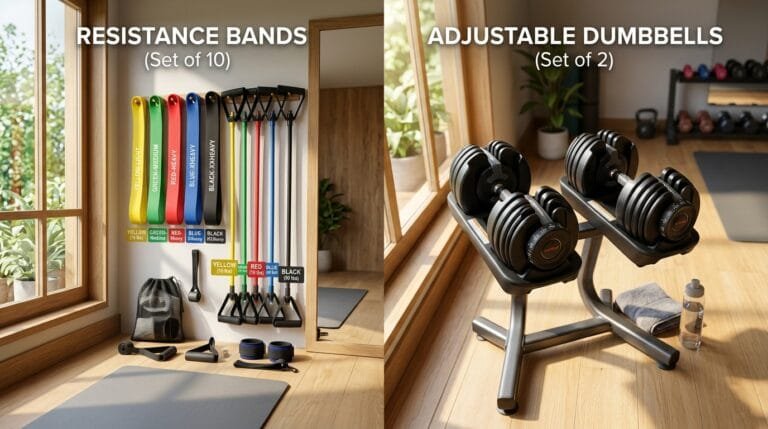
A quality pair of adjustable dumbbells is the single highest-leverage purchase for most home gyms. One compact set replaces an entire rack of fixed dumbbells that would otherwise require significant linear floor space and a much higher total investment.
What it replaces
- Full sets of fixed hex or rubber dumbbells from light to moderately heavy loads
- Multiple pairs needed for supersets or drop sets
Key exercises unlocked Goblet squats, front squats, dumbbell bench press, incline press, single-arm and two-arm rows, Romanian deadlifts, overhead presses, lunges, step-ups, farmer carries, curls, and triceps extensions.
Selection priorities Secure locking system, useful weight range and increments, handle diameter and knurling, durability of the adjustment mechanism. Detailed criteria and model considerations are covered in How to Choose the Best Adjustable Dumbbells for Home Gyms in 2026.
Limitations Very heavy absolute loads eventually require a barbell; adjustment speed varies by design.
2. Power Rack or Squat Stand – The Strength Multiplier
Once dumbbell progressive overload slows, a squat stand or full power rack consolidates several critical stations into one footprint.
What it replaces
- Independent squat rack
- Separate pull-up station
- Free-standing safety spotter arms
- Often a dip station or band-attachment points
Key capabilities Back squats and front squats with safety arms, bench press inside the rack, overhead press, rack pulls, pull-ups and chin-ups, inverted rows, and band-resisted movements.
This becomes the hub for serious barbell training while still supporting dumbbell and band work. Flooring quality and ceiling height become important considerations at this stage.
3. Resistance Bands – The Most Space-Efficient Multi-Tool
Bands deliver variable resistance, assistance, and mobility work that would otherwise require multiple cable stations or specialised machines.
What they replace
- Cable face-pull and rear-delt stations
- Assistance mechanisms for pull-ups and dips
- Some light cable press and row variations
- Dedicated mobility and warm-up tools
Primary uses Band pull-aparts, face pulls, assisted pull-ups, monster walks, lateral band walks, triceps pushdowns, and added resistance on squats or presses.
Different constructions (loop, tube with handles, fabric) serve distinct roles — full comparison in Resistance Bands Buying Guide: Loop vs. Tube vs. Fabric – Which Wins?.
4. Adjustable Bench – The Angle Consolidator
One stable adjustable bench eliminates the need for three separate benches.
What it replaces Flat bench, incline bench, and decline bench.
Key uses Dumbbell and barbell pressing at multiple angles, chest-supported rows, hip thrusts, Bulgarian split squats, and seated shoulder work. Foldable designs further improve storage for apartments and spare bedrooms.
5. Kettlebell – The Ballistic and Conditioning Specialist
A single mid-range kettlebell adds movement patterns that dumbbells and barbells cover less efficiently.
What it replaces Specialty swing implements, some carry tools, and certain explosive dumbbell variations.
Key movements Two-hand and one-hand swings, cleans, snatches, Turkish get-ups, and loaded carries. Sizing and selection guidance: How Heavy Should My Adjustable Kettlebell Be?.
6. Functional Trainers and All-in-One Systems
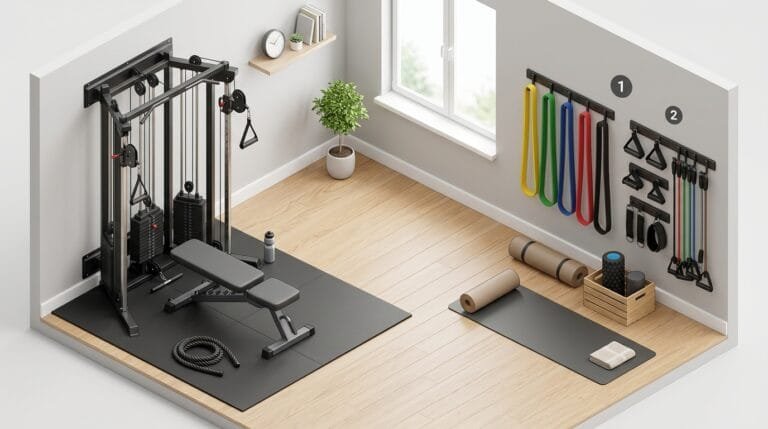
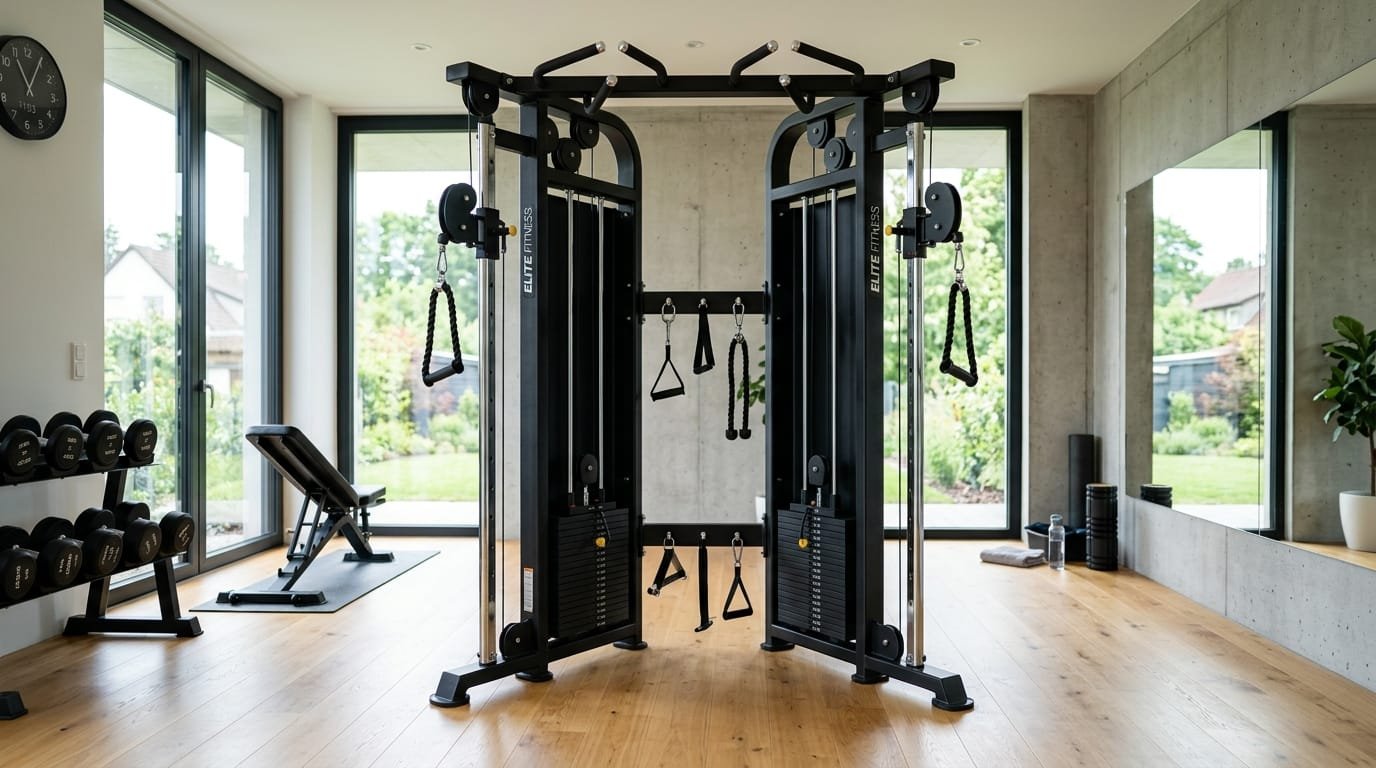
These higher-cost units combine a rack structure with dual adjustable cables (and sometimes a Smith machine) in one footprint. They can replace a cable crossover, lat-pulldown station, and portions of a free-weight setup. They suit trainees who prioritise constant-tension cable work alongside barbell training and have both space and budget. Independent testing frequently highlights models that consolidate three traditional machines into a single frame.
Step-by-Step Implementation Path
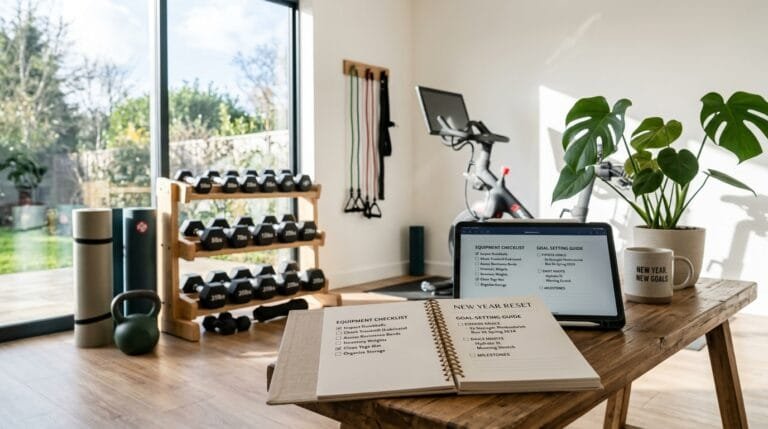
- Begin with adjustable dumbbells and a basic mat for immediate full-body capacity.
- Add an adjustable bench to expand pressing and rowing angles.
- Install a pull-up solution and acquire a comprehensive band set.
- Introduce a kettlebell for ballistic hinge and conditioning work.
- Progress to a squat stand or power rack when heavier axial loading and safety arms become necessary.
- Evaluate a functional trainer or cable attachment only after free-weight foundations are fully utilised.
- Continuously track progressive overload so each upgrade solves a measured limitation.
- Maintain strict technique, including healthy shoulder mechanics on pressing and isolation work .
- Build grip strength to support pulling, carrying, and hanging movements.
- Add recovery tools such as a massage gun or conditioning options like a manual treadmill only as secondary priorities. Core work can advance toward ab-roller progressions when stability allows.
Sample Multi-Functional Full-Body Session
- Goblet squat or rack squat – 3–4 sets of 6–12
- Dumbbell or barbell bench press – 3–4 sets of 6–12
- Pull-ups / chin-ups or band-assisted – 3 sets near failure
- Kettlebell swing or Romanian deadlift – 3 sets of 8–15
- Single-arm dumbbell row or band/cable row – 3 sets of 8–12 per side
- Band face pulls + core finisher
This session uses the core multi-functional arsenal and trains all major movement patterns in a time-efficient format.
Cost-Benefit and Space Analysis
Adjustable dumbbells and bands deliver the greatest exercise variety per dollar and per square foot. A bench multiplies their usefulness. A rack represents a larger but high-leverage step once barbell training is prioritised. Functional trainers offer convenience at higher cost and moderate space demand. Spreading purchases across stages (as outlined in progressive upgrade discussions) prevents over-spending and ensures each item is fully utilised.
Common Mistakes That Reduce the Value of Multi-Functional Equipment
- Purchasing multiple single-purpose machines before owning adjustable dumbbells or a bench
- Choosing an all-in-one system that limits free-weight progressive overload
- Neglecting a dedicated pull-up solution
- Buying a rack before maximising dumbbell and band loading
- Ignoring flooring and noise implications of heavier multi-functional units
- Failing to programme progressive overload, so the versatility of the tools is under-used
Frequently Asked Questions
What single piece of equipment replaces the most machines? Adjustable dumbbells replace the largest number of fixed-weight implements and support the broadest range of exercises for typical home users.
Is a power rack worth the space if I already have dumbbells? Yes, once you need heavier axial loading, safety arms for solo heavy sets, and integrated pull-up capability that dumbbells cannot provide.
Can resistance bands fully replace a cable machine? They cover many overlapping patterns (especially face pulls, pull-aparts, and assistance work) at far lower cost and space. They do not perfectly replicate the constant-tension feel of cables but remain extremely effective.
Should a beginner buy a functional trainer or all-in-one first? Generally no. Free-weight multi-functional tools (dumbbells, bench, bands, pull-up bar) build a stronger foundation and retain more long-term flexibility for most beginners.
How do I know when to add a rack or cable system? When progressive overload on dumbbells and bands has plateaued for primary lifts, and you specifically require heavier barbell loading or greater cable variety.
Do these tools support both strength and hypertrophy goals? Yes. Mechanical tension, sufficient volume, and progressive overload drive both outcomes whether resistance comes from adjustable dumbbells, a barbell in a rack, bands, or cables.
What is the most space-efficient complete starter set? Adjustable dumbbells + adjustable bench + resistance bands + doorway pull-up bar + mat. This combination already replaces a substantial collection of single-purpose machines.
Final Recommendation
Build your home gym around multi-functional equipment that replaces multiple single-purpose machines. Begin with adjustable dumbbells, add an adjustable bench, a pull-up solution, and resistance bands, then incorporate a kettlebell and, when progressive needs demand it, a squat stand or power rack. These tools provide comprehensive movement coverage, superior space efficiency, and strong long-term return on investment.
Progress systematically, prioritise free-weight patterns, track overload, and expand only when clear limitations appear. Maintain excellent technique, support recovery, and use the versatility of each piece fully. When selected and programmed this way, a focused collection of multi-functional equipment outperforms a room filled with specialised machines for the great majority of home trainees — delivering better results with less clutter, lower cost, and greater sustainability.