Does Foam Rolling Actually Reduce Soreness or Just Feel Good?
Quick Answer Foam rolling does more than just feel good. Multiple systematic reviews and meta-analyses show it produces small-to-moderate reductions in perceived muscle soreness (DOMS), especially 24–72 hours after exercise, along with consistent short-term improvements in range of motion. Effects on actual strength recovery and objective markers of muscle damage are smaller or inconsistent. The sensation of relief is real and involves changes in pain perception, blood flow, and tissue stiffness, although expectation effects also contribute. Used correctly after training, foam rolling is a low-cost, evidence-supported recovery tool that provides measurable benefits beyond pure placebo.
What Is Delayed-Onset Muscle Soreness (DOMS)?
Delayed-onset muscle soreness is the stiffness, tenderness, and reduced force-producing capacity that typically peaks 24–72 hours after unaccustomed or high-volume eccentric exercise. It results from microtrauma to muscle fibres, inflammation, and sensitisation of nociceptors. While DOMS is a normal response to novel training stress, excessive or prolonged soreness can impair subsequent sessions and adherence.
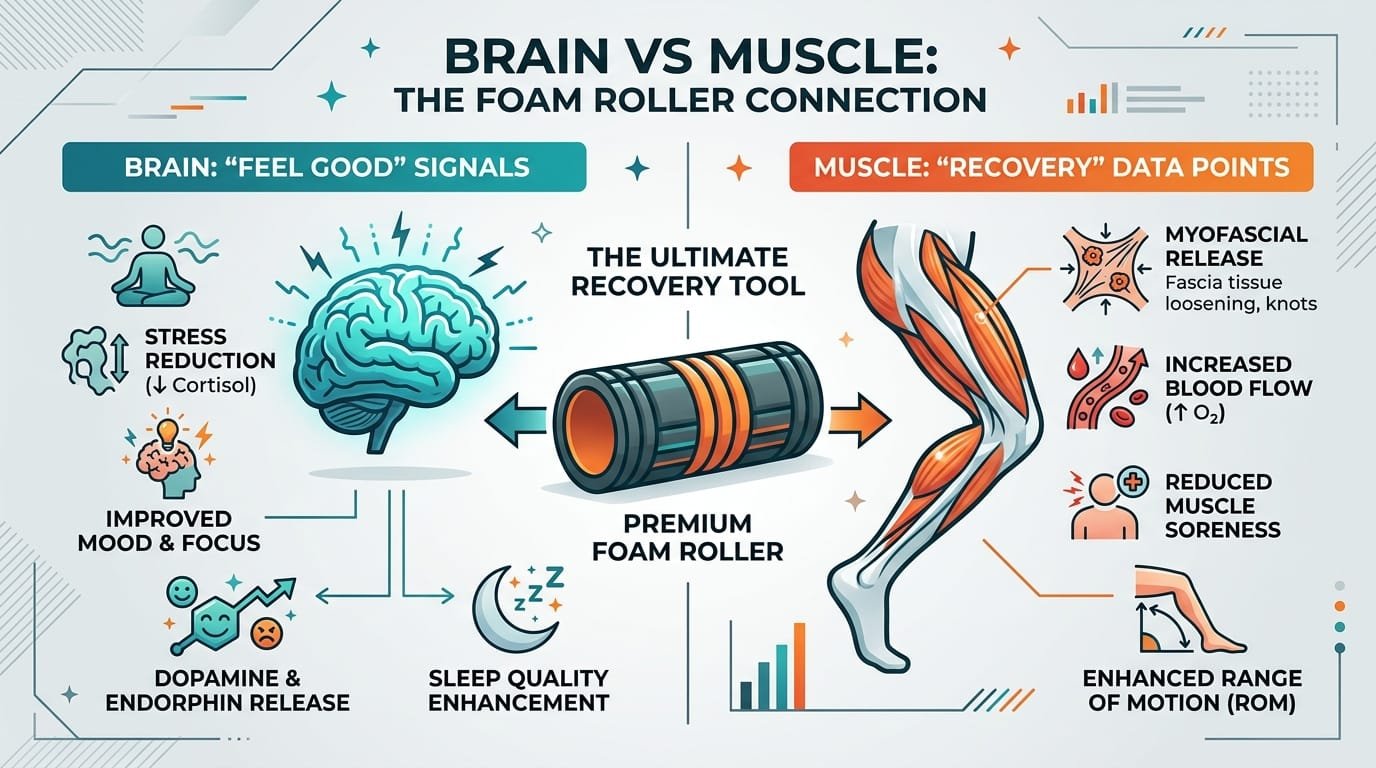
Foam rolling (self-myofascial release) involves applying pressure to soft tissues with a cylindrical roller. Proposed mechanisms include increased local blood flow, reduced tissue stiffness (thixotropy), modulation of pain signalling via gate-control theory, and possible mild reductions in inflammatory signalling.
What the Research Shows on Soreness Reduction
A 2024 systematic review and meta-analysis of 16 randomised trials involving 515 participants examined the preventive effect of foam rolling on post-exercise muscle soreness using both visual analogue scale (VAS) pain scores and pressure-pain threshold (PPT). The analysis found small-to-moderate beneficial effects:
- Immediate post-intervention: small reduction in soreness (SMD ≈ −0.38)
- 24 hours: moderate effect (SMD ≈ −0.53 to −0.77)
- 48 hours: moderate effect
- 72 hours: still favourable
The authors concluded that foam rolling after exercise has a preventive effect on muscle soreness, with clearer benefits appearing after the first 24 hours rather than immediately. You can read the full details here: PubMed abstract and ScienceDirect full text.
An earlier 2019 meta-analysis on foam rolling for performance and recovery reported that post-exercise rolling produced a small reduction in muscle pain perception (approximately 6 %, effect size g ≈ 0.47) while slightly attenuating declines in sprint and strength performance. Pre-rolling improved flexibility and had minor positive effects on sprint performance. The overall conclusion was that effects are modest but can be relevant for reducing pain sensation and supporting recovery in some contexts. Full open-access paper: Frontiers in Physiology.
Other reviews consistently note improvements in range of motion and reductions in perceived soreness, with limited or mixed effects on objective markers such as creatine kinase or maximal strength recovery.
Does It “Just Feel Good” or Produce Real Physiological Change?
Foam rolling produces both sensory and modest physiological effects:
- Pain modulation: Pressure stimulates mechanoreceptors, which can inhibit pain signals (gate-control theory). This contributes to the immediate “feel-good” sensation.
- Tissue stiffness and blood flow: Rolling can temporarily reduce muscle stiffness and increase local circulation, potentially aiding metabolite clearance.
- Range of motion: Multiple meta-analyses show consistent short-term increases in flexibility.
- Objective recovery markers: Effects on strength restoration and blood markers of damage are smaller and less consistent than effects on perceived soreness.
The reduction in soreness is therefore not purely placebo. Placebo and expectation effects certainly play a role in any recovery modality, but the meta-analytic data show statistically significant advantages over control conditions for pain perception and ROM. See the evidence summarised in the 2024 meta-analysis and the 2019 Frontiers review.
Practical Comparison of Recovery Modalities
| Modality | Effect on Perceived Soreness | Effect on ROM | Effect on Strength Recovery | Convenience & Cost | Evidence Strength |
|---|---|---|---|---|---|
| Foam rolling | Small–moderate (24–72 h) | Moderate short-term | Small / mixed | High / Low | Moderate |
| Massage (manual) | Moderate | Moderate | Small–moderate | Low / High | Moderate–strong |
| Cold-water immersion | Moderate short-term | Minimal | Small–moderate | Medium / Medium | Moderate |
| Active recovery | Small | Small | Small | High / Free | Moderate |
| Static stretching | Minimal–none | Moderate | Minimal | High / Free | Weak for DOMS |
| Complete rest | Baseline | Baseline | Baseline | High / Free | — |
Foam rolling sits in a favourable position for home users: low cost, high accessibility, and measurable benefits for soreness perception and mobility.
Step-by-Step Guide to Effective Foam Rolling for Soreness
- Choose a moderate-density roller (too soft provides insufficient pressure; too hard can be painful and counterproductive).
- Target major muscle groups used in the preceding session (quads, hamstrings, glutes, calves, back, lats).
- Spend 30–90 seconds per muscle group, moving slowly.
- Apply pressure that feels uncomfortable but not sharp or bruising (typically 5–7/10 intensity).
- Pause and hold on tender spots for 20–30 seconds if desired.
- Breathe steadily; avoid holding your breath.
- Perform rolling after training or on rest days when soreness is present (most evidence supports post-exercise use for DOMS).
- Combine with light movement or walking for additional blood-flow benefits.
- Stay hydrated and maintain protein intake to support tissue repair.
- Reassess after 48–72 hours; soreness should trend downward faster than with passive rest alone.
How to Integrate Foam Rolling into a Home Training Routine
Foam rolling pairs well with the rest of a minimal-equipment program. After sessions using adjustable dumbbells or kettlebells, rolling the quads, glutes, and upper back can reduce next-day stiffness. Strong grip endurance helps maintain control on the roller itself. Core work with an ab roller benefits from reduced lumbar and hip-flexor tightness.
Low-impact cardio on a manual treadmill can be combined with light rolling on off days. A budget massage gun offers a complementary percussion option for areas the roller cannot easily reach. Maintain healthy shoulder mechanics using principles from your lateral raise guidance so upper-body rolling and training remain comfortable.
Limitations and Realistic Expectations
- Effects are modest, not dramatic.
- Benefits are clearer for perceived soreness and ROM than for maximal strength restoration.
- Individual responses vary; some people experience substantial relief, others milder effects.
- Foam rolling does not replace sleep, nutrition, or progressive programming.
- Excessive pressure or rolling directly on joints or bony prominences can cause discomfort or bruising.
Frequently Asked Questions
Does foam rolling actually reduce DOMS or is it mostly placebo? It produces statistically significant small-to-moderate reductions in perceived soreness beyond control conditions, particularly at 24–72 hours. Sensory and circulatory mechanisms contribute; placebo and expectation effects also play a role but do not fully explain the findings. See the 2024 meta-analysis on PubMed and the 2019 Frontiers review.
When is the best time to foam roll for soreness? Most evidence supports post-exercise or on subsequent days when soreness is present. Pre-rolling improves short-term flexibility and can be useful as part of a warm-up.
How long should each session last? 1–2 minutes per major muscle group is typically sufficient. Total sessions of 5–15 minutes cover the main areas.
Can foam rolling replace other recovery methods? It is a useful adjunct, not a complete replacement for sleep, nutrition, or active recovery.
Is a more expensive or textured roller better? Moderate density is usually optimal. Extreme hardness or complex textures do not consistently outperform simpler rollers for soreness reduction.
Does foam rolling help with performance the next day? It can slightly attenuate strength and sprint decrements and improve readiness via reduced soreness and better mobility, but effects are small.
Final Recommendation
Foam rolling does more than simply feel good. Evidence from multiple meta-analyses shows it reliably produces small-to-moderate reductions in perceived muscle soreness in the 24–72 hour window after exercise and improves short-term range of motion. Effects on objective strength recovery are more modest. For home trainees it remains one of the most accessible, low-cost tools for managing DOMS and maintaining training consistency.
Use it after sessions, focus on major muscle groups for 30–90 seconds each, and combine it with solid sleep, protein intake, and progressive training. When applied this way, foam rolling delivers measurable recovery benefits that support long-term progress rather than serving as mere temporary comfort.