
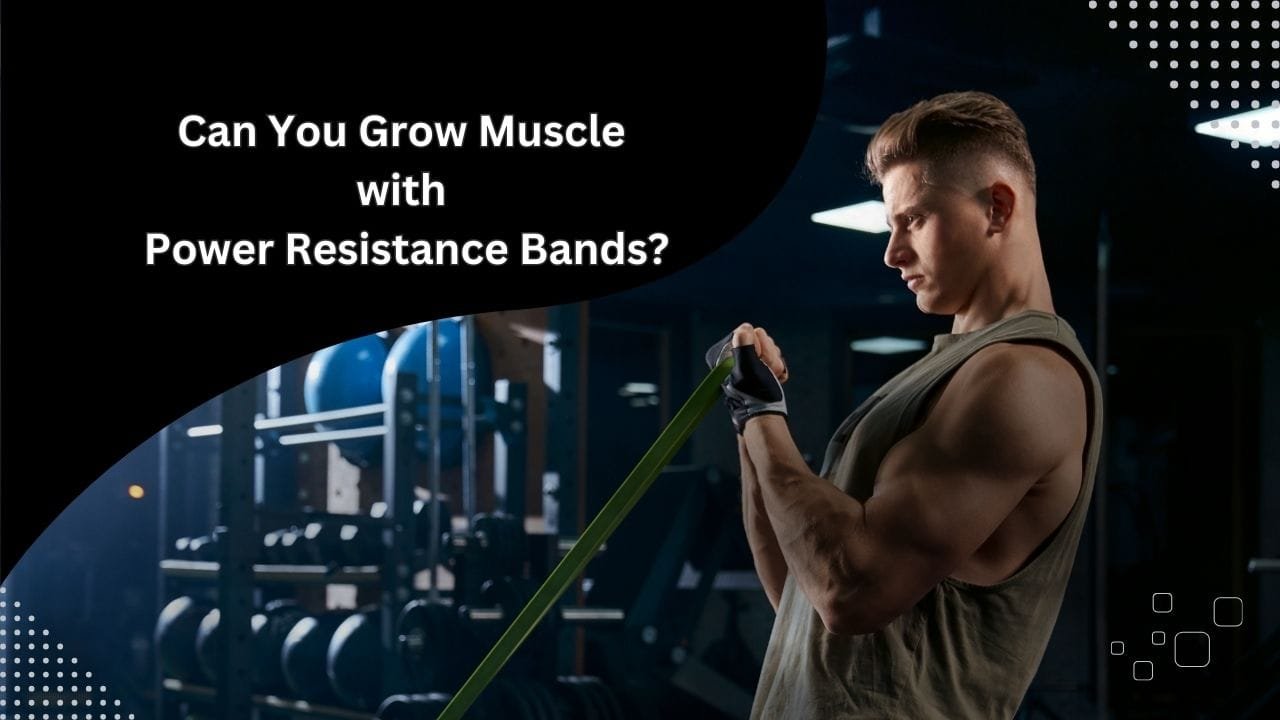
Is Muscle Growth Possible with Power Resistance Bands? The Truth Most Trainers Won’t Tell You
Quick answer: Yes, genuinely — resistance bands can build real muscle hypertrophy comparable to free weights, according to the American College of Sports Medicine’s newly updated 2026 resistance training position stand, which synthesized 137 systematic reviews and over 30,000 participants. The key factor isn’t whether resistance comes from elastic tension or gravity — it’s training with sufficient effort, close to failure, regardless of which tool provides the resistance.
Researched and written by the GymGoodies team, fact-checked against manufacturer specs and current fitness guidance.
Resistance bands often get dismissed as a lighter, less “serious” training tool compared to free weights — useful for warm-ups or rehab, but not for genuine muscle building. Recent, comprehensive research directly challenges this assumption.
The Definitive Recent Evidence
According to the American College of Sports Medicine’s 2026 Position Stand, their first major update to resistance training guidelines in 17 years, synthesizing 137 systematic reviews across more than 30,000 participants — elastic band resistance training produces both genuine strength gains and genuine hypertrophy. Critically, the position stand’s broader conclusion on equipment type generally is that it does not consistently impact training outcomes, meaning the source of resistance itself isn’t the deciding factor in whether you build muscle.
Why This Makes Physiological Sense
The underlying principle here is that muscle growth responds to sufficient mechanical tension and effort applied through an adequate range of motion, close to failure — not to the specific mechanism generating that tension. Whether resistance comes from a weight being pulled down by gravity or a band being stretched, your muscle fibers experience meaningful tension either way, and it’s this tension, combined with adequate training volume and proximity to failure, that drives the growth signal.
Supporting Evidence From Earlier Research
This recent, comprehensive conclusion builds on a consistent pattern already established in earlier research:
- A systematic review and meta-analysis published in SAGE Open Medicine found that elastic resistance training is able to promote strength gains comparable to conventional resistance training.
- A 24-week randomized study of novice lifters comparing free-weight-only training against a combined elastic band plus free weight approach found no significant differences in strength and power outcomes between the two groups — both approaches produced meaningful, comparable improvements in squat and bench press performance.
The Important Nuance: Resistance Curve Differs, but Growth Signal Doesn’t Require a Specific Curve Shape
Bands and free weights do create genuinely different resistance profiles — free weights provide the most resistance around the mid-range of a movement (where gravity’s pull is most directly opposed), while bands provide progressively increasing resistance as they stretch, typically peaking near the end of the range of motion. This is a real, meaningful mechanical difference we’ve covered elsewhere on the site, including in our Resistance Bands for Lateral Raises guide. But according to the current evidence, this difference in where peak tension occurs doesn’t determine whether meaningful hypertrophy occurs — the growth signal responds to overall effort and training proximity to failure, not to matching a specific tension curve.
How to Actually Train With Bands for Muscle Growth
Given this evidence, a few practical principles matter for making sure band training actually produces the hypertrophy the research supports:
- Train close to failure — since this appears to be the key driver of the growth response regardless of resistance type, choosing a band with resistance genuinely challenging by the final reps of a set matters more than the specific tool itself.
- Use progressive overload over time — this means either progressing to thicker/higher-resistance bands, increasing reps, or combining multiple bands for greater total tension as your strength improves, mirroring how you’d add weight to a barbell over time.
- Maintain adequate range of motion — moving through a full, controlled range with a band, rather than a shortened or rushed motion, matters for capturing the full training stimulus.
- Ensure sufficient total volume — general hypertrophy research (independent of resistance tool) points to accumulating adequate weekly sets per muscle group, and this applies to band training the same way it does to any other resistance modality.
When Bands Might Genuinely Be the More Practical Choice
- Travel or limited-space training, where bands offer a genuinely effective alternative without needing a full home gym setup
- Joint-sensitive training phases, since the accommodating resistance curve can feel more controllable at the lightest part of the range, useful during rehab or return-to-training periods
- Adding variable resistance to existing free-weight training, as the combined band-plus-free-weight research above suggests this hybrid approach works at least as well as free weights alone, and some research on combined training even suggests specific benefits for movement velocity and power development
When Free Weights Might Still Be More Practical
- Precise, trackable progressive overload — free weights offer exact, known resistance values that are easier to track and progress systematically compared to band resistance, which can vary somewhat by brand, thickness, and stretch distance
- Very heavy, low-rep strength-focused training — while bands can produce genuine hypertrophy, achieving very heavy absolute loads for low-rep max-strength work is generally more practical and precisely quantifiable with free weights or a barbell
Does This Mean Equipment Choice Doesn’t Matter at All?
Not entirely — the position stand’s finding that equipment type doesn’t consistently impact outcomes applies specifically to the core question of whether meaningful hypertrophy and strength gains occur. Practical factors like convenience, cost, tracking precision, and personal preference still reasonably influence which tool makes sense for your specific situation and goals — the key takeaway is simply that resistance bands shouldn’t be dismissed as inherently inferior for genuine muscle-building purposes, which is a real shift from older assumptions.
Connecting This to a Broader Theme We’ve Covered
This finding reinforces something we’ve discussed elsewhere on the site — that acute measurements like EMG activation don’t always predict actual long-term hypertrophy outcomes as directly as assumed. Our guide on how bent vs. straight arm position affects deltoid activation covers a related example of this same principle: differences in acute muscle activation or resistance mechanics don’t automatically translate into proportionally different real-world muscle growth outcomes, which is exactly what this comprehensive 2026 review confirms specifically for the bands-versus-free-weights question.
Common Mistakes When Training With Bands for Muscle Growth
- Using bands too light to genuinely challenge you close to failure, missing the key variable the research points to as actually driving hypertrophy.
- Never progressing resistance over time, plateauing on the same band tension indefinitely rather than applying progressive overload.
- Assuming bands are only appropriate for warm-ups or rehab, when the current comprehensive evidence supports them as a genuine, standalone hypertrophy tool when used appropriately.
- Rushing through reps with a shortened range of motion, reducing the training stimulus regardless of which tool is providing resistance.
Frequently Asked Questions
Is this 2026 ACSM finding really new, or has this been known for a while?
Earlier research (including the 2019 SAGE meta-analysis and other studies referenced above) already pointed in this direction, but the 2026 ACSM position stand represents a much larger, more comprehensive synthesis — their first major resistance training guideline update in 17 years — giving this conclusion considerably more authoritative weight than earlier, smaller studies alone.
Can I build significant muscle using only resistance bands, with no other equipment?
Based on current evidence, yes — provided you train with adequate effort (close to failure), progressive overload over time, and sufficient volume, resistance bands alone can produce genuine, comparable hypertrophy to free weights.
Do I need to match my band training to a specific resistance curve to get results?
No — the current evidence suggests the growth signal responds to overall effort and training variables like proximity to failure and volume, not to replicating a free weight’s specific tension curve.
Bottom Line
Yes, you can genuinely grow muscle with resistance bands — this isn’t a compromise or lesser alternative to free weights, according to the most current, comprehensive evidence available. The 2026 ACSM position stand, synthesizing an enormous body of research, confirms that equipment type doesn’t consistently determine training outcomes; what matters is training with adequate effort, progressive overload, and sufficient volume, regardless of whether your resistance comes from a barbell or a stretched band.
Have you built muscle using resistance bands as your primary training tool? Let us know in the comments how your progress has compared to free-weight training.