Cable Alternatives That Work in Real Home Spaces
Quick Answer
Effective cable alternatives that work in real home spaces include resistance bands with door anchors, suspension trainers, dumbbells or kettlebells paired with creative angles, and bodyweight leverage adjustments. These tools replicate the constant tension and directional resistance of cable machines without requiring large footprints, permanent installation, or high cost. For most home lifters, a quality set of bands plus a door anchor and one pair of dumbbells solves the majority of cable-style needs for rows, face pulls, chest flyes, triceps extensions, and rotational work while remaining fully storable.
Why Cable Machines Are Rarely Practical at Home
Cable machines and functional trainers offer smooth, constant tension and the ability to adjust resistance angles freely. In commercial gyms they are valuable. In real homes they create problems: large floor plates, high ceilings or wall-mount requirements, significant cost, noise, and permanent visual impact. Most apartments, spare rooms, and multi-use living spaces cannot accommodate them. The good news is that the training benefits cables provide—constant tension, adjustable angles, and joint-friendly resistance curves—can be closely approximated with far simpler tools that store in a drawer or closet.
Core Problems Cables Solve and How Home Alternatives Match Them
| Cable Benefit | Home Alternative | How Closely It Matches | Space & Cost Impact |
|---|---|---|---|
| Constant tension | Resistance bands | Very high – tension increases with stretch | Extremely low |
| Adjustable resistance angle | Door-anchor bands + body position | High – change anchor height and stance | Extremely low |
| Smooth resistance curve | Quality bands or suspension trainer | High for most patterns | Low |
| Single-arm and rotational work | Bands or single dumbbell | High | Low |
| High-load pressing and rowing | Dumbbells or loaded bands | Moderate to high | Low–moderate |
| Easy micro-loading | Band combinations + tempo | Moderate | Low |
Shoulder-friendly technique remains essential when training the upper back and rear delts with any of these tools (Bent Arms vs. Straight Arms in Lateral Raises, The Hidden Mistake in Lateral Raises, and 3 Lateral Raise Modifications). Grip strength supports rowing and carrying variations and can be trained directly (Do Hand Grippers Really Work?).
Highest-Value Cable Alternatives for Home Use
1. Resistance Bands with Door Anchor
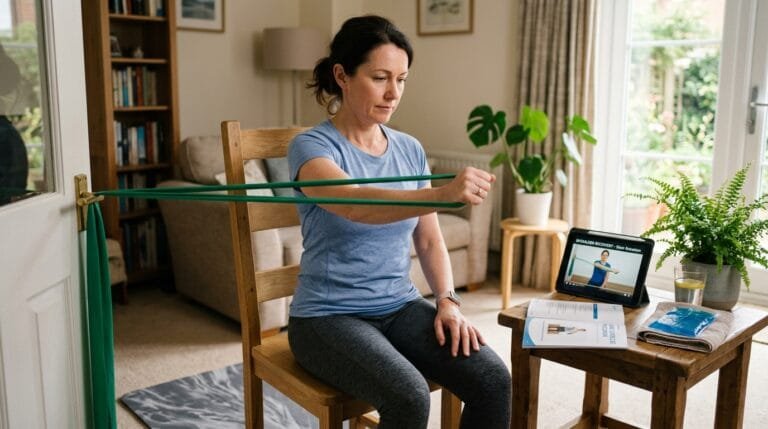
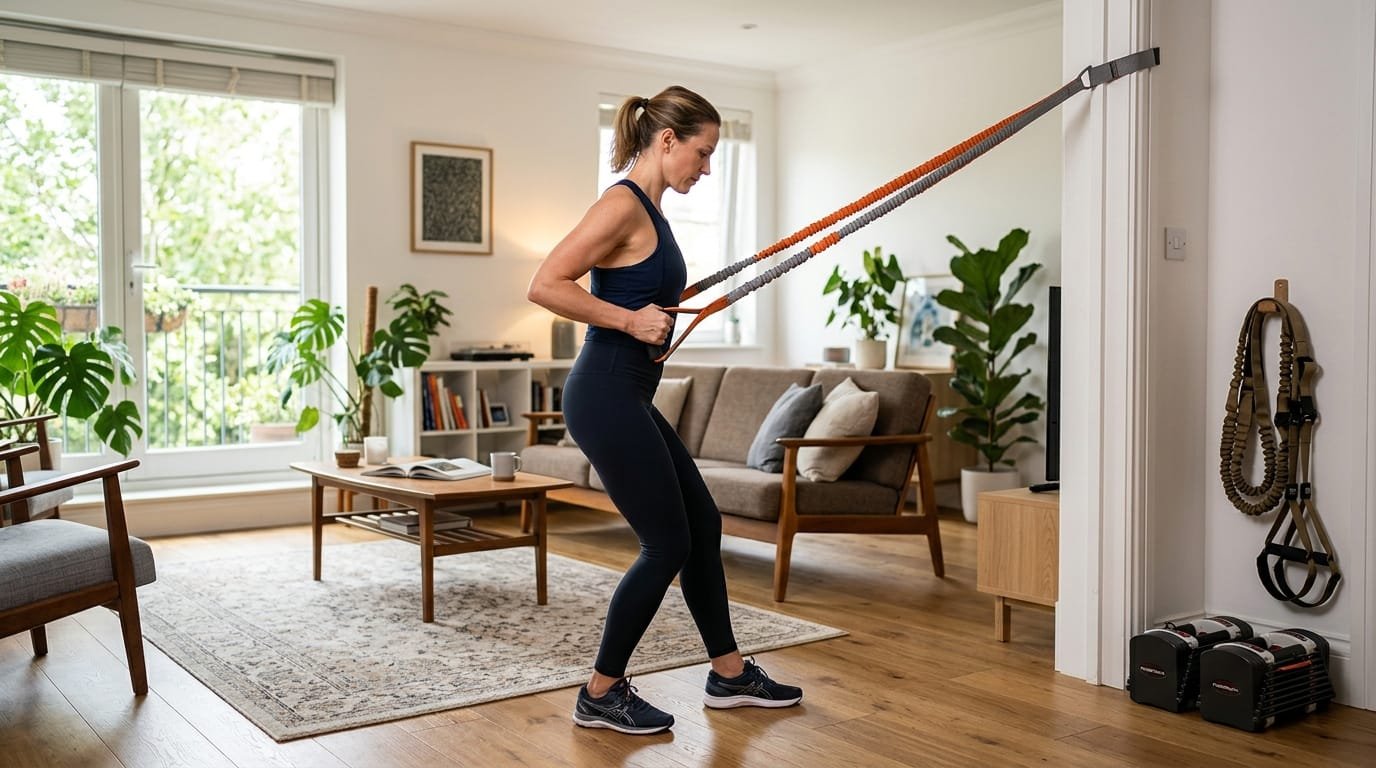
The single most practical cable replacement for real homes. A door anchor allows high, mid, and low attachment points. Loop bands and tube bands with handles cover face pulls, rows, chest flyes, triceps pushdowns, woodchops, and pallof presses. Tension is accommodating (increases as the band stretches), which many people find joint-friendly.
2. Suspension Trainers (TRX-style or equivalent)
Anchored to a door, beam, or sturdy overhead point, suspension trainers provide bodyweight rows, face-pull-type movements, chest flies, and core anti-rotation work. The instability increases demand on stabilisers while still fitting in small spaces when packed away.
3. Dumbbells or Kettlebells with Angle Manipulation
Floor presses, single-arm rows with elbow flaring or tucking, reverse flyes, and pullover variations can approximate many cable patterns. Combining a dumbbell with a slight torso angle or bench incline expands the options further.
4. Band + Dumbbell Combination
Anchoring a band and holding a dumbbell simultaneously creates hybrid tension that feels closer to cables for certain flye and row variations.
5. Bodyweight Leverage and Tempo Adjustments
Elevated or declined inverted rows, archer rows, and slow-tempo push-up variations supply progressive tension without any equipment beyond a sturdy table or bar.
Step-by-Step Guide to Replacing Cable Exercises at Home
- List the cable exercises you actually use
Common ones include seated rows, face pulls, cable flyes, triceps pushdowns, and rotational chops. - Match each to a home alternative
- Rows → single-arm band or dumbbell row, inverted row
- Face pulls → band face pulls or pull-aparts
- Chest flyes → band flyes or dumbbell flyes on floor/incline
- Triceps pushdowns → band pushdowns with door anchor
- Woodchops / anti-rotation → band pallof press or chops
- Set up a reliable anchor system
A quality door anchor is the highest-leverage purchase for most people. Confirm the door is solid and closes toward the working side. - Learn tension and body-position adjustments
Step farther from the anchor to increase band tension. Change stance width and torso angle to alter resistance direction. - Apply progressive overload
Move to stronger bands, increase stretch, slow the tempo, add pauses, or combine with dumbbells. - Organise for rapid deployment
Keep bands, anchor, and handles in one small bag or drawer so setup takes under a minute. - Test joint response
Confirm that the alternative feels comfortable through full controlled ranges. - Integrate into existing programs
Replace cable slots with the matched alternative rather than adding extra volume. - Track performance
Log band strength used, steps from anchor, and repetitions so progress remains visible. - Reassess every 8–12 weeks
Determine whether additional tools are truly needed or if the current alternatives still solve the problem.
Sample Cable to Home Exercise Conversions
| Cable Exercise | Primary Home Alternative | Secondary Option | Progression Method |
|---|---|---|---|
| Seated cable row | Single-arm band or dumbbell row | Inverted row under table | Stronger band / more stretch / load |
| Face pull | Band face pull with door anchor | Band pull-apart | Band strength + pause |
| Cable chest fly | Band fly with mid anchor | Dumbbell floor fly | Stronger band or added dumbbell |
| Triceps pushdown | Band pushdown (high anchor) | Overhead band extension | Band strength + tempo |
| Cable woodchop | Band chop or pallof press | Single-arm dumbbell chop | Band strength or load |
| Straight-arm pulldown | Band pulldown (high anchor) | Dumbbell pullover | Band strength + range |
| Cable lateral raise | Band lateral raise | Dumbbell lateral raise with control | Band strength or light dumbbell |
Space and Storage Reality Check
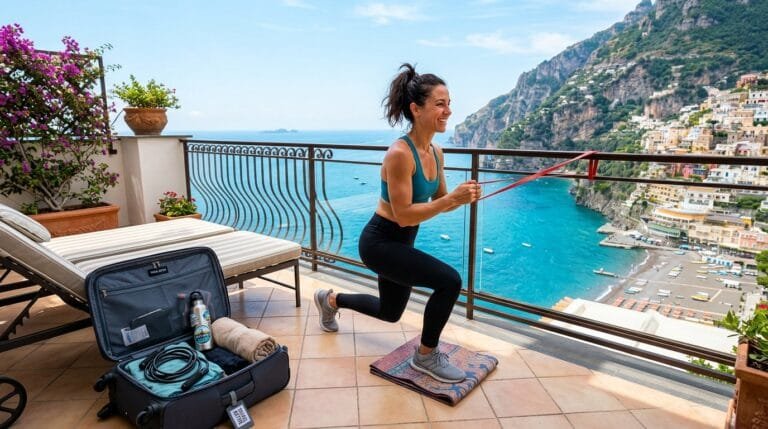
A full set of bands plus door anchor occupies less volume than a pair of adjustable dumbbells and can live in a drawer. Suspension trainers pack into a small bag. Dumbbells require a stable home but still fit under a bed or in a closet. None of these options need permanent floor plates or wall mounting beyond a door. In multi-use living spaces the entire cable-alternative toolkit can disappear after the session, preserving the room’s primary function.
Progressive Overload Without a Cable Stack
- Move to a stronger band
- Increase pre-stretch by stepping farther away
- Slow the eccentric phase (3–5 seconds)
- Add a pause at peak tension
- Combine bands with a dumbbell
- Reduce rest periods for density
- Advance to unilateral or more unstable variations
These methods allow months or years of continued progress without a cable machine.
Common Mistakes When Switching from Cables
| Mistake | Result | Better Approach |
|---|---|---|
| Using only light bands indefinitely | Early plateau | Apply systematic progression |
| Poor door-anchor setup | Damage risk or slipping | Use a proper anchor on a solid door |
| Neglecting scapular control | Neck and trap dominance | Emphasise retraction and depression |
| Expecting identical feel | Frustration | Accept minor differences and focus on stimulus |
| Adding too many new variations at once | Diluted progress | Replace one cable exercise at a time |
| Ignoring storage | Clutter and reduced adherence | Assign a fixed home for every item |
Equipment Recommendations for Real Homes
Minimum Effective Setup
- Set of loop bands (light to heavy)
- Tube bands with handles
- Quality door anchor
- Optional: one pair of dumbbells
Upgraded but Still Compact Setup
- Above items plus a suspension trainer
- One adjustable or fixed kettlebell for additional loading options
This combination covers the vast majority of cable-machine patterns while remaining fully compatible with apartments and shared spaces.
Strength training with simple tools remains highly effective when progressive overload and consistency are present (strength training guidance). Practical home-gym approaches emphasise solutions that fit real living constraints rather than commercial-gym ideals (home gym equipment prioritisation and budget home gym principles).
Frequently Asked Questions
Can bands really replace a cable machine?
For most people and most exercises, yes. The stimulus is comparable when progressive overload is applied. Advanced lifters seeking very high constant loads may eventually want additional free-weight options, but bands cover the majority of needs.
Is a door anchor safe?
When used on a solid door with the anchor properly placed on the side that closes toward you, and when the door is fully closed and locked if possible, door anchors are safe for typical band tensions. Always inspect the door and anchor before loading.
What if I don’t have a suitable door?
Use a suspension trainer anchored to a sturdy overhead beam or rack, or rely more heavily on dumbbell and bodyweight alternatives. Some bands can also be anchored low under a heavy piece of furniture.
How do I progress once my strongest band feels easy?
Increase stretch, slow the tempo, add pauses, move to unilateral versions, combine with a dumbbell, or improve density. These methods extend the useful life of a band set significantly.
Are suspension trainers better than bands?
They excel at bodyweight rows and instability challenges. Bands excel at scalable resistance and easy angle changes. Many home lifters benefit from owning both.
Do I still need dumbbells if I have bands?
Not strictly, but a single pair of dumbbells expands loading options for presses, hinges, and carries and pairs extremely well with bands.
How much space do these alternatives actually require during use?
Most band and suspension exercises need roughly the same footprint as a bodyweight circuit—typically a clear 6×6 ft area or less.
Can I build significant strength with only cable alternatives?
Yes. Progressive tension through bands, suspension work, and free weights builds strength effectively for the large majority of trainees.
Final Recommendation
Cable alternatives that work in real home spaces centre on resistance bands with a door anchor, suspension trainers, and smart use of dumbbells or bodyweight leverage. These tools replicate the majority of cable-machine benefits—constant or accommodating tension, adjustable angles, and joint-friendly resistance—while requiring almost no permanent space or high cost. For most home lifters a quality band set plus door anchor forms the foundation; adding a pair of dumbbells or a suspension trainer covers nearly every remaining need.
Audit the cable exercises you actually perform, match each to a home alternative, and set up a reliable anchor system this week. Apply progressive overload through band strength, stretch, tempo, and pauses, and store everything so the space returns to its primary function after training. When the alternatives are chosen for real living conditions rather than commercial-gym ideals, home training stays effective, sustainable, and clutter-free. Start with the highest-leverage tool—bands and a door anchor—and build from there. The results will come from consistent progressive work, not from the presence of a cable stack.