Myth Busting: Does More Cardio Always Mean More Fat Loss?
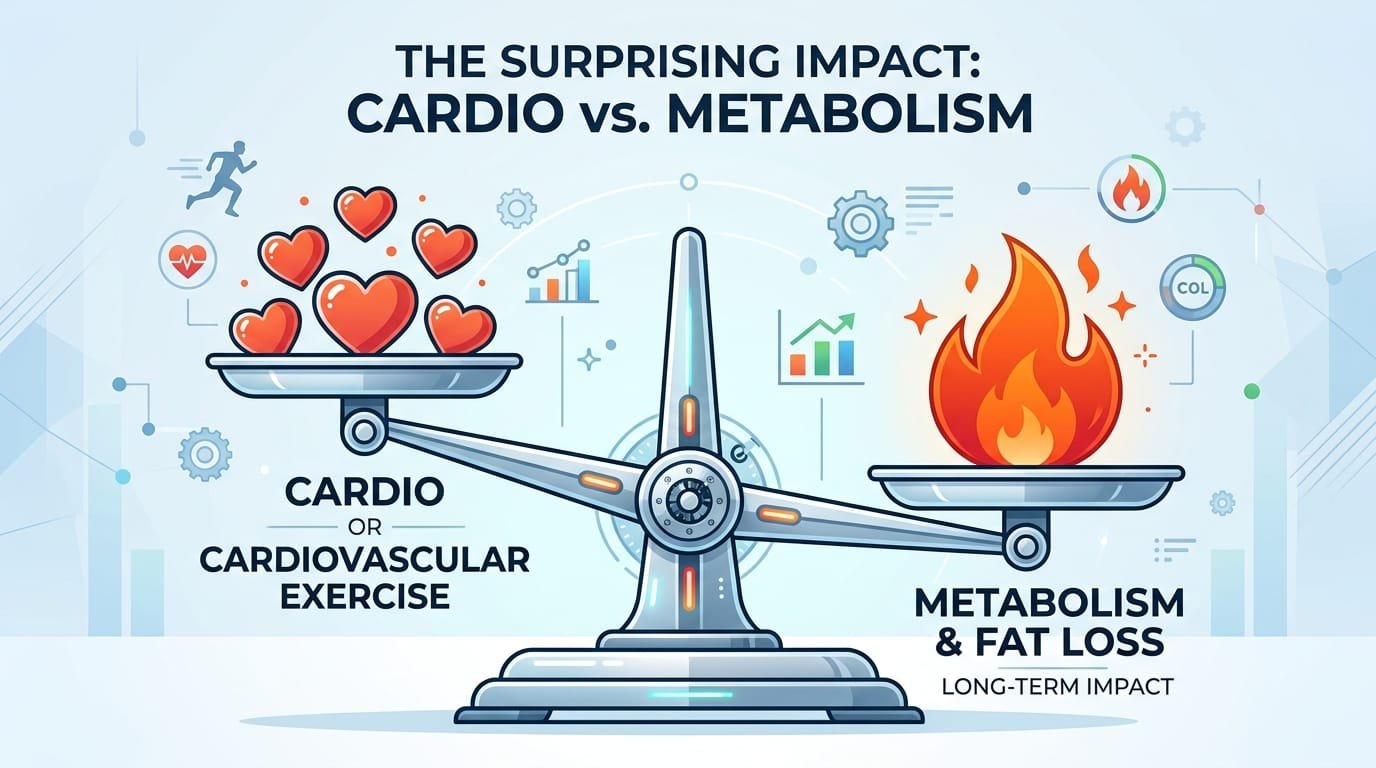
Quick Answer No. More cardio does not automatically produce more fat loss in a simple linear relationship. Aerobic exercise contributes to a calorie deficit and demonstrates a clear dose-response effect on body weight, waist circumference, and body fat up to approximately 150–300 minutes per week of moderate-to-vigorous activity. Beyond that range, returns diminish sharply. Compensatory increases in appetite, reductions in spontaneous daily movement, interference with recovery and strength training, and potential loss of lean mass can blunt or reverse expected benefits. Sustainable fat loss is driven primarily by a consistent energy deficit, supported by resistance training to preserve muscle, adequate protein intake, and a manageable volume of cardio that respects recovery capacity. Endless cardio is neither necessary nor optimal for most people.
The Fundamental Physiology of Fat Loss
Fat loss occurs when total energy expenditure exceeds energy intake over a sustained period, forcing the body to mobilise stored triglycerides. Cardio elevates expenditure during the session and can produce a small excess post-exercise oxygen consumption (EPOC) effect, but 24-hour (and weekly) energy balance—not the mere presence of cardio—determines whether fat is lost.
A large dose-response meta-analysis of 116 randomised clinical trials involving nearly 6,900 adults with overweight or obesity found that each additional 30 minutes per week of aerobic exercise was associated with reductions of approximately 0.52 kg in body weight, 0.56 cm in waist circumference, and 0.37% in body-fat percentage. Benefits continued in a roughly linear fashion up to about 300 minutes per week, with clinically important changes in waist and body-fat measures appearing around 150 minutes of moderate-to-vigorous activity (see the open-access analysis in PMC).
When total energy expenditure is matched across modalities, steady-state and interval training produce similar fat-loss outcomes. Resistance training, by contrast, is superior for preserving or increasing lean mass during a deficit. Concurrent programs that combine both therefore tend to deliver the best overall body-composition results.
Why the “More Cardio = More Fat Loss” Assumption Fails
Several well-documented mechanisms explain why simply adding more cardio sessions does not guarantee proportionally greater fat loss:
- Metabolic and behavioural compensation The body frequently adapts by increasing hunger hormones, reducing non-exercise activity thermogenesis (NEAT), or becoming more movement-efficient. Research summarised in practical reviews shows that actual fat loss from cardio-only interventions is often only 20–50% of the amount predicted from the calories recorded on the machine.
- Diminishing returns past moderate-to-high volumes Once weekly aerobic volume reaches roughly 150–300 minutes of moderate-to-vigorous effort, additional sessions produce smaller incremental fat-loss benefits while raising fatigue, injury risk, and recovery demand.
- Risk of lean-mass loss High-volume cardio performed in a calorie deficit without progressive resistance training fails to provide the mechanical tension required to signal muscle retention. Loss of lean tissue lowers resting metabolic rate and can leave an individual looking softer even as scale weight declines.
- The interference effect (dose- and modality-dependent) Concurrent cardio and strength training can modestly reduce strength and hypertrophy adaptations when cardio volume is very high, sessions are performed in close proximity, or high-impact modalities (especially running) are used. Meta-analyses of dozens of studies indicate that moderate volumes (approximately 2–3 sessions per week) of lower-impact cardio produce minimal to negligible interference with muscle growth for most trainees.
- Adherence and long-term sustainability Extreme cardio volumes are difficult to maintain. The program that produces the best long-term fat loss is the one an individual can follow consistently for months and years.
Evidence Comparison of Training Approaches
| Approach | Typical Fat-Loss Magnitude | Effect on Lean Mass | Recovery Demand | Sustainability | Best Use Case |
|---|---|---|---|---|---|
| High-volume cardio only | Moderate | Often negative | High | Low–moderate | Short-term when lifting is not possible |
| Resistance training only | Lower scale weight change | Positive or neutral | Moderate | High | Body-composition focus |
| Concurrent (moderate cardio + RT) | Highest overall fat loss + best composition | Near-neutral to positive | Moderate | High | Most people seeking fat loss |
| Very high cardio (>300–400 min/week) | Diminishing additional fat loss | Increased muscle-loss risk | Very high | Low | Rarely optimal |
| Diet only (no structured exercise) | Fat loss occurs | Higher lean-mass loss | Low | Variable | Misses fitness and health benefits |
Large reviews comparing aerobic, resistance, and concurrent training consistently show that well-designed concurrent programs produce superior body-composition outcomes when volumes remain realistic. When energy expenditure is equalised, the type of exercise matters less than the total deficit created and the presence of a muscle-preserving stimulus.
Step-by-Step Framework for Effective Fat Loss Without Excessive Cardio
- Create a moderate, sustainable calorie deficit (typically 300–500 kcal below estimated maintenance).
- Perform progressive resistance training 3–5 days per week, prioritising compound movements and progressive overload.
- Add 2–4 cardio sessions of 20–45 minutes (or an equivalent daily step target) rather than maximising steady-state volume.
- Prefer lower-impact modalities (cycling, rowing, elliptical, incline walking) when recovery from lifting is a priority.
- Keep the majority of cardio at moderate intensity; use short high-intensity intervals sparingly if desired and recovery allows.
- Increase daily non-exercise movement (steps, standing, light activity) as a low-recovery way to raise expenditure.
- Consume adequate protein (approximately 1.6–2.2 g per kg of body weight) to support muscle retention.
- Monitor recovery markers: sleep quality, gym performance, resting heart rate, and subjective energy.
- Increase cardio volume only if fat loss has stalled and recovery remains solid.
- Reassess every 4–6 weeks, adjusting based on waist measurements, strength, and adherence rather than scale weight alone.
Sample Sustainable Weekly Structure
- 3–4 resistance-training sessions (full-body or upper/lower split)
- 2–3 cardio sessions of 25–40 minutes (steady-state or mixed intensity)
- Daily step goal of 8,000–12,000
- One full rest or active-recovery day
This structure supplies meaningful energy expenditure while protecting muscle tissue and recovery capacity.
Persistent Myths and Evidence-Based Corrections
Myth: Fasted cardio burns significantly more fat. Substrate utilisation during the session may shift slightly toward fat, but 24-hour fat balance is governed by total energy intake versus expenditure, not meal timing around cardio.
Myth: HIIT is inherently superior for fat loss. When total calories burned are matched, HIIT and moderate-intensity continuous training produce similar fat-loss results. HIIT is time-efficient but carries a higher recovery cost.
Myth: Cardio is required to lose fat. A calorie deficit created through diet alone produces fat loss. Cardio accelerates the process and delivers important health benefits, yet it is not mandatory.
Myth: More sweat equals more fat burned. Sweat reflects thermoregulation and fluid loss, not the quantity of fat oxidised.
Myth: Very high cardio volumes are the fastest route to leanness. Extreme volumes increase compensation, recovery demands, and muscle-loss risk while offering diminishing fat-loss returns.
Integrating Cardio Intelligently with Strength and Recovery Practices
Cardio delivers its best results when it supports rather than competes with strength training. Build the foundation with progressive work using adjustable dumbbells and kettlebell training to preserve or build muscle. Strong grip endurance improves performance in loaded carries and pulling movements. Core stability developed through ab roller variations enhances posture and force transfer during both lifting and cardio.
Low-impact cardio options such as a manual treadmill or mobility and strength work with resistance bands allow additional activity with minimal joint stress. Recovery tools like a budget massage gun help manage residual muscle tension. Continue applying sound shoulder-mechanics principles from your lateral raise guidance so upper-body sessions remain productive. For further context on cardio modality choices, related discussions on rowing versus treadmill approaches and elliptical timelines provide useful complementary reading.
Frequently Asked Questions
Does more cardio always produce more fat loss? No. Benefits follow a dose-response curve that flattens beyond roughly 150–300 minutes of moderate-to-vigorous activity per week. Additional volume brings higher recovery costs and greater risk of compensation. Supporting evidence appears in the large aerobic-exercise dose-response meta-analysis available via PMC.
How much cardio is optimal for most people seeking fat loss? Two to four sessions of 20–45 minutes, combined with daily walking and progressive resistance training, produces excellent results for the majority of trainees.
Will high-volume cardio cause muscle loss? It elevates the risk when protein intake is insufficient, resistance training is absent, and the calorie deficit is aggressive. Well-programmed concurrent training with adequate protein largely protects lean mass.
Is steady-state or HIIT better for fat loss? When total energy expenditure is equated, outcomes are similar. Select the modality that best matches preference, schedule, and recovery capacity.
Can fat loss occur with strength training and little or no cardio? Yes. A calorie deficit plus resistance training produces fat loss and often superior body composition compared with cardio alone. Cardio remains valuable for cardiovascular health and additional energy expenditure.
What should I do if fat loss stalls? First confirm adherence to the calorie target, protein intake, sleep, and daily steps. Adding a moderate amount of cardio is reasonable if recovery is solid; large increases in volume are rarely the most effective next step.
Does the type of cardio matter for interference with lifting? Yes. Lower-impact, concentric-dominant modalities (cycling, rowing, elliptical) generally produce less interference with lower-body strength and hypertrophy than high-impact running, especially when volumes are moderate and sessions are separated.
Final Recommendation
More cardio does not always equal more fat loss. Aerobic exercise is a valuable tool that contributes to a calorie deficit and improves health markers, with clear benefits up to moderate-to-high weekly volumes. Beyond that point, additional sessions yield diminishing returns, increase recovery demands, and raise the risk of muscle loss if resistance training and nutrition are neglected.
The most effective and sustainable approach combines a controlled calorie deficit, progressive resistance training to preserve lean mass, adequate protein, daily movement, and a realistic amount of cardio (typically 2–4 sessions plus steps). Focus on consistency, muscle retention, and recovery rather than maximising cardio minutes. Track progress through waist measurements, strength levels, and how clothing fits. When these elements are balanced, fat loss becomes more efficient, sustainable, and health-promoting than simply performing ever-greater volumes of cardio.