How to Transition from Machine-Based Gym Training to Home Free Weights
Quick Answer
Transition from machine-based gym training to home free weights by starting with lighter loads than you used on machines, prioritising movement quality and stability, learning the main free-weight patterns (squat, hinge, push, pull), and progressing gradually through increased control before adding significant load. Expect an initial drop in the weights you can handle, treat the first 4–8 weeks as a skill-and-stability phase, and use simple full-body sessions. Free weights demand more coordination and core engagement but build more transferable strength and require far less equipment.
Why the Transition Feels Harder Than Expected
Machines guide the path of motion, reduce stability demands, and often allow higher loads because the machine supports the body and controls the trajectory. Free weights remove that external support. The result is that a weight that felt manageable on a machine can feel dramatically heavier or less stable with dumbbells, a kettlebell, or bodyweight variations. This is normal. The transition is less about losing strength and more about learning to express strength in a less constrained environment. Approached correctly, most people regain and then exceed previous performance while gaining better joint control and movement skill.
Core Principles for a Successful Transition
- Reduce load and prioritise control – Start lighter than your machine numbers suggest.
- Master basic patterns before intensity – Squat, hinge, push, pull, and carry form the foundation.
- Accept temporary performance drops – Stability and coordination take time to develop.
- Use full-body sessions – They maximise limited equipment and training frequency.
- Progress through control, then load – Tempo, range, and stability come before heavy weights.
- Keep training frequency consistent – Momentum matters more than perfect workouts during the switch.
Machines vs Free Weights: Key Differences
| Factor | Machine-Based Training | Free-Weight / Home Training | Transition Implication |
|---|---|---|---|
| Stability demand | Low | High | Must rebuild stabiliser strength |
| Movement path | Fixed | Free | Requires more motor control |
| Load potential (early) | Higher | Lower initially | Expect to drop weight |
| Core engagement | Moderate | High | Core becomes a limiting factor |
| Equipment needed | Large machines | Minimal | Home training becomes practical |
| Skill requirement | Lower | Higher | Technique practice is essential |
| Transfer to daily life | Moderate | Higher | Better real-world strength |
Shoulder-friendly technique is especially important when moving from machine presses and raises to free-weight versions (Bent Arms vs. Straight Arms in Lateral Raises, The Hidden Mistake in Lateral Raises, and 3 Lateral Raise Modifications). Grip strength often becomes more relevant with free weights and can be trained directly (Do Hand Grippers Really Work?).
Step-by-Step Transition Plan
- Audit your current machine exercises
List the primary movements you performed (leg press, chest press, lat pulldown, etc.). - Match each to a free-weight or bodyweight pattern
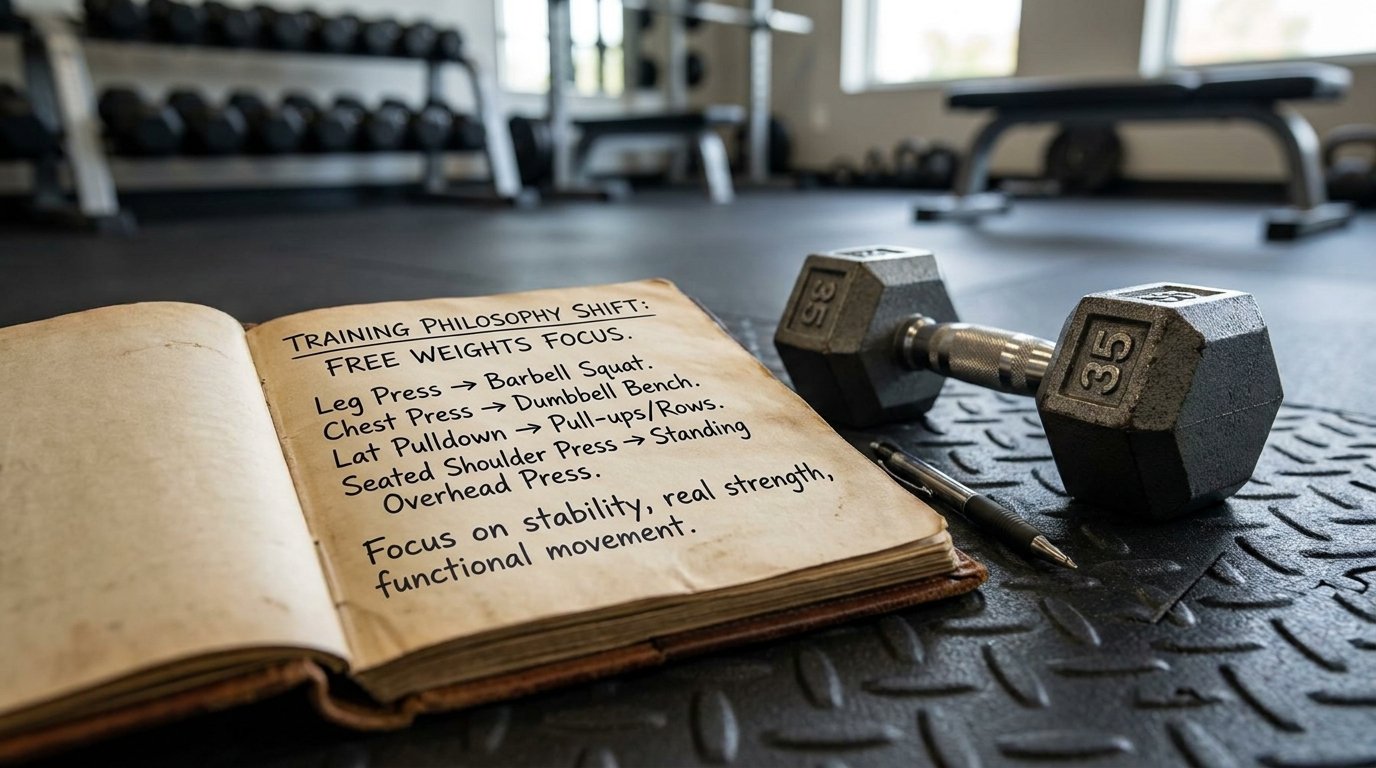
Leg press → goblet squat or split squat
Chest press → floor press or push-up variation
Lat pulldown → single-arm row or inverted row
Leg curl / extension → hinge and single-leg work - Begin with conservative loads
Choose weights that allow perfect control for the target repetitions. - Emphasise tempo and full range
Slower eccentrics and complete ranges build control quickly. - Adopt a simple full-body template
Train the main patterns two to four times per week. - Treat the first 4–8 weeks as skill acquisition
Focus on stability and technique rather than matching old machine numbers. - Track free-weight performance separately
Do not compare early free-weight numbers directly to machine loads. - Progress through control metrics first
Improve tempo, range, and unilateral balance before adding significant load. - Reintroduce intensity gradually
Once movements feel stable, begin standard progressive overload. - Build a sustainable home routine
Consistency with free weights matters more than replicating every machine exercise.
Exercise Conversion Guide
| Machine Exercise | Primary Free-Weight Alternative | Secondary Option | Key Transition Cue |
|---|---|---|---|
| Leg press | Goblet squat / split squat | Step-up | Control depth and knee tracking |
| Chest press | Floor press / push-up | Dumbbell press | Maintain scapular control |
| Shoulder press machine | Seated or standing dumbbell press | Band press | Avoid excessive lower-back arch |
| Lat pulldown | Single-arm row / inverted row | Band pulldown | Initiate with scapula |
| Seated row | Single-arm dumbbell or band row | Two-arm band row | Avoid torso rotation |
| Leg curl | Romanian deadlift / single-leg RDL | Glute bridge | Hinge at hips, neutral spine |
| Leg extension | Split squat / step-up | Goblet squat | Controlled knee flexion |
| Machine crunch | Dead bug / plank | Pallof press | Anti-movement focus |
Sample Transition Program (First 6 Weeks)
Session A
- Goblet squat or box squat – 3 × 8–12
- Romanian deadlift – 3 × 8–12
- Floor press or push-up variation – 3 × 8–12
- Single-arm row – 3 × 10–15 per arm
- Dead bug or plank – 2–3 sets
Session B
- Reverse lunge or split squat – 3 × 8–12 per leg
- Single-leg glute bridge or hip thrust – 3 × 8–12 per leg
- Band or dumbbell overhead / incline press – 3 × 8–12
- Inverted row or band row – 3 × 8–15
- Suitcase carry or side plank – 2 sets per side
Perform these sessions 2–4 times per week. Focus on controlled tempos and perfect form. Increase difficulty through range, tempo, or load only when stability feels solid.
Managing the Psychological Side of the Transition
Many people feel discouraged when free-weight loads are much lower than previous machine loads. This comparison is misleading. Machines reduce stability demands and often place the body in mechanically advantageous positions. Free-weight performance will rise steadily as coordination and stabiliser strength improve. Track free-weight progress on its own terms and celebrate improved control, range, and consistency.
Common Transition Mistakes
| Mistake | Result | Better Approach |
|---|---|---|
| Trying to match machine loads immediately | Form breakdown and frustration | Start lighter and rebuild |
| Too many isolation exercises | Inefficient home sessions | Focus on compound patterns |
| Neglecting unilateral work | Persistent imbalances | Include single-leg and single-arm variations |
| Skipping the skill phase | Plateau or minor injuries | Spend 4–8 weeks prioritising control |
| Inconsistent training frequency | Slow adaptation | Schedule sessions like appointments |
| Comparing home numbers to gym numbers | Unnecessary discouragement | Track free-weight progress independently |
Equipment Priorities for the Transition
You do not need a full commercial setup. A highly effective home transition can be built with:
- Resistance bands and a door anchor
- One pair of adjustable or fixed dumbbells
- A single kettlebell
- Bodyweight progressions
These tools cover the major patterns and allow years of progressive training.
Long-Term Advantages of Free-Weight Home Training
Once the transition is complete, free weights typically provide:
- Better transfer to real-world tasks
- Greater core and stabiliser development
- Lower equipment and membership costs
- Higher schedule flexibility
- More scalable progressive overload options through tempo, pauses, and unilateral work
Strength training remains highly effective when performed with free weights and consistent progressive overload (strength training guidance). Practical home-gym approaches emphasise simple systems that replace machine dependency (home gym equipment prioritisation and budget home gym principles).
Frequently Asked Questions
How much lighter should I start with free weights?
There is no fixed percentage. Choose a load that allows perfect control for the target repetitions. Many people begin 30–50 % lower than their machine working weights and progress from there.
How long does the transition usually take?
Most trainees feel reasonably stable within 4–8 weeks of consistent free-weight practice. Strength numbers often surpass previous machine performance in subsequent months.
Do I lose muscle when switching?
Not if training frequency and progressive tension are maintained. Any temporary drop in performance is largely neural and stabiliser-related rather than true muscle loss.
Is bodyweight training enough during the transition?
It can be, especially when progressive variations, tempo, and unilateral work are used. Adding bands or a single pair of dumbbells accelerates progress for most people.
What if I feel unstable on free-weight exercises?
Reduce the load, shorten the range of motion, or use supported variations until control improves. Instability is a normal part of the learning process.
Should I keep using machines if I still have gym access?
You can, but if the goal is a sustainable home program, prioritise free-weight practice so the transition completes fully.
How do I know when I’m ready to push intensity again?
When the primary movements feel controlled through full range, balance is reliable, and you can complete target repetitions without form breakdown.
Can I still build significant strength at home?
Yes. Free weights, progressive overload, and consistency are sufficient for substantial strength and muscle gains for the large majority of trainees.
Final Recommendation
Transitioning from machine-based gym training to home free weights succeeds when you reduce initial loads, focus on movement quality and stability, learn the core patterns, and treat the first month or two as a skill-building phase. Use simple full-body sessions, progress through control before heavy loading, and track free-weight performance independently of old machine numbers.
Map your previous machine exercises to free-weight alternatives today, schedule your first two home sessions, and begin with loads you can control perfectly. Emphasise tempo and full range while the stabilisers catch up. When the transition is handled this way, home free-weight training becomes not only viable but often superior for long-term strength, convenience, and consistency. Start with the next session—the control you build now becomes the foundation for years of productive training without machines.