Common Push-Up Form Mistakes That Cause Wrist and Shoulder Pain
Quick Answer The most common push-up mistakes that produce wrist and shoulder pain are flared elbows (creating a “T” shape), hands placed too far forward or too wide, excessive wrist extension, poor scapular control (winging or shrugging), and a sagging or arched body line. Correct these by setting hands roughly shoulder-width with fingers spread, tucking elbows to a 30–45° angle, actively protracting the scapulae at the top, maintaining a rigid plank from head to heels, and using modifications (parallettes, dumbbells, or fists) when wrist extension is painful. Proper form distributes load across the chest, triceps, and serratus anterior instead of dumping stress into the joints.
Why Push-Up Form Matters So Much
Push-ups are a closed-chain, bodyweight pressing movement that demands strength, stability, and mobility simultaneously. When form breaks down, the wrists are forced into end-range extension under load and the shoulder joint loses the protective space it needs. Over time this leads to anterior shoulder irritation, rotator-cuff tendinopathy, wrist joint overload, and stalled progress.
Physical therapists and strength coaches repeatedly identify the same handful of technical errors. Resources from Squat University, SELF, and clinical discussions on scapular kinematics (including work summarized by the Brookbush Institute) show that most pain is mechanical rather than a mysterious “weakness.”
The Most Common Mistakes and Exactly How to Fix Them
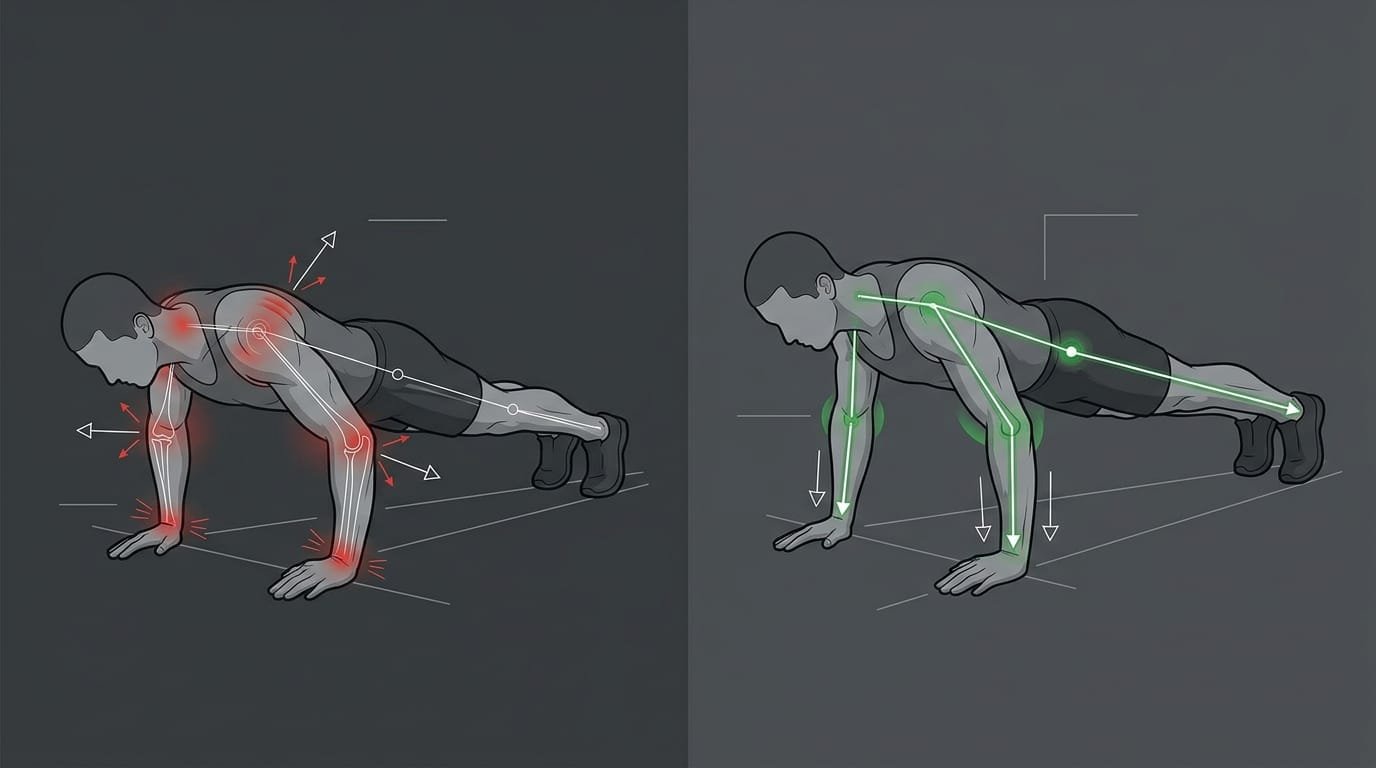
1. Elbows Flaring Outward (the “T” Position) When the upper arms form a 90° angle with the torso, the humeral head is driven forward and the subacromial space narrows. This is the single most frequent cause of front-of-shoulder pain during push-ups.
Fix: Tuck the elbows so they sit at roughly 30–45° from the body, creating an arrow shape rather than a T. Cue “screw your hands into the floor” to create external-rotation torque.
2. Hands Too Far Forward or Too Wide Hands placed well in front of the shoulders increase wrist extension angle and shift load onto the anterior shoulder. Excessively wide hands demand more horizontal abduction and can irritate the AC joint or biceps tendon.
Fix: Set the hands directly under or just slightly outside the shoulders. Index fingers should roughly align with the outer edges of the shoulders. Spread the fingers for a larger base of support.
3. Excessive Wrist Extension A flat-palm push-up forces the wrist into approximately 90° of extension while supporting a large percentage of body weight. Limited wrist mobility or hands drifting backward under fatigue makes this position painful.
Fix options:
- Use parallettes, push-up handles, or hex dumbbells to keep the wrist closer to neutral.
- Perform push-ups on fists (knuckles down).
- Place a rolled towel or yoga mat under the heel of the hand to reduce extension angle.
- Gradually build wrist tolerance with controlled loading rather than avoiding the movement entirely.
4. Poor Scapular Control (Winging, Shrugging, or Locked Blades) If the shoulder blades do not protract (spread) at the top and retract smoothly at the bottom, the glenohumeral joint absorbs forces it was never designed to handle alone. Serratus anterior weakness is a frequent culprit.
Fix: Practice scapular push-ups (arms stay straight; only the shoulder blades move). At the top of every regular push-up, actively “push the floor away” to protract the scapulae. Keep the shoulder blades depressed (away from the ears) throughout.
5. Sagging Hips or Arched Lower Back A broken body line shifts weight forward onto the shoulders and wrists and removes core contribution. The movement ceases to be a full-body plank and becomes an inefficient, joint-stressing exercise.
Fix: Brace the core and squeeze the glutes as if performing a moving plank. Maintain a straight line from head to heels. Film yourself from the side to check alignment.
6. Head Jutting Forward or Chin Tucking Excessively Neck position affects thoracic and scapular mechanics. Looking too far up or dropping the head changes the entire kinetic chain.
Fix: Keep a neutral neck—eyes looking at the floor roughly 12–18 inches in front of the hands.
Comparison of Painful vs. Correct Positions
| Mistake | Joint Stress Created | Correct Position | Immediate Benefit |
|---|---|---|---|
| Elbows at 90° (T-shape) | Subacromial impingement, anterior shoulder | Elbows 30–45° (arrow shape) | Opens subacromial space |
| Hands far forward | High wrist extension + anterior shoulder | Hands under or just outside shoulders | Reduces wrist angle and shear |
| Flat palms, limited mobility | End-range wrist compression | Neutral grip (handles/fists) or elevated | Removes painful end-range |
| Scapulae locked or winged | Unstable glenohumeral joint | Controlled protraction/retraction | Shares load with serratus |
| Sagging hips | Forward weight shift onto shoulders/wrists | Rigid plank line | Distributes force through core |
Step-by-Step Guide to Pain-Free Push-Ups
- Set hands slightly wider than shoulder-width, fingers spread and pointing forward.
- Screw the hands into the floor to create external-rotation tension.
- Brace the core and squeeze the glutes so the body forms a rigid plank.
- Lower under control with elbows tracking at 30–45°.
- Allow the shoulder blades to retract naturally as you descend.
- At the bottom, pause briefly without letting the chest collapse.
- Drive the floor away, fully protracting the scapulae at the top.
- Maintain the rigid body line throughout the entire set.
- If wrists still complain, switch to a neutral-grip variation immediately.
- Film sets regularly and compare against the checklist above.
Progressions and Modifications
- Beginner / Pain-sensitive: Elevate the hands on a bench or wall, or drop to the knees while keeping the same rigid torso and elbow angle.
- Wrist-friendly: Parallettes, hex dumbbells, or fist push-ups.
- Scapular emphasis: Add 5–10 scapular push-ups before working sets.
- Strength progression: Once form is solid, add tempo (3-second lowering), pauses, or elevated feet.
Integrating Push-Up Work with the Rest of Your Training
Clean push-up mechanics transfer directly to pressing strength with adjustable dumbbells and kettlebells. Strong grip endurance helps you maintain hand pressure and external-rotation torque. Core stability from ab roller variations or hanging work supports the rigid plank position required for safe push-ups.
Recovery tools such as a budget massage gun can help manage residual forearm, shoulder, and upper-back tension. Light cardio on a manual treadmill or mobility flows with resistance bands aid recovery. Review lateral raise form to ensure isolation work does not reinforce poor scapular patterns that later appear in push-ups.
Common Programming Mistakes That Prolong Pain
- Adding volume before cleaning up form
- Ignoring early wrist or shoulder discomfort
- Using only flat-palm variations when mobility is limited
- Neglecting scapular strengthening (serratus and lower traps)
- Skipping core bracing cues
- Progressing to deficit or weighted push-ups too soon
Frequently Asked Questions
Why do my wrists hurt even when my form looks okay? Limited wrist extension mobility or hands drifting backward under fatigue are the usual culprits. Neutral-grip options (handles, fists, or dumbbells) almost always resolve the issue while you build tolerance. Practical fixes are discussed in resources such as E3 Rehab and SELF.
Is the “T” elbow position ever useful? For most people it is not worth the joint stress. A 30–45° elbow angle still trains the chest effectively while protecting the shoulder. Research on scapular kinematics during push-ups supports keeping abduction angles closer to 60° or less for healthier joint loading (see Brookbush Institute summary).
Should I stop push-ups completely if I have pain? Not necessarily. Reduce range of motion, elevate the hands, switch to a neutral wrist position, or perform scapular-focused variations until symptoms settle. Complete rest is rarely the fastest path back to training.
How important is the “push the floor away” cue? Very. Active protraction at the top engages the serratus anterior, stabilizes the scapula, and keeps the humeral head centered. This is one of the highest-value technical cues for long-term shoulder health.
Can push-up handles permanently fix wrist pain? They remove the painful end-range extension and allow you to train the pattern. Most people can gradually return to flat-palm push-ups once strength and mobility improve, but handles remain a permanent option if preferred.
Final Recommendation
Wrist and shoulder pain during push-ups is almost always the result of a small number of correctable form errors. Prioritize elbow angle, hand placement, scapular control, and a rigid body line. Use neutral-grip modifications whenever wrists complain, and treat scapular push-ups and core bracing as non-negotiable foundations.
Clean technique turns the push-up from a joint-stressing exercise into one of the most effective upper-body strength and stability tools available. Film your sets, apply the corrections outlined above, and progress only when every rep looks and feels solid. Your wrists, shoulders, and long-term training consistency will thank you.
Master the positions first, then add volume and difficulty. Consistent attention to these details produces stronger, more resilient pressing mechanics that carry over to every other upper-body movement in your program.