Bent-Knee vs. Straight-Leg Deadlifts: Which Is Safer for Your Lower Back?
Quick Answer Bent-knee (conventional) deadlifts from the floor are generally safer and more sustainable for most lifters when performed with solid technique. They allow greater knee flexion, keep the bar closer to the body, and distribute load across more muscle mass. True straight-leg or locked-knee deadlifts increase the moment arm on the lumbar spine and place higher demand on the hamstrings in a lengthened position, raising injury risk if form breaks down. The Romanian deadlift (RDL)—a controlled hip hinge with soft knees—offers a middle ground that many coaches consider lower-risk for high-volume posterior-chain work. Technique, load selection, and individual mobility matter far more than the name of the variation.
Why This Comparison Matters
Deadlifts are one of the most effective exercises for building total-body strength, posterior-chain muscle, and real-world lifting capacity. They are also one of the movements most commonly blamed for lower-back pain. The confusion often comes from mixing up three distinct patterns:
- Conventional (bent-knee) deadlift from the floor
- Romanian deadlift (soft-knee hip hinge)
- Stiff-leg / straight-leg deadlift (knees nearly locked)
Each places different demands on the spine, hips, and hamstrings. Understanding these differences helps you choose the variation that matches your goals, mobility, and injury history while minimizing unnecessary risk.
Clear Definitions of Each Variation
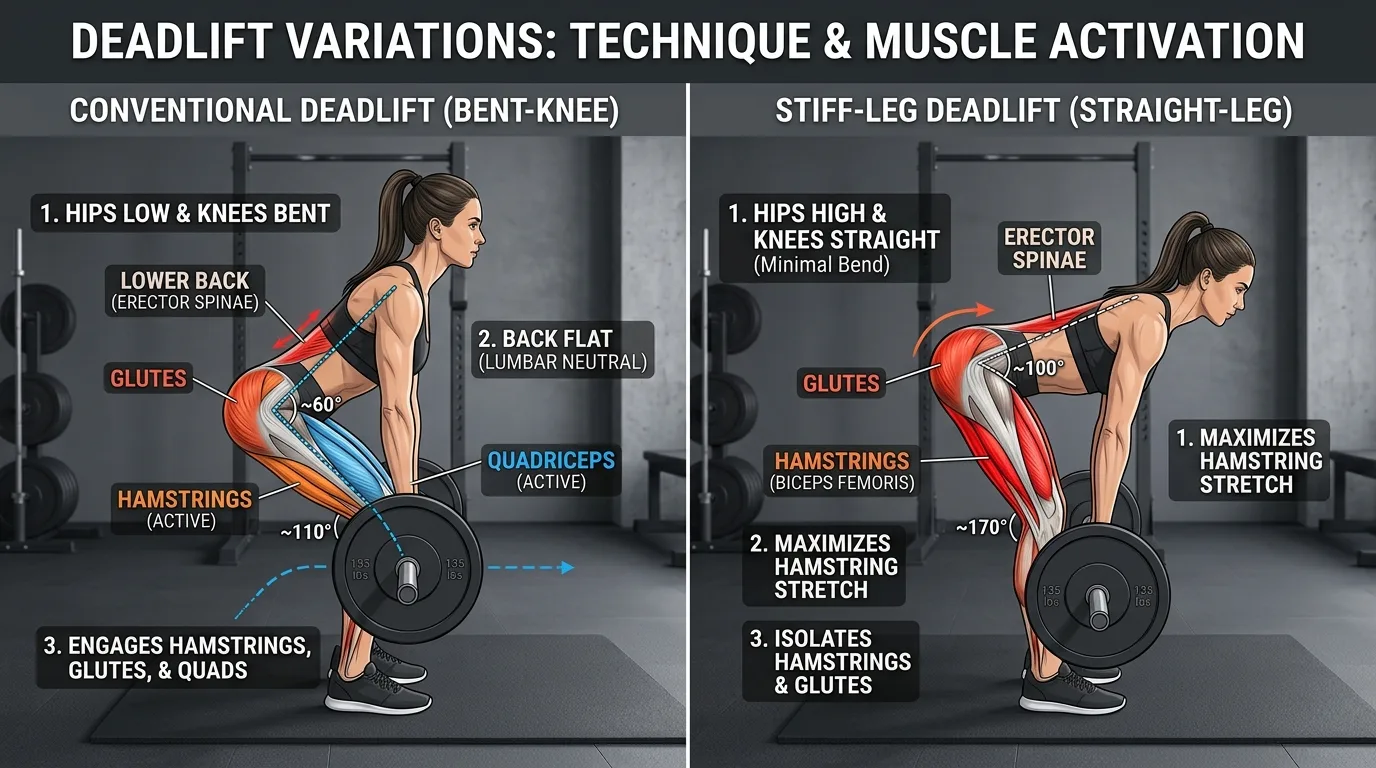
Bent-Knee / Conventional Deadlift The bar starts on the floor. You bend both the knees and hips so you can reach the bar while keeping the torso at a manageable angle. The lift involves simultaneous knee and hip extension. This version allows the heaviest absolute loads and trains the quads, glutes, hamstrings, and spinal erectors together.
Romanian Deadlift (RDL) You start standing with the bar at hip height. Soften the knees slightly, push the hips back, and lower the bar while keeping a neutral spine until you feel a strong stretch in the hamstrings (usually mid-shin). Then drive the hips forward to stand tall. The knees stay in roughly the same soft position throughout. RDLs emphasize the eccentric (lowering) phase and are excellent for hamstring and glute hypertrophy at moderate loads.
Stiff-Leg / Straight-Leg Deadlift The knees remain nearly locked or only very slightly bent. The movement becomes an almost pure hip hinge with a large range of motion. Many versions are performed with the bar starting on the floor or from an elevated surface. This variation places the greatest stretch on the hamstrings and can create the longest moment arm on the lumbar spine if the bar drifts forward.
Biomechanics and Spinal Loading Explained
Spinal stress during deadlift variations is influenced by four main factors:
- Horizontal distance of the barbell from the hips (moment arm)
- Degree of lumbar flexion under load
- Absolute weight on the bar
- Speed and control of the movement
When the knees stay more bent (conventional style), the hips can stay closer to the bar and the torso remains more upright relative to a pure stiff-leg version. This shortens the lever arm acting on the lower back. Research comparing conventional and Romanian deadlifts has shown differences in muscle activation and joint moments. Conventional pulls typically produce higher overall ground-reaction forces and greater quadriceps and glute involvement. RDLs often produce higher relative hamstring activation at matched loads.
True stiff-leg variations with locked knees tend to push the bar farther forward, increasing shear and compressive forces on the lumbar spine. Analyses from the Brookbush Institute note that locking the knees can also alter pelvic mechanics and increase reliance on the lumbar extensors in a lengthened position. A detailed electromyographic and kinetic comparison is available in the study published in the Journal of Exercise Science & Fitness (see PubMed summary).
Safety Comparison Table
| Variation | Knee Position | Typical Load | Primary Muscle Emphasis | Relative Lower-Back Demand | Best Use Case |
|---|---|---|---|---|---|
| Conventional (bent-knee) | Moderately bent at start | Highest | Full posterior chain + quads | Moderate–High (load-dependent) | Maximal strength & overall power |
| Romanian Deadlift | Soft / slightly bent | Moderate | Hamstrings + glutes (eccentric) | Lower per unit of weight | Hypertrophy & technique practice |
| Stiff / Straight-Leg | Nearly locked | Lower–Moderate | Hamstrings (lengthened) | Higher if form breaks | Advanced accessory (use with caution) |
Which Variation Is Actually Safer?
For the large majority of lifters, a well-executed bent-knee conventional deadlift or a controlled Romanian deadlift is safer than a locked-knee straight-leg version. Supporting reasons include:
- Greater ability to keep the bar close to the body
- More muscular contribution from the quads and glutes, reducing pure spinal demand
- Easier maintenance of a neutral or near-neutral lumbar spine
- Better tolerance for progressive loading over months and years
That said, no deadlift variation is inherently safe or dangerous. Injury risk rises sharply with:
- Excessive lumbar flexion under heavy load
- Fatigue-induced form breakdown
- Inadequate warm-up or mobility
- Rapid jumps in volume or intensity
- Pre-existing disc or soft-tissue issues
Physiotherapy perspectives, including those discussed by Pursuit Physiotherapy, emphasize that the spine is adaptable. Many injuries occur when tissue capacity is exceeded rather than from any single “bad” position. Controlled technique and gradual progression remain the strongest protective factors. Additional practical commentary on the risks of locked-knee variations can be found in resources from Advanced Human Performance and StrengthLog.
Detailed Technique Guidelines
Conventional Bent-Knee Deadlift
- Stand with mid-foot under the bar, feet roughly hip-width.
- Hinge at the hips and bend the knees until you can grip the bar with a neutral spine.
- Brace the core hard (as if preparing for a punch).
- Drive the floor away by extending the knees and hips together.
- Lock out tall without hyperextending the lower back.
- Lower under control by reversing the hip-and-knee pattern, keeping the bar close.
Romanian Deadlift
- Start standing with the bar at hip height, feet hip-width.
- Soften the knees slightly and lock that knee angle.
- Push the hips straight back while maintaining a neutral spine and slight natural lumbar curve.
- Lower until you feel a strong hamstring stretch (usually mid-shin or just below the knee).
- Drive the hips forward to return to standing, squeezing the glutes at the top.
- Keep the bar in light contact with the legs throughout the entire movement.
If Using a Stiffer-Leg Variation Keep a soft (never fully locked) knee angle, limit range of motion to what allows a neutral spine, use lighter loads than your conventional deadlift, and prioritize slow eccentrics. Many coaches recommend treating true locked-knee versions as advanced accessory work rather than primary strength movements.
Programming for Lower-Back Resilience
- Spend several weeks mastering the hip-hinge pattern with light loads or even a dowel before adding significant weight.
- Use conventional deadlifts for lower-rep strength work (3–6 reps).
- Use Romanian deadlifts for moderate-to-higher rep posterior-chain work (6–12 reps).
- Avoid heavy, high-volume locked-knee stiff-leg deadlifts if you have any history of lower-back issues.
- Pair all deadlift variations with dedicated core stability work and thoracic mobility drills.
- Monitor recovery carefully—persistent low-back tightness that does not resolve within 48 hours is a signal to reduce load or volume.
A balanced approach that includes both conventional and Romanian patterns tends to produce the best long-term results while keeping spinal stress manageable.
Integrating Deadlift Variations with the Rest of Your Training
Deadlifts pair extremely well with upper-body work using adjustable dumbbells or kettlebells. Strong grip endurance is essential for holding heavy pulls without the bar slipping. Core control developed through ab roller variations or hanging leg raises on a power tower supports spinal stability under load.
Recovery tools such as a budget massage gun can help manage residual tension in the lower back, glutes, and hamstrings. Light cardio on a manual treadmill or mobility flows with resistance bands aid recovery between heavy posterior-chain sessions. Review lateral raise form guidance to ensure balanced upper-back development that supports overall posture during hinged movements.
Common Mistakes That Increase Lower-Back Risk
- Rounding the lumbar spine under load
- Letting the bar drift forward away from the body
- Using a true locked-knee position with heavy weights
- Jumping too quickly to maximal loads without sufficient volume at submaximal intensities
- Neglecting warm-up sets and mobility work
- Training through sharp, stabbing, or radiating pain
- Ignoring early warning signs such as lingering tightness or reduced range of motion
Frequently Asked Questions
Are Romanian deadlifts safer than conventional deadlifts? Per unit of weight, RDLs often produce lower spinal demand and are easier to control, making them suitable for higher volume. Conventional deadlifts allow heavier absolute loads and train more total muscle mass. Both can be safe when technique is solid. Kinetic comparisons are discussed in the PubMed study.
Should I ever fully lock my knees on deadlift variations? Fully locking the knees on stiff-leg variations is generally discouraged by many coaches because it can increase lumbar shear and hamstring strain risk. Soft knees are preferred for most lifters. See commentary from the Brookbush Institute and Advanced Human Performance.
Can deadlifts actually strengthen my lower back? Yes. When performed with good form and progressive overload, deadlift variations strengthen the entire posterior chain—including the spinal erectors—and improve the work capacity of the tissues around the spine. The key is controlled loading rather than avoidance.
What if I already have lower-back pain? Reduce load, shorten range of motion, emphasize Romanian deadlifts or other controlled hinges, and consult a qualified professional. Pain is information—do not train through sharp or worsening symptoms. Additional perspective is available from Pursuit Physiotherapy.
Is one variation better for muscle growth? Conventional deadlifts are excellent for overall strength and mass. Romanian deadlifts excel at targeting the hamstrings in a lengthened position and are often superior for hypertrophy-focused blocks. Both have value depending on your primary goal.
How do I know if my form is good enough? Film yourself from the side. The bar should stay close to the legs, the spine should remain near-neutral (no excessive rounding), and the hips and shoulders should rise at roughly the same rate on conventional pulls. If you cannot maintain these positions, reduce the weight.
Final Recommendation
For most people concerned with lower-back safety, prioritize a well-coached bent-knee conventional deadlift for strength development and a soft-knee Romanian deadlift for accessory and hypertrophy work. Treat true locked-knee straight-leg deadlifts with caution—use lighter loads, limited range of motion, and excellent control if you include them at all.
Master the hip-hinge pattern first, keep the bar close to your body, maintain a braced and near-neutral spine, and progress gradually. Technique and intelligent load management protect the lower back far more effectively than any single variation name. When these fundamentals are in place, both bent-knee and controlled soft-knee patterns become productive tools rather than liabilities.
Assess your current mobility and technique honestly, choose the variation that allows the cleanest movement with the loads you can handle today, and build capacity over time. Strong, resilient posterior-chain training supports better athletic performance, improved posture, and long-term spinal health.