How to Fix Rounded Shoulders During Overhead Presses
Quick Answer Rounded shoulders (forward shoulder posture) during overhead presses usually stem from tight chest and lat muscles, weak mid-back and external rotators, limited thoracic extension, and poor scapular control. Fix it by improving thoracic mobility, strengthening the rear delts, lower traps, and serratus anterior, stretching the pecs and lats, and practicing proper pressing mechanics (ribs down, scapulae packing, head through at the top). Consistent daily mobility work plus balanced programming typically yields noticeable improvement in 4–8 weeks.
Why Rounded Shoulders Sabotage Overhead Presses
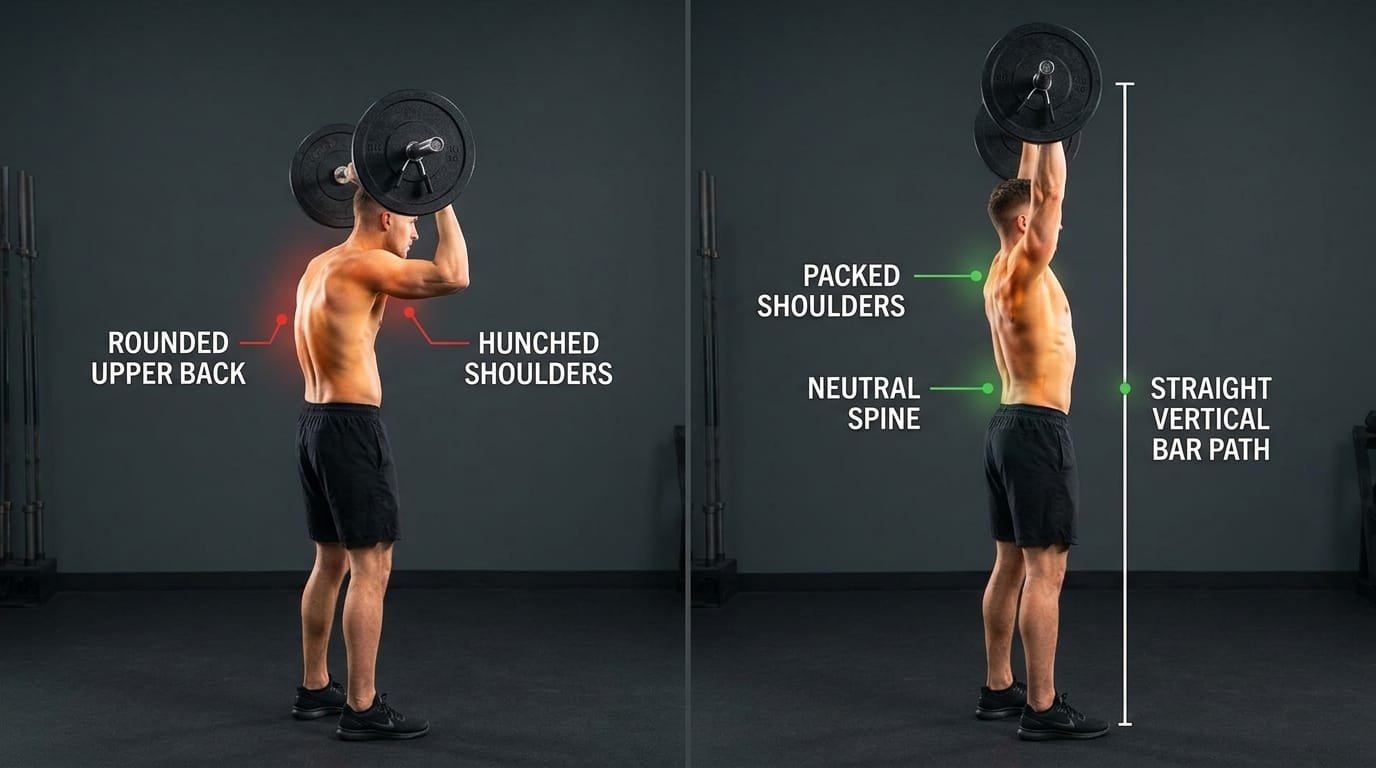
When the shoulders sit forward, the scapulae tend to tilt anteriorly and the thoracic spine stays flexed. This combination:
- Limits full overhead range of motion
- Forces compensatory lumbar extension (excessive lower-back arch)
- Increases anterior shoulder stress and impingement risk
- Reduces force transfer and lockout strength
- Makes the bar path less efficient
Over time this pattern contributes to pain, stalled progress, and higher injury risk. Addressing the root causes—mobility, muscle balance, and motor control—restores cleaner, stronger, and safer pressing. Guidance from physical-therapy and strength resources such as Built With Science and Muscle & Fitness consistently highlights thoracic extension and scapular control as key limiting factors.
Primary Causes of Rounded Shoulders in Pressing
- Tight pectoralis major/minor and latissimus dorsi – pull the shoulders forward and restrict upward rotation.
- Weak mid/lower trapezius, rhomboids, and serratus anterior – fail to stabilize and upwardly rotate the scapulae.
- Limited thoracic extension – the upper back cannot extend enough to allow the arms to travel overhead without compensation.
- Poor motor control – inability to keep ribs down and scapulae packed under load.
- Imbalanced programming – excessive horizontal and vertical pressing relative to pulling and external-rotation work.
Step-by-Step Fix Protocol
1. Daily Mobility & Soft-Tissue Work (5–10 minutes)
- Foam-roll thoracic spine (upper and mid-back) – 1–2 minutes.
- Doorway or wall pec stretch – 2 × 30 seconds each side.
- Lat stretch (band or doorway) – 2 × 30 seconds each side.
- Thoracic extension over foam roller or bench “prayer” stretch – 2 × 8–10 slow reps.
2. Activation & Scapular Control (before pressing sessions)
- Wall slides or forearm wall slides – 2 × 10–12.
- Band pull-aparts or face pulls – 2–3 × 15–20.
- Scapular push-ups or serratus punches – 2 × 10–12.
- Prone Y-raises or blackburns – 2 × 10–12.
3. Strengthen the Weak Links
- Face pulls (high volume) – 3–4 × 12–20.
- Seated or chest-supported rows with a pause – 3 × 8–12.
- External-rotation work (side-lying or cable) – 2–3 × 12–15.
- Lower-trap focused movements (prone Y or modified cobra) – 2–3 × 10–15.
4. Refine Overhead Press Technique
- Set ribs down and create a slight posterior pelvic tilt.
- Pack the scapulae (down and slightly back) before initiating the press.
- Press in the scapular plane (slightly forward of pure frontal plane).
- Drive the head “through” at the top so the bar finishes over the mid-foot.
- Lower under control without letting the shoulders dump forward.
5. Programming Adjustments Aim for a pull-to-push ratio of at least 1.5–2:1 (horizontal and vertical). Include dedicated rear-delt and external-rotation volume 2–3 times per week. Practical programming advice on balancing push and pull appears in resources such as LiftStrong.
Comparison of Helpful vs. Problematic Habits
| Habit / Exercise | Effect on Rounded Shoulders | Recommendation |
|---|---|---|
| High-volume face pulls | Strongly corrective | Prioritize |
| Strict lateral raises | Neutral to positive if form is good | Use with control |
| Traditional upright rows (high) | Often aggravating | Modify or replace |
| Excessive bench + OHP volume | Worsens imbalance | Reduce relative to pulling |
| Thoracic extension drills | Highly corrective | Daily practice |
| Heavy behind-the-neck presses | High risk | Avoid |
Integrating the Fix into Your Training
Use adjustable dumbbells or kettlebells for controlled overhead work while you rebuild mobility and control. Pair pressing days with higher pulling volume and face pulls. Maintain grip endurance so you can hold implements securely during high-rep scapular work. Core stability from ab roller variations or power-tower hanging work further supports rib position.
Recovery tools such as a budget massage gun can help manage upper-trap and pec tightness. Light cardio on a manual treadmill or mobility flows with resistance bands complement the corrective work. Review lateral raise form to ensure isolation movements do not reinforce poor scapular patterns.
Sample Weekly Corrective Add-On
- Daily: 5–8 minutes thoracic + pec/lat mobility.
- Pressing days: Activation circuit (wall slides + face pulls + scap push-ups) before main work.
- Non-pressing days: Extra rowing and external-rotation volume.
- Every session: Cue ribs-down and scapular packing on all overhead movements.
Common Mistakes That Slow Progress
- Stretching without strengthening the opposing muscles.
- Performing mobility drills only once or twice per week.
- Continuing to press heavy loads with visible forward shoulder dump.
- Ignoring thoracic extension in favor of only shoulder-joint stretches.
- Using excessive momentum on face pulls or lateral raises.
- Neglecting overall pull volume relative to pressing.
Frequently Asked Questions
How long does it take to see improvement? Most people notice better positioning and reduced discomfort within 3–6 weeks of consistent daily mobility and activation work. Full postural change can take several months.
Can I still overhead press while fixing the issue? Yes—reduce load, shorten range if needed, and prioritize perfect positioning. Switch temporarily to landmine or dumbbell variations if barbell pressing remains uncomfortable.
Are face pulls really that important? Yes. They simultaneously train rear delts, external rotators, and scapular retractors—key missing pieces for most people with rounded shoulders. See practical discussions in sources such as LiftStrong.
Should I foam-roll every day? Thoracic foam-rolling and soft-tissue work can be performed daily if it feels beneficial and does not cause irritation.
When should I see a professional? If pain is sharp, persistent, or accompanied by weakness, numbness, or significant loss of range, consult a qualified physical therapist or sports-medicine provider.
Final Recommendation
Rounded shoulders during overhead presses are highly correctable with a focused combination of thoracic mobility, targeted strengthening of the mid-back and external rotators, chest and lat flexibility, and deliberate technique practice. Consistency beats intensity—short daily sessions plus balanced programming produce the best long-term results.
Start with the mobility and activation drills outlined above, reduce pressing volume slightly while you rebuild control, and gradually reintroduce heavier loads only when positioning remains solid. Your overhead press will become stronger, cleaner, and far more sustainable once the underlying postural and motor-control issues are addressed.
Commit to the process for at least four to six weeks, track how your shoulders feel under the bar, and adjust volume as needed. Cleaner mechanics and better muscle balance will reward you with improved pressing performance and greater training longevity.