Should You Lock Out Your Elbows on Bench Press? Pros, Cons, and Science
Quick Answer Yes, you should lock out your elbows on the bench press in most cases—especially if your goal is maximal strength, powerlifting performance, or full-range joint integrity. Full lockout trains the triceps through their complete range, reinforces bone and connective-tissue adaptation, and is required for a legal lift in competition. For pure hypertrophy-focused bodybuilding work, stopping just short of lockout can maintain constant tension on the pecs and may be preferable on higher-rep sets. The decision depends on your primary goal, joint comfort, and training phase. Never hyperextend or “rest” passively on the joint; always maintain muscular tension.
Why the Lockout Debate Exists
The bench press is unique because the sticking point and the lockout demand different muscle contributions. In the bottom and mid-range, the pectoralis major and anterior deltoids dominate. As the elbows approach full extension, the triceps become the primary movers. This shift creates two schools of thought:
- Powerlifting / strength camp: Lock out every rep to build complete strength, satisfy competition rules, and strengthen the end-range.
- Bodybuilding / hypertrophy camp: Stop short of lockout to keep continuous tension on the chest and reduce joint stress on high-volume days.
Both approaches are valid when applied intelligently. The science does not support a universal ban on lockouts; it supports context-dependent use. Practical discussions appear in resources such as Stronger by Science and coaching analyses from PowerliftingTechnique.com.
Biomechanics of the Lockout
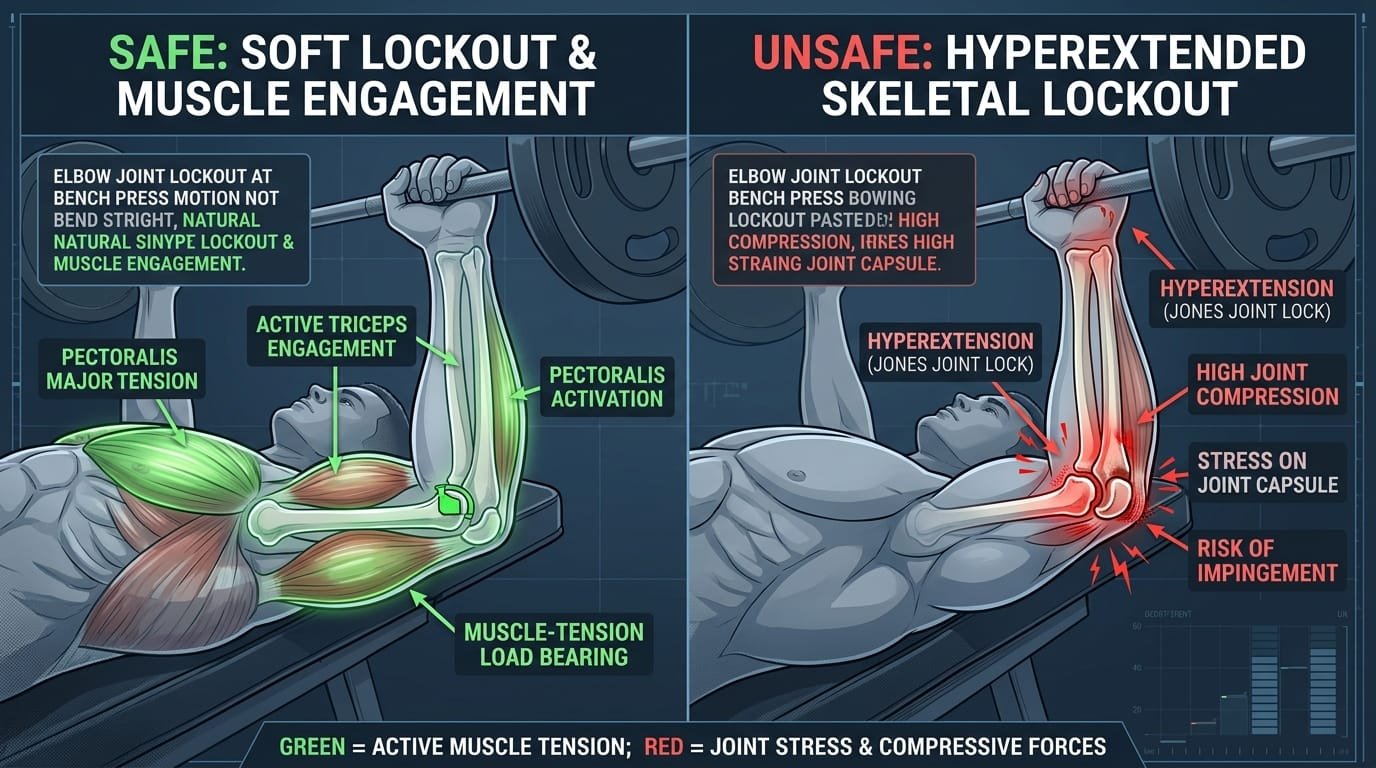
At full elbow extension the joint is in its most stable bony position for axial loading. The olecranon of the ulna seats into the olecranon fossa of the humerus, creating a natural bony stop. When muscular tension is maintained, the triceps, anconeus, and surrounding stabilizers share the load. Passive “resting” on the ligaments is what older safety advice warned against—not the lockout itself.
Research and practical analyses show that the final portion of the press is highly triceps-dominant. Lifters who consistently miss at lockout almost always need targeted triceps strength work. Conversely, lifters who never train the lockout may develop a strength deficit exactly where competition or heavy singles demand it. Detailed breakdowns of muscle contribution and sticking points can be found in Stronger by Science and related biomechanics reviews.
Pros of Locking Out
- Full-range strength development – Trains the triceps and supporting structures through their complete available range.
- Competition specificity – Required for a legal bench press in powerlifting.
- Connective-tissue and bone adaptation – End-range loading under control stimulates positive adaptation.
- Brief recovery between reps – Allows a short pause to reset breathing and tightness on heavy sets.
- Identification of weak points – Reveals whether lockout strength is limiting overall performance.
Cons of Locking Out (and When to Avoid It)
- Reduced constant tension on the pecs – At true lockout the chest contribution drops sharply.
- Potential joint irritation – Lifters with existing elbow issues, hyperextension tendencies, or poor control may experience discomfort.
- Energy expenditure on non-target tissue – On high-rep hypertrophy sets, the final lockout can fatigue the triceps before the chest is fully stimulated.
- Risk of passive resting – If the lifter relaxes completely, stress shifts to ligaments rather than muscle.
For pure chest hypertrophy work, many coaches recommend stopping 1–2 inches short of lockout on most working sets while still locking out the final rep of each set or on heavier strength-focused days. This approach is commonly discussed in hypertrophy-focused coaching content, including material popularized by Renaissance Periodization.
Comparison Table: Lockout vs. Soft Lock
| Factor | Full Lockout | Soft Lock (stop short) |
|---|---|---|
| Primary goal suitability | Strength, powerlifting, full ROM | Hypertrophy, constant tension |
| Triceps involvement | High at end-range | Moderate |
| Pec tension at top | Lower | Higher |
| Joint loading | Bony stability + muscular tension | Continuous muscular tension |
| Competition legality | Required | Not legal |
| Recovery between reps | Easier | Harder (constant tension) |
| Best for | Heavy singles, triples, strength blocks | Higher-rep chest-focused sets |
Practical Recommendations by Goal
Strength / Powerlifting Focus Lock out every rep with control. Maintain tightness; do not sag into the joint. Use board presses, pin presses, and close-grip work to strengthen the specific joint angles near lockout. Programming strategies for lockout strength are covered in detail at PowerliftingTechnique.com.
Hypertrophy / Bodybuilding Focus On most working sets, stop just short of full lockout to keep tension on the pecs. Lock out the final rep of each set or use a separate strength-oriented day where full lockouts are emphasized.
Joint Comfort Issues If full lockout produces sharp elbow pain, reduce range temporarily, strengthen the triceps with extensions and close-grip work, and address any mobility or stability deficits. Soft-tissue work and gradual exposure usually resolve mild irritation.
Step-by-Step Technique for a Clean Lockout
- Lower the bar under control to the chest with elbows at an appropriate angle (generally 45–75° depending on grip and anthropometry).
- Drive the bar up and slightly back toward the face/rack.
- As the elbows approach extension, continue pressing until the arms are straight and the elbows are fully extended.
- Squeeze the triceps and maintain scapular retraction and leg drive—do not relax.
- Pause briefly if desired, then reverse the motion under control.
- Never bounce or hyperextend aggressively.
Programming the Lockout
- Include full-range bench presses in strength blocks.
- Use partial-range overload (boards, pins, or Spoto presses) to target weak lockout ranges.
- Pair with direct triceps work: close-grip bench, overhead extensions, or pushdowns.
- On hypertrophy days, emphasize the lengthened and mid-range positions of the press.
- Monitor elbow recovery; persistent pain is a signal to adjust volume or range.
Integrating Bench Press Work with Supporting Training
A strong lockout benefits from robust triceps and stable shoulders. Use adjustable dumbbells for close-grip and overhead work. Kettlebell floor presses or bottoms-up variations improve stability. Strong grip endurance helps maintain bar control throughout the press.
Core stability from ab roller variations supports the braced torso needed for heavy pressing. Recovery tools such as a budget massage gun can help manage triceps and forearm tension. Light cardio on a manual treadmill or mobility work with resistance bands aids recovery between sessions. Review lateral raise form to ensure balanced shoulder development that supports pressing health.
Common Myths
Myth: Locking out is inherently dangerous. Reality: Passive resting on the joint can be problematic; controlled lockout with muscular tension is not. This distinction is emphasized in older point/counterpoint discussions in strength literature and modern coaching resources.
Myth: You must never lock out for muscle growth. Reality: Full range of motion is generally superior for long-term development. Soft-lock techniques are a useful tool, not a requirement.
Myth: Lockout is only for powerlifters. Reality: Anyone who wants complete pressing strength benefits from training the end range.
Frequently Asked Questions
Does locking out reduce chest activation? At the very top, yes—the pecs contribute less once the elbows are fully extended. That is why many hypertrophy programs use a soft lock on higher-rep sets. See practical explanations in Stronger by Science.
Is it okay to rest at lockout on heavy sets? A brief, controlled pause while staying tight is fine. Completely relaxing and letting the skeleton hang is not recommended.
What if my elbows hurt when I lock out? Reduce range temporarily, strengthen the triceps directly, check grip width and elbow path, and consider professional assessment if pain persists. Lockout-specific training strategies are outlined at PowerliftingTechnique.com.
Should beginners lock out? Yes. Learning full-range movement patterns early builds better long-term strength and coordination.
Do dumbbell presses change the recommendation? Dumbbells allow a more natural path and often feel less stressful at lockout. The same principles apply: full extension with control is generally desirable unless hypertrophy tension is the priority.
Final Recommendation
Lock out your elbows on the bench press when strength, full-range development, or competition performance is the goal. Maintain muscular tension and avoid passive resting on the joint. On pure hypertrophy-focused sets, stopping just short of lockout is a valid strategy to keep constant tension on the pecs. The optimal approach is periodized: emphasize full lockouts in strength blocks and use soft-lock techniques selectively for muscle-building volume.
Master controlled full-range pressing, address any triceps weakness that shows up at lockout, and listen to your joints. When technique is solid and programming matches your goal, the lockout becomes a strength rather than a liability.