Complete Beginner’s Guide to Starting Home Strength Training Safely
Quick Answer
Begin home strength training safely by mastering a small number of fundamental movement patterns with bodyweight or light resistance, prioritising controlled technique over load, starting with 2–3 full-body sessions per week, and progressing gradually through added repetitions, slower tempos, or slightly harder variations. Focus on squat/sit-to-stand, hinge, push, pull, and carry patterns. Keep every repetition pain-free, leave repetitions in reserve, and build consistency before intensity. Safety and long-term progress both come from patience and good form.
Why Start Strength Training at Home
Strength training improves muscle mass, bone density, metabolic health, posture, and the ability to perform everyday tasks. Training at home removes travel time, membership costs, and schedule constraints, making consistency easier for many people. The key is beginning with movements and loads that match current capacity so that confidence and tissue tolerance can develop together. Rushing into heavy or complex exercises is the most common reason beginners become injured or discouraged.
Core Principles for Safe Beginner Progress
- Master movement before adding load – Technique is the foundation.
- Start easier than you think you need – Early success builds adherence.
- Use full pain-free ranges – Never force a position that produces joint pain.
- Progress one variable at a time – Reps, tempo, range, or variation—not everything at once.
- Train the whole body – Full-body sessions 2–3 times per week are ideal for beginners.
- Leave repetitions in reserve – Stop most sets 1–3 reps before failure.
- Recover deliberately – Sleep, protein, and rest days are part of the programme.
Essential Movement Patterns for Beginners
| Pattern | Why It Matters | Beginner-Friendly Options | Common Mistakes to Avoid |
|---|---|---|---|
| Squat / Sit-to-Stand | Rising from chairs, toilets, cars | Bodyweight squat to a box or chair, sit-to-stand | Knees collapsing inward, rounding the lower back |
| Hinge | Picking up objects, posterior-chain strength | Hip hinge with broomstick, glute bridge, Romanian deadlift with light weight | Rounding the spine, turning it into a squat |
| Push | Upper-body strength, pushing movements | Elevated push-up, wall push-up, knee push-up | Flaring elbows excessively, sagging hips |
| Pull | Posture, balanced upper-body strength | Band row, towel row, inverted row under a sturdy table | Shrugging the shoulders, using momentum |
| Carry / Core | Real-world strength and stability | Suitcase carry with a light bag, dead bug, bird dog | Holding the breath, losing neutral spine |
Shoulder-friendly technique is important even for beginners when raising or pressing (Bent Arms vs. Straight Arms in Lateral Raises, The Hidden Mistake in Lateral Raises, and 3 Lateral Raise Modifications). Grip strength develops naturally through rows and carries and can be trained more directly later (Do Hand Grippers Really Work?).
Step-by-Step Guide to Starting Safely
- Obtain medical clearance if needed
Consult a doctor if you have existing health conditions, joint problems, or have been inactive for a long time. - Choose a clear floor space and basic equipment
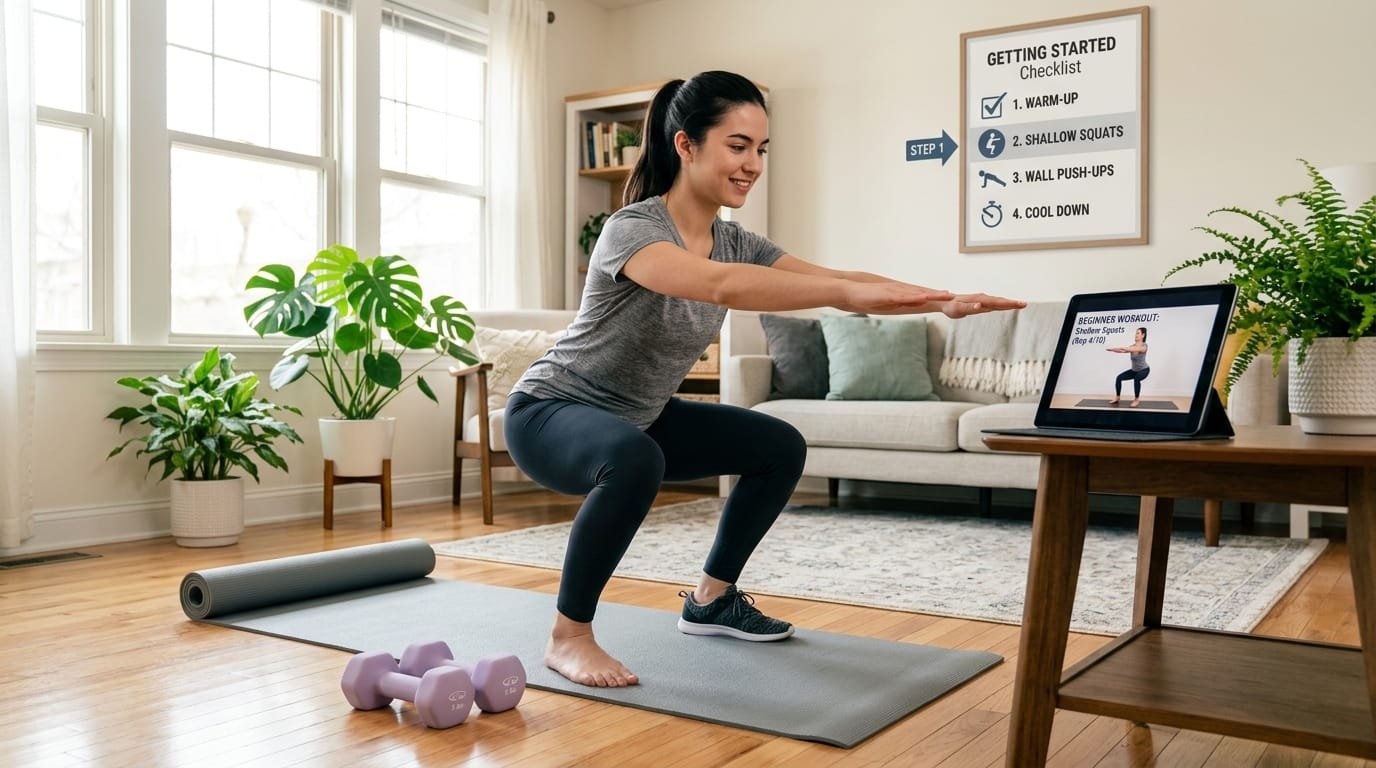
A mat, a resistance band, and optionally a pair of light dumbbells or a backpack are enough to begin. - Learn the five fundamental patterns
Practise each movement slowly with bodyweight or very light resistance until the positions feel stable. - Create a simple full-body workout
Select one exercise from each pattern. Perform 2 sets of 8–12 controlled repetitions. - Schedule 2–3 sessions per week
Leave at least one day between sessions when starting. - Warm up briefly
3–5 minutes of easy movement and the first pattern performed with lighter effort. - Focus on technique every set
Film yourself or use a mirror. Stop the set if form deteriorates. - Progress gradually
When you can complete all sets with good form and 1–3 reps left in reserve, add repetitions or move to a slightly harder variation. - Track sessions
Record exercises, sets, reps, and how the movements felt. - Prioritise recovery
Sleep 7–9 hours, eat adequate protein, and respect rest days.
Sample Beginner Full-Body Workouts
Workout A (Foundation)
- Box squat or sit-to-stand – 2–3 × 8–12
- Glute bridge or hip hinge – 2–3 × 8–12
- Elevated push-up – 2–3 × 8–12
- Band or towel row – 2–3 × 10–15
- Dead bug or bird dog – 2 × 6–8 per side
Workout B (Slight Progression)
- Bodyweight squat or reverse lunge – 3 × 8–12
- Romanian deadlift with light weight or single-leg bridge – 3 × 8–12
- Knee push-up or full push-up from knees – 3 × 8–12
- Single-arm band row – 3 × 10–12 per arm
- Suitcase carry or plank – 2–3 sets
Rest as needed to maintain good form. Total session time is usually 25–40 minutes.
Progression Methods Suitable for Beginners
- Add repetitions within the target range
- Slow the lowering phase (3-second eccentric)
- Increase range of motion once control is solid
- Move from supported to less-supported variations
- Add light external load (dumbbell, household object, or stronger band)
- Reduce rest times slightly once technique is reliable
Change only one variable at a time and only when the current level feels comfortable.
Equipment Recommendations for Absolute Beginners
| Equipment | Priority | Why It Helps | Storage Notes |
|---|---|---|---|
| Exercise mat | High | Comfort and floor protection | Rolls up easily |
| Resistance bands | High | Progressive pulling and assistance | Drawer or bag |
| Light dumbbells or adjustable set | Medium | Load progression for many patterns | Under bed or closet |
| Sturdy chair or box | High | Depth control for squats and support | Already in most homes |
| Backpack | Low–medium | Makeshift load for carries and squats | Everyday item |
Start with what you have. Add equipment only when bodyweight versions become easy.
Common Beginner Mistakes and How to Avoid Them
| Mistake | Risk | Better Approach |
|---|---|---|
| Adding weight too quickly | Form breakdown and injury | Master movement first |
| Training to failure every set | Excess fatigue and poor technique | Leave 1–3 reps in reserve |
| Skipping rest days | Accumulated fatigue | 2–3 sessions per week with recovery between |
| Ignoring joint discomfort | Escalation of irritation | Stay pain-free; regress range or load |
| Copying advanced programmes | Overwhelm and injury | Use simple full-body routines |
| Neglecting pulling movements | Shoulder and posture imbalance | Match or exceed pushing volume with rows |
Safety Guidelines That Prevent Most Problems
- Stay within pain-free ranges at all times.
- Breathe continuously; do not hold your breath excessively.
- Keep the spine neutral during hinges and loaded carries.
- Track knees in line with toes during squats and lunges.
- Stop any set in which technique clearly deteriorates.
- Progress more slowly if joints feel sensitive.
- Seek professional assessment for persistent pain.
Strength training is one of the most effective ways to build resilience and function at any age (strength training guidance). Practical home-gym approaches emphasise starting simple and building sustainable systems (home gym equipment prioritisation and budget home gym principles).
Frequently Asked Questions
How many days per week should a beginner train?
Two to three full-body sessions are ideal. This frequency allows practice of the patterns while providing recovery time.
Do I need equipment to start?
No. Bodyweight versions of the main patterns are effective for the first weeks or months. Bands and light dumbbells expand options later.
How long should each session last?
25–40 minutes is sufficient for beginners when the focus is on quality of movement.
What if I have never exercised before?
Begin with the easiest variations (wall push-ups, chair-supported squats, glute bridges) and shorter sessions. Consistency matters more than difficulty.
Is muscle soreness normal?
Mild soreness is common when starting. Sharp joint pain or soreness that increases across sessions is not. Reduce volume or range if needed.
How fast will I see results?
Strength and confidence often improve within 3–6 weeks. Visible muscle changes take longer and depend on nutrition and consistency.
Should I do cardio as well?
Light walking or cycling on off days supports recovery and general health. It does not need to be intense.
When should I add more advanced exercises?
Only after the basic patterns feel stable and you can complete the target repetitions with good form and repetitions left in reserve.
Final Recommendation
Starting home strength training safely requires mastering a small number of fundamental movement patterns, prioritising technique over load, and progressing gradually. Begin with 2–3 full-body sessions per week using bodyweight or light resistance, keep every repetition controlled and pain-free, and add difficulty only when the current level feels solid. Consistency and good form produce better long-term results than early intensity.
Clear a small training space today, choose one exercise for each main pattern, and perform your first two-set session with full attention to technique. Track the workout, protect your sleep and protein intake, and plan the next session. When beginners start this way, strength training becomes a sustainable, confidence-building practice rather than a source of injury or frustration. Begin simply—the safest progress is also the most lasting.