Garage Gym vs. Spare Bedroom Gym: Space, Noise, and Equipment Priorities
Quick Answer A garage gym generally offers more space, higher noise tolerance, easier heavy equipment access, and greater freedom for dropping weights or dynamic movements, but it often lacks climate control, can suffer from moisture and temperature extremes, and may require more flooring investment. A spare bedroom gym provides climate control, cleanliness, privacy, and convenience, yet faces stricter noise and vibration limits, smaller footprints, and constraints on heavy or impact-based training. Equipment priorities shift accordingly: garages favour power racks, barbells, bumper plates, and durable rubber flooring; spare bedrooms prioritise adjustable dumbbells, foldable benches, resistance bands, quieter tools, and careful floor protection. Choose based on your primary training style, household tolerance for noise, climate needs, and available square footage.
Core Differences at a Glance
| Factor | Garage Gym | Spare Bedroom Gym | Winner for Most Beginners / Intermediates |
|---|---|---|---|
| Usable Floor Space | Often 150–400+ sq ft (1- or 2-car) | Typically 80–150 sq ft | Garage |
| Ceiling Height | Frequently 8–10+ ft | Standard residential (often 8 ft) | Garage (for racks/pull-ups) |
| Noise & Vibration Tolerance | High – isolated from living areas | Low – shared walls/floors/ceilings | Garage |
| Climate Control | Usually poor (hot/cold/humid extremes) | Excellent (existing HVAC) | Spare Bedroom |
| Moisture / Dust | Higher risk | Low | Spare Bedroom |
| Equipment Delivery & Heavy Gear | Easy (driveway access) | Harder (stairs, doorways, floor loading) | Garage |
| Privacy & Convenience | Separate but less convenient in bad weather | High – steps away from living areas | Spare Bedroom |
| Flooring Requirements | Heavy-duty rubber essential | Lighter protection + vibration control | Context-dependent |
| Ideal Training Style | Heavy barbell, strongman, high-impact | Dumbbell, bodyweight, controlled free weights | Depends on goals |
Space Considerations in Detail
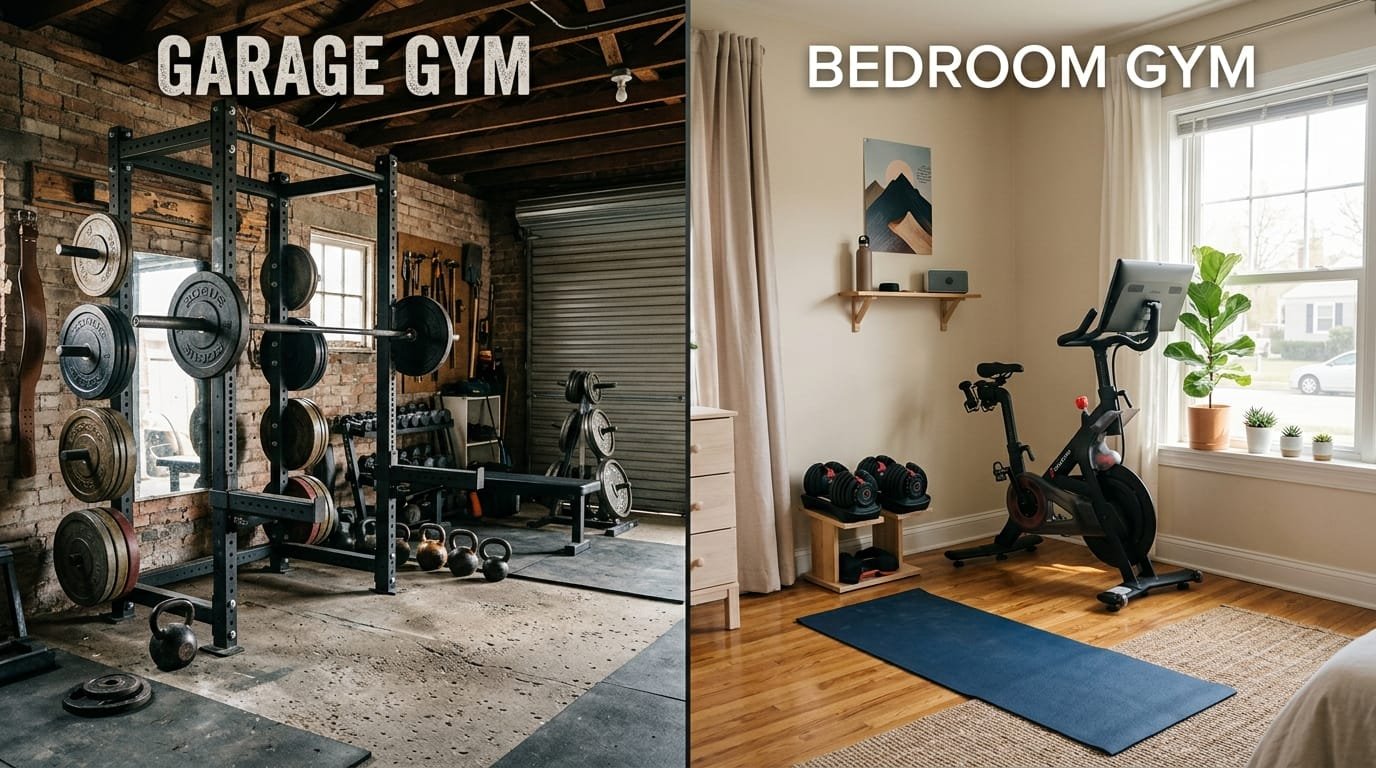
Garage Advantages A single-car garage commonly provides a long rectangular footprint ideal for a power rack, deadlift platform, and clear lanes for carries or sled work. Two-car garages allow multiple stations. Higher ceilings support full-height racks and overhead presses without restriction. Layout flexibility is high — equipment can be arranged against walls while preserving a central training zone.
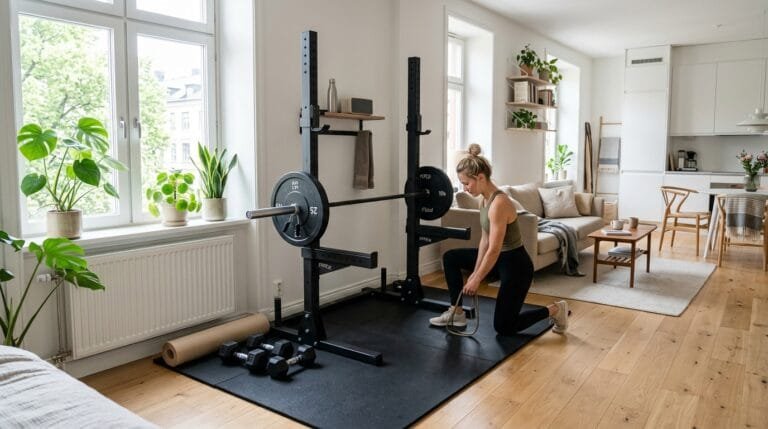
Spare Bedroom Realities Most spare bedrooms measure 10×10 to 12×12 feet. This is sufficient for adjustable dumbbells, a foldable or compact bench, a wall-mounted or folding rack (if ceiling and wall structure allow), and floor work, but tight for a full power cage plus plates and a separate cardio piece. Ceiling height often limits overhead work or tall racks. Multi-use considerations (occasional guest room) further constrain permanent installations.
Measure carefully: note door swings, window locations, closet space, and any low beams or sloping ceilings before purchasing large items.
Noise and Vibration: The Decisive Factor for Many Households
Impact noise (dropped weights, bar collisions) travels through structural framing far more than airborne sound. Garages, being detached or on a concrete slab separated from living spaces, tolerate this far better. Spare bedrooms on upper floors or adjacent to living areas require strict control:
- Controlled eccentrics instead of dropping
- Bumper plates or rubber-coated options where possible
- Thick rubber mats or horse-stall mats under lifting zones
- Avoidance of high-impact plyometrics or Olympic lifting if neighbours or family sleep nearby
Early-morning or late-night sessions are usually more acceptable in a garage. In a spare bedroom, train during normal waking hours and communicate with household members.
Climate, Comfort, and Equipment Longevity
Garages experience wide temperature and humidity swings. This affects both the trainee (motivation drops in extreme heat or cold) and equipment (rust on bars and plates, degraded rubber, electronics issues). Solutions include insulation, a mini-split or portable heater/AC, dehumidifier, and rust prevention for metal.
Spare bedrooms inherit the home’s climate control, remain clean, and protect equipment better. Lighting and aesthetics are also easier to optimise, which can improve consistency for some people.
Equipment Priorities by Space Type
Garage Gym Priority Order
- Durable rubber flooring (¾-inch horse-stall mats or equivalent) – protects the slab and reduces noise/vibration.
- Power rack or sturdy squat stand with safety arms.
- Olympic barbell + 200–300+ lb of plates (bumper preferred for noise and floor protection).
- Adjustable or flat bench.
- Pull-up capability (often built into the rack).
- Optional: adjustable dumbbells, kettlebells, conditioning tools.
Garages excel with heavier free-weight systems. See guidance on related tools such as adjustable dumbbells and kettlebell selection for hybrid setups.
Spare Bedroom Gym Priority Order
- Adjustable dumbbells – maximum variety in minimal footprint.
- Foldable or compact bench.
- Doorway or wall-mounted pull-up bar (lease- and structure-friendly options preferred).
- Resistance bands for assistance, face pulls, and mobility.
- Quality mat or interlocking tiles with good vibration dampening.
- Optional later: compact folding rack, single kettlebell, quiet cardio.
Bedroom setups thrive on multi-use, quieter, and easily stored items. Resistance-band details are covered in our bands guide. Maintain shoulder health with sound technique on pressing and isolation work .
Step-by-Step Decision and Setup Process
- List your primary training goals (heavy barbell strength vs. general hypertrophy and conditioning).
- Measure both potential spaces accurately (floor area, ceiling height, access routes).
- Assess household noise tolerance and schedule.
- Evaluate climate challenges and willingness to invest in insulation/HVAC for a garage.
- Determine budget for flooring and core equipment.
- Choose the space that removes the biggest constraint first (noise, climate, or size).
- Buy flooring and core strength tools appropriate to that space.
- Arrange equipment to preserve clear movement lanes and safety.
- Establish rules for noise, storage, and shared use if applicable.
- Reassess after 3–6 months of consistent training and expand only as needed.
Programming and Technique Considerations by Space
Garage environments support higher-load barbell work, deadlift platforms, and occasional dropping with proper flooring. Bedroom environments favour controlled dumbbell and band work, higher-rep sets, and strict form to minimise noise. In both cases, progressive overload, sufficient protein, and recovery remain the drivers of results. Develop grip strength for better pulling and carrying performance. Core work can progress toward ab-roller variations when stability allows. Low-impact conditioning options such as a manual treadmill or outdoor activity fit either space with different storage implications.
External practical comparisons and layout examples appear in independent resources such as Home Gym Foundry spare-bedroom guidance and broader garage-versus-indoor discussions.
Common Pitfalls
- Forcing a full power-rack setup into a small bedroom and creating noise or space problems.
- Under-investing in garage flooring and damaging the concrete or creating excessive noise.
- Ignoring climate control in a garage and losing training consistency.
- Overloading a spare bedroom floor without proper distribution and matting.
- Buying equipment before confirming access routes (stairs, door widths).
Frequently Asked Questions
Which is better overall – garage or spare bedroom? Neither is universally better. Garages win for space, noise tolerance, and heavy lifting. Spare bedrooms win for comfort, climate, and convenience. Match the space to your goals and household constraints.
Can I do serious strength training in a spare bedroom? Yes, especially with adjustable dumbbells, a bench, pull-up bar, and bands. Heavy barbell work is more limited by noise and space.
How much flooring do I need in each space? Garage: full lifting platform or wall-to-wall heavy rubber. Bedroom: targeted thick mats under key zones plus a general exercise mat.
What about moisture and rust in a garage? Use a dehumidifier, keep equipment wiped down, consider rust-resistant coatings or stainless options, and improve ventilation or insulation where possible.
Is a folding rack viable in a spare bedroom? Yes, if wall structure and ceiling height allow. It maximises floor space when not in use.
Can I combine both spaces? Some households use the garage for heavy sessions and the bedroom for lighter or recovery work. This requires careful equipment allocation.
Final Recommendation
Select the space that best solves your biggest constraint — whether that is noise isolation, climate comfort, available square footage, or ease of heavy-equipment access. For garage gyms, prioritise robust flooring, a power rack or stand, barbell and plates, and durability against temperature swings. For spare bedroom gyms, prioritise adjustable dumbbells, a foldable bench, a pull-up solution, resistance bands, and noise-conscious practices.
Build around the essentials for your chosen environment first, establish consistent training, and only then expand. Both locations can support excellent long-term results when equipment priorities, noise management, and programming align with the physical realities of the space. Measure carefully, invest in appropriate flooring, and choose tools that match how and when you actually train — your home gym will then become a sustainable asset rather than a source of friction.