Common Kettlebell Swing Errors That Stress the Back
Quick Answer
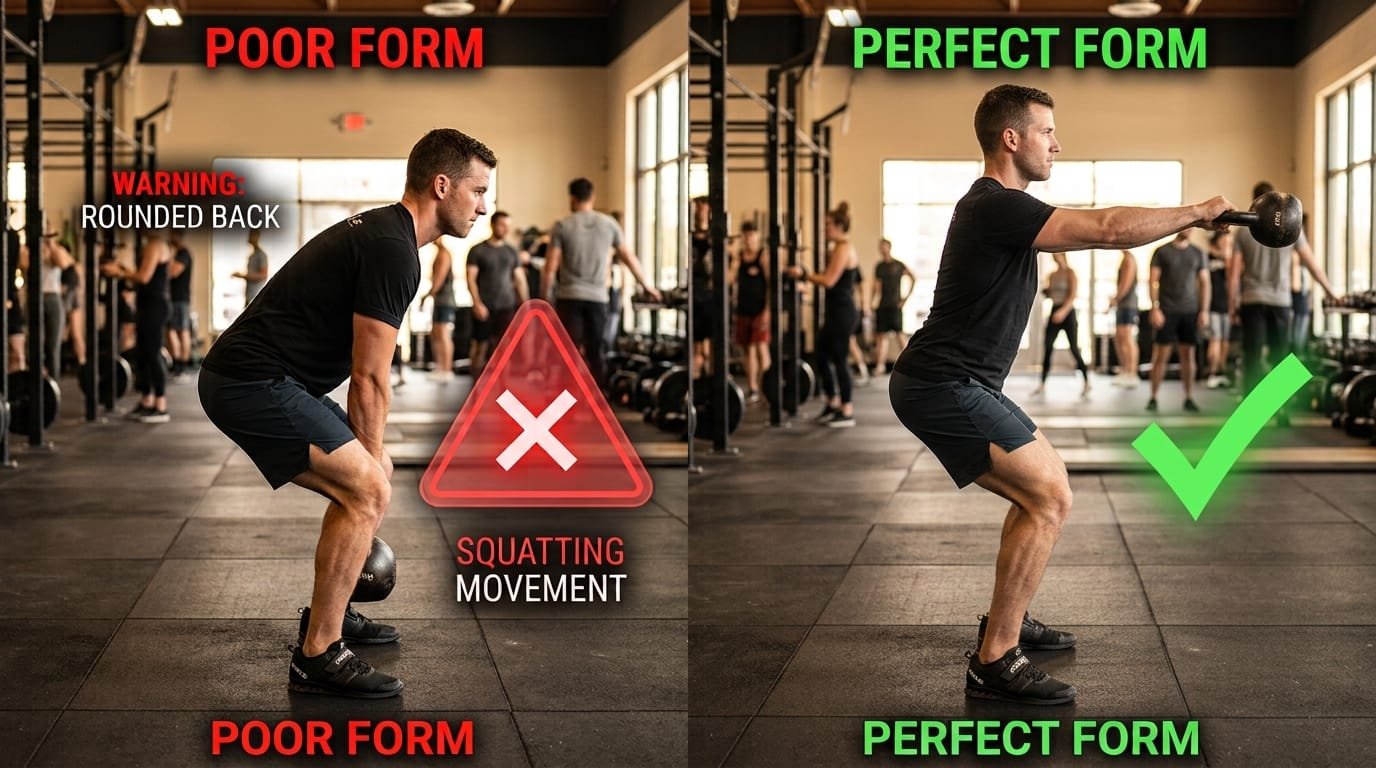
The kettlebell swing stresses the lower back primarily when it is performed as a squat instead of a hip hinge, when the lumbar spine rounds or over-extends, when the bell is lifted with the arms rather than driven by the hips, or when the core loses its brace at any point in the movement. Correct these errors by mastering a powerful hip hinge, keeping a neutral spine, bracing the midsection 360 degrees, and letting the arms stay relaxed while the hips generate the force. When executed properly, the swing trains the posterior chain and can strengthen the back rather than strain it.
Why the Swing Can Become a Back Stressor
The kettlebell swing is a ballistic hip-hinge movement. Force is produced by rapid extension of the hips and then transferred through a braced torso to the bell. When technique breaks down, the lumbar spine is often forced to compensate—either by flexing under load, hyperextending at the top, or absorbing shear forces because the hips are not doing their job. These compensations accumulate quickly because swings are typically performed for higher repetitions.
The good news is that almost every back-stressing error is visible and correctable with focused practice.
Error 1: Turning the Swing into a Squat
What it looks like
The knees bend excessively and travel forward, the hips drop down rather than driving back, and the torso stays more upright.
Why it stresses the back
The movement loses its posterior-chain emphasis. The load is transferred less efficiently and the spine often ends up in a less stable position at the bottom of the rep.
How to fix it
- Think “hips back” rather than “hips down.”
- Keep the shins relatively vertical.
- Hinge until the forearms contact the upper inner thighs, then explode the hips forward.
- Practise pure hip hinges with a dowel or light bell until the pattern is automatic.
Error 2: Rounding the Lower Back at the Bottom
What it looks like
The lumbar spine flexes as the bell swings back between the legs.
Why it stresses the back
Flexion under load places significant stress on the discs and posterior ligaments, especially when repeated at speed.
How to fix it
- Set a neutral spine before the first rep and maintain it.
- Brace the core hard before hinging.
- Shorten the backswing until control improves.
- Film from the side to confirm the lower back stays flat.
Error 3: Over-Extending or Hyperextending at the Top
What it looks like
The lifter leans backward, pushes the hips too far forward, and finishes with an arched lower back and flared ribs.
Why it stresses the back
Repeated end-range lumbar extension under ballistic conditions can irritate the facet joints and surrounding tissues.
How to fix it
- Finish tall with the glutes squeezed and the ribs down.
- Think “stand tall and tight” rather than “lean back.”
- Keep the brace engaged through the top of the movement.
- Reduce the power of the hip drive slightly until the finish position is controlled.
Error 4: Lifting with the Arms and Upper Back
What it looks like
The arms pull the bell upward, the shoulders shrug, and the upper traps dominate.
Why it stresses the back
When the hips do not generate enough force, the spine and shoulder girdle compensate. The lower back often ends up working overtime to stabilise an inefficient pattern.
How to fix it
- Keep the arms relaxed—“arms are ropes.”
- Generate power exclusively from the hip snap.
- The bell should float as a result of hip extension, not arm pull.
- Practise the hike-pass and hip-hinge drills to reinforce the correct sequence.
Error 5: Losing the Brace Mid-Rep
What it looks like
The abdomen softens, the ribs flare, or the torso collapses at some point in the swing.
Why it stresses the back
Without intra-abdominal pressure the spine relies more on passive structures for stability during a rapid, loaded movement.
How to fix it
- Create a strong 360-degree brace before every set.
- Maintain the pressure through both the backswing and the upswing.
- Re-brace quickly between repetitions if performing higher-rep sets.
- Strengthen the bracing skill with dead bugs, bird dogs, and loaded carries.
Error 6: Letting the Bell Pull You Out of Position
What it looks like
The kettlebell swings too far back or too far away from the body, dragging the torso into excessive forward lean or rounding.
Why it stresses the back
An overly long backswing increases the moment arm and makes it harder to maintain neutral spine and tension.
How to fix it
- Keep the bell close—forearms in contact with the thighs at the bottom.
- Hinge only as far as you can control.
- Choose a weight that allows crisp, powerful hip extension without being pulled out of position.
Comparison Table of Errors and Corrections
| Error | Primary Stress on Back | Immediate Cue | Drill to Correct |
|---|---|---|---|
| Squat pattern | Inefficient loading, potential shear | “Hips back, shins vertical” | Dowel hip hinge |
| Lumbar rounding | Disc and ligament stress | “Chest up, spine long” | Short-range swings + side video |
| Hyperextension at top | Facet joint irritation | “Stand tall, ribs down” | Pause at top with glute squeeze |
| Arm pull | Compensatory spinal loading | “Arms are ropes” | Hike-pass practice |
| Lost brace | Reduced spinal stability | “Brace before every rep” | Dead bugs + braced swings |
| Overly long backswing | Increased moment arm | “Bell stays close” | Controlled short-range swings |
Step-by-Step Technique Checklist for a Back-Friendly Swing
- Set the feet roughly shoulder-width, toes slightly out.
- Hinge at the hips and grip the bell with both hands.
- Create a strong 360-degree brace and set the shoulders in a stable pack.
- Hike the bell back between the legs while keeping the spine neutral.
- Drive the feet into the floor and snap the hips forward powerfully.
- Allow the bell to float to roughly chest height; arms stay relaxed.
- At the top, stand tall with glutes tight and ribs down—do not lean back.
- Guide the bell back down by hinging the hips again, maintaining the brace.
- Repeat with consistent rhythm and tension.
- Park the bell safely by hinging and setting it down with control.
Progressions and Regressions for Sensitive Backs
Regressions
- Short-range swings (bell stays higher)
- Two-hand swings with a lighter bell
- Hip-hinge drills with a dowel or light dumbbell
- Dead-stop swings (reset the brace every rep)
Progressions (once technique is solid)
- Heavier two-hand swings
- Single-arm swings (greater rotational demand)
- Higher volume or denser sets
- Hand-to-hand swings
Programming Considerations
- Prioritise technique over load and volume, especially when returning from back sensitivity.
- Film sets regularly from the side.
- Place swings early in the session while fresh, or after thorough warm-up and hinge preparation.
- Balance swing volume with dedicated core stability and posterior-chain strength work.
- Allow adequate recovery between high-volume swing sessions.
Grip strength influences control of the bell, particularly on higher-rep or single-arm variations (Do Hand Grippers Really Work?). Shoulder and upper-back stability also contribute to overall torso rigidity during ballistic movements; controlled lateral-raise patterns that reinforce good scapular mechanics can be useful accessories (Bent Arms vs. Straight Arms in Lateral Raises, The Hidden Mistake in Lateral Raises, and 3 Lateral Raise Modifications).
Supporting Strength and Mobility Work
- Hip-hinge patterning drills
- Core bracing practice (dead bugs, bird dogs, planks, carries)
- Hamstring and glute strength (Romanian deadlifts, hip thrusts)
- Thoracic mobility so the upper back can maintain position
Strength training with good movement quality remains one of the most effective ways to build a resilient posterior chain and back (strength training guidance). Practical home-gym approaches emphasise mastering the hinge before adding ballistic load (home gym equipment prioritisation and budget home gym principles).
Frequently Asked Questions
Can kettlebell swings strengthen the lower back?
Yes. When performed with a neutral spine and powerful hip drive, the swing trains the spinal erectors isometrically and builds the posterior-chain strength that protects the back.
How do I know if I’m hinging correctly?
The hips move back, the shins stay relatively vertical, the spine remains neutral, and you feel the load in the hamstrings and glutes rather than the lower back.
Should I feel my lower back working during swings?
You should feel muscular work in the erectors as stabilisers, but not sharp pain, strain, or fatigue that lingers into the next day.
Is the American swing (overhead) more stressful for the back?
It can be, because it requires greater shoulder mobility and often encourages more lumbar extension at the top. Most people concerned about the back do better with the Russian-style swing to chest height.
How heavy should the bell be when learning?
Light enough that every repetition looks crisp and controlled. Technique first, load second.
Can I do swings if I have a history of lower-back pain?
Many people can once technique is excellent and range is controlled. Individual medical clearance and gradual progression are essential.
What is the most important cue for protecting the back?
“Hips back, spine long, brace hard, arms relaxed.”
Final Recommendation
Most lower-back stress from kettlebell swings comes from a handful of clear technical errors: squatting instead of hinging, losing neutral spine, over-extending at the top, pulling with the arms, or dropping the brace. Correct these by mastering a powerful, controlled hip hinge, keeping the spine neutral, bracing 360 degrees, and letting the hips—not the arms or the lower back—drive the movement.
Film your swings, shorten the range if necessary, and prioritise crisp technique over load or volume. When performed correctly the kettlebell swing becomes a powerful tool for building a strong, resilient posterior chain rather than a source of irritation.
Start with the technique checklist, address the specific errors that show up on video, and build from a foundation of clean, braced hip hinges. The difference in both safety and training effect is usually dramatic once the pattern is locked in.