New Year Equipment Check and Goal Reset for Home Lifters
Quick Answer
A New Year equipment check and goal reset for home lifters combines a thorough inspection of bands, benches, bars, flooring, and accessories with a realistic review of the past year’s training and a simplified plan for the year ahead. Inspect every major item for wear, safety, and function, retire or repair compromised equipment, clarify primary strength or consistency goals, and design a sustainable weekly structure. This dual process removes hidden safety risks and decision fatigue so training starts the year organised, safe, and focused.
Why a Combined Equipment Check and Goal Reset Works
January often brings renewed motivation, but motivation alone does not create results. Two common obstacles derail home lifters early in the year: equipment that has quietly deteriorated and goals that are vague or overly ambitious. A structured equipment audit eliminates safety gaps and forgotten maintenance issues. A concurrent goal reset replaces vague resolutions with a small number of clear, process-based targets. Together they create a clean operational and psychological starting point for the next twelve months.
Core Principles for the New Year Reset
- Safety first – No goal is worth training on compromised equipment.
- Honesty about the past year – Accurate review prevents repeating the same obstacles.
- Fewer, clearer goals – One to three primary targets outperform long wish lists.
- Process over outcome – Consistency and progressive overload are the controllable variables.
- Equipment supports the plan – Only keep or acquire items that serve the stated goals.
- Systems beat motivation – Schedules, checklists, and simple progression rules sustain training when enthusiasm fluctuates.
Part 1: Complete Equipment Check
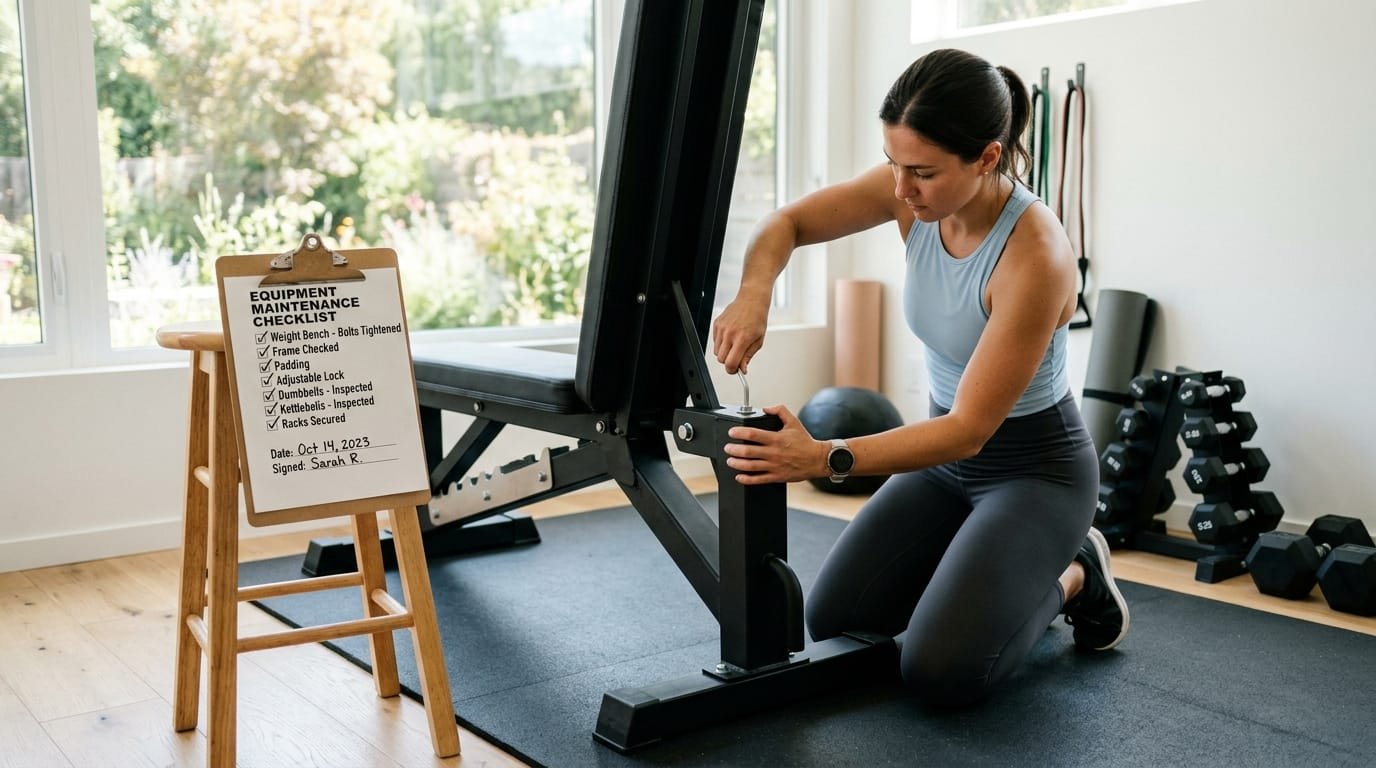
| Equipment Category | Key Inspection Points | Pass Criteria | Fail / Action Criteria |
|---|---|---|---|
| Resistance bands | Fraying, cracks, elasticity, sticky texture | Smooth, even resistance, no visible damage | Any fraying, cracking, or major elasticity loss → replace |
| Bench | Frame integrity, bolt tightness, lock reliability, padding | Stable under load, locks secure, no structural cracks | Wobble, failed locks, cracks → repair or replace |
| Barbell / bars | Straightness, sleeve condition, knurling, hardware | Rolls true, sleeves spin smoothly, hardware secure | Visible bend, cracked sleeves, unsafe knurling → replace |
| Dumbbells & kettlebells | Head security, handle condition, coating | Heads tight, handles intact | Loose heads or major coating failure → address or replace |
| Flooring / mats | Tears, compression, moisture underneath | Stable surface, dry, intact | Major tears or chronic moisture → clean or replace sections |
| Racks / stands | Bolt torque, welds, stability | No movement under load, hardware tight | Instability or structural concerns → professional assessment or replacement |
| Accessories (collars, straps, handles) | Wear, stitching, function | Reliable under intended load | Frayed stitching or failure to secure → replace |
Shoulder-friendly technique and controlled training reduce unnecessary stress on equipment throughout the year (Bent Arms vs. Straight Arms in Lateral Raises, The Hidden Mistake in Lateral Raises, and 3 Lateral Raise Modifications). Grip tools and small accessories should be included in the same audit (Do Hand Grippers Really Work?).
Step-by-Step Equipment Audit Process
- Clear the training floor completely
Remove every item so nothing is overlooked. - Inspect bands under light stretch
Examine the full length for fraying, nicks, or texture changes. - Test the bench thoroughly
Sit, lie, adjust every position, and apply body weight while checking for movement or noise. - Roll and spin every bar
Confirm straightness and sleeve function on a flat surface. - Check all free weights
Confirm heads are secure and handles are intact. - Lift flooring and examine underneath
Look for moisture, mold, or damage to the floor surface. - Tighten every accessible bolt
Benches, racks, and adjustable equipment receive a full hardware pass. - Test safety mechanisms
Collars, adjustable dumbbell locks, and rack safeties must function reliably. - Create a repair-or-replace list
Note every item that fails the criteria and decide the action and timeline. - Restore the organised layout
Return only safe, functional equipment to its assigned storage home.
Part 2: Goal Reset for the Year Ahead
Review the Previous Year Honestly
- Which habits were consistent?
- Where did training break down (time, recovery, motivation, equipment, programming)?
- What measurable progress occurred (strength, consistency, body composition, energy)?
- Which obstacles were environmental versus personal?
Define 1–3 Primary Goals
Effective examples:
- Train full-body 3 times per week for at least 40 weeks of the year
- Add 10–20 kg to a key lift while maintaining good form
- Complete a minimum of 150 total strength sessions
- Reduce joint irritation through better technique and recovery habits
Avoid long lists of unrelated outcomes. Process goals that you control produce better adherence than pure outcome goals.
Design the Weekly Structure
- Choose a realistic frequency (2–4 sessions)
- Select a simple full-body or upper/lower template
- Decide the progression rule in advance (add reps, then load, etc.)
- Schedule deloads every 4–8 weeks
- Identify the minimum viable session for disrupted weeks
Align Equipment with Goals
If the goal is consistent strength training, prioritise reliable bands, a stable bench, and functional free weights. Avoid purchasing new equipment that does not directly serve the stated goals until the core system is running smoothly.
Sample New Year Goal and Program Framework
Primary Goal
Train full-body strength 3 times per week with progressive overload for the majority of the year.
Weekly Template
Session A: Squat/lunge pattern, hinge, horizontal push, horizontal pull, core
Session B: Single-leg emphasis, hinge variation, vertical or incline push, pull variation, carry
Progression Rule
Add repetitions until the top of the range is reached with 1–3 reps in reserve, then increase load and return to the lower end of the range.
Recovery Rules
- 7–9 hours of sleep target
- Protein intake consistent across the day
- Planned deload every 6 weeks
Equipment Priority
Only items that passed the safety audit remain in service. Any replacements are scheduled before volume or intensity increases.
Integrating Equipment Care into the Yearly Plan
- Pre-session inspection remains non-negotiable
- Monthly 10–15 minute maintenance block is scheduled like a training session
- Quarterly deep review coincides with goal progress check-ins
- Replacement budget line is included for bands and any items flagged during the audit
When care is built into the annual system, equipment reliability supports rather than interrupts training.
Common New Year Pitfalls and How to Avoid Them
| Pitfall | Result | Prevention |
|---|---|---|
| Setting too many goals | Diluted focus and early abandonment | Limit to 1–3 primary targets |
| Ignoring equipment issues | Safety risk and mid-year interruption | Complete the audit before increasing training stress |
| Dramatic program overhaul | Unnecessary complexity and decision fatigue | Keep the template simple and familiar |
| All-or-nothing frequency targets | Missed sessions become failed weeks | Define a minimum viable session |
| Buying new equipment immediately | Clutter and distraction | Prove consistency with existing gear first |
| No deload plan | Accumulated fatigue by spring | Schedule deloads in advance |
Quarterly Review Framework
Every three months:
- Re-inspect high-wear items (bands, bench locks, bar condition)
- Review training log for consistency and progressive overload
- Adjust volume or exercise selection if recovery or progress has stalled
- Confirm that storage and organization still support easy session starts
These light reviews keep both equipment and goals on track without requiring another full reset.
Strength training produces reliable long-term results when consistency and progressive overload are protected (strength training guidance). Practical home-gym approaches emphasise systems that remain usable and safe across years (home gym equipment prioritisation and budget home gym principles).
Frequently Asked Questions
How long should the New Year equipment check take?
A thorough audit of a typical home gym usually takes 45–90 minutes. The time is recovered through fewer interruptions later in the year.
What if I find multiple items that need replacement?
Prioritise by safety risk. Bands and any structurally compromised bench or bar come first. Phase remaining replacements over the following weeks.
Should I change my entire program in January?
Only if the previous program had clear, recurring problems. Most lifters benefit more from refining an existing simple template than from a complete overhaul.
How ambitious should strength goals be?
Choose targets that require consistent work but remain achievable with your realistic training frequency and recovery capacity. Process goals (sessions completed, progressive overload applied) are often more effective than pure outcome numbers.
Is a full reset necessary every year?
A full equipment audit and goal review once a year is highly useful. Lighter quarterly check-ins keep the system current between annual resets.
What if motivation is high right now but usually fades?
Build the system around the minimum viable session and pre-scheduled training days rather than relying on peak motivation. Equipment reliability and low decision fatigue support adherence when enthusiasm drops.
Do I need new equipment to make progress this year?
Usually not. Most home lifters can make substantial progress with bands, a stable bench or floor setup, and a modest set of free weights, provided the equipment is safe and the programming is consistent.
How do I handle shared family spaces during the reset?
Include household members in the organization discussion. Clear storage homes and a rapid reset habit keep the space usable for everyone.
Final Recommendation
A New Year equipment check and goal reset gives home lifters a clean, safe, and focused starting point. Conduct a thorough inspection of bands, benches, bars, flooring, and accessories, retire or repair anything that fails safety criteria, then define one to three clear process-based goals and a simple weekly structure that supports them. Align equipment with those goals and embed maintenance habits into the yearly plan.
Clear the training floor this week, complete the equipment audit, write your primary goals and weekly template, and schedule the first month of sessions. When safety issues are removed and the plan is simple enough to execute on ordinary days, the year becomes far more productive. Start the audit now—the combination of reliable equipment and realistic goals creates the conditions for consistent progressive training across the next twelve months.