Best Compact Equipment That Delivers Full-Body Results
Quick Answer
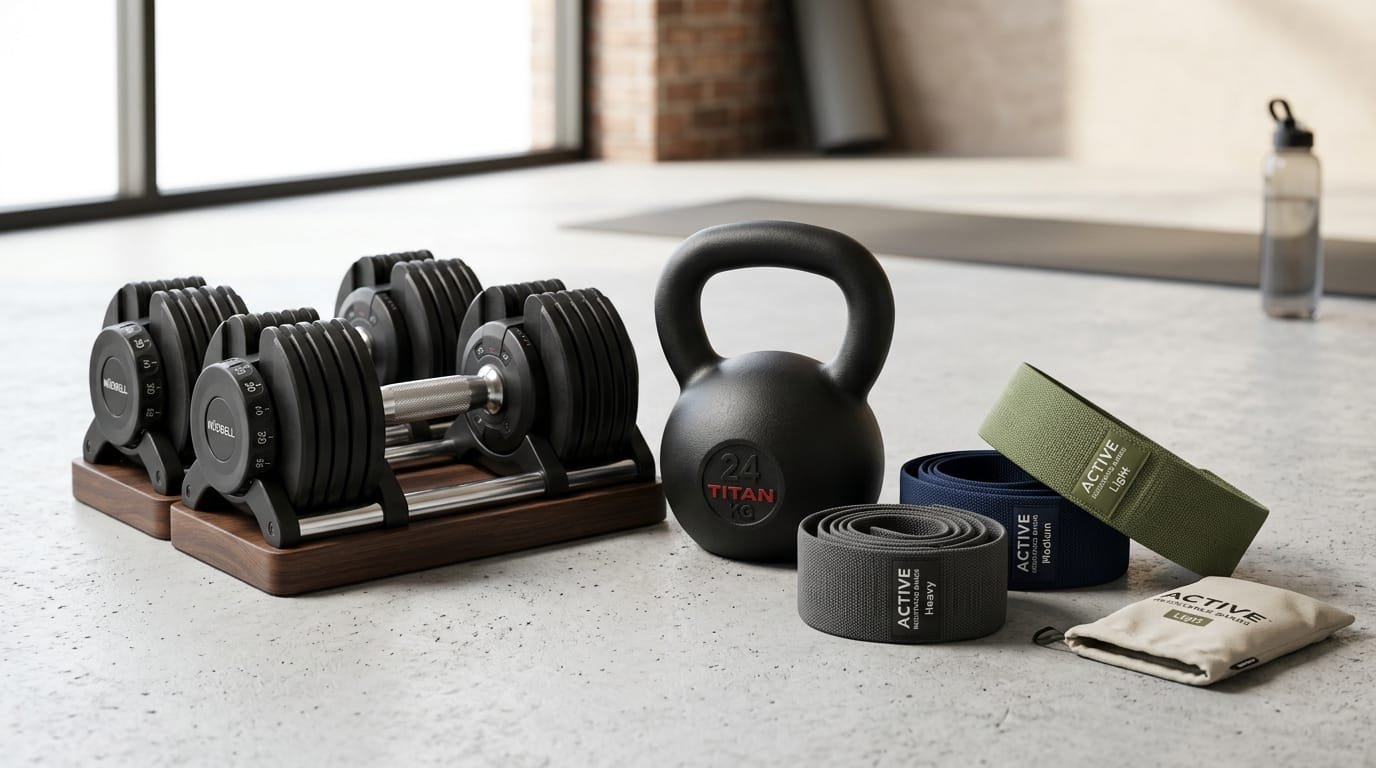
The best compact equipment for full-body results includes adjustable dumbbells, a quality set of resistance bands with door anchor, a suspension trainer, a pair of kettlebells or a single adjustable kettlebell, and a thick rollable mat. These tools cover squat/lunge, hinge, push, pull, and core patterns while storing vertically or under furniture. Progressive overload is achieved through added reps, slower tempos, pauses, unilateral variations, and density rather than constant equipment expansion. With intelligent programming, this minimal toolkit supports long-term strength and muscle gains in even the smallest spaces.
Why Compact Equipment Can Deliver Complete Results
Full-body results do not require a commercial-gym inventory. They require the ability to load the major movement patterns with progressive tension. Compact tools excel when they allow multiple patterns, store easily, and support long-term progression methods. The limiting factor is rarely the equipment itself—it is the programming and consistency applied to it.
Core Selection Criteria for Compact Equipment
- Multi-pattern capability – Each item should contribute to at least two major movement categories.
- Minimal footprint and vertical storage – Must fit under a bed, in a closet, or on a wall.
- Progressive potential – Must allow increases in difficulty without immediate new purchases.
- Quiet operation – Controlled use should not disturb household members or neighbours.
- Durability and safety – Reliable under repeated hard use.
- Setup speed – Ready to train in under two minutes.
Top Compact Equipment Ranked for Full-Body Training
| Equipment | Footprint | Patterns Covered | Progression Methods | Storage Ease | Overall Value |
|---|---|---|---|---|---|
| Adjustable dumbbells | Low–moderate | Squat, hinge, push, pull, carry | Load, tempo, pauses, unilateral | High (under bed or vertical) | Excellent |
| Resistance bands + door anchor | Very low | Squat, hinge, push, pull, core | Band strength, stretch, tempo, density | Excellent | Excellent |
| Suspension trainer | Very low | Pull, core, assisted push/squat | Angle, tempo, unilateral | Excellent | Very high |
| Kettlebell (single or pair) | Low | Hinge, squat, push, carry, conditioning | Load, tempo, complex variations | High | Very high |
| Thick rollable mat | Low | All floor-based work | Comfort and joint protection | High | Essential |
| Optional foldable bench | Moderate | Supported press, hip thrust | Only if storage is solved | Conditional | Situational |
Detailed Equipment Breakdown
Adjustable Dumbbells
One pair replaces an entire rack. They allow goblet squats, Romanian deadlifts, floor presses, single-arm rows, overhead presses, and loaded carries. Progression comes from increasing the load when possible, then from slower eccentrics, pauses, and unilateral work. Choose a set whose weight range matches your current and near-future strength.
Resistance Bands with Door Anchor
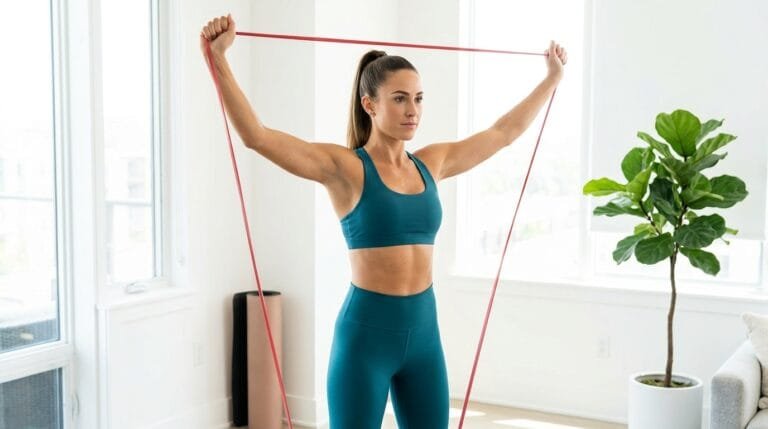
The most space-efficient tool available. Bands handle rows, face pulls, chest presses, squats, good-mornings, pull-aparts, and assisted or resisted push-ups. A door anchor expands exercise options dramatically. Progression is achieved by moving to stronger bands, increasing stretch, slowing tempo, adding pauses, or raising density.
Suspension Trainer
Excellent for inverted rows, face-pull variations, assisted pistol-squat progressions, and core work. Angle adjustment provides a simple progression ladder. It stores in a small bag and requires only a sturdy door or beam.
Kettlebell
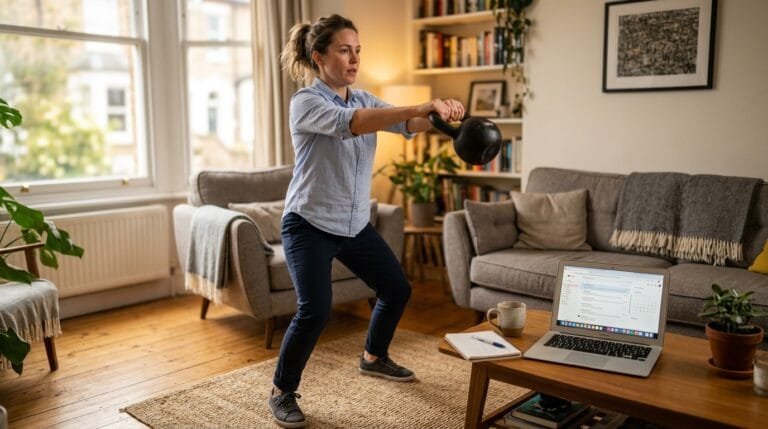
A single moderate-to-heavy kettlebell supports swings, goblet squats, Romanian deadlifts, single-arm presses, rows, and carries. Two kettlebells expand options further but are not required. Controlled tempos and unilateral variations keep progress moving when load increases are limited.
Mat
A thick, rollable mat protects joints and floors and defines the training zone. It should store compactly so the room returns to normal use immediately.
Full-Body Movement Coverage with Compact Tools
Squat / Lunge Pattern
Goblet squat, band-resisted squat, reverse lunge, Bulgarian split squat (rear foot on chair or bed), single-leg sit-to-stand.
Hinge Pattern
Romanian deadlift, single-leg Romanian deadlift, kettlebell swing (controlled), band good-morning, glute bridge variations.
Horizontal Push
Floor press, push-up variations (including band-resisted), single-arm dumbbell press.
Horizontal Pull
Single-arm dumbbell or band row, suspension inverted row, band face pulls and pull-aparts.
Vertical Push / Pull & Core
Overhead press variations, pike push-up progressions, suspension or band pulldown equivalents, planks, dead bugs, suitcase carries.
Shoulder-friendly technique remains critical even with compact equipment (Bent Arms vs. Straight Arms in Lateral Raises, The Hidden Mistake in Lateral Raises, and 3 Lateral Raise Modifications). Grip strength can be trained effectively with the same tools (Do Hand Grippers Really Work?).
Step-by-Step Setup for Compact Full-Body Training
- Measure available storage (under bed, closet, wall, door).
- Select the minimum equipment that covers all major patterns (bands + adjustable dumbbells is the most common high-value combination).
- Assign every item a fixed storage home.
- Create a standard 25–35 minute full-body workout and a 15-minute minimum version.
- Practise setup and teardown until both take under two minutes.
- Install soft flooring that also stores compactly.
- Begin with controlled tempos and moderate loads while refining technique.
- Track sessions and apply one progressive-overload method at a time.
- Reassess equipment every 8–12 weeks; add only what solves a clear limitation.
- Maintain household harmony through quiet technique and rapid put-away.
Sample Compact Full-Body Workouts
Standard 30-Minute Session
- Goblet squat or band squat – 3 × 8–12
- Romanian deadlift or single-leg RDL – 3 × 8–12
- Floor press or push-up variation – 3 × 8–12
- Single-arm row or suspension row – 3 × 8–12 per arm
- Optional carry or core – 2 sets
Minimum Viable 15-Minute Session
- Squat or lunge – 2 sets
- Hinge – 2 sets
- Push – 2 sets
- Pull – 2 sets
Density Circuit
Set a timer for 20–25 minutes. Rotate through the four patterns with controlled repetitions. Track total quality rounds and improve over time.
Progressive Overload Methods for Compact Equipment
- Add repetitions within a target range
- Slow the eccentric phase (3–5 seconds)
- Insert pauses at the hardest point
- Increase range of motion under control
- Move to unilateral or more leveraged variations
- Raise density (more work in less time)
- Progress to stronger bands or the next dumbbell increment when available
These methods allow years of continued results without expanding the equipment footprint.
Storage and Living-Space Integration
- Vertical wall or over-door storage for bands and straps
- Under-bed containers for dumbbells and mats
- Single rolling basket or cart for the entire kit
- Strict teardown routine so the room returns to living use immediately
When storage is solved, the psychological barrier to training drops significantly.
Common Mistakes with Compact Equipment
| Mistake | Result | Better Approach |
|---|---|---|
| Buying too many single-purpose items | Clutter and abandoned gear | Multi-use tools only |
| No progressive plan | Stagnation after initial gains | Systematic tempo, pause, unilateral methods |
| Ignoring storage | Space conflict and reduced adherence | Fixed home for every item |
| Neglecting technique | Joint irritation and noise | Controlled tempos and full range |
| All-or-nothing session length | Skipped workouts | Minimum viable version always ready |
| Expanding equipment too early | Unnecessary cost and footprint | Exhaust non-load progression first |
Strength training with compact, well-chosen tools remains highly effective for building and maintaining muscle and strength (strength training guidance). Practical home-gym approaches emphasise systems that deliver results without dominating living space (home gym equipment prioritisation and budget home gym principles).
Frequently Asked Questions
What is the single best compact purchase for most people?
A quality set of resistance bands with a door anchor, followed closely by a pair of adjustable dumbbells if budget and storage allow.
Can I build significant strength with only bands and bodyweight?
Yes, especially when tempo, pauses, unilateral work, and density are applied systematically. Many people maintain and improve strength for long periods with this combination.
How heavy should adjustable dumbbells be?
Choose a set whose top weight challenges your strongest movements for 6–12 repetitions. You can still progress after reaching the top weight via non-load methods.
Is a kettlebell necessary if I already have dumbbells?
Not necessary, but useful. A single kettlebell adds swing variations and a different loading profile. Prioritise dumbbells and bands first if space is extremely limited.
How do I progress when I can no longer increase the load?
Slow the eccentric, add pauses, move to single-limb versions, increase range of motion, or raise density. These methods remain effective for months or years.
What flooring is best with compact equipment?
A thick rollable mat that protects joints and floors and stores compactly. Interlocking tiles work if they can be put away.
Can this equipment work in a studio apartment?
Yes. The entire recommended toolkit can store under a bed or in a closet and deploy in under two minutes.
How many sessions per week are ideal with compact equipment?
Two to four full-body sessions per week provide an excellent balance of stimulus and recovery for most people.
Final Recommendation
The best compact equipment for full-body results is a focused toolkit: adjustable dumbbells, resistance bands with door anchor, a suspension trainer, an optional kettlebell, and a quality mat. These tools cover every major movement pattern, store vertically or under furniture, and support years of progressive overload through tempo, pauses, unilateral work, and density. Pair the equipment with short full-body sessions, a strict storage routine, and consistent tracking.
Select the minimum effective set that fits your storage constraints today, write a standard and a minimum viable workout, and establish a sub-two-minute setup/teardown process. When equipment is compact, storage is solved, and programming is intelligent, full-body results do not require a large dedicated gym—they require only consistency and progressive tension. Start with the highest-value tools and build the habit; the results will follow