
How to Maintain Strength When Life Gets Busy and You Train Less
Quick Answer
You can maintain most of your strength with surprisingly little training by prioritising intensity over volume, focusing on a few big compound movements, keeping loads heavy (or close to your current best), and training each major pattern at least once every 7–10 days. Two high-quality full-body sessions per week, or even one focused session plus minimal maintenance work, are often enough to preserve strength for weeks or months. Reduce volume first, keep effort high on the sets you do, and return to normal training as soon as life allows.
Why Strength Is More Resilient Than Most People Think
Muscle and neural adaptations that support strength decay more slowly than many expect. Research and practical experience show that trained individuals can maintain strength for several weeks with substantially reduced frequency and volume, provided the intensity (load or effort) remains relatively high. The biggest losses occur when training stops completely or when loads become too light for too long. Strategic minimalism therefore works far better than all-or-nothing thinking.
Core Principles of Strength Maintenance
- Intensity over volume – Keep the weight heavy or the effort high on the sets you perform.
- Minimum effective frequency – Hit each main movement pattern at least once every 7–10 days.
- Compound movements first – Squats or lunges, hinges, horizontal pushes and pulls, and vertical pushes or pulls deliver the most return.
- Accept temporary reductions – Performance may not increase; the goal is preservation.
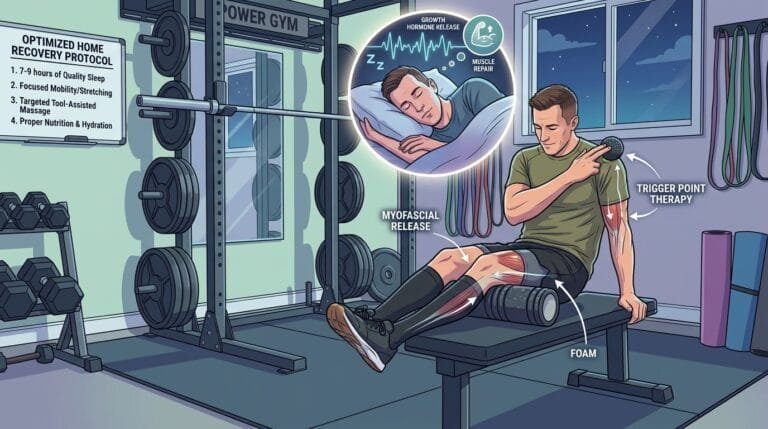
- Protect recovery – Busy periods often coincide with higher stress and less sleep; do not add unnecessary training stress.
Minimum Effective Training Dose
| Goal | Frequency | Volume per Pattern | Intensity Guidance |
|---|---|---|---|
| Maintain strength 2–6 weeks | 1–2 sessions per week | 2–4 hard sets | Near-current loads or high effort |
| Maintain strength 6–12 weeks | 2 sessions per week | 3–6 hard sets | Keep loads within 10–15% of best |
| Maintain with very limited time | 1 full-body session + optional short secondary | 2–3 hard sets per pattern | Prioritise quality and load |
These doses assume previous consistent training. Complete beginners have less reserve and may need slightly more frequent practice.
Practical Session Structures for Busy Periods
Option A – Two Full-Body Sessions (Ideal Minimum)
Session 1 and Session 2 (3–4 days apart)
- Squat or split-squat variation – 3 sets
- Hinge (RDL or swing) – 3 sets
- Horizontal push – 3 sets
- Horizontal pull – 3 sets
- Optional: vertical push or pull, core, or loaded carry – 2 sets
Keep total session time 30–45 minutes by limiting rest and accessory work.
Option B – One Full-Body + One Short Maintenance Session
Main session: as above.
Short session (20 minutes): 2–3 compound movements performed with high quality.
Option C – Single Weekly Session (Short-Term Emergency Mode)
One thorough full-body workout covering the main patterns with 3–4 hard sets each. Strength can often be held for several weeks this way, though it is less robust than two sessions.
Exercise Selection for Maximum Efficiency
Prioritise movements that give the biggest systemic return:
- Lower body: goblet squat, Bulgarian split squat, or Romanian deadlift
- Push: floor press, push-up progression, or overhead press variation
- Pull: single-arm row, inverted row, or band pull
- Optional: kettlebell swing for hinge + conditioning, loaded carries for full-body tension
Shoulder-friendly pressing and raising technique remains important even when volume is low (Bent Arms vs. Straight Arms in Lateral Raises, The Hidden Mistake in Lateral Raises, and 3 Lateral Raise Modifications). Grip strength supports carrying and pulling movements and can be maintained with minimal extra work (Do Hand Grippers Really Work?).
Step-by-Step Plan for Busy Periods
- Identify the realistic number of sessions you can protect each week.
- Choose the minimum effective structure (two full-body, one plus short, or single session).
- Select 4–6 high-return exercises that cover the main patterns.
- Keep loads as close as possible to your recent working weights.
- Perform fewer total sets but take most sets close to technical failure.
- Drop almost all isolation and “extra” work.
- Track the reduced programme so you know exactly what you are maintaining.
- Prioritise sleep and protein as much as circumstances allow.
- Reassess every two weeks and add volume back as soon as life permits.
- Avoid the temptation to make the limited sessions overly complicated or excessively long.
Managing Expectations and Mindset
During busy phases the goal is maintenance, not personal records. Accepting this reduces frustration and makes the reduced programme feel successful. Strength that is deliberately maintained is far easier to build upon later than strength that has been lost through complete inactivity.
Recovery Factors That Become More Important
When training volume drops, recovery variables exert greater influence:
- Sleep quantity and quality
- Protein intake (aim to keep it consistent)
- Overall stress management
- Avoiding the urge to compensate with excessive conditioning or new stressors
A short, hard training session followed by poor sleep and low protein will not maintain strength as effectively as the same session supported by decent recovery.
Transitioning Back to Normal Training
When schedule and energy improve:
- Add volume before intensity.
- Reintroduce accessory work gradually.
- Expect a short period of mild soreness.
- Use the first 1–2 weeks as a bridge rather than an immediate push for new maximums.
Most people regain any minor losses quickly once regular training resumes.
Programming Examples for Different Time Constraints
Very busy (one session per week)
Full-body: squat/hinge, push, pull, carry – 3–4 sets each, focus on load and quality.
Busy (two sessions per week)
Full-body A and B with slight exercise variation, 3 sets per main movement.
Moderately busy (two sessions + optional short work)
Two full-body sessions plus one 15–20 minute session of carries, swings, or core + grip.
Common Mistakes During Busy Periods
| Mistake | Result | Better Approach |
|---|---|---|
| Stopping training completely | Faster strength loss | Keep minimum effective dose |
| Keeping high volume with low intensity | Little maintenance effect | Reduce volume, keep intensity |
| Changing exercises too frequently | Harder to gauge maintenance | Stick to familiar movements |
| Neglecting sleep and protein | Reduced ability to maintain gains | Protect recovery basics |
| Adding intense new conditioning | Extra fatigue without strength benefit | Keep extra work minimal |
| Expecting continued progress | Frustration | Redefine success as maintenance |
Strength training remains one of the most effective ways to preserve muscle and function even with reduced frequency (strength training guidance). Practical home-gym approaches emphasise efficient, sustainable systems that survive real life (home gym equipment prioritisation and budget home gym principles).
Frequently Asked Questions
How long can I maintain strength with only one or two sessions per week?
Most trained individuals can maintain the majority of their strength for 4–8 weeks or longer with one to two focused sessions, provided intensity stays high.
Should I reduce the weight as well as the volume?
Ideally keep the weight as close as possible to normal working loads. If necessary, drop only slightly while maintaining high effort.
Is it better to train full-body or keep a split when time is limited?
Full-body sessions are usually more efficient for maintenance because each pattern is hit more frequently.
Can I maintain strength with only bodyweight exercises?
Yes for moderate periods, especially if you progress leverage, tempo, or unilateral difficulty. Heavy compound loading is more robust for longer maintenance.
What about cardio or step count during busy times?
Light daily movement supports recovery and health. Avoid adding intense conditioning that compromises strength sessions or sleep.
Should I use a deload protocol or just reduce frequency?
Reducing frequency and volume while keeping intensity is the practical approach during busy life periods. Formal deloads can be used if fatigue is already high.
How quickly does strength return after a busy period?
Most people regain any small losses within 1–3 weeks of resumed regular training.
Is grip training worth keeping when time is short?
A few sets of carries or dedicated grip work once a week is often enough and supports other lifts.
Final Recommendation
Strength is highly maintainable when life becomes busy, provided you switch from a progress-focused mindset to a preservation mindset. Reduce volume first, keep intensity high on a small number of compound movements, and train each major pattern at least once every 7–10 days. Two efficient full-body sessions per week (or even one quality session in the short term) can hold the majority of your hard-earned strength for weeks or months.
Protect sleep and protein as much as possible, track the reduced programme, and return to normal volume as soon as circumstances allow. The goal during these periods is not to improve—it is to avoid unnecessary loss so that progress can resume smoothly later.
Design your minimum effective schedule today, choose the exercises that give the biggest return, and commit to consistent execution even when time is limited. Maintaining strength through busy seasons is one of the most valuable skills a long-term trainee can develop.