Tracking Progress at Home Without a Coach or Fancy App
Quick Answer
You can track progress effectively at home with nothing more than a notebook, a simple notes app, or a basic spreadsheet and consistent habits. Record the exercise, weight or variation, sets, repetitions, tempo, rest, and a short note on form or how the set felt. Review the log weekly, aim for clear progressive overload (more reps, slower tempo, harder variation, or more load), and use occasional photos, measurements, or performance tests for additional feedback. Simple, consistent tracking outperforms complex systems that are abandoned.
Why Tracking Matters More at Home
Without a coach watching or the social accountability of a gym, it is easy to repeat the same workouts indefinitely and lose sight of progress. A written record turns subjective feelings into objective data. It shows whether you are actually applying progressive overload, reveals patterns in recovery, and provides motivation when the mirror or scale is slow to change. The best tracking system is the one you will use consistently for months.
Essential Variables to Record
| Variable | Why It Matters | Simple Way to Log |
|---|---|---|
| Exercise name | Identifies the movement | Write the full name or a clear abbreviation |
| Load or variation | Measures intensity | Weight, band colour, or bodyweight progression (e.g., “feet-elevated”) |
| Sets and reps | Core volume data | 3 × 10, 3 × 11, etc. |
| Tempo or pauses | Captures non-load progression | “4-sec eccentric” or “2-sec pause” |
| Rest periods | Tracks density | Approximate seconds or “shorter than last time” |
| Form / RPE note | Quality and effort | Short phrase: “clean”, “last rep grind”, “elbows flared” |
| How you felt | Recovery context | “Good energy”, “shoulders tight”, “slept poorly” |
These few columns already give a complete picture of progressive overload.
Low-Tech Tracking Tools That Work
1. Paper notebook
Fast, no battery, always available. Use one page per session or a simple table format. Many people find handwriting improves retention and commitment.
2. Notes app on your phone
Create a dedicated folder or note. Use a consistent template so entries stay uniform. Searchable and always with you.
3. Basic spreadsheet (Google Sheets or Excel)
Allows easy sorting, weekly summaries, and simple charts if desired. Still free and does not require specialised fitness apps.
4. Whiteboard or wall calendar
Useful for high-level weekly volume or habit tracking (sessions completed). Less detailed for individual sets.
Choose one primary method and stick with it. Switching systems frequently destroys continuity.
Step-by-Step Tracking System
- Decide on your logging tool and create a simple template.
- Record every working set during or immediately after the session.
- Include the key variables listed above—especially any non-load progression methods.
- At the end of each week, spend five minutes reviewing the log.
- Ask: Did I improve at least one variable on my main lifts?
- Plan the next week’s targets based on what the log shows.
- Every 4 weeks, compare photos, measurements, or a repeated performance test (e.g., max clean push-ups or time on a plank).
- Every 8–12 weeks, step back and evaluate overall trends in strength, technique, and recovery.
- Adjust exercise selection or volume if progress has stalled despite consistent effort.
- Keep the system simple enough that it never feels like a burden.
Tracking Non-Load Progression (Critical for Home Training)
When heavier weights are limited, the log must capture the other progressive-overload methods:
- Added repetitions
- Slower tempo
- Added pauses
- Reduced rest (density)
- Increased range of motion
- Harder variation or unilateral version
Write these clearly. “3 × 12, 3-sec eccentric” or “moved to archer push-ups” is far more useful than simply writing the same weight again.
Tracking Technique and Joint Health
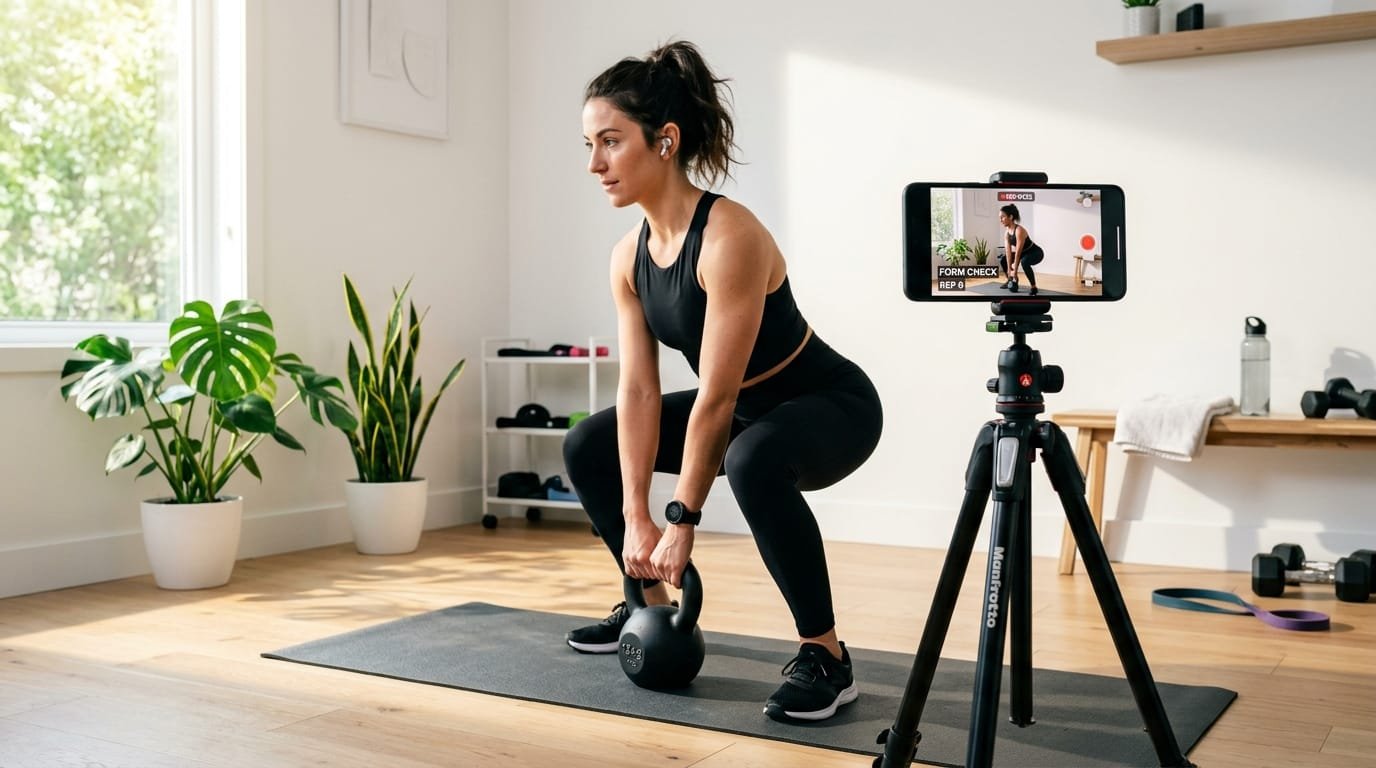
Form quality determines whether progress is sustainable. Periodically film key lifts from the side and front. Note any recurring issues (elbow flare, loss of brace, rounded back, etc.). Short comments in the log such as “elbows better today” or “kept brace solid” create a technique record over time. Shoulder-friendly mechanics on raising and pressing patterns are especially worth monitoring (Bent Arms vs. Straight Arms in Lateral Raises, The Hidden Mistake in Lateral Raises, and 3 Lateral Raise Modifications). Grip strength can also be tracked with simple tests or dedicated work (Do Hand Grippers Really Work?).
Supplementary Progress Markers
Performance tests (every 4–6 weeks)
- Maximum clean push-ups or inverted rows in one set
- Time to complete a fixed number of quality repetitions
- Longest plank or dead-hang
Body measurements
Waist, hips, chest, arms, thighs—taken under the same conditions.
Progress photos
Same lighting, same poses, every 4 weeks. More reliable than daily mirror checks.
Subjective markers
Energy, sleep quality, joint comfort, and motivation. These often explain plateaus that numbers alone cannot.
Sample Log Entry (Notebook or Notes App)
Date: 16 Sept 2026
Floor press – 22.5 kg DBs – 3 × 11, 3 × 11, 3 × 10 (3-sec lower) – clean, good lockout
Bulgarian split squat – bodyweight – 3 × 10/leg, paused – balance better
Band face pulls – strong band – 3 × 15 – focused on external rotation
Felt: good energy, shoulders warm after warm-up
Next target: 3 × 12 on floor press or add pause
This level of detail takes less than two minutes and provides clear direction for the next session.
Common Tracking Mistakes
| Mistake | Consequence | Solution |
|---|---|---|
| Logging only weight and reps | Misses non-load progress | Include tempo, variation, and notes |
| Waiting until the end of the week to record | Forgotten details | Log during or right after the session |
| Changing systems every month | Broken continuity | Pick one method and stay with it |
| Tracking too many variables | Overwhelm and abandonment | Stick to the essential columns |
| Never reviewing the log | Data without insight | Weekly 5-minute review |
| Focusing only on the scale | Misses strength and technique gains | Combine performance, measurements, and photos |
Programming and Review Rhythm
- Daily/session: record the work
- Weekly: review and set targets
- Monthly: photos, measurements, or performance tests
- Every 8–12 weeks: broader programme evaluation
This rhythm keeps tracking useful without becoming a chore.
Strength training with consistent progressive overload remains one of the most reliable ways to build muscle and strength (strength training guidance). Practical home-gym approaches emphasise simple systems that support long-term adherence (home gym equipment prioritisation and budget home gym principles).
Frequently Asked Questions
Do I really need to track if I train consistently?
Yes. Consistency without progressive overload produces diminishing returns. Tracking makes overload visible and deliberate.
Is a paper notebook better than a phone app?
Whichever you will use consistently is best. Many people prefer paper for simplicity and fewer distractions.
How detailed should form notes be?
Short and specific. “Kept elbows at 45°” or “lost brace on last rep” is enough.
Should I track warm-up sets?
Usually not necessary. Focus on working sets unless a warm-up change is relevant to performance.
What if I miss logging a session?
Record it as soon as possible from memory, then resume the habit. Do not abandon the system over one missed entry.
Can tracking help prevent injury?
Yes. Patterns of joint discomfort, form breakdown, or excessive fatigue often appear in the log before they become serious.
How long before tracking shows clear progress?
Most people see useful trends within 2–4 weeks of consistent logging.
Is it worth tracking bodyweight exercises the same way?
Absolutely. Note the variation, tempo, pauses, and repetitions exactly as you would with weights.
Final Recommendation
Effective progress tracking at home requires neither a coach nor sophisticated apps. A simple notebook, notes app, or spreadsheet, used consistently, captures everything needed to apply progressive overload and make informed decisions. Record the exercise, load or variation, sets, reps, tempo, and a brief quality note. Review weekly, test performance monthly, and adjust based on the data.
Start your next session with a blank page or note already prepared. Log the work while it is fresh, review it at the end of the week, and let the numbers guide the following sessions. Over time this modest habit becomes one of the most powerful tools for continuous improvement in a home-training environment. The simplest system you actually use will always outperform the perfect system you abandon.