Power Rack vs Squat Stand: Which Solves Safety Concerns for Solo Lifters?
Quick Answer
For solo lifters, a power rack (power cage) generally solves safety concerns more completely than a squat stand because it provides four uprights, fully enclosed safety bars or straps, and the ability to fail a lift without needing to dump the bar outside the structure. A squat stand is lighter, more space-efficient, and less expensive, but it usually offers only two uprights and limited safety-arm options, leaving greater risk if a lift goes wrong. Choose a power rack when maximum safety for heavy barbell squats and bench presses is the priority; choose a quality squat stand when space, budget, or portability constraints are tighter and loads remain moderate.
Why Safety Is Different When You Train Alone
In a commercial gym a spotter or the presence of others provides a backup. At home you are responsible for every failed repetition. The primary risks for solo barbell training are:
- Getting pinned under a squat
- Failing a bench press with no way to escape
- Losing control of the bar on the way up or down
- Equipment tipping or shifting under uneven loads
The equipment itself must supply the safety net. This single requirement changes the comparison between power racks and squat stands.
Clear Definitions
Power Rack (Power Cage)
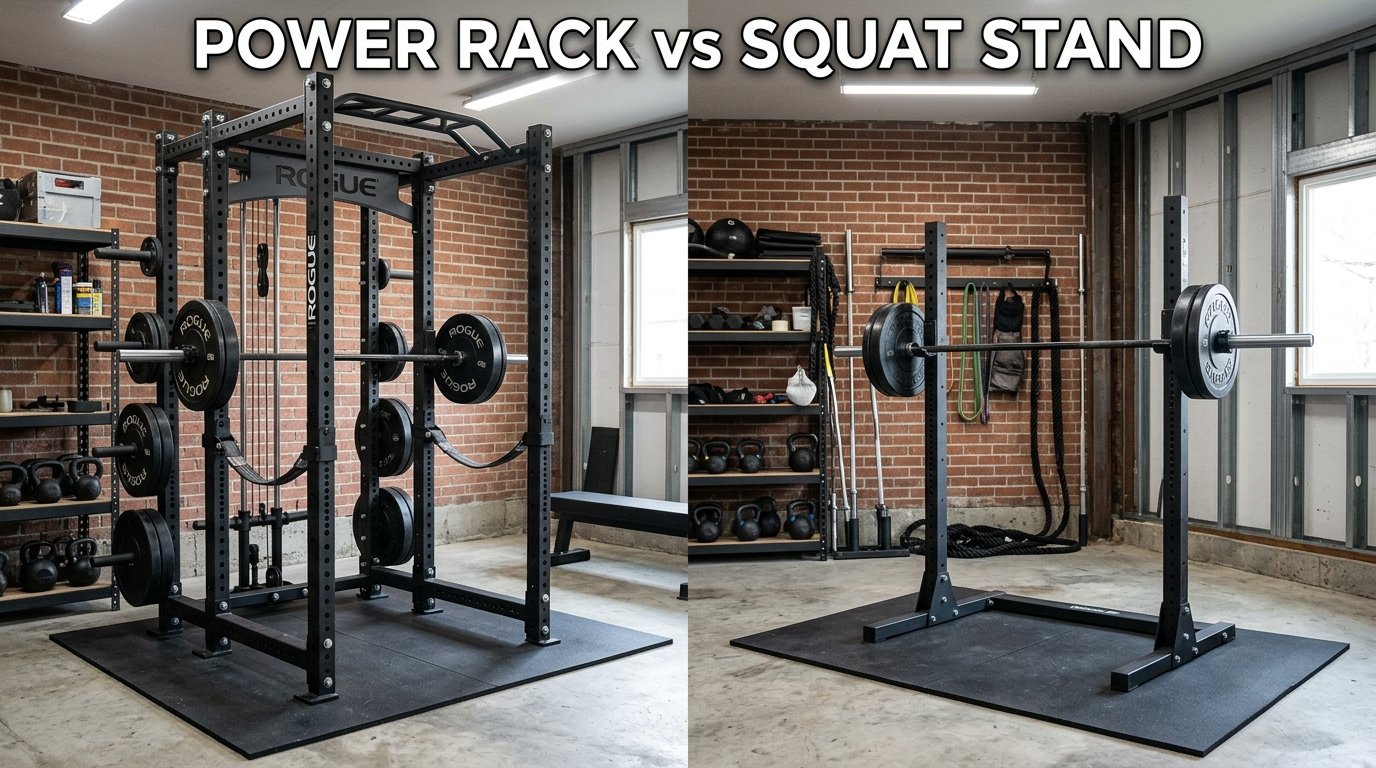
A four-post structure that surrounds the lifter. Safety bars, straps, or pins run between the uprights so the bar can be set down at any point in the range of motion. The lifter stays inside the rack for both squats and bench presses.
Squat Stand (or Pair of Squat Stands)
Two independent or lightly connected uprights that hold the bar at the start of the lift. Safety arms may extend forward, but the lifter is not enclosed. If the lift fails, the bar must often be dumped forward or sideways.
Direct Safety Comparison for Solo Lifters
| Safety Factor | Power Rack | Squat Stand | Winner for Solo Safety |
|---|---|---|---|
| Failed squat protection | Excellent – bar catches on side safeties | Moderate – depends on arm length and position | Power Rack |
| Failed bench press protection | Excellent – bar catches inside the rack | Limited – arms may not reach or may tip | Power Rack |
| Ability to “fail safely” without dumping | High | Lower | Power Rack |
| Stability under uneven loads | High (four posts) | Moderate to High (depends on design) | Power Rack |
| Risk of equipment tipping | Very Low | Higher if not bolted or weighted | Power Rack |
| Ease of setting precise safety height | High | Moderate | Power Rack |
| Space required | Larger footprint | Smaller footprint | Squat Stand |
| Cost | Higher | Lower | Squat Stand |
| Portability / storage | Low | Higher | Squat Stand |
For pure safety when training alone, the power rack holds a clear advantage.
How a Power Rack Protects Solo Lifters
- Enclosed design – The bar remains within the four uprights.
- Adjustable safety bars or straps – Set just below the lowest point of the lift. If you fail, the bar lands on the safeties and you can crawl out.
- Bench press integration – The same safeties protect the bench press when the bench is placed inside the rack.
- Pull-up and accessory options – Many racks include pull-up bars and attachment points, increasing utility without extra safety risk.
- Bolting or weighting options – Most racks can be bolted to the floor or loaded with weight plates on the base for extreme stability.
These features create a closed safety system that does not rely on perfect dumping technique or external help.
How a Squat Stand Handles Safety (and Where It Falls Short)
Modern squat stands often include:
- Forward-facing safety arms
- Crossmembers for added stability
- Weight-horn storage that lowers the centre of gravity
- The ability to bolt the stands to the floor
These features improve safety considerably over basic uprights. However, limitations remain:
- Safety arms are usually shorter and only protect in one direction.
- On bench press the arms may not extend far enough or may require the bench to be positioned precisely.
- A missed squat can still force the lifter to dump the bar backward or sideways.
- Independent stands can shift if not properly secured.
For moderate loads and experienced lifters who have practiced dumping the bar, a well-designed squat stand can be acceptable. For heavier loading or less experienced solo lifters, the margin of safety is smaller.
Space, Budget, and Practical Trade-Offs
Space
A power rack typically needs a footprint of roughly 4 ft × 4 ft plus clearance for loading plates and walking around. A squat stand can fit into a narrower area and is easier to move or store.
Budget
Quality squat stands cost significantly less than comparable power racks. The savings can be directed toward a better barbell, plates, or flooring.
Other Considerations
- Ceiling height: both require enough vertical clearance for overhead work and standing the bar up.
- Flooring: both benefit from proper rubber flooring, but a rack’s greater weight makes floor protection more important.
- Future expansion: racks usually accept more attachments (cable systems, dip bars, etc.).
Practical home-gym resources consistently note that the safest solo barbell setup is a rack with properly set safeties, while squat stands serve well when space or budget is the binding constraint (home gym equipment prioritisation and budget home gym build principles).
Decision Framework for Solo Lifters
Ask these questions in order:
- Do I plan to squat and bench press with a barbell at loads that approach or exceed bodyweight? → Lean strongly toward a power rack.
- Is floor space extremely limited or must the equipment be moved regularly? → A squat stand may be the only realistic option.
- Is the budget tight after buying a bar and plates? → A quality squat stand can provide an acceptable safety compromise.
- Will I primarily use dumbbells and kettlebells with only occasional barbell work? → A squat stand (or even a sturdy rack alternative) may suffice.
- Do I value the ability to fail a lift and stay safe without dumping the bar? → Power rack.
Step-by-Step Guide to Choosing and Setting Up Safely
- Measure available floor space and ceiling height.
- Determine maximum expected loads for squat and bench within the next 12–24 months.
- Decide the maximum budget for the rack or stand.
- Shortlist models that meet capacity and safety-arm requirements.
- Verify that safety bars or arms can be set at the correct height for your body and the lifts you perform.
- Plan flooring and, if necessary, bolting or weighting of the base.
- On first assembly, practice setting safeties and performing controlled failures with an empty bar.
- Start with conservative loads until the movement pattern and safety setup feel automatic.
- Inspect bolts, welds, and safety attachments monthly.
- Re-evaluate after six months whether the chosen setup still matches your loading and space needs.
Additional Safety Practices That Apply to Both
- Always set safeties at the correct height before loading the bar.
- Use collars every set.
- Learn how to fail a squat and a bench press deliberately with light loads.
- Keep the area around the equipment clear.
- Never train heavy barbell lifts when excessively fatigued or distracted.
- Maintain good overall technique so the bar path stays predictable. Shoulder-friendly pressing technique reduces secondary risks (Bent Arms vs. Straight Arms in Lateral Raises, The Hidden Mistake in Lateral Raises, and 3 Lateral Raise Modifications). Grip strength also influences bar control on heavy pulls and carries (Do Hand Grippers Really Work?).
Strength training itself remains highly effective for building and maintaining muscle and resilience when performed safely (strength training guidance).
Frequently Asked Questions
Is a squat stand ever safe enough for solo heavy squatting?
Yes for moderate loads and experienced lifters who have practiced dumping the bar and who use stands with long, sturdy safety arms. For maximal or near-maximal loading, a power rack is safer.
Can I bench press safely in a squat stand?
Only if the safety arms extend far enough and are set correctly. Many lifters find the setup less secure than benching inside a power rack.
Do I need to bolt a power rack to the floor?
Not always, but bolting or loading the base with plates increases stability, especially on lighter racks or when performing dynamic movements.
What is the minimum ceiling height required?
Most racks and stands need at least 7.5–8 feet for comfortable standing presses and racking the bar. Measure your ceiling and the height of the uprights.
Can a half-rack solve the same safety problems?
A half-rack offers a partial compromise: more stability than a squat stand and less footprint than a full cage, but safety coverage is still not as complete as a four-sided power rack.
How important are safety straps versus solid safety bars?
Both work. Straps absorb some impact and are quieter; solid bars are more rigid. Choose based on preference and the specific model’s design quality.
Should beginners start with a squat stand?
Beginners often benefit more from the psychological and practical safety of a power rack, provided space and budget allow. Confidence to train hard increases when failure is not dangerous.
Final Recommendation
For solo lifters whose primary concern is safety on barbell squats and bench presses, a power rack provides the more complete solution. Its enclosed design and reliable safety bars or straps allow true fail-safe training without relying on perfect dumping technique. A squat stand remains a valid, space-efficient, and budget-friendly option when loads are moderate, space is tightly constrained, or the equipment must remain portable.
Measure your space, estimate future loads, and decide which constraint—safety margin, footprint, or cost—is non-negotiable. Once the equipment is chosen, set the safeties correctly, practice failure with light loads, and maintain the hardware. Pair the setup with sound technique on accessory movements and consistent progressive training.
Choose the option that lets you train hard with confidence rather than hesitation. A correctly selected and properly used power rack or squat stand removes the largest safety barrier to productive solo barbell training at home. Make the decision based on your actual space, budget, and loading plans, then commit to using the safety features every session.