Holiday Season Workouts That Use Common Household and Gym Gear
Quick Answer
Holiday season workouts remain effective when built around common household items (chairs, backpacks, water jugs, towels, stairs) combined with basic gym gear you already own (dumbbells, kettlebells, resistance bands, or a mat). Short, full-body sessions of 20–40 minutes that cover squats, hinges, pushes, pulls, and carries preserve strength, conditioning, and mental well-being despite disrupted schedules. Prioritise consistency over perfection, keep the programme flexible for travel and social events, and use progressive options only when energy allows. This practical approach maintains results through the busiest time of year and makes the return to normal training in January far smoother.
Why Holiday Training Requires a Different Strategy
The holiday period reliably disrupts routines. Travel, family gatherings, richer meals, late nights, and elevated stress make high-volume or highly specific gym programmes difficult to sustain. Attempting to force a normal training schedule often produces missed sessions, guilt, and eventual abandonment.
A more successful approach accepts the constraints and designs training that fits real life: short sessions, minimal equipment, full-body focus, and an emphasis on showing up rather than optimising every variable. The objective is maintenance of strength, muscle, work capacity, and the training habit itself so that January begins from a position of continuity rather than a full restart. Practical strength-training guidance consistently supports the value of consistent, compound-focused movement even when conditions are imperfect (strength training principles).
The Five Movement Patterns That Matter Most
Every productive holiday workout should address these fundamental patterns:
- Squat / knee-dominant
- Hinge / hip-dominant
- Upper-body push
- Upper-body pull
- Carry or core anti-movement
These patterns can be trained effectively with almost any combination of household objects and basic gym tools. Mastering this short list removes the need for complicated exercise selection during a hectic season.
Household Items That Function as Training Tools
| Household Item | Best Uses | Example Exercises |
|---|---|---|
| Sturdy chair or couch | Squats, step-ups, dips, elevated push-ups | Chair squats, Bulgarian split-squat holds, bench dips |
| Backpack | Loading for squats, hinges, and carries | Backpack goblet squat, backpack RDL, farmer carry |
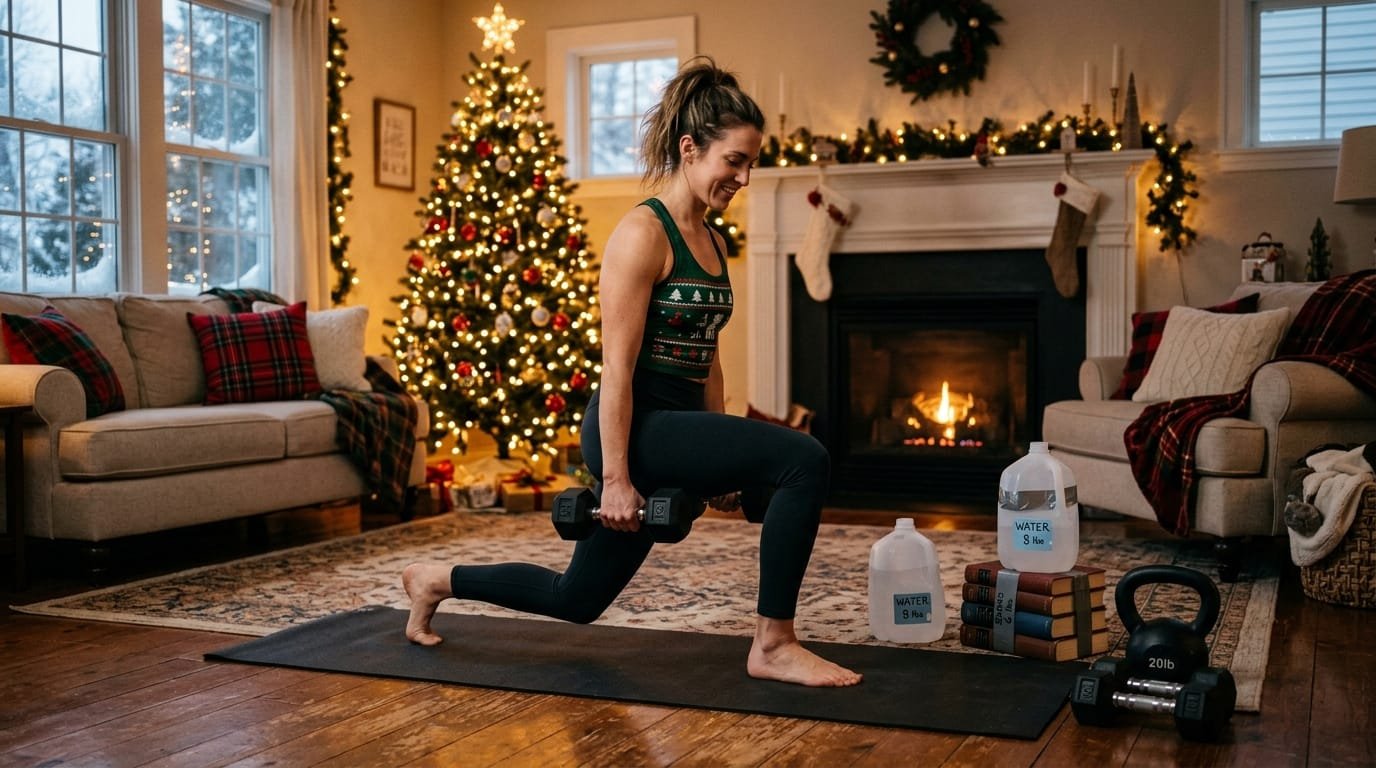
| Water jugs, milk bottles, detergent containers | Dumbbell substitutes | Overhead press, rows, lunges, loaded carries |
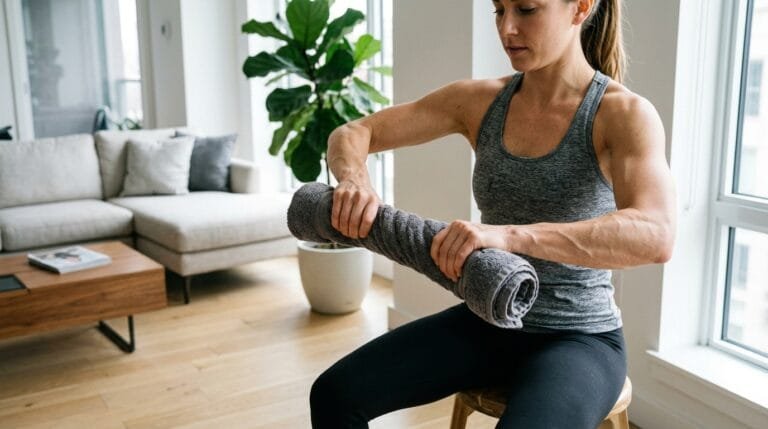
| Towel | Sliding work, isometric rows, grip | Towel rows around a post, towel slides, isometric holds |
| Stairs or a solid step | Strength + conditioning | Step-ups, elevated push-ups, stair climbs |
| Wall | Support and isometrics | Wall sits, wall push-ups, supported balances |
| Heavy books, bags, or suitcases | Additional loading | Goblet-style holds, suitcase carries |
These items cost nothing extra and are available in almost every home or hotel room.
Basic Gym Gear Worth Using When Available
- One kettlebell or a pair of dumbbells
- Resistance bands (extremely travel-friendly)
- Exercise mat
- Optional jump rope
When both household items and basic gym gear are present, mix them freely for greater variety and progressive options. Home-gym equipment principles favour versatile, multi-use tools that support the main compound patterns (home gym equipment prioritisation).
Ready-to-Use Holiday Workout Templates
Template A – 25-Minute Household Full-Body
- Chair or backpack goblet squat – 3 sets of 10–15
- Backpack or jug Romanian deadlift – 3 sets of 8–12
- Elevated or regular push-up – 3 sets of 8–15
- Towel or band row – 3 sets of 10–12 per side
- Suitcase carry (backpack or jug) – 3 sets of 30–40 seconds
Template B – Kettlebell + Band Session (30–35 Minutes)
- Kettlebell swing or goblet squat – 4 sets of 10–15
- Single-arm kettlebell row – 3 sets of 8–12 per side
- Band or kettlebell floor press – 3 sets of 8–12
- Band pull-apart – 3 sets of 15–25
- Farmer carry – 3 sets of 30–45 seconds
Template C – Bodyweight + Household Circuit (20–30 Minutes)
Complete 3–5 rounds of:
- 15 chair squats
- 10–12 backpack RDLs
- 10–15 push-ups (elevate hands if needed)
- 12 towel or band rows per side
- 30-second wall sit or plank
Rest 45–75 seconds between rounds.
Template D – Travel / Hotel Room Special
- Suitcase or backpack goblet squat
- Single-leg RDL (bodyweight or water bottles)
- Push-up variation
- Towel or doorway row
- Marching, stair climbing, or jumping jacks for conditioning
How to Progress When Time and Energy Allow
- Add repetitions or an extra round
- Slow the lowering phase of each repetition
- Shorten rest periods
- Increase load (heavier backpack, stronger band, larger jug)
- Advance to single-leg or single-arm versions
- Finish with a short swing, mountain-climber, or stair-climb finisher
Progress is optional during the holidays. Maintaining the habit is the primary win.
Shoulder Health and Grip Considerations
Irregular sleep and higher stress can increase tension around the neck and shoulders. Keep all raising and pressing movements controlled and within comfortable ranges. Technique details for lateral raises—including arm position and common errors—are covered in Bent Arms vs. Straight Arms in Lateral Raises, The Hidden Mistake in Lateral Raises, and 3 Lateral Raise Modifications.
Awkward household loads often challenge grip more than gym implements. Simple grip work and carries help maintain capacity (Do Hand Grippers Really Work?).
Realistic Weekly Scheduling During the Holidays
| Situation | Suggested Approach |
|---|---|
| Normal week at home | 3–4 full-body sessions of 25–40 minutes |
| Heavy social calendar | 2–3 shorter sessions + daily walking |
| Travel week | 2–3 hotel-room or bodyweight-based sessions |
| Very low energy or poor sleep | 15–20 minute movement snacks or longer walks |
| Immediate post-holiday period | Resume normal programme with a lighter first week |
Frequency of movement matters more than the perfection of any single session. Practical home-training resources emphasise sustainable frequency over heroic volume (practical home gym programming principles).
Step-by-Step System for Holiday Consistency
- Identify the exact equipment available each week (home, hotel, family house).
- Select one primary template as the default.
- Place sessions in the calendar at times that are realistic given social plans.
- Prepare a small travel kit (bands, towel, jump rope) if leaving home.
- Focus on the five movement patterns rather than specific exercise names.
- Track sessions with a simple yes/no or short note.
- Walk daily whenever possible—it supports recovery, digestion, and calorie balance.
- Protect sleep to the extent the social calendar allows.
- Release guilt about imperfect sessions; consistency beats intensity in this phase.
- Plan a gentle re-entry week in early January rather than an aggressive restart.
Nutrition and Recovery Context for the Season
Holiday workouts deliver the best return when paired with realistic expectations around food and recovery. Maintain protein intake at each meal, stay hydrated, and accept that some higher-calorie meals are part of the season. Training itself helps regulate stress, energy, and appetite even when scale weight fluctuates temporarily. Strength training remains one of the most effective tools for preserving muscle and metabolic health during periods of dietary variation (strength training evidence).
Common Holiday Training Mistakes and Corrections
| Mistake | Consequence | Better Approach |
|---|---|---|
| Trying to run a normal high-volume programme | Missed sessions and frustration | Switch to short full-body templates |
| All-or-nothing mindset | Complete loss of weekly momentum | Treat any session as a win |
| Neglecting daily walking | Lower energy and poorer recovery | Walk after meals or during social time |
| Poor form with awkward loads | Joint irritation | Reduce load and prioritise control |
| Skipping warm-ups because time is short | Higher stiffness or minor injury risk | Use a 3-minute mini warm-up |
| Returning in January with excessive volume | Soreness and potential setback | Begin with a lighter re-entry week |
Frequently Asked Questions
How many workouts per week are realistic during the holidays?
Two to four short full-body sessions plus daily walking is achievable for most people and sufficient for maintenance.
What if I only have bodyweight and a suitcase?
That combination is enough. Use the suitcase for goblet squats, Romanian deadlifts, and carries, and perform push-ups, towel rows, and lunges.
Can strength be maintained with shorter sessions?
Yes. Compound movements performed with reasonable effort preserve strength effectively for several weeks.
Should fat loss still be a goal during the holiday season?
Most people succeed by aiming to maintain rather than aggressively lose fat. Focus on consistency, protein, and daily movement.
Is morning or evening training better during the holidays?
The best time is the one you can protect most reliably. Morning sessions often survive social plans more successfully.
How should travel across time zones be handled?
Prioritise sleep first. Insert short movement sessions when energy allows. Walking remains especially valuable.
What is the smartest way to restart training in January?
Begin with a light-to-moderate week using the same movement patterns, then gradually return to normal volume and intensity.
Do I need any specialised holiday programme?
No. The templates above cover the essential patterns with whatever equipment is available.
Final Recommendation
Holiday season training succeeds when it is simple, flexible, and built around the fundamental movement patterns. Combine common household items with any basic gym gear you can access, keep sessions in the 20–40 minute range, and prioritise showing up over perfection.
Use chairs, backpacks, water jugs, towels, and stairs alongside kettlebells, dumbbells, or bands. Protect shoulder health with controlled technique, maintain grip capacity through carries, and walk as much as the schedule permits. Schedule realistic sessions, track them simply, and treat the period as habit protection and maintenance rather than peak performance.
When January arrives you will be glad the training stimulus never fully stopped. Choose one of the templates, adapt it to the equipment available this week, and complete the first session. Consistency through the holidays is one of the highest-leverage actions you can take for long-term progress. Start with whatever you have today—the cumulative effect of these practical, shorter workouts will carry you into the new year in a noticeably stronger position.