Progressive Overload at Home Without Adding New Weights Every Month
Quick Answer
Progressive overload at home is entirely achievable without constantly purchasing heavier weights. You can create continuous training stress by increasing repetitions, slowing tempo (especially the eccentric phase), adding pauses, reducing rest periods, expanding range of motion, advancing to harder exercise variations, using unilateral loading, increasing time under tension, or adding sets. These methods raise mechanical tension, metabolic stress, and motor-control demands even when the external load remains fixed. Consistent application of these strategies produces steady strength and muscle gains with minimal equipment.
Why Progressive Overload Matters More Than Equipment
Progressive overload—the gradual increase of training stress over time—is the fundamental driver of strength and hypertrophy. In a well-equipped commercial gym it is easy to add plates. At home, particularly with fixed dumbbells, a single kettlebell, or resistance bands, the same principle must be applied through intelligent programming rather than heavier iron.
Multiple progression variables exist beyond load. Volume, density, range of motion, tempo, and exercise difficulty are all powerful tools. When manipulated systematically, they allow months or years of measurable progress without requiring new weights every training cycle. This approach is supported by practical strength-training resources that emphasise multiple overload methods beyond simply adding weight (progressive overload principles).
The Complete Set of Home Progression Levers
| Progression Method | How It Increases Difficulty | Best Applied When | Practical Example |
|---|---|---|---|
| Increase repetitions | Higher total volume and fatigue | You complete the top of your current rep range with solid form | Move from 3×8 to 3×12 |
| Slow the eccentric | Greater time under tension and control demand | Technique is reliable and you want more stimulus | 3-second lowering phase on every rep |
| Add pauses | Removes stretch-reflex assistance and increases tension | You need harder work at the same load | 2-second pause at the bottom of a squat or row |
| Reduce rest periods | Higher training density and metabolic stress | Work capacity and conditioning are priorities | Drop rest from 90 seconds to 60 seconds |
| Increase range of motion | More muscle lengthening and work per repetition | Mobility and control safely allow it | Deeper goblet squat or deficit Romanian deadlift |
| Harder exercise variation | Greater stability, leverage, or range demand | Bilateral lifts feel manageable | Switch from goblet squat to Bulgarian split squat |
| Unilateral loading | Effectively doubles relative load per limb + balance demand | You own only moderate weights | Single-arm row or single-leg Romanian deadlift |
| Add sets | Higher total weekly volume | Recovery capacity supports extra work | Move from 3 sets to 4 sets |
| Cluster or rest-pause sets | More high-quality repetitions at a given load | Strength focus with limited external weight | Rest-pause sets to accumulate challenging reps |
Detailed Progression Strategies Explained
1. Repetition Progression
This is the simplest and most under-utilised method. Once you reach the top of your target rep range (for example 12 repetitions) with clean technique on all sets, either add weight if available or continue increasing reps until a new range becomes challenging. Many home trainees make six to twelve months of progress simply by moving from 8 to 15 controlled repetitions on the same weights.
2. Tempo Manipulation
Slowing the eccentric (lowering) phase substantially increases time under tension and forces greater muscular control. A tempo such as 3-1-2-0 (3 seconds down, 1-second pause, 2 seconds up, no pause at the top) can transform a moderate weight into a significantly harder stimulus. This remains one of the highest-return methods when external load is fixed.
3. Pause Repetitions
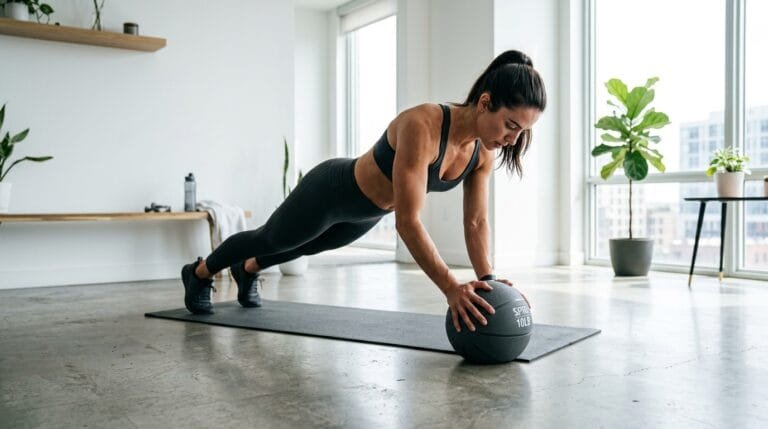
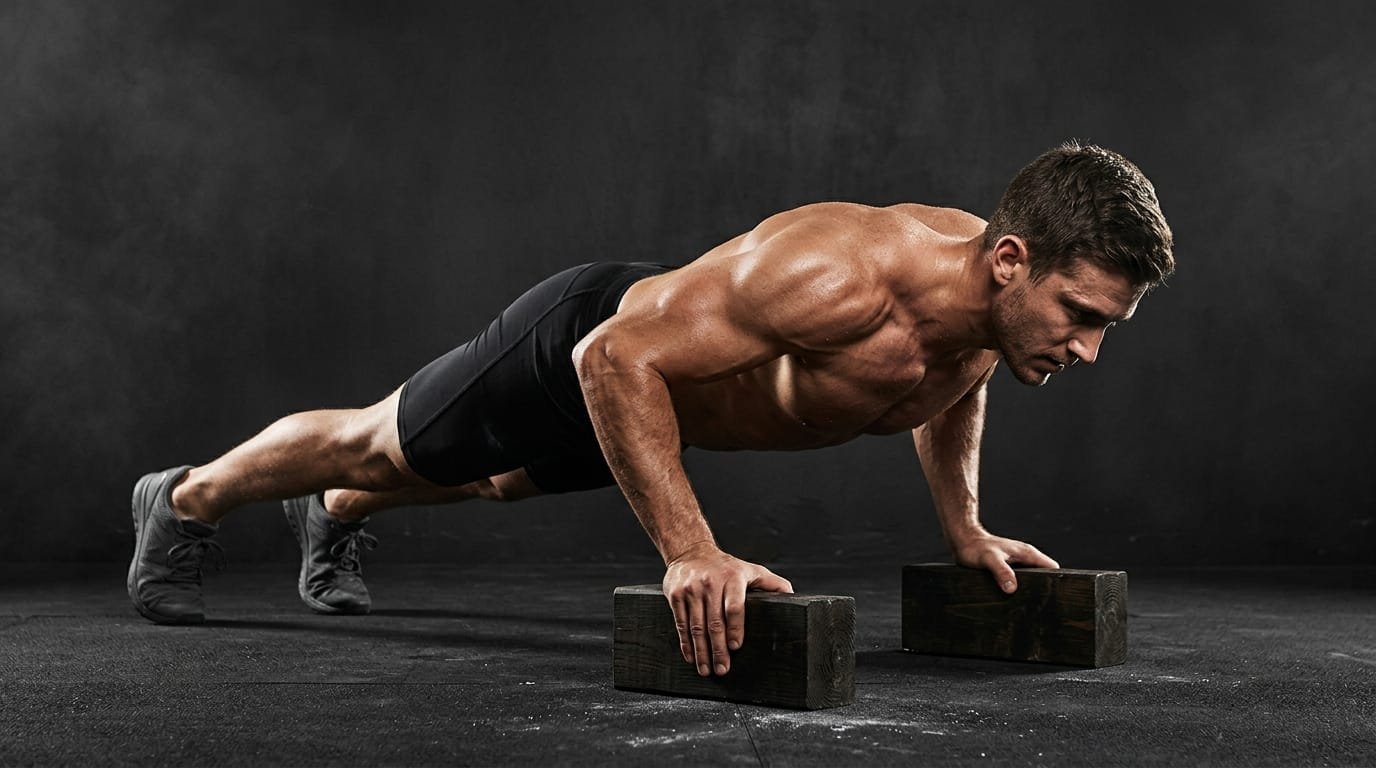
Inserting a deliberate pause at the most difficult point of the lift eliminates momentum and requires the muscles to generate force from a dead stop. Paused goblet squats, paused push-ups, paused rows, and paused Romanian deadlifts are exceptionally effective home progressions.
4. Reduced Rest Intervals
Shortening rest periods raises training density and metabolic stress. This approach works particularly well for hypertrophy and conditioning goals. Track rest times precisely and reduce them gradually (10–15 seconds every one to two weeks) while maintaining performance quality.
5. Range-of-Motion Expansion
Performing a deeper squat, achieving a greater stretch in a hinge, or completing a fuller pull-up increases mechanical work per repetition. Expand range only when mobility and control allow it without pain or technical breakdown.
6. Exercise Variation Ladder
Systematically move from easier to harder versions of the same movement pattern:
- Push-up → feet-elevated push-up → archer push-up or uneven push-up
- Goblet squat → Bulgarian split squat → shrimp squat progressions
- Inverted row → feet-elevated inverted row → single-arm row
- Glute bridge → single-leg glute bridge → shoulder-elevated single-leg hip thrust
7. Unilateral Training
Single-leg and single-arm work effectively doubles the relative load on each limb while simultaneously increasing balance and core demand. This is one of the most powerful tools available when you own only moderate dumbbells or a single kettlebell.
8. Additional Sets and Density Techniques
Adding a fourth set or employing rest-pause and cluster sets increases total volume without requiring heavier external loads. These methods are especially useful once basic rep and tempo progressions begin to plateau.
Sample Multi-Month Progression Using Fixed Weights
Assume access to a pair of 20 kg dumbbells and a 16 kg kettlebell.
Phase 1 (Weeks 1–4)
Goblet Squat 3×8–10
Romanian Deadlift 3×8–10
Push-Up 3×10–12
Single-Arm Row 3×10–12 per side
Phase 2 (Weeks 5–8)
Goblet Squat 3×10–12 with 3-second eccentric
Romanian Deadlift 3×8–10 with 2-second pause at the bottom
Feet-Elevated Push-Up 3×8–10
Single-Arm Row 3×10–12 with slower tempo
Phase 3 (Weeks 9–12)
Bulgarian Split Squat 3×8–10 per leg
Single-Leg Romanian Deadlift 3×8 per leg
Archer or uneven Push-Up progression 3×6–8 per side
Single-Arm Row 3×8–10 with pause at full contraction
Continue cycling and combining these methods. Progress remains available for many additional months.
Step-by-Step Implementation System
- Select a small number of high-value compound movements (squat, hinge, push, pull).
- Establish a clear baseline of controlled sets and repetitions with your current weights.
- Choose one primary progression method for the next 2–4 weeks.
- Record every session in detail (load, reps, tempo, rest intervals, variation used).
- When the chosen method becomes manageable, introduce the next progression lever.
- Schedule a deload (reduced volume or intensity) every 4–8 weeks.
- Re-evaluate exercise variations every 8–12 weeks.
- Prioritise technical mastery and full available range of motion before adding difficulty.
- Combine multiple methods only after you have applied them successfully in isolation.
- Remain patient—progress is cumulative and often non-linear.
Applying These Methods Across Common Home Tools
These progression strategies transfer directly to every major home-training implement:
- Lateral raises and shoulder work can be advanced through tempo, pauses, and angle adjustments while adhering to safe technique (safe lateral-raise guidance and shoulder health routine).
- Kettlebell swings, goblet squats, and carries respond extremely well to denser sets, higher repetitions, and unilateral variations (kettlebell sizing guide).
- Grip strength progresses via longer hangs, thicker grips, towel variations, or slower tempos (grip strength guidance).
- Resistance bands advance through stronger band tensions, slower tempos, and increased range of motion (Resistance Bands Buying Guide).
- Core training progresses through longer levers, pauses, and tools such as the ab roller.
- Conditioning can be advanced by increasing density, incline, or work-to-rest ratios on a treadmill (manual treadmill guidance).
Recovery becomes even more important when difficulty rises without added external load (Best Post-Workout Recovery Tools, Best Massage Gun for Post-Workout Recovery on a Budget, and Sleep and Recovery Strategies). Accurate tracking is the only reliable way to confirm that progressive overload is occurring (Best Ways to Track Progress Without a Gym or Personal Trainer).
External training resources confirm that non-load progression methods—tempo, pauses, unilateral work, and advanced variations—effectively drive long-term strength and hypertrophy when applied consistently (strength training progression methods).
Common Mistakes That Stall Progress
- Adding difficulty too rapidly and sacrificing technical quality
- Changing several variables simultaneously so cause-and-effect becomes unclear
- Failing to record sessions in detail
- Jumping to advanced variations before mastering fundamental patterns
- Neglecting recovery while steadily increasing training stress
- Assuming progress must stop once external weights remain constant
- Using only one progression method for too long without cycling others
Frequently Asked Questions
Can I build significant muscle without ever adding heavier weights?
Yes, particularly as a beginner or intermediate trainee. Advanced lifters will eventually benefit from heavier loads, yet substantial progress remains available for a long period using the methods outlined above.
How long can I realistically progress with the same set of dumbbells?
Many individuals achieve 6–18 months of continuous improvement by systematically applying tempo, pauses, unilateral loading, and harder variations.
Is simply increasing repetitions enough for strength development?
Higher repetitions build muscle and muscular endurance effectively. For maximal strength qualities, lower-repetition work combined with pauses, slower tempos, and more demanding variations is more specific.
Should I eventually purchase heavier weights?
Yes if budget and space allow. The strategies in this article simply eliminate the need to buy new weights every month.
Which progression method should I use first?
Begin with adding repetitions. Once that stalls, introduce tempo or pauses. Move to harder exercise variations when those become manageable.
Do these methods work equally well with resistance bands?
Yes—extremely well. Bands respond particularly strongly to tempo, range-of-motion, and density progressions.
Is deloading still necessary when external load is not increasing?
Yes. Fatigue still accumulates. Planned easier weeks improve long-term progress and reduce injury risk.
How do I know when to change progression methods?
When you can complete the top of your current targets with excellent form and the work no longer feels challenging, introduce the next lever.
Final Recommendation
Progressive overload at home does not require a continuous stream of heavier weights. By systematically increasing repetitions, manipulating tempo, inserting pauses, shortening rest intervals, expanding range of motion, advancing exercise variations, and employing unilateral loading, you can generate productive training stress for months or years with the equipment you already own.
Select a small number of compound movements, track every session meticulously, apply one progression method at a time, and maintain high technical standards. Support these efforts with solid recovery practices and consistent execution. The outcome is reliable strength and muscle development without the ongoing expense or storage demands of continually expanding your weight collection.
Master the skill of progressing with what you currently have. The long-term results—measurable strength, improved physique, and training independence—will far outweigh the temporary convenience of simply adding more plates. Start applying these methods in your next session and let cumulative progress compound.