Complete Beginner’s Guide to Starting a Home Gym Routine Safely
Quick Answer
Starting a home gym routine safely rests on four foundations: clear goals, minimal effective equipment, mastery of basic movement patterns with strict form, and progressive programming that values consistency over intensity. Begin with 2–4 full-body sessions per week using bodyweight, resistance bands, adjustable dumbbells, or a single kettlebell. Focus on the fundamental patterns—squat, hinge, push, pull, and core/carry. Warm up thoroughly, control every repetition, progress gradually, and prioritise recovery. Safety comes from good technique, appropriate loading, and listening to your body rather than from complex programmes or heavy weights.
Why Home Training Is Ideal for Beginners
Home workouts remove the biggest barriers that stop most people: travel time, gym intimidation, fixed class schedules, and membership costs. Beginners can make excellent strength and fitness progress with simple tools and consistent effort. The critical success factors are starting conservatively, learning high-quality movement, and establishing the training habit before pursuing advanced progressions or maximal loads.
Step 1: Clarify Goals and Realistic Constraints
Before purchasing equipment or following any programme, write down:
- Primary goal (general health, strength, fat loss, muscle gain, or athletic performance)
- Available floor space and ceiling height
- Weekly time budget and preferred session length
- Financial budget for the next 3–6 months
- Existing injuries, mobility limitations, or medical considerations
These answers determine equipment choices, training frequency, and exercise selection. Vague goals lead to inconsistent effort; specific constraints prevent frustration.
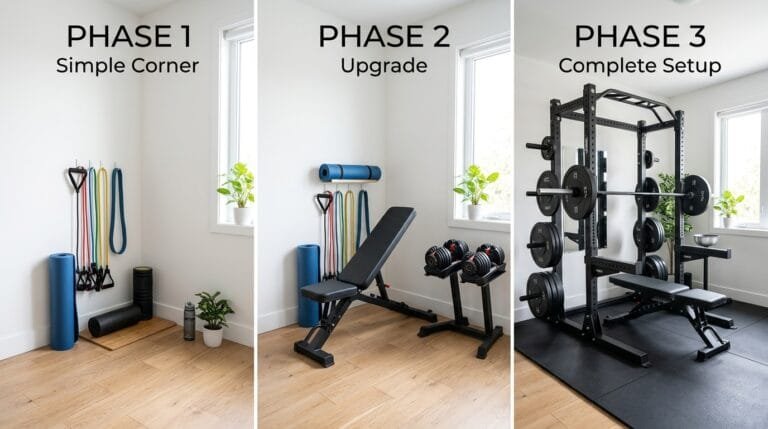
Step 2: Build a Minimal Effective Equipment Setup
You do not need a full commercial gym. A highly effective beginner setup includes:
| Priority Level | Equipment | Primary Purpose | Beginner Starting Recommendation |
|---|---|---|---|
| Essential | Resistance bands or adjustable dumbbells | Progressive resistance for all patterns | Light-to-moderate range |
| Essential | Exercise mat | Floor work, joint comfort, hygiene | Non-slip, adequate thickness |
| High | One or two kettlebells | Hinges, squats, carries, conditioning | 8–16 kg depending on current strength |
| High | Doorway or mounted pull-up bar | Vertical pulling and hanging | Lever-style if renting |
| Useful | Sturdy bench or step | Pressing, split squats, step-ups | Optional in the first month |
| Optional | Jump rope or cardio space | Conditioning | Bodyweight options suffice initially |
Many beginners start productively with only bands, a mat, and bodyweight. Add tools as movement quality and strength improve.
Step 3: Master the Five Fundamental Movement Patterns
Every sustainable beginner programme is built on these patterns:
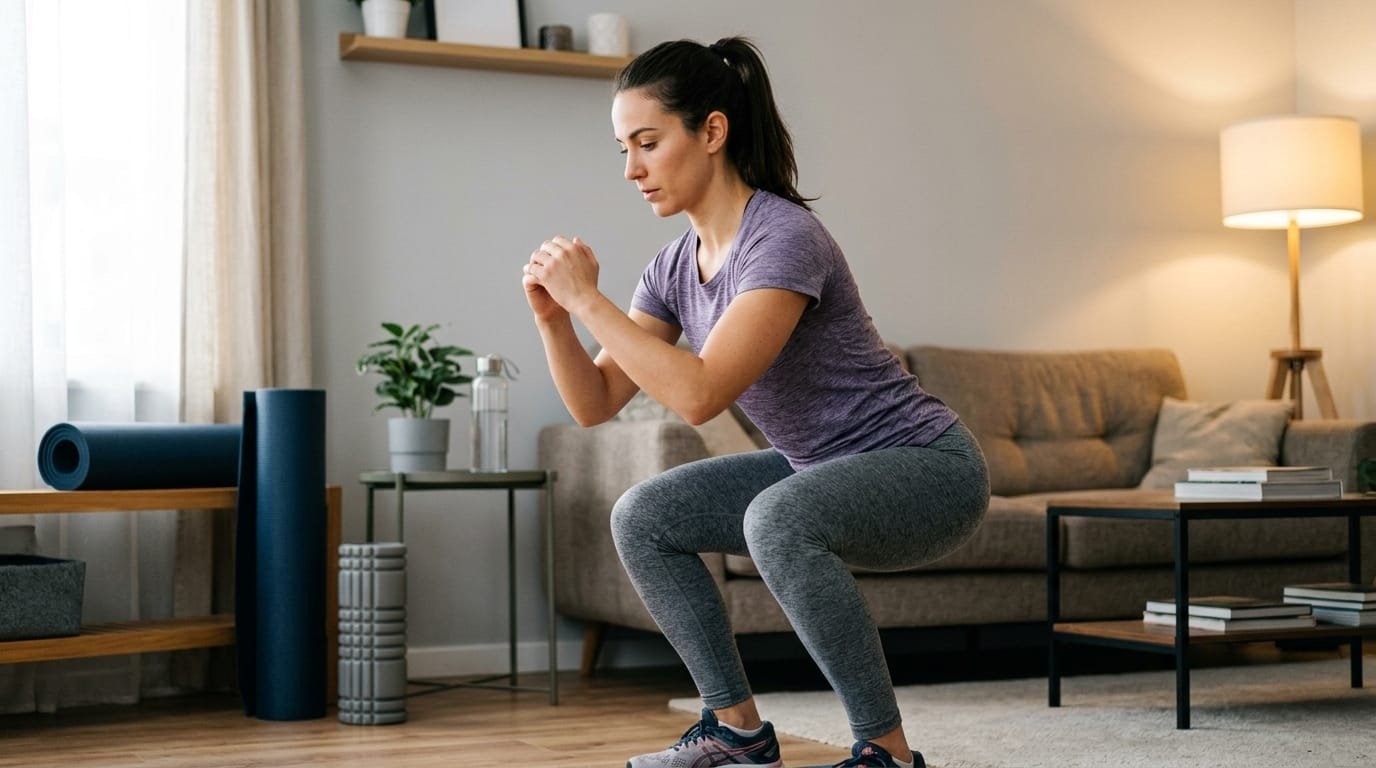
- Squat pattern – Bodyweight squat, box squat, or goblet squat
- Hinge pattern – Romanian deadlift, kettlebell deadlift, or good morning
- Horizontal / vertical push – Push-up variations, dumbbell floor press, or overhead press
- Horizontal / vertical pull – Band or dumbbell row, inverted row, pull-up progression
- Core stability & loaded carry – Plank, dead bug, bird-dog, farmer carry, or suitcase carry
Spend the first 2–4 weeks practising these patterns with bodyweight or very light resistance until the movements feel natural, balanced, and controlled through a full comfortable range of motion.
Step 4: Implement a Proper Warm-Up (5–10 Minutes)
A consistent warm-up reduces injury risk and improves performance. Use this simple template:
- 1–2 minutes of light cardio (marching in place, jumping jacks, or easy cycling)
- Upper-body mobility: arm circles, band pull-aparts, gentle shoulder dislocations
- Thoracic rotations and cat-cow
- Lower-body preparation: bodyweight squats, hip hinges, and leg swings
- 1–2 light sets of the first main exercise in the workout
Never skip this step, even on busy days.
Step 5: Beginner Full-Body Training Template
Perform 2–4 sessions per week on non-consecutive days.
Workout A (Primary Strength Focus)
- Goblet Squat or Bodyweight Squat – 3 sets of 8–12
- Push-Up (knee, incline, or full) – 3 sets of 6–12
- Single-Arm Dumbbell or Band Row – 3 sets of 8–12 per side
- Romanian Deadlift or Kettlebell Deadlift – 3 sets of 8–12
- Plank or Dead Bug – 3 sets of 20–40 seconds / 6–8 per side
Workout B (Unilateral & Core Emphasis)
- Split Squat or Reverse Lunge – 3 sets of 8–10 per leg
- Dumbbell Floor Press or Overhead Press – 3 sets of 8–12
- Pull-Up progression or Band Lat Pulldown – 3 sets of controlled maximum reps
- Glute Bridge or Single-Leg Glute Bridge – 3 sets of 10–15
- Bird-Dog or Side Plank – 3 sets of 6–8 per side / 20–30 seconds
Rest 60–120 seconds between sets. Emphasise a controlled eccentric (lowering) phase of 2–3 seconds on every repetition.
Step 6: Safe and Sustainable Progression Rules
- Increase load only after you complete all target sets and reps with solid technique.
- When using bodyweight or bands, increase repetitions or slow the tempo before adding external load.
- Change only one variable at a time (weight, reps, sets, or range of motion).
- If form deteriorates, reduce the load or regress to an easier variation immediately.
- Schedule a lighter week (deload) every 4–8 weeks or whenever progress stalls and fatigue accumulates.
Step 7: Non-Negotiable Safety Principles
- Perfect technique with light loads before adding weight.
- Control the lowering phase of every repetition.
- Avoid training to absolute failure in the first 6–8 weeks.
- Stop any exercise that produces sharp joint pain.
- Maintain a neutral spine during squats and hinges.
- Brace the core and breathe rhythmically—do not hold your breath excessively.
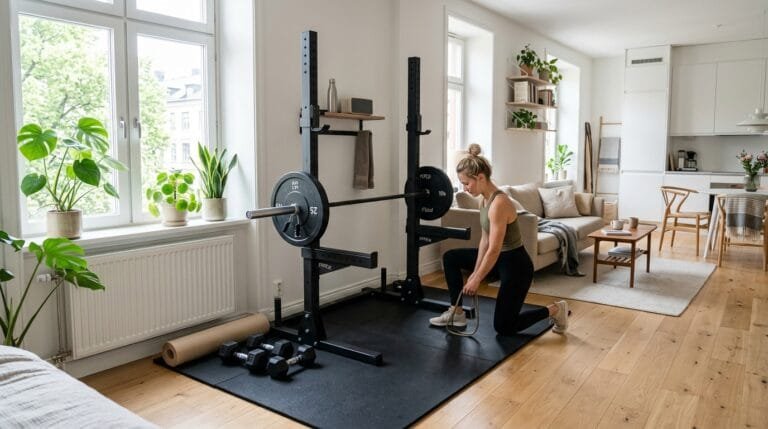
- Keep the training area clear and stable.
- Warm up before every session.
- Prioritise sleep and stress management.
- When uncertain, choose the easier variation rather than risking poor form.
Common Beginner Mistakes and Evidence-Based Corrections
| Mistake | Potential Consequence | Correction |
|---|---|---|
| Starting too heavy | Injury and poor motor patterns | Use lighter loads and higher control |
| Skipping the warm-up | Higher injury risk, reduced performance | Commit to 5–10 minutes every session |
| Ego-driven loading | Form breakdown | Film sets or reduce weight |
| Neglecting pulling movements | Shoulder imbalance | Match push volume with equal or greater pull volume |
| Inconsistent schedule | Failed habit formation | Fix 2–3 non-negotiable training days |
| Ignoring recovery | Stalled progress and accumulated fatigue | Sleep 7–9 hours and manage daily stress |
| Program hopping | Lack of progressive overload | Stick to one simple template for 8–12 weeks |
Sample 4-Week On-Ramp Plan
Weeks 1–2
Emphasise movement quality. Use bodyweight or very light resistance. Perform 2–3 full-body sessions. Record how each exercise feels.
Weeks 3–4
Add small load increases or extra repetitions only where form remains excellent. Keep the same movement patterns. Note improvements in control and work capacity.
After four weeks, evaluate strength, energy levels, joint comfort, and habit consistency before progressing further.
Expanding Your Home Routine with Proven Tools
Once the fundamental patterns are solid, integrate additional tools safely:
- Shoulder health and lateral-raise technique should follow established guidelines (safe lateral-raise form and shoulder health routine).
- Kettlebell swings, goblet squats, and carries are excellent next-level movements (kettlebell sizing guide.
- Grip strength directly supports pulling and carrying performance (grip strength guidance.
- Resistance bands remain one of the most useful tools for learning patterns and adding light progressive resistance (Resistance Bands Buying Guide.
- Core training can advance to the ab roller once basic stability is established.
- Conditioning options include treadmill walking or intervals (manual treadmill guidance.
Recovery practices should be present from the first week (Best Post-Workout Recovery Tools, Best Massage Gun for Post-Workout Recovery on a Budget, and Sleep and Recovery Strategies. Simple tracking accelerates progress (Best Ways to Track Progress Without a Gym or Personal Trainer.
External beginner resources consistently emphasise mastering fundamental movement patterns, prioritising technique, and progressing gradually for long-term safety and results (beginner home gym training principles and practical on-ramp programming).
Nutrition and Recovery Foundations
- Consume adequate protein (approximately 1.6–2.2 g per kilogram of body weight daily).
- Stay consistently hydrated.
- Target 7–9 hours of quality sleep most nights.
- Manage overall stress—training provides the stimulus, recovery produces the adaptation.
- Avoid aggressive calorie deficits while learning new movements and building a strength base.
Frequently Asked Questions
How many days per week should a true beginner train?
Two to four full-body sessions produce excellent results. Consistency matters more than high frequency at the start.
Do I need to train to failure?
No. Leave 2–4 repetitions in reserve during the first 1–2 months while motor patterns are still being established.
What if I have zero equipment?
Bodyweight squats, push-up variations, inverted rows (using a sturdy table), glute bridges, and planks form a complete and effective starting routine.
How soon will I see results?
Neurological strength improvements often appear within 2–4 weeks. Noticeable body-composition changes typically require 6–12 weeks of consistent training and supportive nutrition.
Should beginners include cardio?
Yes. Moderate cardio such as walking or easy cycling supports recovery and overall health without interfering with strength development.
When should I add more equipment?
Once you can no longer progress meaningfully with current tools or when specific weak points become clear.
Is muscle soreness normal?
Mild delayed-onset muscle soreness is common when beginning. Sharp joint pain is not—stop the exercise and regress the movement.
How long should I stay on a beginner programme?
Most people benefit from 8–12 weeks of consistent focus on the fundamentals before introducing more advanced variations or specialised programmes.
Final Recommendation
Starting a home gym routine safely is straightforward when you concentrate on the essentials: clear goals, minimal effective equipment, mastery of basic movement patterns, controlled progressive training, and consistent recovery. Begin with full-body sessions two to four times per week, prioritise technique over load, and build the training habit before chasing intensity or complexity.
Use the sample templates as a starting point, warm up properly every session, progress one variable at a time, and listen carefully to your body. Support your training with adequate protein, sleep, and stress management. Over the following months you can expand both equipment and programming, but the foundation established in the first 8–12 weeks largely determines long-term success and injury resilience.
Start simple, remain consistent, and train with patience. The strongest and most sustainable results come from performing the basics with high quality, week after week. Begin today with the equipment and space you already have—your future strength, health, and confidence will be built on these early, deliberate sessions.