Manual Treadmill vs. Motorized: Real Differences in Effort and Results
Quick Answer
Manual treadmills require significantly more user effort than motorized treadmills at the same speed because the runner or walker must power the belt. This typically produces higher heart rates, greater energy expenditure, and increased muscular demand—especially in the posterior chain and pushing muscles—for a given pace. Motorized treadmills provide consistent belt speed, easier pace control, and often better cushioning, making them superior for precise speed work, longer steady-state sessions, and users who want lower relative effort at a target pace. Results depend on how hard and consistently you train: a hard manual session can burn more calories per minute, while a motorized treadmill enables higher sustainable speeds and volume for many people.
Core Mechanical Difference
On a motorized treadmill an electric motor drives the belt at a set speed. You keep up with the belt.
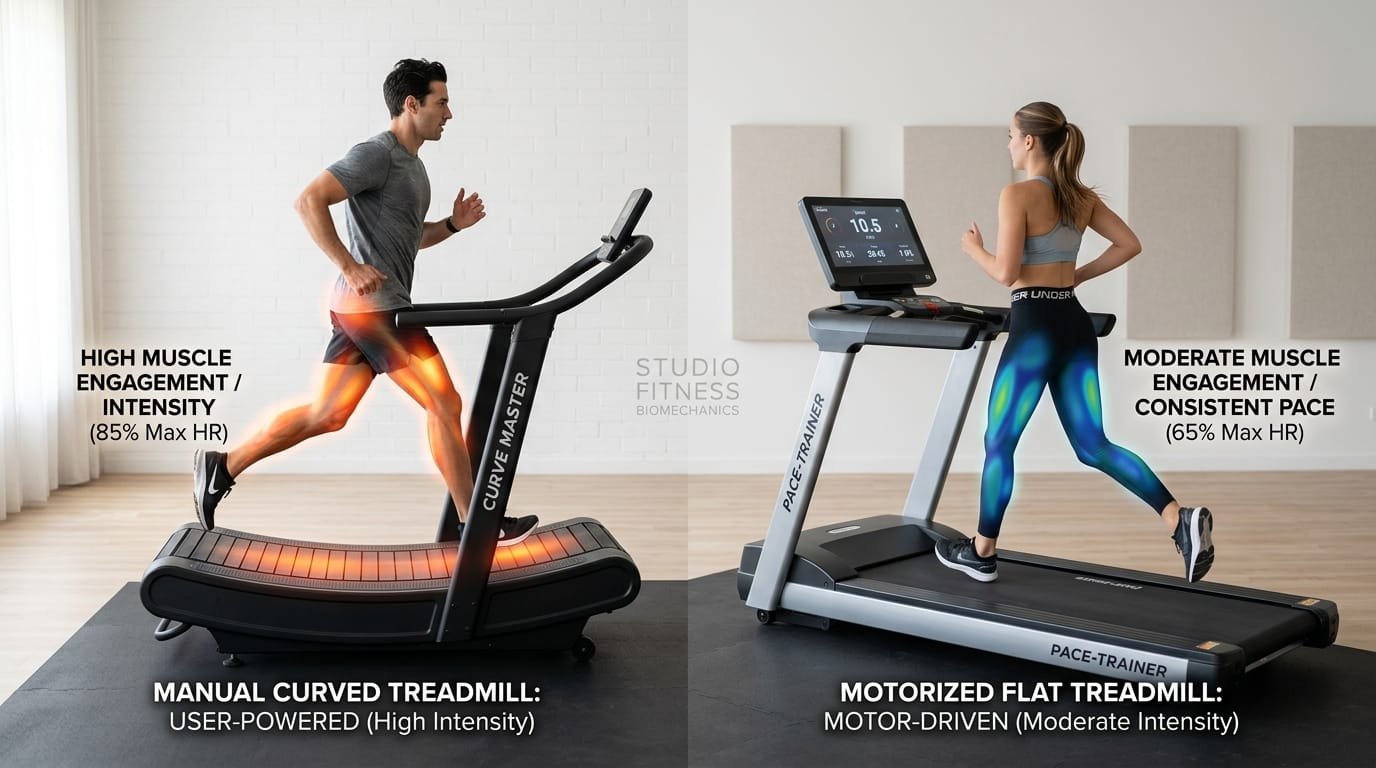
On a manual treadmill (flat-belt or curved non-motorized) there is no motor. Your leg drive powers the belt. To go faster you must push harder; to slow down you reduce force. Curved manual treadmills amplify this effect because the shape requires continuous acceleration of the belt with each stride.
This single difference drives most of the physiological and practical distinctions.
Effort, Calorie Burn, and Physiological Response
| Aspect | Manual / Non-Motorized | Motorized | Practical Implication |
|---|---|---|---|
| Effort at same speed | Higher | Lower | Manual feels harder at any given pace |
| Heart rate at matched speed | Higher (often +15–25 bpm or more) | Lower | Manual elevates cardiovascular demand faster |
| Energy expenditure | Higher per mile/km at same speed | Lower | Manual can burn more calories in less time |
| Muscle activation | Greater posterior-chain & push-off demand | More similar to overground in many cases | Manual emphasizes different muscular qualities |
| Pace control | User-determined, variable | Precise digital control | Motorized better for intervals with exact targets |
| Learning curve | Higher (technique affects belt speed) | Lower | Beginners often prefer motorized |
| Joint impact | Can be higher (less advanced cushioning on many models) | Often lower with quality decks | Context- and model-dependent |
Studies comparing non-motorized and motorized treadmills show that at similar relative intensities or speeds, the non-motorized version frequently elicits higher oxygen cost, heart rate, and lactate responses. Users tend to self-select slower speeds on manual units to keep perceived effort manageable, yet still achieve high cardiovascular and caloric demand.
Detailed Breakdown
Manual Treadmills – Effort and Results
Because you supply all propulsion, every stride becomes a concentric push. This increases demand on the glutes, hamstrings, calves, and quadriceps relative to simply matching a moving belt. Curved designs exaggerate the effect and are popular for high-intensity interval training and sprint work in performance settings.
Results profile:
- Higher calorie burn per minute at a given speed
- Stronger posterior-chain stimulus
- Excellent for short, intense sessions and metabolic conditioning
- Builds “real” propulsion strength that transfers well to overground running and sports
Limitations:
- Harder to maintain steady pace for long durations
- Technique strongly influences speed and efficiency
- Many budget flat-belt manuals have limited incline options and poorer ergonomics
- Can feel punishing for easy recovery or long steady-state work
Motorized Treadmills – Effort and Results
The motor removes the need to drive the belt, so effort is closer to (though not identical with) overground running or walking at the same speed. Quality models offer precise speed and incline control, programmed workouts, and superior cushioning systems.
Results profile:
- Easier to hit and hold exact paces (ideal for interval training with target speeds)
- Better for longer steady-state or tempo sessions
- Lower relative effort at a given speed allows higher volume for many users
- Incline features enable high-calorie walking with reduced impact
Limitations:
- Lower muscular demand per stride at the same speed compared with manual
- Requires electricity and has higher purchase/maintenance cost
- Some users find the fixed belt less engaging
Which Produces Better Results?
For calorie burn and conditioning in limited time
Manual treadmills often win because the higher effort cost means more energy expended per minute. A hard 20–30 minute manual session can match or exceed the caloric output of a longer, easier motorized session.
For running performance and pace-specific training
Motorized treadmills are superior. Precise speed control, reliable incline, and the ability to sustain target paces make them the better tool for structured running programmes.
For muscle development
Manual units emphasise concentric propulsion and posterior-chain loading more heavily. Motorized units more closely mimic overground gait patterns for many users.
For joint health and accessibility
High-quality motorized treadmills with good cushioning frequently feel better on the joints for longer sessions. Manual curved treadmills are low-impact in terms of external belt force but still demand high muscular effort.
For long-term adherence
The “better” machine is the one you use consistently at a challenging intensity. Many people find motorized treadmills more approachable for daily or frequent use; others prefer the engaging, self-powered nature of manual units.
Practical Decision Guide
| Goal or Constraint | Preferred Option | Reason |
|---|---|---|
| Max calories in short sessions | Manual (especially curved) | Higher effort cost per minute |
| Precise speed/interval training | Motorized | Exact pace control |
| Posterior-chain strength + cardio | Manual | Greater propulsion demand |
| Long steady-state or recovery runs | Motorized | Easier to sustain pace |
| Apartment / low noise | Manual (no motor) | Quieter operation |
| Limited budget | Entry-level manual or basic motorized | Context-dependent |
| Beginners or technique focus | Motorized | Lower coordination demand |
| HIIT / sprint conditioning | Curved manual | Self-selected high intensity |
Step-by-Step Recommendations for Each Type
Using a Manual Treadmill Effectively
- Focus on driving the belt with powerful hip extension rather than overstriding.
- Start with shorter sessions and build tolerance to the higher effort.
- Use for intervals: accelerate by moving up the curve or pushing harder, recover by easing off.
- Maintain upright posture and avoid excessive handrail reliance.
- Pair with strength work for balanced lower-body development.
Using a Motorized Treadmill Effectively
- Use the speed and incline controls to create precise workouts.
- Incorporate incline walking for high calorie burn with lower impact.
- Progress duration or intensity systematically.
- Avoid holding handrails during working sets.
- Combine with strength training for optimal body-composition results.
Integration with Home Strength and Conditioning
Both treadmill types complement a complete home programme. Maintain balanced shoulder and upper-body work with proper lateral-raise technique and dedicated rear-delt training (safe lateral-raise guidance and shoulder health routine).
Kettlebell swings and carries add powerful hip-hinge conditioning that pairs well with either treadmill (kettlebell sizing guide. Grip strength supports better running posture and loaded carries (grip strength guidance.
Band work remains useful for activation and lateral stability (Resistance Bands Buying Guide. Core strength supports efficient running posture (ab roller progressions.
For treadmill-specific fat-loss context see Does a Manual Treadmill Burn Belly Fat?. Recovery, hydration, and sleep determine how well you adapt to the higher effort of manual sessions or the higher volume possible on motorized units (Best Post-Workout Recovery Tools, Hydration and Electrolyte Needs for Intense Home Cardio Sessions, and Sleep and Recovery Strategies. Tracking progress ensures intensity stays effective (Best Ways to Track Progress Without a Gym or Personal Trainer.
External research confirms higher physiological demand on non-motorized treadmills at matched speeds and notes differences in muscle recruitment and energy cost (non-motorized vs motorized physiological comparison and practical manual vs motorized analyses).
Common Misconceptions
- “Manual always burns more calories.” → True at the same speed; users often self-select slower speeds, so total session calories depend on duration and effort.
- “Motorized is less effective.” → False — higher sustainable speeds and volume can produce equal or greater weekly energy expenditure.
- “Manual is always harder on joints.” → Depends on model, cushioning, and user technique.
- “You can’t do proper intervals on manual.” → Curved designs excel at self-paced high-intensity intervals.
Frequently Asked Questions
Does a manual treadmill burn more calories?
At the same speed, yes — typically 15–30% or more depending on design and study. In practice, total calories also depend on how long and hard you work.
Is a manual treadmill better for fat loss?
It can be, if the higher effort leads to greater total energy expenditure and you remain consistent. The best machine is the one you use regularly at a challenging intensity.
Can I train for a road race on a manual treadmill?
Possible, but motorized units allow more precise pace work that transfers directly to race-pace training.
Are curved manual treadmills worth the higher cost?
For athletes and serious HIIT users, yes. For general fitness and walking, a quality motorized or basic manual may be more practical.
Which is quieter?
Manual treadmills (no motor) are generally quieter, an advantage in apartments.
Do I need both?
No. Choose the one that matches your primary goals and space. Many home trainees thrive with one well-used treadmill plus strength training.
How should beginners start?
Most beginners find motorized treadmills more approachable. Start with walking and gradual speed or incline increases.
Final Recommendation
Manual treadmills demand more effort at any given speed, producing higher heart rates, greater caloric cost, and increased muscular demand—particularly useful for short, intense, high-calorie sessions and posterior-chain development. Motorized treadmills offer precise pace control, easier long-duration work, and often superior cushioning, making them better for structured running, higher weekly volume, and users who prefer consistent belt speed.
Choose based on your goals: prioritise manual (especially curved) for maximal effort and metabolic conditioning in limited time; prioritise motorized for pace accuracy, longer sessions, and running-specific training. Pair either with progressive strength work, solid recovery, and consistent tracking for the best body-composition and fitness results. Test the feel of both if possible, then commit to the one you will use hard and often — effort and consistency ultimately determine results more than the presence or absence of a motor.