Best Kettlebell-Only Full-Body Workout for Busy People
Quick Answer
The best kettlebell-only full-body workout for busy people uses one (or two) kettlebells and takes 20–30 minutes. It combines a powerful hinge (swing), a squat pattern (goblet or front squat), an upper-body press, a row, and optional carries or core work into an efficient circuit, complex, or AMRAP. This format simultaneously builds strength, muscle, power, and conditioning while requiring almost no space or set-up time. Perform it 2–4 times per week, prioritise crisp technique, and progress by increasing load, reps, rounds, or density.
Why Kettlebells Are Ideal for Busy Schedules
Kettlebells allow a single implement to load every major movement pattern: hinge, squat, push, pull, and carry. Transitions between exercises take seconds, heart rate remains elevated, and the offset centre of mass automatically challenges the core and grip. Practical programming and coaching experience show that consistent full-body kettlebell sessions improve strength, work capacity, and body composition when progressive overload and recovery are managed.
Key advantages for time-crunched people include:
- Extremely fast set-up and pack-away
- Minimal space requirement
- Combined strength and conditioning stimulus in one session
- High transfer to daily life and athletic movement
- Scalable from beginner to advanced with the same exercises
Efficient single-bell sessions are frequently recommended by coaches who specialise in time-efficient training (examples of short full-body kettlebell workouts).
Core Movement Patterns and Best Kettlebell Variations
| Pattern | Primary Exercise Options | Main Benefit | Typical Rep Range for Busy Workouts |
|---|---|---|---|
| Hinge | Two-hand swing, one-hand swing, clean | Posterior-chain power & conditioning | 10–20 |
| Squat | Goblet squat, double front squat, rack squat | Lower-body strength & mobility | 6–15 |
| Push | Strict press, push press, floor press | Upper-body pressing strength | 6–12 |
| Pull | Single-arm row, renegade row | Back strength & posture | 8–15 per side |
| Carry / Core | Farmer carry, suitcase carry, windmill, halo | Grip, core stability, resilience | Distance or 5–10 |
| Combination | Thruster, clean-to-press | Power & time efficiency | 6–12 |
Choosing the Right Kettlebell Weight
- Beginners: women 8–12 kg, men 12–16 kg
- Intermediate: women 12–16 kg, men 16–24 kg
- Advanced: women 16–20+ kg, men 24–32+ kg
Select a weight that allows solid technique for the target repetitions while becoming challenging on the final few reps. Detailed guidance on sizing and progression is available in How Heavy Should My Adjustable Kettlebell Be?.
The Most Effective Time-Efficient Workouts
Workout A – Classic 20–25 Minute Full-Body Circuit (Top Recommendation)
Complete 3–5 rounds. Rest 30–60 seconds between exercises if technique requires it; keep rest shorter for greater conditioning. Rest 60–90 seconds between rounds.
- Kettlebell Swing – 15–20 reps
- Goblet Squat – 8–12 reps
- Single-Arm Row – 8–12 reps per side
- Strict Press or Push Press – 6–10 reps per side
- Optional: Farmer carry 30–45 seconds or Windmill 5–8 per side
Workout B – 20-Minute AMRAP
As many quality rounds as possible in 20 minutes:
- 10 Swings
- 8 Goblet Squats
- 6 Single-Arm Rows per side
- 6 Presses per side
Rest only as needed to maintain form. This format is excellent for busy people who want maximum work density (practical AMRAP-style kettlebell examples).
Workout C – Strength-Bias Session (25–30 minutes)
3–4 sets of each movement with 90–120 seconds rest:
- Goblet or Double Front Squat – 6–10
- Single-Arm Press – 6–8 per side
- Single-Arm Row – 8–10 per side
- Swing – 12–15
- Optional carry or core finisher
Beginner Adaptation
Reduce to 2–3 rounds, use a lighter bell, and take longer rests. Master the swing and goblet squat before increasing complexity or density.
Detailed Technique Cues
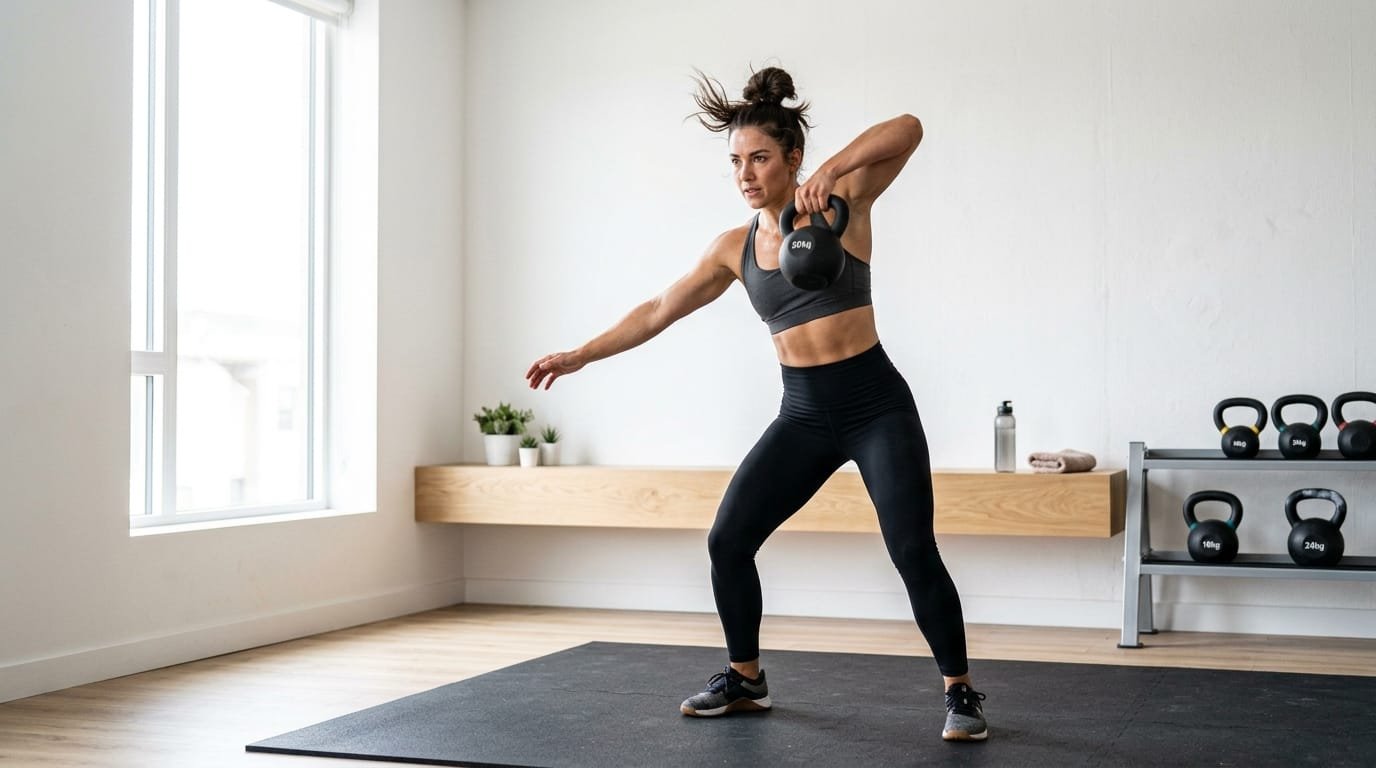
Two-Hand Swing
Hinge at the hips (push the hips back, slight knee bend), hike the bell high into the groin, then explosively extend the hips to propel the bell forward to chest or eye level. The arms remain relaxed; power comes from the posterior chain. Brace the core and keep the spine neutral throughout.
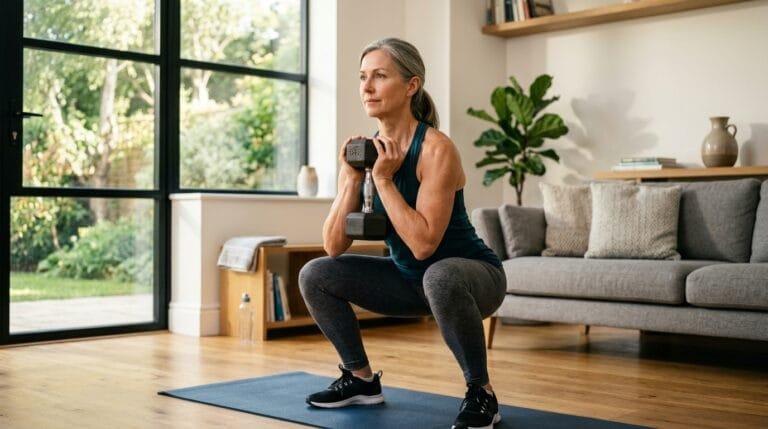
Goblet Squat
Hold the bell close to the chest with elbows pointing down. Squat between the knees while keeping the torso relatively upright, then drive through the mid-foot to stand tall.
Single-Arm Row
Hinge at the hips or place one hand on a bench/knee for support. Pull the elbow past the torso while keeping the shoulders square and the core braced.
Strict Press
Clean the bell to the rack position (elbow tucked, bell resting on the forearm). Brace the core hard and press the bell upward until the arm is fully locked out. Lower under control.
Farmer / Suitcase Carry
Hold the bell at your side with a locked grip and walk while maintaining tall posture and minimal torso lean.
Programming Guidelines for Busy People
- Frequency: 2–4 sessions per week
- Session length: 20–30 minutes is ideal
- Progression levers: heavier kettlebell, more repetitions, more rounds in the same time, shorter rest periods, or more advanced variations
- Recovery focus: prioritise sleep and protein intake; kettlebell work is demanding on grip, posterior chain, and core
On non-training days, light walking or mobility work aids recovery. Track rounds completed, weight used, and session quality.
Sample Weekly Schedule
- Monday: Workout A (Circuit)
- Wednesday: Workout B (AMRAP)
- Friday: Workout A or C
- Optional light weekend session: swing practice or active recovery
This provides full-body stimulus three times per week while remaining realistic for busy schedules.
Grip, Core, Shoulder Health, and Supporting Work
Kettlebell training places high demand on grip strength. Develop it further with dedicated methods from grip strength guidance. Maintain healthy shoulder mechanics on all pressing and isolation work by following the technique principles in safe lateral-raise guidance.
The offset load of the kettlebell continuously trains core stability. Additional floor-based core work or progressions toward an ab roller can be added when desired. Low-impact conditioning options such as those discussed in manual treadmill guidance pair well on recovery days. A budget massage gun can help manage residual muscle tension after dense sessions.
Further examples of efficient single-kettlebell complexes and short full-body sessions are available from coaches focused on time-efficient training (short kettlebell workout resources).
Common Mistakes That Waste Time and Limit Results
- Selecting a kettlebell that is too heavy and compromising form
- Turning the swing into a squat instead of a powerful hip hinge
- Neglecting rows and presses, leaving upper-body development incomplete
- Skipping any warm-up and jumping straight into heavy swings
- Failing to track performance or apply progressive overload
- Turning every session into complete exhaustion without regard for recovery
Frequently Asked Questions
How many times per week is optimal?
2–4 times per week works well for most busy people. Consistency outperforms extreme frequency.
Can I build meaningful muscle with only kettlebells?
Yes. Progressive overload on compound movements produces effective hypertrophy, particularly for beginners and intermediate trainees.
What if I only have 15 minutes?
Perform 2–3 rounds of the main circuit or a dense swing–squat–press complex. Some high-quality work is always better than none.
Is one kettlebell sufficient?
Yes for the large majority of goals. Two kettlebells enable double-bell variations and heavier loading as you advance.
How do I progress without adding more time?
Increase the kettlebell weight, add repetitions, complete more rounds in the same time frame, or reduce rest periods while preserving form.
Do I need separate cardio?
Not necessarily. Higher-round circuits and swing-focused work deliver substantial conditioning. Add walking or other low-impact activity if you enjoy it or need extra recovery.
Is this suitable for complete beginners?
Yes, provided technique is prioritised and a conservative weight is chosen. Master the swing and goblet squat before increasing density or complexity.
Should I do the same workout every session?
Rotating between a circuit format and an AMRAP or strength-bias session provides variety while keeping the movement patterns consistent and effective.
Final Recommendation
The best kettlebell-only full-body workout for busy people is a simple, repeatable circuit or AMRAP that includes swings, goblet squats, single-arm rows, and presses, completed with one kettlebell in 20–30 minutes. Train 2–4 times per week, focus on clean technique, and progress systematically through load, volume, or work density.
This approach delivers strength, muscle, power, and conditioning with minimal time and equipment investment. Master the key movements, record your performance, and remain consistent — a single kettlebell ranks among the most efficient tools available for full-body training when life is demanding. Start with Workout A using a manageable weight, prioritise form, and build from there for sustainable, long-term results.