Safe Alternatives to Traditional Sit-Ups for Core Strength
Quick Answer Traditional sit-ups place high compressive and shear forces on the lumbar spine through repeated flexion, which research has linked to increased disc stress and a higher risk of lower-back discomfort over time. Safer and often more effective alternatives focus on anti-extension, anti-rotation, and anti-lateral-flexion patterns that train the core to stabilise the spine rather than repeatedly bend it. The most evidence-supported options include the McGill Big 3 (modified curl-up, side plank, and bird-dog), dead bugs, front and side planks, Pallof presses, and controlled hollow-body or leg-lowering variations. These exercises build functional core strength and endurance while significantly reducing spinal load.
Why Traditional Sit-Ups Carry Elevated Risk
Sit-ups require repeated spinal flexion under muscular tension. Biomechanical research led by spine expert Dr. Stuart McGill has demonstrated that this pattern can generate compressive forces on the lumbar intervertebral discs exceeding 3,000 N—levels that approach or surpass occupational safety guidelines when performed for high repetitions. In addition, once the rectus abdominis fatigues, the hip flexors (particularly the iliopsoas) often take over, increasing anterior shear on the lumbar spine.
While sit-ups can produce a training stimulus for the superficial abdominals, they do relatively little to develop the deeper stabilising muscles (transverse abdominis, multifidus, and obliques) in the manner the spine actually requires during real-world and athletic movement—resisting unwanted motion rather than creating it. For these reasons, many physiotherapists, strength coaches, and even military physical-training programs have reduced or eliminated high-volume sit-ups in favour of spine-sparing alternatives. Detailed discussions of these risks appear in resources such as analyses from the Spine Health Foundation and clinical summaries drawing on McGill’s work.
The Core’s Primary Job: Creating Stiffness and Stability
A well-trained core functions as a muscular cylinder that stiffens the torso so force can be transferred efficiently between the upper and lower body. The most valuable training qualities are:
- Anti-extension (resisting excessive arching of the lower back)
- Anti-rotation (resisting twisting forces)
- Anti-lateral flexion (resisting side-bending)
- Muscular endurance of the deep stabilisers under low-to-moderate load
Exercises that challenge these qualities while keeping the lumbar spine near neutral produce superior transfer to daily activities, lifting, and sport, while imposing far lower cumulative stress on the discs and facet joints.
Top Evidence-Based Safe Alternatives
1. The McGill Big 3 (Modified Curl-Up, Side Plank, Bird-Dog) These three exercises emerged from extensive laboratory research as the combination that delivers high activation of the key stabilisers with the lowest spinal compressive penalty. They form the foundation of many clinical rehabilitation and athletic performance programs. Practical coaching breakdowns are available from sources such as Squat University.
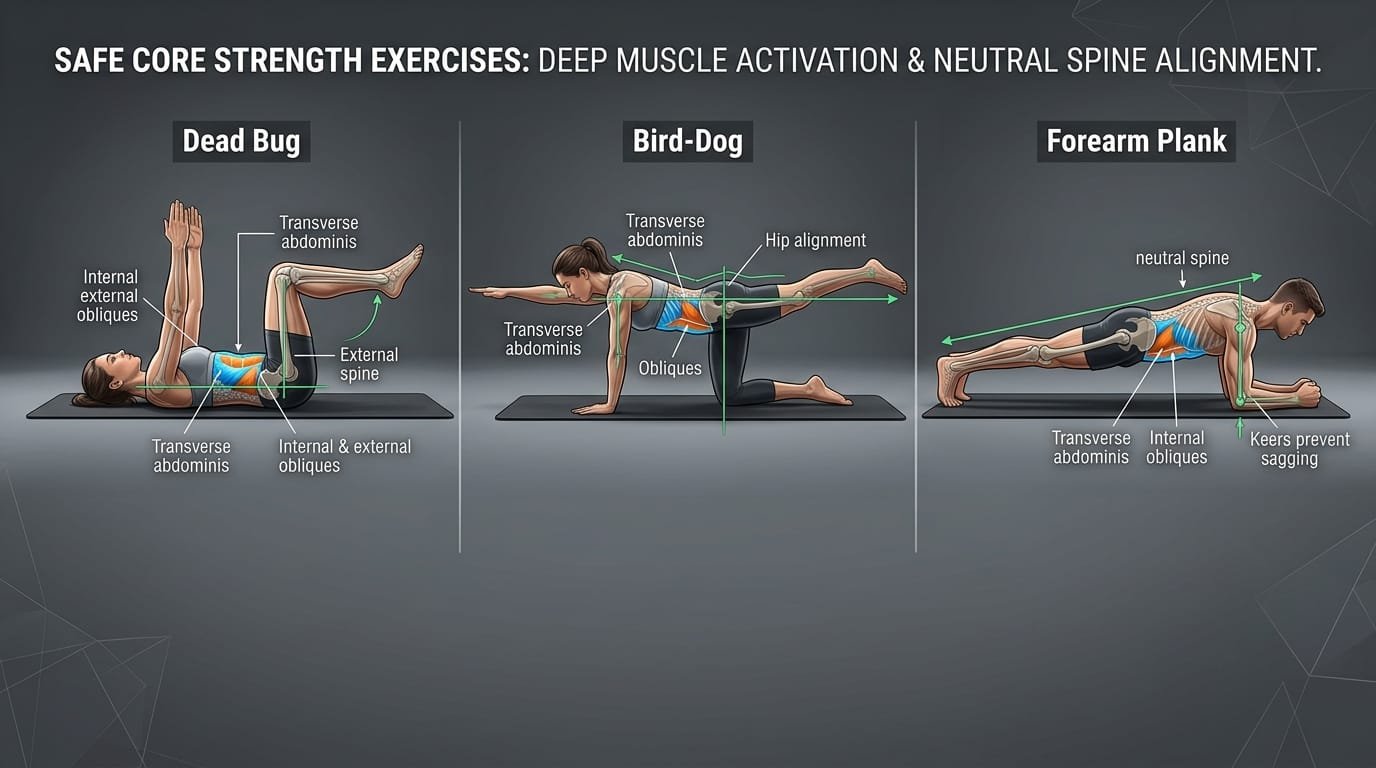
2. Dead Bug An outstanding anti-extension and anti-rotation drill performed in a supine position. The lower back remains gently pressed toward the floor while opposite limbs move, teaching the core to maintain stability under changing lever arms.
3. Front Plank and Side Plank Variations Isometric holds that train circumferential bracing. They can be progressed by increasing duration, narrowing the base of support, elevating a limb, or adding controlled movement.
4. Pallof Press (Anti-Rotation Press) One of the highest-value anti-rotation exercises. Performed with a cable or resistance band, it is easily scaled and directly transfers to rotational sport and loaded carrying.
5. Hollow-Body Holds and Controlled Leg Lowers These develop anterior-core endurance in a more spine-friendly manner than full sit-ups when the pelvis is kept in a neutral or slightly posterior position and the lumbar spine does not flatten excessively.
6. Bird-Dog with Progressive Variations Trains posterior-chain stability and contralateral coordination while the spine remains rigid. Excellent for teaching the body to maintain neutral under unilateral load.
7. Ab-Wheel or Stability-Ball Rollouts (Advanced Progression) Powerful anti-extension movements once basic bracing competence is established. Begin from the knees and progress only when form remains perfect.
Detailed Comparison: Sit-Ups vs. Safer Alternatives
| Exercise / Category | Primary Training Quality | Relative Spinal Load | Functional Transfer | Suitable for Most Back-Sensitive Individuals |
|---|---|---|---|---|
| Traditional Sit-Up | Repeated spinal flexion | High | Low–Moderate | Often No |
| Modified Curl-Up (McGill) | Anti-extension / bracing | Low | High | Yes |
| Side Plank | Anti-lateral flexion | Low | High | Yes |
| Bird-Dog | Anti-extension + anti-rotation | Low | High | Yes |
| Dead Bug | Anti-extension + anti-rotation | Very Low | High | Yes |
| Front Plank | Anti-extension | Low–Moderate | High | Yes (with strict form) |
| Pallof Press | Anti-rotation | Low | Very High | Yes |
| Hollow-Body / Leg Lowers | Anti-extension endurance | Low–Moderate | High | Yes (with pelvic control) |
Step-by-Step Technique for the Key Alternatives
Modified Curl-Up (McGill Style)
- Lie on your back with one knee bent and the foot flat; keep the other leg straight.
- Place both hands under the natural lumbar curve to preserve neutral spine.
- Gently brace the abdominal wall as if preparing for a light impact.
- Raise the head and shoulders only a short distance as a rigid unit—do not round the lower back.
- Hold for 8–10 seconds while breathing normally, then lower with control.
- Perform multiple short holds (e.g., a 5-3-1 descending pyramid) rather than long continuous sets.
Side Plank
- Lie on one side with the elbow directly under the shoulder and legs stacked (or knees bent for an easier version).
- Brace the core and lift the hips until the body forms a straight line from head to feet (or knees).
- Hold 8–10 seconds, actively preventing the hips from dropping or rotating forward/backward.
- Progress from the knee-supported version to the full side plank, then to longer holds or added reaching movements.
Bird-Dog
- Begin on all fours with hands under shoulders and knees under hips; establish a neutral spine.
- Brace the core.
- Simultaneously extend one arm forward and the opposite leg backward while keeping the hips and shoulders perfectly level.
- Hold 8–10 seconds, then switch sides.
- Avoid any twisting, sagging, or excessive lumbar extension.
Dead Bug
- Lie on your back with arms extended toward the ceiling and hips/knees bent at 90°.
- Press the lower back gently into the floor and maintain a braced core.
- Slowly lower the opposite arm and leg toward the floor while keeping the lumbar spine in contact with the ground.
- Return to the start position with control and alternate sides.
Sample Progressive Core Routine (Spine-Sparing)
Beginner (Weeks 1–3)
- Modified Curl-Up: 5–6 × 8-second holds
- Side Plank (knees): 3–4 × 8-second holds per side
- Bird-Dog: 5–6 × 8-second holds per side
- Dead Bug: 6–8 controlled reps per side
Intermediate (Weeks 4–8)
- Modified Curl-Up: 6–8 × 10-second holds
- Full Side Plank: 4–5 × 10-second holds per side
- Bird-Dog with longer reaches or light pauses: 6–8 × 10-second holds
- Dead Bug with slower tempo: 8–10 reps per side
- Optional: Front plank 20–40 seconds or light Pallof press
Advanced Additions
- Longer plank variations, ab-wheel rollouts from the knees, or weighted Pallof presses once the foundation is solid.
Perform the routine 2–4 times per week. Rest between holds as needed to preserve perfect form. Progress only when control remains excellent.
Programming Principles for Sustainable Progress
- Emphasise quality of the brace and spinal position far above total repetitions or hold time.
- Prefer multiple short holds (6–10 seconds) over long continuous efforts that cause form breakdown.
- Combine anterior, lateral, and posterior stability work in the same session for balanced development.
- Reduce or eliminate high-repetition spinal-flexion exercises if you have a history of disc issues or ongoing low-back symptoms.
- Re-evaluate every 4–6 weeks: improved bracing during main lifts and reduced low-back fatigue in daily life are the best indicators of progress.
Integrating Safe Core Training with the Rest of Your Program
Spine-sparing core work directly improves performance and safety in every major lift. It enhances bracing for pressing movements performed with adjustable dumbbells and supports the powerful hip-hinge pattern used in kettlebell swings. Strong grip endurance assists with hanging leg raises or ab-wheel variations. The ab roller itself can be introduced as an advanced anti-extension progression once basic planks and dead bugs are mastered.
Recovery tools such as a budget massage gun can help manage residual tension in the hip flexors, lumbar area, or upper back. Light cardio on a manual treadmill or mobility flows with resistance bands complement the routine. Continue applying sound shoulder-mechanics principles from your lateral raise guidance so upper-body positioning remains stable during planks and bird-dogs.
Frequently Asked Questions
Are all forms of spinal flexion inherently bad? No. Controlled flexion occurs in daily life and can be appropriate in some training contexts. The concern is high-repetition, poorly controlled, or heavily loaded flexion that repeatedly stresses the discs beyond their ability to recover.
Can I still include some form of crunch? Partial-range crunches performed with a strong brace and limited lumbar flexion are less stressful than full sit-ups. However, the modified McGill curl-up and pure anti-extension drills are generally preferable for long-term spinal health.
How quickly will I notice improvements in core strength and back comfort? Most people report better bracing awareness and reduced low-back fatigue within 2–4 weeks of consistent practice. Visible changes in endurance and performance continue over subsequent months.
What if I already experience lower-back pain? Begin with the lowest-load options (dead bugs, short side-plank holds, and modified curl-ups) and seek guidance from a qualified professional if symptoms persist or worsen. Many of these exercises are used in clinical settings precisely because they are spine-sparing.
Do I need any equipment? No. The McGill Big 3, dead bugs, and basic planks require only body weight and floor space. Resistance bands or a cable machine expand anti-rotation options but are not required for effective training.
How do these exercises compare to sit-ups for “six-pack” appearance? Visible abdominal definition is primarily a function of body-fat level. The safer alternatives still train the rectus abdominis effectively while also developing the deeper stabilisers that improve posture and functional strength—often producing better overall results.
Final Recommendation
Traditional sit-ups are neither the safest nor the most functional method for building core strength for the majority of people. Replace or substantially supplement them with exercises that train the core to resist motion—especially the McGill Big 3, dead bugs, planks, and anti-rotation drills such as the Pallof press. These movements develop the spinal stability required for daily life and athletic performance while minimising compressive and shear stress on the lumbar discs.
Prioritise perfect bracing, short high-quality holds, and gradual progression. When the core can create reliable stiffness on demand, every other lift becomes stronger and safer. Begin with the foundational drills outlined above, remain consistent, and let long-term spinal health guide your exercise selection. A resilient, pain-free core is built through intelligent stability training, not endless repeated flexion.