
Are Upright Rows Bad for Your Shoulders? A Safer Alternative Guide
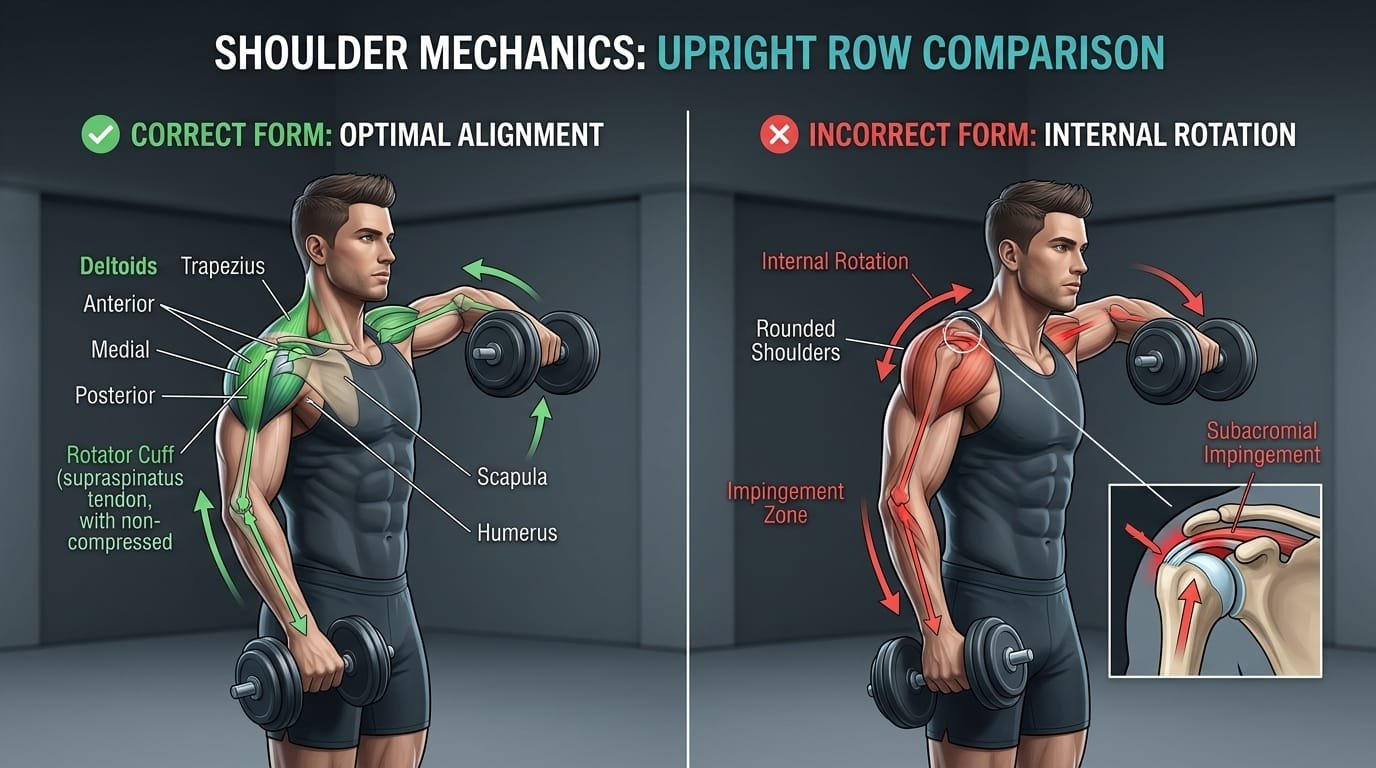
Quick Answer Upright rows are not inherently “bad,” but the traditional narrow-grip, high-elbow version places the shoulder in internal rotation while elevating the arm—positions associated with reduced subacromial space and higher risk of impingement for many lifters. Safer execution (wider grip, elbows stopping at or below shoulder height) reduces risk. For most people, especially those with existing shoulder issues or a history of discomfort, better long-term options include face pulls, lateral raises performed with good form, high pulls with a wider grip, and other external-rotation-friendly movements. Prioritize pain-free training and balanced shoulder development over any single exercise.
Understanding the Concern: Why Upright Rows Get a Bad Reputation
The upright row is a compound movement that targets the lateral deltoids, upper trapezius, and to a lesser extent the biceps and rhomboids. In its classic form—narrow grip on a barbell or EZ-bar, elbows driven high toward the ears—it combines shoulder abduction with internal rotation at elevated angles.
Research published in the Journal of Strength and Conditioning Research and guidance from the NSCA have linked this combination to increased likelihood of subacromial impingement characteristics when the elbows travel well above shoulder height. Independent analyses and clinical reviews (including discussions in sources such as BarBend and Muscle & Fitness) note that the risk is real for a meaningful percentage of lifters, though not universal.
Individual anatomy, load, volume, and technique all influence outcomes. Many people perform modified upright rows without issue. The practical takeaway is to recognize when the movement is a poor fit for your shoulders and to have effective replacements ready.
Biomechanics in Simple Terms
- Internal rotation + elevation narrows the subacromial space more than external rotation + elevation.
- Peak impingement risk for many people occurs roughly between 70–120° of elevation when the arm is internally rotated.
- Stopping the elbows at or just below shoulder height and using a wider grip meaningfully reduces that risk.
- Pain during or after the exercise is a clear signal to modify or replace it—do not “push through” sharp joint discomfort.
Safer Execution If You Choose to Keep Upright Rows
If you still want to include a version of the movement:
- Use a wider grip (closer to 1.5–2× shoulder width).
- Pull with the elbows rather than leading with the wrists.
- Stop when the elbows reach approximately shoulder height—do not chase the bar to the chin or higher.
- Prefer dumbbells, cables, or an EZ-bar over a straight barbell for more natural wrist and shoulder positioning.
- Keep loads moderate and focus on controlled tempo.
- Pair the movement with external-rotation work (face pulls, band pull-aparts, or specific rotator-cuff exercises).
Even with these modifications, many coaches and physical therapists prefer to substitute entirely for clients with any history of shoulder irritation.
Best Safer Alternatives
| Alternative | Primary Muscles Worked | Key Advantage | Equipment Needed |
|---|---|---|---|
| Face Pulls | Rear delts, external rotators, upper back | Excellent for shoulder health & posture | Cable or bands |
| Lateral Raises (strict) | Lateral delts | Isolates the target muscle with less risk | Dumbbells, cables, bands |
| Wide-Grip High Pulls | Lateral delts, traps, upper back | Power-oriented, more external rotation | Barbell or dumbbells |
| Cable or Band Pull-Aparts | Rear delts, external rotators | Simple, high-rep recovery work | Cable or bands |
| Prone or Seated Y-Raises | Lower/mid traps, rear delts | Improves scapular control | Light dumbbells or cables |
Face Pulls stand out as one of the highest-value replacements. They train the rear delts and external rotators while encouraging better scapular positioning—exactly the qualities many upright-row users lack. Detailed comparisons of upright rows versus face pulls appear in resources such as Community Strength Austin.
Lateral Raises, when performed with a slight forward lean, neutral wrists, and controlled tempo (and without excessive internal rotation or shrugging), effectively target the lateral delts. Our earlier guidance on lateral raise form remains highly relevant here.
Step-by-Step Guide to Transitioning Away from Traditional Upright Rows
- Assess current shoulder comfort: note any pinching, clicking, or lingering ache after upright rows.
- Remove or heavily modify the exercise for 4–6 weeks while monitoring symptoms.
- Insert 2–3 sets of face pulls (12–20 reps) and strict lateral raises (10–15 reps) into your upper-body sessions.
- Add light external-rotation work (side-lying or band external rotations) 2–3 times per week.
- Rebuild volume gradually on the new movements.
- Re-test a modified upright row later only if desired and only if completely pain-free.
- Maintain overall pulling balance (horizontal and vertical) and thoracic mobility.
- Track progress by strength on the alternatives and by how the shoulders feel during pressing and overhead work.
Integrating Safer Shoulder Work into Your Program
Healthy shoulders support everything else you do. Pair face pulls and lateral raises with your main pressing and pulling work using adjustable dumbbells or kettlebells. Strong grip endurance helps you control the implements during high-rep shoulder isolation. Core stability from movements such as those performed on an ab roller or power tower further supports clean upper-body mechanics.
Recovery tools such as a budget massage gun can help manage residual tension in the upper traps and rear delts after higher-volume shoulder sessions. Light cardio on a manual treadmill or mobility flows with resistance bands also complement dedicated shoulder health work.
Common Mistakes That Keep Shoulder Problems Alive
- Continuing upright rows despite recurring pinching or post-session ache.
- Performing lateral raises with excessive momentum, shrugging, or internal rotation.
- Neglecting rear-delt and external-rotation volume relative to pressing and internal-rotation dominant work.
- Using excessively heavy loads on isolation movements.
- Ignoring thoracic spine mobility and scapular control.
- Treating any single exercise as mandatory rather than a tool that can be replaced.
Frequently Asked Questions
Are upright rows completely unsafe? No. Modified versions with wider grips and limited elevation are tolerated well by many people. The traditional high-elbow, narrow-grip style carries higher risk for a significant portion of lifters. See discussions in BarBend and NSCA-related reviews for context.
What is the single best replacement? Face pulls are among the most useful because they train the rear delts and external rotators while promoting better posture and scapular health.
Can I still train traps without upright rows? Yes. Shrugs, farmer carries, high pulls with a wider grip, and even well-performed face pulls contribute to upper-trap development.
How do I know if my shoulders are “healthy enough” for upright rows? If you can perform a modified version through a full planned range with zero joint pain during or after, and you have no history of impingement symptoms, they may be acceptable. When in doubt, choose the safer alternatives.
Should beginners avoid upright rows? Most beginners are better served by lateral raises, face pulls, and basic pressing/pulling patterns while they build general shoulder resilience.
Do cables or dumbbells make upright rows safer? They often feel better because they allow more natural hand and shoulder paths, but the fundamental elevation + internal-rotation issue remains if elbows travel too high.
Final Recommendation
Upright rows are not universally dangerous, but the cost-benefit ratio is unfavorable for many lifters when safer, equally effective options exist. Prioritize face pulls, well-executed lateral raises, and other external-rotation-friendly movements to build the lateral delts and upper traps while actively supporting long-term shoulder health.
Listen to your joints, favor pain-free progress, and program balanced pushing, pulling, and rotator-cuff work. When in doubt, replace the traditional upright row—your shoulders will usually thank you with better resilience, fewer setbacks, and more consistent training over the years.
Assess how your shoulders currently feel, introduce the alternatives outlined above, and build volume on movements that leave you feeling stronger rather than irritated. Consistent, intelligent shoulder training compounds into better pressing performance, healthier posture, and greater training longevity.