
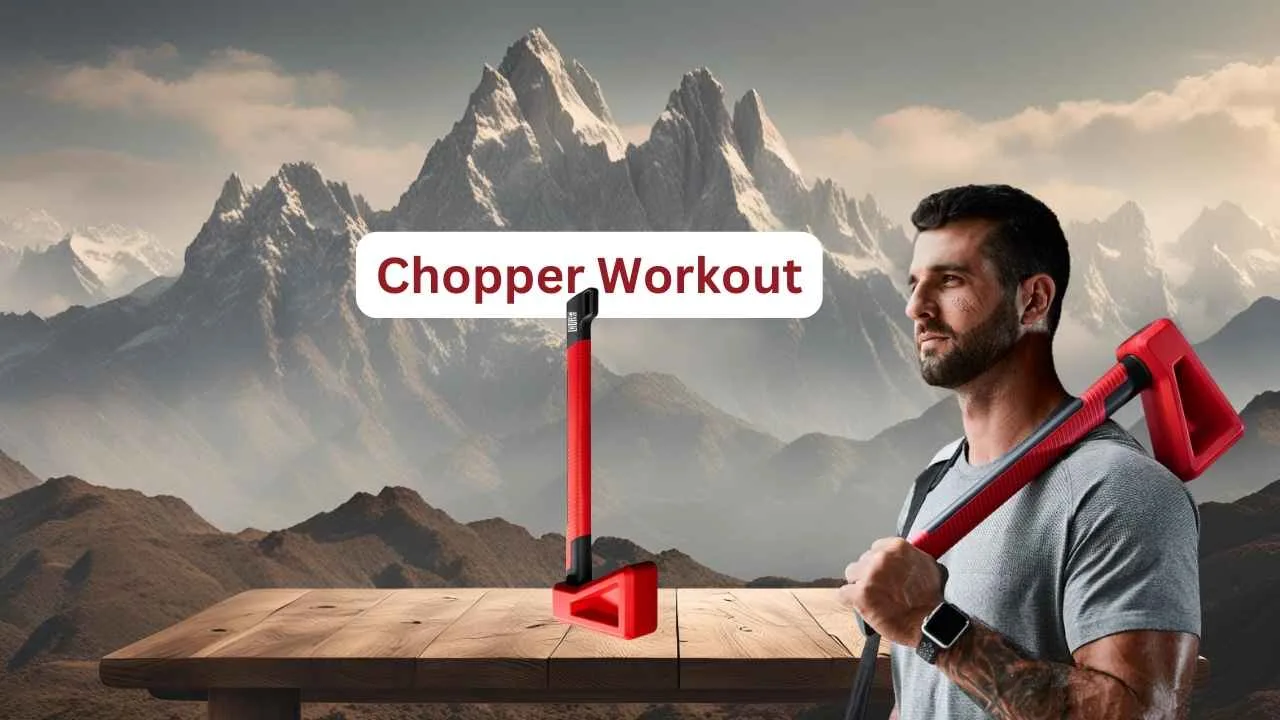
Chopfit Chopper: The Axe-Inspired Fitness Tool Revolutionizing Functional Training
Quick answer: The ChopFit Chopper is an axe-shaped piece of home fitness equipment paired with an app offering roughly 20-minute HIIT-style circuit workouts built around chopping and rotational movement patterns. The underlying training concept — rotational and anti-rotational core work — is genuinely well-supported by exercise science, even if the specific branded product is just one of several ways to train that movement pattern.
Researched and written by the GymGoodies team, fact-checked against manufacturer specs and current fitness guidance.
ChopFit’s Chopper has built a following as a distinctive, Instagram-friendly piece of home fitness equipment. Here’s an honest look at what it actually is, the real training science behind the chopping movement pattern it’s built around, and whether it’s a reasonable addition to your setup.
What the ChopFit Chopper Actually Is
The Chopper is a solid metal-core fitness tool shaped like an axe, attached to a reinforced handle, paired with a free companion app offering close to 60 circuit-style workouts. Depending on where you grip the handle, the effective resistance changes — the standard Chopper can feel anywhere from roughly 6 to 16 pounds depending on hand placement, with a heavier “Pro” version available for more resistance. Workouts are generally structured as 20-minute, HIIT-style circuits combining cardio and strength elements.
The Real Training Concept Behind It: Rotational and Anti-Rotational Core Work
Setting the specific branded product aside, the movement pattern the Chopper is built around — chopping and rotational core training — has genuine, established support in exercise science. According to Garage Gym Reviews, citing research published in the Journal of Strength and Conditioning Research, isometric (anti-rotation) training approaches have shown particular effectiveness for enhancing core stiffness and stability. The wood chop movement pattern specifically is highlighted as a genuinely functional, full-body exercise, engaging the shoulders and core through the upper body along with the hips and legs — largely because it mirrors a real-world functional movement (the actual motion of chopping), rather than an isolated, artificial exercise pattern.
According to Experience Life Magazine, the wood chop trains spinal rotation specifically — a movement pattern that’s genuinely relevant to sports like golf, tennis, and pickleball, as well as everyday tasks like shoveling, raking, or lifting something to the side of your body.
Rotation vs. Anti-Rotation: Two Distinct Training Categories
It’s worth understanding this distinction, since it applies directly to how you might use a tool like the Chopper:
- Rotational exercises (like a standard wood chop or the Chopper’s core movements) involve actively creating rotation through the torso — generating explosive or controlled force through a twisting motion.
- Anti-rotational exercises (like a Pallof press or renegade row) involve resisting an external force trying to rotate your torso, training stability rather than movement.
Both categories train your core in ways that basic crunches and sit-ups — which mostly work through a single, forward-flexion plane of motion — simply don’t address, making either category a genuinely useful addition for well-rounded core training.
Genuine Benefits of Chop-Pattern Training
- Trains the transverse plane of motion, a rotational movement pattern that most standard core exercises (crunches, planks in their basic form) don’t address
- Builds functional strength with real-world carryover — since the movement mirrors actual chopping, raking, or swinging motions rather than an artificial isolated pattern
- Engages multiple muscle groups simultaneously — obliques, shoulders, hips, and legs all contribute to a properly executed chop, making it a genuinely efficient compound movement
- Relevant for rotational sports specifically (golf, tennis, baseball) where trunk rotation power is a real performance factor
Is the Specific ChopFit Product Necessary, or Just One Option?
This is worth being clear about: the training concept behind the Chopper — rotational chop-pattern training — can be performed with several other tools, including a cable machine, resistance bands, a medicine ball, or a landmine barbell attachment. The ChopFit Chopper offers a portable, no-setup-required way to access this movement pattern, which is a genuine convenience advantage, particularly for home or travel-based training. But it’s not the only way to train this pattern, and lifters with access to a cable machine or landmine attachment already have effective alternatives without needing additional equipment.
Common Technique Mistakes With Chop-Pattern Movements
Whether you’re using a Chopper, cable machine, or medicine ball, a few technique issues come up consistently with this movement pattern:
- Initiating the movement from the shoulders/arms rather than the core — the rotational power should originate from your torso and hips, not just your arms swinging the implement.
- Insufficient leg involvement — particularly in the high-to-low chop variation, some leg drive and hip rotation should contribute to the movement, rather than treating it as a purely upper-body exercise.
- Using excessive range of motion beyond what you can control — rotational power exercises reward control as much as raw range, and overdoing the twist can increase strain on the lower back if not well controlled.
- Rushing the movement without proper bracing — core engagement throughout the movement matters more than speed alone, especially for beginners still building comfort with the pattern.
Who Chop-Pattern Training (With or Without a Chopper) Suits Well
- Anyone participating in rotational sports (golf, tennis, baseball, hockey) looking to build sport-relevant core power
- People looking to diversify core training beyond standard crunches and planks
- Home or travel-based trainers who want a portable way to add a rotational training element without a full home gym setup
Who Might Want to Approach This Cautiously
- Anyone with current lower back pain or a history of back injury, since rotational movements under load can be more demanding on the spine than static core work — starting with lighter resistance and shorter range of motion, or beginning with anti-rotational exercises like the Pallof press instead, may be a more conservative starting point
- Complete beginners to core training generally, who may benefit from building baseline core stability with simpler movements before adding a dynamic rotational element
How This Fits Into a Broader Training Program
Rotational and anti-rotational chop-pattern work is a genuinely useful addition to a well-rounded program, but it’s a specific category alongside — not a replacement for — other foundational movement patterns. Our Push vs. Pull Exercises guide covers two other foundational movement categories worth balancing in your overall training; rotational core work like the chop pattern is a genuinely distinct third category worth including alongside both, rather than a substitute for either.
Frequently Asked Questions
Do I need the specific ChopFit Chopper, or can I get the same benefit elsewhere?
The underlying training benefit comes from the rotational movement pattern itself, which can be trained with a cable machine, resistance bands, medicine ball, or landmine attachment — the Chopper’s main advantage is portability and convenience rather than being uniquely necessary for this type of training.
Is chop-pattern training safe for people with back issues?
This depends on your specific condition and current back health — starting conservatively with lighter resistance, shorter range of motion, or beginning with anti-rotational exercises instead is a reasonable, more cautious approach, and checking with a doctor or physical therapist first is worthwhile if you have an existing back condition.
How does this fit alongside my regular strength training?
Chop-pattern rotational work complements rather than replaces standard strength training — it’s best thought of as filling a specific gap (rotational core strength and power) that many standard programs don’t directly address.
Bottom Line
The training concept behind the ChopFit Chopper — rotational and anti-rotational core work — is genuinely well-supported by exercise science and fills a real gap left by more traditional core exercises. The Chopper itself is a convenient, portable way to access this movement pattern, particularly for home or travel training, though it’s one option among several rather than a uniquely necessary piece of equipment if you already have access to a cable machine or similar alternative.
Have you tried rotational core training, whether with the ChopFit Chopper or another tool like a cable machine or medicine ball? Let us know in the comments what’s worked for your core training.