Age Gracefully with These Powerful Yoga Poses
Quick answer: Regular yoga practice is associated with meaningful improvements in balance, flexibility, and fall-related outcomes in older adults, according to multiple controlled studies. A gentle, consistent practice — ideally starting with a class labeled “gentle yoga,” “seniors yoga,” or “chair yoga” — can be a genuinely valuable, low-impact way to support mobility and reduce fall risk as you age.
Researched and written by the GymGoodies team, fact-checked against manufacturer specs and current fitness guidance.
Falls are a serious concern for older adults — roughly one in three adults over 65 experiences a fall each year, according to research on balance and aging. Yoga has become one of the more studied approaches for addressing this risk, and there’s genuine, controlled research behind its benefits — not just general wellness enthusiasm.
What the Research Actually Shows
According to the National Center for Complementary and Integrative Health (NCCIH), part of the National Institutes of Health, regular yoga practice may improve balance, relieve tension, and increase strength. NCCIH also notes yoga’s growing popularity specifically among older Americans — the percentage of U.S. adults 65 and older practicing yoga has increased substantially over the past two decades.
A controlled study examining yoga’s effect on falls in rural older adults found that yoga classes reduced self-reported falls and improved measurable balance outcomes. Specific improvements included right-leg single-leg stand time increasing from an average of 13.3 to 17.1 seconds, and standing forward reach distance improving from 26.0 to 29.6 centimeters — both meaningful, measurable gains in the kind of balance capacity directly relevant to fall prevention. Participants also showed improvement on the Berg Balance Scale, a standardized clinical balance assessment.
A separate systematic review and meta-analysis examining yoga-based exercise in adults 60 and older found small improvements in balance and medium improvements in physical mobility, though the reviewers noted further research is still needed to confirm how directly these improvements translate into reduced fall rates specifically.
Why Yoga Specifically Helps With Balance and Fall Risk
Yoga combines several elements that are individually well-supported for fall prevention: static balance challenges (standing poses), controlled strength work (holding and transitioning between poses), and flexibility training — all performed in a generally low-impact, controllable format that can be adapted to different ability levels.
Safe, Foundational Poses for Older Adults
The following poses are commonly recommended starting points, generally considered accessible with appropriate modifications:
1. Mountain Pose (Tadasana)
A foundational standing pose focused on posture and body awareness. Stand tall, feet hip-width apart, weight evenly distributed, shoulders relaxed down and back. This builds the postural awareness that underlies most other standing poses.
2. Supported Tree Pose (Vrksasana, Modified)
A balance-focused pose, but importantly modifiable — rather than lifting your foot high onto your inner thigh (a more advanced version), place your foot lightly on your ankle or calf, and use a wall or chair for support as needed. Building balance safely, with support available, matters more than achieving the “full” version of the pose.
3. Chair Pose (Utkatasana)
Builds lower-body strength directly relevant to functional movements like standing up from a seated position — a connection covered in more depth in our guide on the muscles used for sitting and standing. Bend your knees as if sitting into an invisible chair, keeping your weight in your heels.
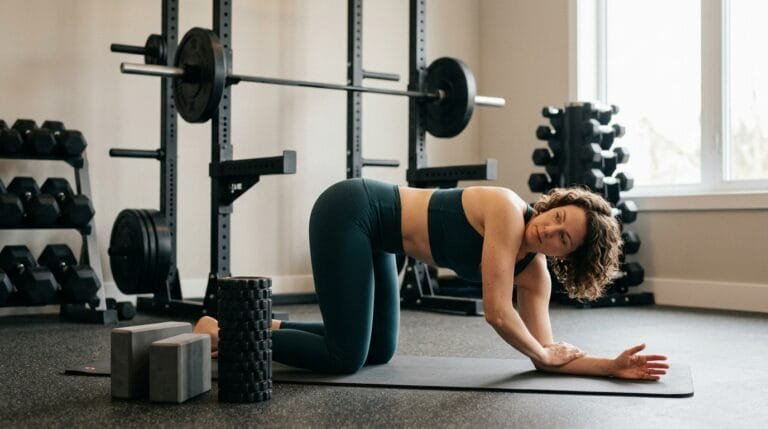
4. Cat-Cow Stretch (Marjaryasana-Bitilasana)
A gentle, seated-or-on-hands-and-knees spinal mobility movement, alternating between arching and rounding your back with your breath. Low fall-risk since it’s performed close to the ground, making it a good option even for those working on standing balance separately.
5. Seated Forward Fold (Paschimottanasana, Modified)
Performed seated, this stretches the hamstrings and lower back without any balance demand at all — a good option for building flexibility safely regardless of current balance confidence.
6. Legs-Up-The-Wall Pose (Viparita Karani)
A gentle, fully supported restorative pose — lying on your back with your legs resting up against a wall. No balance or strength demand at all, useful for relaxation and gentle circulation, and a good example of how yoga can offer meaningful practice even on days when standing poses aren’t appropriate.
7. Warrior II (Virabhadrasana II, Modified as Needed)
A standing pose building leg strength and stability, which can be modified with a wider, more supported stance or performed near a wall for balance support as needed.
Important Safety Guidance Before Starting
NCCIH specifically recommends that older adults practicing yoga put safety first, starting with an appropriate class type — one specifically labeled “gentle yoga,” “seniors yoga,” rather than a general or advanced class. Chair yoga is highlighted as an even gentler option for those with more limited mobility, since poses can be performed seated or using a chair for support throughout.
Critically, NCCIH also recommends that older adults with existing medical issues talk to both their healthcare provider and their yoga instructor before starting a practice, since some poses may need modification or avoidance depending on individual health conditions — this is especially relevant for anyone with osteoporosis, given how our guide on why bones become fragile with age discusses fracture risk considerations that could affect which movements and depths of stretch are appropriate.
How to Build a Consistent Practice
- Start with a class or instructor-led session rather than attempting to learn poses entirely independently, particularly early on, so you get feedback on form and appropriate modifications
- Use props liberally — chairs, walls, and yoga blocks aren’t a sign of doing it “wrong,” they’re legitimate tools that make poses safer and more accessible
- Prioritize consistency over intensity — research generally supports regular, moderate practice over occasional, more strenuous sessions for balance and mobility benefits
- Track how you feel over time, not just in the moment — balance and mobility improvements from yoga tend to build gradually over weeks and months of consistent practice
Common Mistakes to Avoid
- Starting with an advanced or general class rather than one specifically designed for older adults or beginners, which can include poses or transitions that aren’t appropriately modified.
- Skipping the conversation with your doctor, especially if you have osteoporosis, a recent injury, or balance-related medical conditions — this step matters more than it might seem given how directly some poses interact with bone and joint health.
- Pushing into pain rather than a gentle stretch sensation — yoga shouldn’t hurt, and pushing through discomfort increases injury risk without added benefit.
- Avoiding props out of a sense that “modified” means “less effective” — using support is a legitimate part of safe practice, not a shortcut.
Frequently Asked Questions
Is yoga safe for someone with osteoporosis?
Many yoga poses can be safely practiced with appropriate modification, but certain movements (particularly deep forward bends or twists) may need to be avoided or modified depending on your specific bone density and fracture risk — this is a conversation worth having directly with your doctor and a qualified instructor before starting.
How often should I practice for balance benefits?
Research generally supports regular, consistent practice — multiple sessions weekly over a sustained period — rather than infrequent or one-off sessions, for meaningful balance and mobility improvements.
Can yoga replace strength training for older adults?
Yoga offers real balance, flexibility, and some strength benefits, but it’s reasonably viewed as a complement to, rather than a complete replacement for, dedicated strength training — a well-rounded approach for healthy aging typically includes both.
Bottom Line
Yoga offers genuine, research-supported benefits for balance, flexibility, and fall-related outcomes in older adults — not just general wellness marketing. Starting with an appropriately gentle class, using props as needed, and having a conversation with your doctor about any specific health considerations sets up a safe, sustainable practice that can meaningfully support mobility and confidence as you age.
Have you incorporated yoga into your routine as you’ve gotten older? Let us know in the comments which poses have made the biggest difference for your balance and mobility — and if you’re just starting out, this is a great topic to bring up with your doctor first.