Signs Your Bands, Bench, or Bar Need Replacement
Quick Answer
Replace resistance bands at the first signs of fraying, cracking, sticky texture, or significant loss of elasticity. Replace a bench if it has structural cracks, unstable legs or frame, failed locking mechanisms, or severely degraded padding that affects stability. Replace a barbell or bar if it is bent, has cracked or excessively worn sleeves, damaged knurling that compromises grip safety, or loose or damaged hardware that cannot be reliably secured. When in doubt about structural integrity, prioritise safety and replace the item.
Why Timely Replacement Matters
Home gym equipment is subjected to repeated loading, sweat, temperature changes, and occasional accidental drops. Unlike commercial facilities that cycle equipment on a schedule, home users must recognise failure signs themselves. Continuing to use compromised bands, benches, or bars increases the risk of sudden failure mid-set, unstable support, or loss of control. Recognising clear replacement criteria protects both safety and training consistency.
Core Principles for Replacement Decisions
- Safety over sentiment – Equipment is a tool; structural compromise is not worth the risk.
- Early signs predict sudden failure – Fraying bands and loose hardware rarely improve.
- Function is not the same as safety – An item may still “work” while being unsafe under load.
- Document and act – Once a clear sign appears, schedule replacement rather than monitoring indefinitely.
- Match replacement quality to use case – Higher-frequency or heavier use justifies more durable replacements.
Resistance Bands: Clear Replacement Signs
| Sign | What It Looks / Feels Like | Risk Level | Action |
|---|---|---|---|
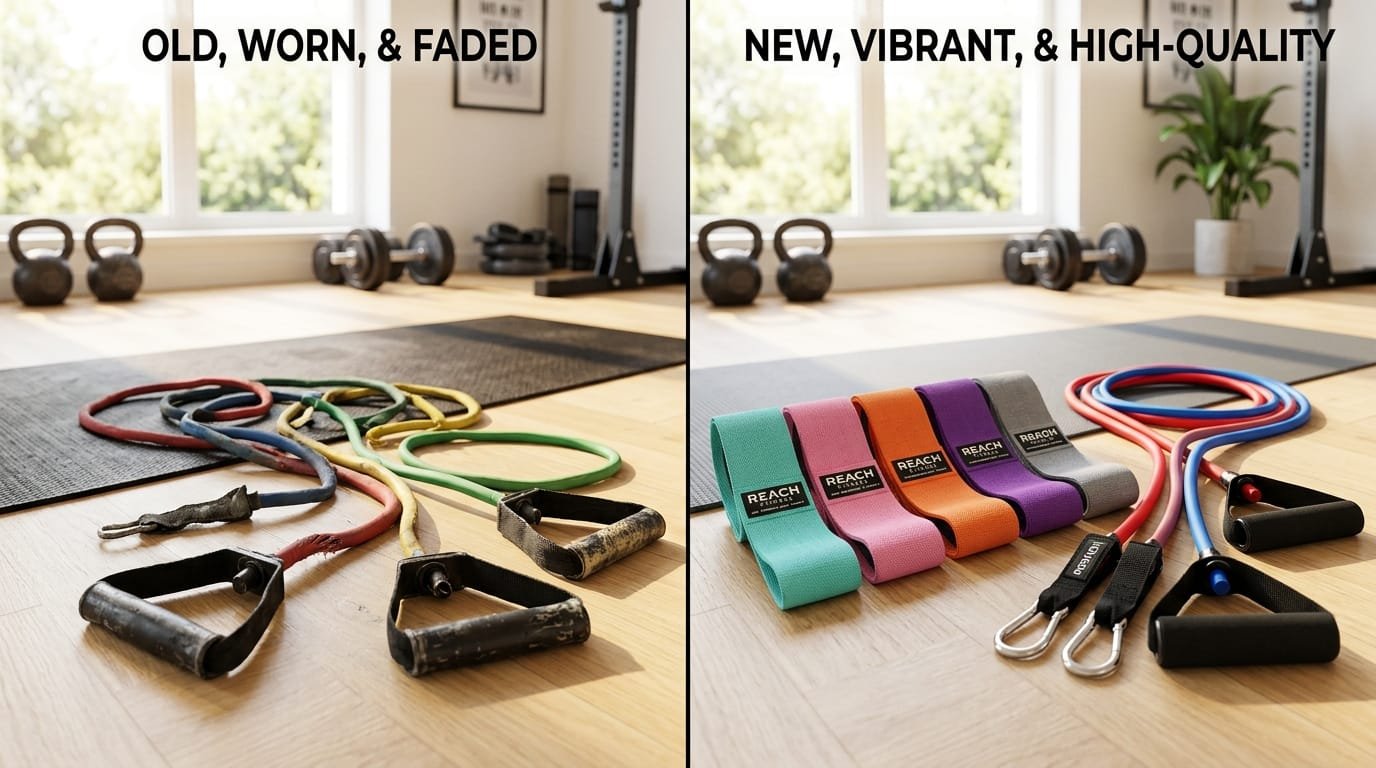
| Fraying or broken strands | Visible threads, thin spots, or peeling layers | High | Replace immediately |
| Cracking or dry rot | Surface cracks, especially when stretched | High | Replace immediately |
| Sticky or tacky texture | Band feels gummy or leaves residue | Moderate–High | Replace soon |
| Significant loss of elasticity | Band stays stretched or feels “dead” | Moderate–High | Replace |
| Discoloration with texture change | Fading accompanied by stiffness or softness | Moderate | Inspect closely and replace if texture is affected |
| Nicks from sharp edges | Small cuts or abrasions | High if depth is significant | Replace |
Additional Band Guidance
Inspect the entire length before every session by stretching the band lightly and examining it under good light. Avoid anchoring on rough concrete or sharp corners. Store away from direct sunlight and extreme heat. Bands are consumable items—budget for periodic replacement as normal training cost.
Weight Benches: Clear Replacement Signs
| Sign | What It Looks / Feels Like | Risk Level | Action |
|---|---|---|---|
| Structural cracks in frame | Visible cracks in metal or welds | Critical | Stop use and replace |
| Unstable or wobbling legs | Bench shifts or rocks under body weight | High | Repair if possible; otherwise replace |
| Failed or unreliable locking mechanisms | Adjustment pins slip or fail to engage fully | High | Replace if not repairable |
| Bent or deformed frame members | Visible bending or asymmetry | High–Critical | Replace |
| Severely compressed or torn padding | Padding no longer provides stable support | Moderate | Replace padding if possible; otherwise consider full bench replacement |
| Loose bolts that will not stay tight | Repeated tightening fails to maintain stability | High | Investigate cause; replace if frame is compromised |
Additional Bench Guidance
Perform a stability test monthly: sit, lie, and shift body weight while checking for movement. Confirm every adjustment point locks securely before loading. If the bench has a leg developer or preacher attachment, inspect those pivot points and pads with the same criteria. A bench is foundational safety equipment—err on the side of caution.
Barbells and Bars: Clear Replacement Signs
| Sign | What It Looks / Feels Like | Risk Level | Action |
|---|---|---|---|
| Visible bend in the shaft | Bar does not roll straight or spins unevenly | Critical | Replace |
| Cracked or damaged sleeves | Cracks, excessive play, or rough rotation | High–Critical | Replace |
| Compromised knurling | Sharp burrs, excessively worn sections, or sharp edges that cut | Moderate–High | Replace if grip safety is affected |
| Loose or damaged hardware | End caps, snap rings, or bolts that cannot be secured | High | Repair if possible; replace if structural |
| Excessive sleeve rust or pitting | Deep corrosion that affects rotation or structural integrity | Moderate–High | Evaluate depth; replace if severe |
| Spinning or loose bar ends | Sleeves move independently in unintended ways | High | Replace |
Additional Bar Guidance
Roll the bar on a flat floor periodically to check for bends. Spin the sleeves and listen for rough bearings or excessive play. Inspect knurling for sharp damage that could injure hands. Store bars horizontally on proper racks when possible to minimise stress. Olympic bars, trap bars, and specialty bars all follow the same structural criteria.
Step-by-Step Replacement Decision Process
- Perform a focused inspection
Examine the item under good lighting, both at rest and under light stress (stretch band, load bench lightly, roll bar). - Compare against the clear signs tables above
Match what you observe to the listed criteria. - Categorise the severity
Critical or high-risk signs require immediate removal from service. - Determine whether repair is realistic
Some issues (loose bolts, surface rust, replaceable padding) can be repaired. Structural cracks, bends, and advanced band degradation generally cannot. - Remove compromised equipment from the training area
Avoid the temptation to “use it carefully one more time.” - Select an appropriate replacement
Match the new item to your training needs and storage constraints. - Inspect the new item on arrival
Confirm there are no shipping or manufacturing defects before first use. - Update your maintenance checklist
Note the replacement date and any lessons learned. - Dispose of or recycle the old item responsibly
Do not leave failed equipment where it could be used accidentally. - Resume training with the new equipment
Perform a light technique session to confirm feel and function.
How Training Habits Affect Equipment Lifespan
Controlled technique and appropriate loading extend equipment life. Dropping weights excessively, using bands on sharp edges, overloading benches beyond rated capacity, and storing metal in damp environments accelerate wear. Shoulder-friendly, controlled lifting reduces peak forces on both the body and the equipment (Bent Arms vs. Straight Arms in Lateral Raises, The Hidden Mistake in Lateral Raises, and 3 Lateral Raise Modifications). Grip tools and accessories should be held to the same replacement standards (Do Hand Grippers Really Work?).
Repair vs Replacement Decision Guide
| Issue | Usually Repairable | Usually Requires Replacement |
|---|---|---|
| Loose bolts on bench | Yes | No (unless threads or frame are stripped) |
| Surface rust on bar or plates | Often yes | Deep structural rust |
| Worn bench padding | Yes (re-upholstery) | Frame damage |
| Fraying resistance band | No | Yes |
| Slightly sticky band | Temporary cleaning possible | Recurring stickiness or elasticity loss |
| Bent barbell | No | Yes |
| Worn knurling | Sometimes (professional re-knurling is rare) | If grip safety is compromised |
| Failed adjustable dumbbell mechanism | Sometimes | Often more cost-effective to replace |
Cost of Delayed Replacement
Delaying replacement of compromised equipment risks sudden failure, potential injury, lost training time, and secondary damage to flooring or other gear. The cost of a new band, bench, or bar is almost always lower than the combined cost of an injury and the disruption it causes. Treating replacement as normal maintenance rather than an emergency expense improves both safety and consistency.
Integrating Replacement Awareness into Routine Care
- Pre-session inspection includes looking specifically for the signs listed above
- Monthly maintenance includes a more deliberate examination of bands, bench stability, and bar straightness
- Seasonal deep reviews include rolling bars, fully stretching bands, and testing all bench adjustment points under body weight
When these checks are habitual, replacement decisions become straightforward and timely.
Strength training remains highly effective when equipment is kept in safe working order (strength training guidance). Practical home-gym approaches emphasise systems that include ongoing inspection and timely replacement (home gym equipment prioritisation and budget home gym principles).
Frequently Asked Questions
How often should I seriously inspect bands, benches, and bars?
Quick visual checks before every session and a more thorough examination monthly. Bands deserve especially frequent attention because they can degrade suddenly.
Can I repair a frayed band with tape or knots?
No. Tape and knots create new stress points and do not restore structural integrity. Replace the band.
My bench wobbles slightly—can I keep using it?
Identify the cause first. If bolts can be tightened and the frame is sound, repair may be sufficient. If the frame is bent or cracked, replace the bench.
How can I tell if a barbell is bent?
Roll it on a flat, level floor and watch the ends. A bent bar will wobble or fail to roll smoothly. You can also spin it on a rack and observe the shaft.
Is surface rust on a bar a reason to replace it?
Surface rust can often be cleaned and treated. Deep pitting or rust that affects structural integrity or sleeve function is a stronger reason to replace.
What if the replacement cost is high right now?
Remove the compromised item from service immediately. Train with remaining safe equipment or bodyweight progressions until replacement is possible. Do not continue loading unsafe gear.
Do higher-end bands and bars last longer?
Generally yes, when used and stored properly. However, all bands are still consumables, and any bar can be bent or damaged by severe misuse.
Should I keep old equipment “just in case”?
Only if it is still structurally sound and clearly labelled. Compromised equipment should leave the training environment entirely.
Final Recommendation
Clear signs dictate when bands, benches, and bars need replacement: fraying, cracking, or elasticity loss in bands; structural cracks, instability, or failed locks in benches; and bends, cracked sleeves, or compromised safety features in bars. When these signs appear, remove the item from service and replace it. Safety and training continuity both depend on timely action rather than prolonged monitoring of known problems.
Inspect your bands, bench, and bar this week using the criteria above. Retire anything that meets high-risk or critical signs, and schedule replacements as needed. Integrate these checks into your normal pre-session and monthly maintenance routines. When equipment is kept within safe operating condition, the home gym remains a reliable environment for long-term progressive training. Start with the next inspection—the cost of timely replacement is always lower than the cost of failure under load.