Core Training That Doesn’t Aggravate the Lower Back
Quick Answer
Core training that doesn’t aggravate the lower back prioritises anti-extension, anti-rotation, and anti-lateral-flexion exercises performed with a neutral spine and controlled breathing. Dead bugs, bird dogs, side planks, pallof press variations, and properly braced planks strengthen the deep core while minimising spinal flexion and high compressive loading. Avoid or heavily modify sit-ups, crunches, and straight-leg raises if they reproduce symptoms. Progress through longer holds, added resistance, or more challenging leverages only when the current level remains completely pain-free.
Why Traditional Core Work Often Irritates the Lower Back
Many classic abdominal exercises involve repeated spinal flexion (sit-ups, crunches) or long-lever loading that increases shear and compressive forces on the lumbar spine (straight-leg raises, certain V-ups). For individuals with existing lower-back sensitivity, disc issues, or poor motor control, these movements can reproduce or worsen symptoms. Effective core training does not require flexion under load. The core’s primary real-world roles are to resist unwanted motion—extension, rotation, and side-bending—while transferring force between the upper and lower body. Training these anti-movement functions builds a more resilient midsection with far lower risk of aggravation.
Core Principles for Back-Friendly Core Training
- Neutral spine first – Maintain a braced, neutral position rather than forcing flexion or end-range extension.
- Anti-movement emphasis – Prioritise resisting extension, rotation, and lateral flexion.
- Breathing and bracing coordination – Learn to create intra-abdominal pressure without breath-holding for long periods.
- Pain-free only – Any exercise that reproduces lower-back symptoms is modified or removed.
- Progressive difficulty – Increase challenge through leverage, duration, or resistance, not through painful ranges.
- Full-body context – Strong glutes, hips, and upper back reduce compensatory stress on the lumbar spine.
Back-Friendly vs Higher-Risk Core Exercises
| Goal | Back-Friendly Options | Higher-Risk Options (Often Aggravating) | Why the Difference Matters |
|---|---|---|---|
| Anti-extension | Dead bug, plank, ab wheel (with form), hollow hold progressions | Sit-ups, crunches, long-lever leg raises | Avoids repeated flexion and high shear |
| Anti-rotation | Pallof press, bird dog, single-arm carries | Russian twists with heavy load or poor control | Trains resistance to rotation without spinal twisting under load |
| Anti-lateral flexion | Side plank, suitcase carry | Side bends with heavy weight | Builds lateral stability with lower compressive stress |
| Dynamic control | Controlled mountain climbers (elevated), slow mountain-climber variations | Fast bicycle crunches or unanchored leg throws | Maintains neutral spine under mild dynamic demand |
| Hip flexor integration | Dead bug with reduced range, supported knee tucks | Hanging leg raises or straight-leg lowers | Reduces lumbar extension compensation |
Shoulder and upper-back strength support better overall posture and reduce compensatory patterns during core work (Bent Arms vs. Straight Arms in Lateral Raises, The Hidden Mistake in Lateral Raises, and 3 Lateral Raise Modifications). Grip strength aids loaded carries that double as excellent anti-lateral-flexion training (Do Hand Grippers Really Work?).
Step-by-Step Guide to Building a Back-Friendly Core Routine
- Assess current tolerance
Note which movements or positions currently produce lower-back symptoms. - Master bracing and breathing
Practice creating 360-degree tension around the midsection while breathing into the sides and back of the torso. - Begin with the lowest-risk anti-extension drills
Dead bugs and short, high-quality planks are ideal starting points. - Add anti-rotation and anti-lateral-flexion work
Bird dogs, pallof presses, side planks, and suitcase carries. - Use controlled tempos and short sets
Quality of position matters more than duration or high repetitions. - Progress only when symptom-free
Increase hold times, add light resistance, or lengthen levers gradually. - Integrate with full-body training
Perform core work at the end of strength sessions or on separate low-fatigue days. - Track response for 24–48 hours
Symptoms should remain stable or improve. Any increase requires regression. - Deload or simplify when overall fatigue is high
Core work is still training stress and must be managed. - Reassess every 4–6 weeks
Adjust exercise selection and difficulty based on tolerance and strength gains.
High-Value Back-Friendly Core Exercises
Dead Bug
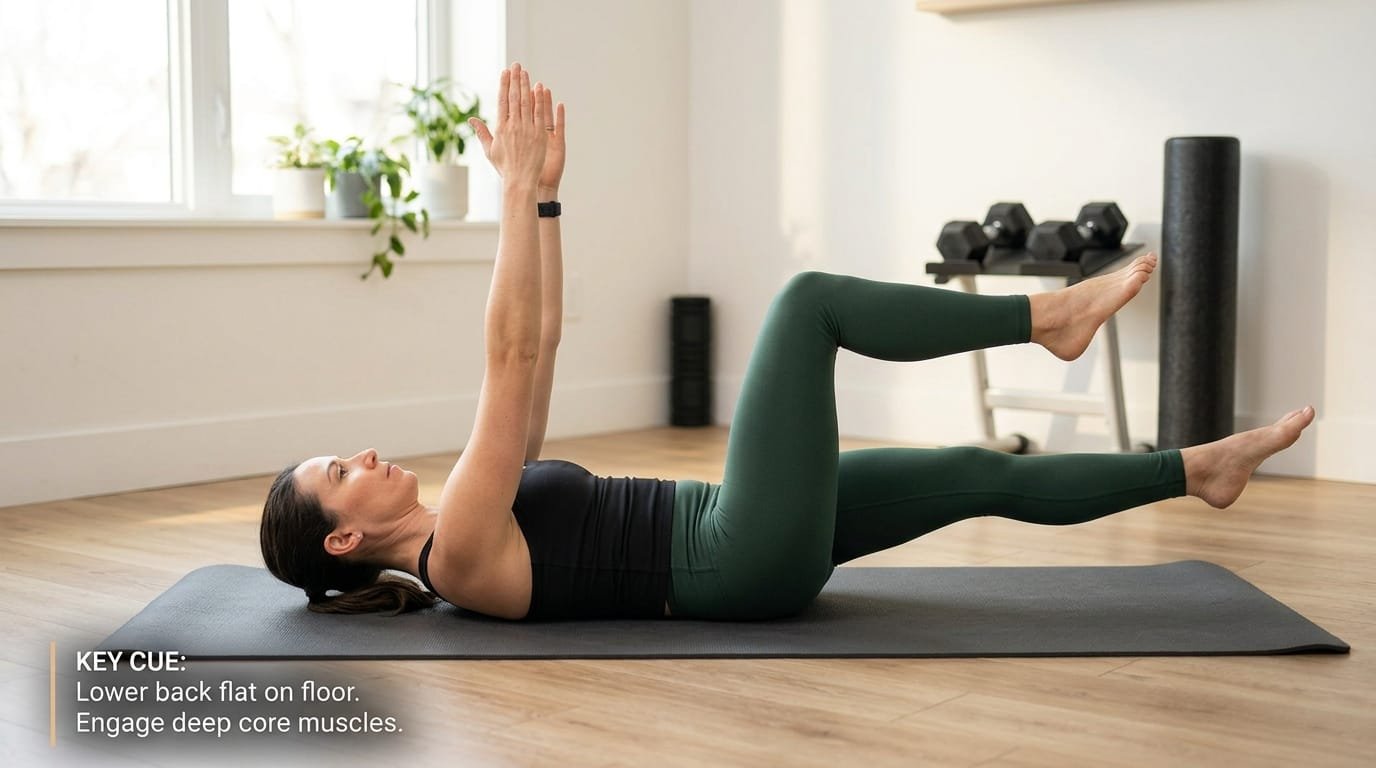
Lie on your back with arms extended and knees bent at 90 degrees. Slowly extend the opposite arm and leg while keeping the lower back pressed gently toward the floor. Return with control. Reduce range if the lower back arches.
Bird Dog
From a hands-and-knees position, extend the opposite arm and leg while keeping the hips level and the spine neutral. Pause briefly, then return. Focus on stability rather than height of the limbs.
Front Plank (High-Quality Short Holds)
Maintain a straight line from head to heels with ribs down and glutes lightly engaged. Begin with 10–20 second holds of perfect position rather than long, sagging efforts.
Side Plank
Support on one forearm and the side of the bottom foot. Keep the body in a straight line and the hips elevated. Shorten the lever (knees bent) if needed.
Pallof Press
Stand sideways to a band or cable anchored at chest height. Press the handle straight out, resisting the rotational pull. Hold briefly, then return. Keep the pelvis and ribs stable.
Suitcase Carry
Hold a weight on one side and walk with upright posture, resisting the lateral pull. This trains anti-lateral flexion and grip simultaneously.
Glute Bridge with Core Emphasis
Drive through the heels to lift the hips while keeping the ribs down. This teaches posterior-chain contribution to spinal stability.
Sample Back-Friendly Core Sessions
Session A – Anti-Extension Focus (8–12 minutes)
- Dead bug – 2–3 × 6–8 per side
- Front plank – 2–3 × 15–30 seconds
- Glute bridge – 2 × 10–12
- Bird dog – 2 × 6–8 per side
Session B – Anti-Rotation & Anti-Lateral Focus
- Pallof press – 2–3 × 8–12 per side
- Side plank – 2–3 × 15–30 seconds per side
- Suitcase carry – 2 × 20–40 seconds per side
- Dead bug or bird dog – 2 sets
Perform these after main strength work or as a short stand-alone session. Quality of position always takes priority over volume.
Progressive Overload for Back-Friendly Core Training
- Increase hold times in 5-second increments
- Add light band or dumbbell resistance
- Lengthen levers (straighter legs or arms) only when control remains perfect
- Reduce base of support (e.g., from plank on knees to full plank)
- Slow the tempo of dynamic drills
- Add mild instability only after mastery of stable variations
Never progress into pain or loss of neutral spine.
Common Mistakes That Aggravate the Lower Back
| Mistake | Result | Better Approach |
|---|---|---|
| Performing sit-ups or crunches despite symptoms | Repeated flexion under load | Replace with dead bugs and planks |
| Allowing the lower back to arch in dead bugs or planks | Lumbar extension stress | Reduce range, focus on ribs-down position |
| Holding the breath excessively | Increased pressure and tension | Coordinate bracing with controlled breathing |
| Chasing long plank holds with poor form | Sagging and lumbar stress | Short, perfect-position holds |
| Adding rotation under fatigue or load | Loss of control | Master anti-rotation first |
| Ignoring glute and hip strength | Compensatory lumbar loading | Include bridges and hinges in overall training |
Integrating Core Work with Full-Body Strength Training
A resilient core is built not only through isolation drills but also through proper bracing during squats, hinges, pushes, and pulls. Teach the same neutral-spine, 360-degree brace used in dead bugs and apply it to compound lifts. This transfers core strength into real-world and training situations while distributing stress away from the lumbar spine.
Strength training that includes intelligent core work supports long-term resilience and performance (strength training guidance). Practical home-gym approaches emphasise simple, joint-friendly systems that can be sustained for years (home gym equipment prioritisation and budget home gym principles).
Frequently Asked Questions
Can I still train core if I currently have lower-back pain?
Yes, provided every exercise remains completely pain-free. Start with the lowest-demand anti-extension and anti-rotation drills and progress only when symptoms are stable.
Are planks safe for the lower back?
High-quality planks with a neutral spine and short holds are generally safe. Sagging or excessively long holds can increase stress—prioritise position over duration.
Should I avoid all flexion exercises forever?
Not necessarily. Some people tolerate controlled flexion once symptoms resolve and motor control improves. Others do better avoiding it long-term. Individual response guides the decision.
How often should I train core?
Two to four short sessions per week are effective. The core recovers relatively quickly when volume and intensity stay moderate.
Is the ab wheel safe?
It can be when performed with a neutral spine and gradual range. Many people with back sensitivity do better starting with dead bugs and planks before attempting roll-outs.
Do I need equipment for effective core training?
No. Bodyweight dead bugs, bird dogs, planks, and side planks form a complete foundation. Bands and light dumbbells expand anti-rotation and carry options.
How long before I notice improved stability?
Many people feel better control and reduced symptoms within 2–4 weeks of consistent, pain-free practice.
Can stronger glutes help my lower back?
Yes. Glute strength and proper hip extension reduce compensatory lumbar loading. Include bridges and hinges in your overall program.
Final Recommendation
Core training that does not aggravate the lower back centres on anti-extension, anti-rotation, and anti-lateral-flexion exercises performed with a neutral spine and complete symptom control. Dead bugs, bird dogs, high-quality planks, side planks, pallof presses, and suitcase carries form a safe and highly effective foundation. Progress through longer holds, added resistance, or more challenging leverages only when the current level remains pain-free. Pair this work with strong glutes, solid bracing on compound lifts, and overall recovery habits.
Choose 3–4 of the recommended exercises today, perform them with strict attention to neutral spine and breathing, and track how your lower back responds over the next 24–48 hours. Build from a completely symptom-free baseline and progress conservatively. When core training follows these principles, you develop a stronger, more resilient midsection without the setbacks that often accompany traditional flexion-based routines. Start with the next session—the combination of smart exercise selection and disciplined technique delivers sustainable results.