How to Set Up Effective Training in a Studio Apartment
Quick Answer
Effective training in a studio apartment is achieved by selecting compact, multi-use equipment that stores vertically or under furniture, prioritising bodyweight and resistance-band movements, creating a small dedicated or convertible zone, and designing short full-body sessions that require minimal setup and teardown. Focus on compound patterns (squat/lunge, hinge, push, pull), use tempo and unilateral progressions for overload, and keep noise low. With smart storage and efficient programming, a studio can support consistent strength training without dominating the living space.
The Constraints and Opportunities of Studio Living
Studio apartments combine living, sleeping, and training space into one room. Floor area is limited, storage is scarce, and noise can affect neighbours. These constraints force prioritisation: every piece of equipment must earn its footprint, every session must be time-efficient, and every movement must remain controlled. The upside is that the best studio solutions are also among the most sustainable long-term training systems—simple, focused, and low-friction.
Core Principles for Studio Training Setup
- Vertical storage first – Walls, doors, and the backs of doors hold more than floors.
- Multi-use equipment only – Items that serve several movement patterns justify their space.
- Convertibility – The training zone must disappear or shrink when not in use.
- Quiet by default – Controlled tempos and soft contact protect neighbour relations.
- Minimal setup time – If it takes more than two minutes to start, adherence drops.
- Full-body efficiency – Each session covers the major patterns so frequency stays high even with limited total time.
Space-Efficient Equipment Recommendations
| Equipment | Footprint | Storage Method | Primary Uses | Noise Level |
|---|---|---|---|---|
| Resistance bands (set) | Very low | Drawer, bag, or wall hooks | Rows, presses, squats, pull-aparts | Very low |
| Adjustable dumbbells or fixed pair | Low–moderate | Under bed, closet, or vertical rack | Presses, rows, RDLs, squats | Low if controlled |
| Suspension trainer | Very low | Door anchor + bag | Rows, face pulls, assisted work | Low |
| Thick exercise mat | Low | Rolled or folded against wall | All floor work | Low |
| Optional foldable bench | Moderate | Under bed or vertical | Supported presses, hip thrusts | Low |
| Jump rope (optional) | Negligible | Drawer | Conditioning | Moderate |
Avoid bulky machines, large barbell sets, and anything that cannot be stored vertically or under existing furniture.
Creating the Training Zone
Option 1 – Dedicated corner
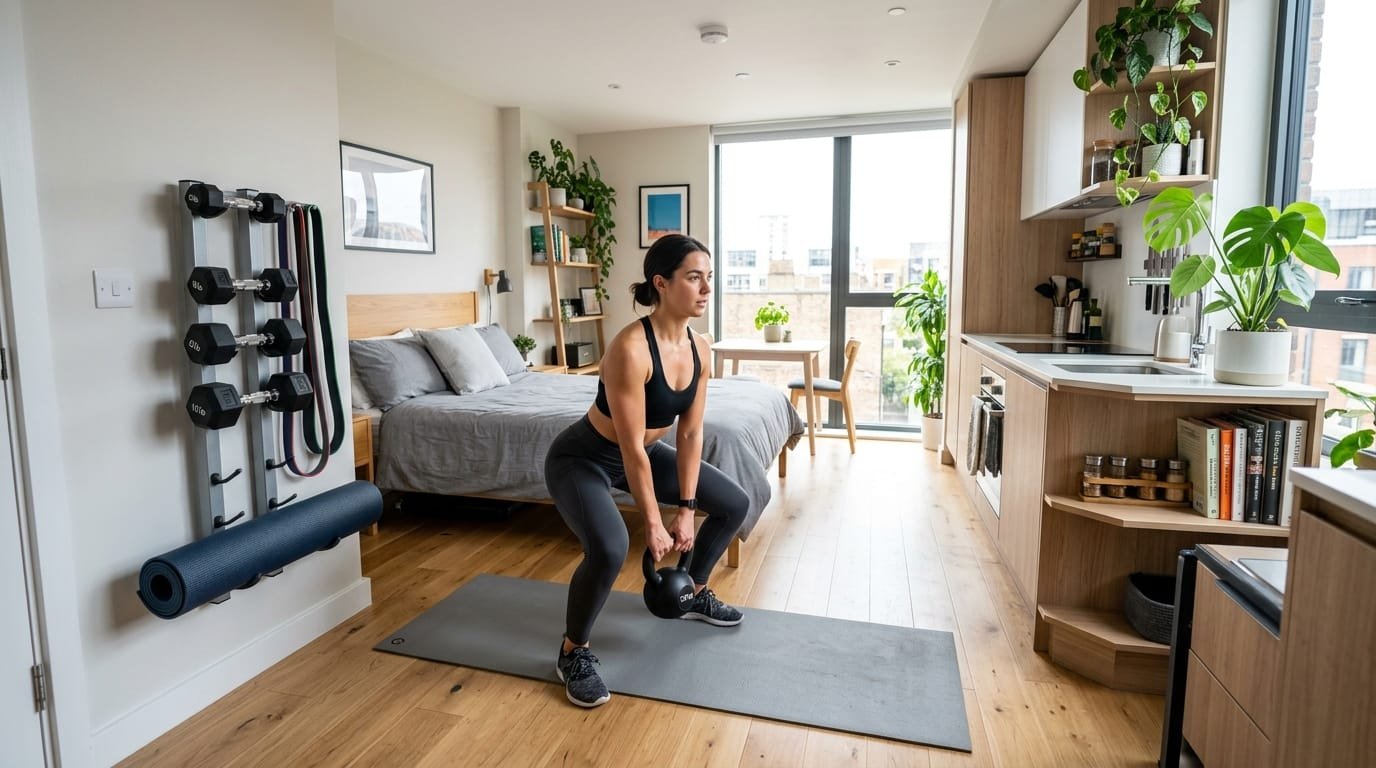
Clear a 6×6 ft (or smaller) area near a wall or door. Keep the mat down if space allows, or roll it away after each session.
Option 2 – Convertible living space
Use the area in front of a couch or bed. Move one piece of furniture temporarily, train, then restore the room.
Option 3 – Doorway and wall focus
Many effective sessions can be built around a door anchor for bands or suspension straps plus floor space for lower-body and core work.
Test the floor for stability and sound transmission. Add interlocking rubber tiles or a thick mat if vibration is a concern.
Quiet, Space-Efficient Exercise Menu
Squat / Lunge
- Goblet squat or bodyweight squat with slow tempo
- Reverse lunge or Bulgarian split squat (rear foot on chair or bed)
- Single-leg sit-to-stand from a sturdy chair
Hinge
- Single-leg Romanian deadlift
- Glute bridge or single-leg bridge
- Band good-morning
Push
- Push-up variations (elevated, standard, decline with feet on bed)
- Floor press with dumbbells or band
Pull
- Single-arm band or dumbbell row
- Inverted row under a sturdy table or suspension trainer
- Band face pulls or pull-aparts
Core / Carry
- Plank variations, dead bugs
- Suitcase carry with a dumbbell or loaded backpack across the short available distance
Shoulder-friendly technique remains important in limited space (Bent Arms vs. Straight Arms in Lateral Raises, The Hidden Mistake in Lateral Raises, and 3 Lateral Raise Modifications). Grip strength can be trained with towel holds or short band work (Do Hand Grippers Really Work?).
Step-by-Step Setup Process
- Measure the largest clear floor area you can temporarily claim.
- Choose equipment that fits the storage options you already have (under bed, closet, wall).
- Select 4–5 compound movements that cover the main patterns.
- Create a standard 25–35 minute workout and a 15-minute minimum version.
- Establish a consistent storage and setup routine so the space returns to living use quickly.
- Add soft flooring where feet and weights contact the ground.
- Test noise with a few controlled repetitions and adjust (extra mat, different time of day).
- Write the workouts down so decisions are eliminated when energy is low.
- Schedule sessions at times that minimise conflict with neighbours or roommates.
- Review every 4–6 weeks and remove any equipment or exercise that is not earning its space.
Sample Studio-Friendly Workouts
Standard 30-Minute Session
- Goblet or bodyweight squat – 3 × 8–12 (slow eccentric)
- Single-leg Romanian deadlift – 3 × 8–12 per leg
- Push-up variation – 3 × 8–15
- Single-arm row or suspension row – 3 × 8–12 per arm
- Optional plank or carry – 2 sets
Minimum Viable 15-Minute Session
- Squat or lunge – 2 sets
- Hinge – 2 sets
- Push – 2 sets
- Pull – 2 sets
Density Option
Set a timer for 20–25 minutes and rotate through the four patterns with controlled reps. Rest only as needed. Track total rounds.
Progressive Overload in Limited Space
- Slow the eccentric phase
- Add pauses at the hardest point
- Increase range of motion under control
- Move to unilateral versions
- Improve density while keeping noise low
- Add band resistance where helpful
These methods create continued progress without requiring larger equipment or more floor space.
Storage and Daily Living Integration
- Vertical wall hooks or over-door racks for bands and straps
- Under-bed storage boxes for dumbbells or a foldable bench
- A single basket or bag that holds the entire “gym” and can be moved in one trip
- Mat that rolls tightly and stands in a closet or corner
The faster the room returns to normal living use, the lower the psychological barrier to training.
Common Studio-Specific Mistakes
| Mistake | Result | Better Approach |
|---|---|---|
| Buying bulky equipment | Space conflict and eventual abandonment | Multi-use, vertical-storage items only |
| No clear setup/teardown routine | Friction and skipped sessions | Fixed 60–90 second setup process |
| Ignoring noise | Neighbour complaints | Controlled tempos and soft flooring |
| Too many exercise options | Decision fatigue | 4–5 core movements maximum |
| Training only when “in the mood” | Inconsistency | Fixed weekly target + minimum viable session |
| Neglecting recovery | Fatigue in a high-stress living environment | Sleep and protein as priorities |
Strength training with efficient, low-footprint methods remains highly effective for building and maintaining muscle and strength (strength training guidance). Practical home-gym approaches emphasise systems that work in real, constrained living spaces (home gym equipment prioritisation and budget home gym principles).
Frequently Asked Questions
How much floor space do I actually need?
A 6×6 ft area is more than enough for most effective sessions. Many workouts can be performed in even smaller zones with creative exercise selection.
Can I make real strength progress in a studio?
Yes. Progressive overload through tempo, pauses, unilateral work, and density is fully available with bands, dumbbells, and bodyweight.
What is the single most useful piece of equipment?
A set of resistance bands with a door anchor, followed by one pair of adjustable or fixed dumbbells if space and budget allow.
How do I keep the apartment from feeling like a gym?
Strict setup and teardown habits, vertical storage, and a mat that disappears after training. The room should return to living use within two minutes.
Is a foldable bench worth the space?
Only if you will use it for multiple supported movements and can store it under a bed or vertically. Otherwise, floor-based variations are sufficient.
How do I manage noise with downstairs neighbours?
Thick mats, controlled lowering of every weight, no jumping, and considerate timing. Extra layers of flooring help significantly.
Can I train effectively with zero equipment?
Yes. Bodyweight progressions (leverage, tempo, pauses, unilateral) can maintain and build strength for extended periods.
How often should I train in a studio setup?
Two to four short full-body sessions per week is realistic and effective. Consistency matters more than volume.
Final Recommendation
Effective training in a studio apartment is built on compact multi-use equipment, vertical storage, a small convertible training zone, and short full-body sessions that emphasise controlled compound movements. Choose bands and a pair of dumbbells (or pure bodyweight), keep setup under two minutes, apply progressive overload through tempo, pauses, and unilateral variations, and protect neighbour and household peace with quiet technique.
Measure your available space today, select the minimum equipment that covers the main patterns, write a standard and a minimum viable workout, and establish a fixed storage routine. When the system respects the realities of studio living, training becomes a sustainable part of daily life rather than a spatial or social conflict. Start simple, store vertically, and train consistently—the results will follow even in the smallest apartments.