Best Rotator Cuff Warm-Up to Reduce Shoulder Irritation Before Pressing
Quick Answer
The best rotator-cuff warm-up before pressing combines low-load external rotation, scapular activation, and controlled elevation patterns that prepare the cuff and scapular stabilisers without fatiguing them. A highly effective sequence includes band or light-dumbbell external rotations, face pulls or band pull-aparts, scapular push-ups or serratus work, and light scapular-plane raises. Perform 2–3 sets of 10–15 controlled repetitions for each movement, focusing on quality and blood flow rather than fatigue. This 5–8 minute routine reduces the likelihood of shoulder irritation during subsequent pressing by improving joint centring, tissue temperature, and motor control.
Why a Targeted Rotator-Cuff Warm-Up Matters
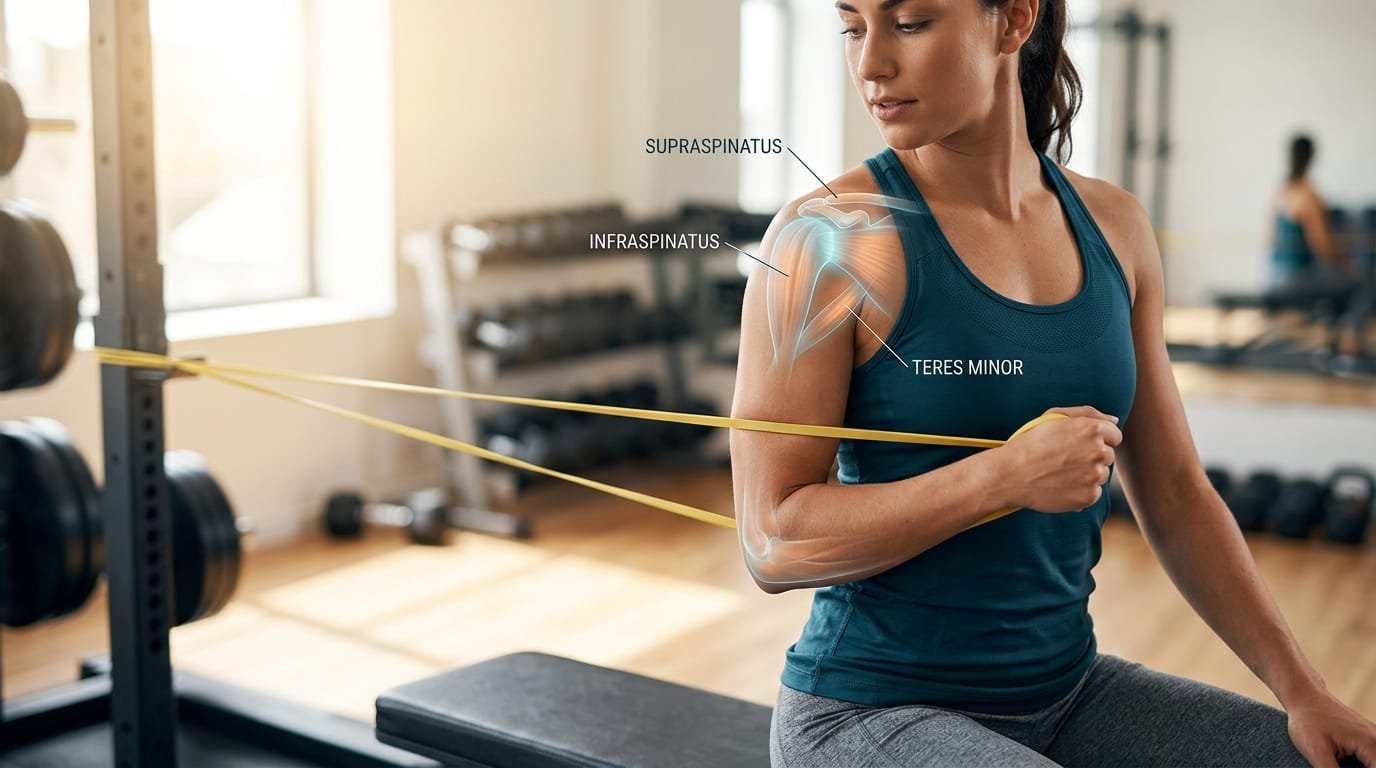
The rotator cuff (supraspinatus, infraspinatus, teres minor, and subscapularis) keeps the humeral head centred in the glenoid during arm elevation and pressing. When these muscles are cold, under-activated, or poorly coordinated with the scapular stabilisers, the humeral head can migrate upward or forward under load. This increases stress on the subacromial tissues and is a common source of irritation during bench presses, overhead presses, and related movements.
A proper warm-up raises local tissue temperature, enhances neuromuscular activation, and grooves the scapulo-humeral rhythm before heavier loads are introduced. It is not a strength session; it is targeted preparation.
Key Goals of the Warm-Up
- Activate the external rotators (infraspinatus and teres minor).
- Engage the serratus anterior and lower trapezius for upward rotation and stability.
- Promote blood flow through the cuff tendons.
- Reinforce neutral-to-externally rotated shoulder positions.
- Leave the muscles primed but not fatigued.
The Recommended Warm-Up Sequence
1. Band or Side-Lying External Rotation
- Anchor a light band at elbow height or use a very light dumbbell while lying on your side.
- Keep the elbow bent 90 degrees and tucked against your side.
- Rotate the forearm outward against resistance, pausing briefly at the end range.
- 2 sets of 12–15 repetitions per side.
This directly prepares the infraspinatus and teres minor—the primary external rotators that counteract the internal-rotation tendency of most pressing movements.
2. Band Pull-Aparts or Face Pulls
- Use a light to moderate band.
- Pull the band apart at chest-to-face height while externally rotating the shoulders (end with thumbs pointing backward).
- Emphasise scapular retraction and posterior tilt.
- 2 sets of 12–20 repetitions.
These movements activate the rear delts, lower and middle trapezius, and external rotators simultaneously.
3. Scapular Push-Ups or Serratus Punches
- In a high-plank or kneeling position, keep the arms straight and isolate scapular movement.
- Protract the shoulder blades at the top (push the floor away) and control the return.
- 2 sets of 10–15 repetitions.
Serratus anterior activation is critical for upward rotation and for preventing winging under load.
4. Light Scapular-Plane Raises
- Use very light dumbbells or bands.
- Raise the arms in the scapular plane (approximately 30 degrees forward of pure lateral) with a slight elbow bend.
- Stop at or just below shoulder height.
- 2 sets of 10–12 controlled repetitions.
This grooves elevation mechanics while reinforcing the same joint-friendly patterns detailed in Bent Arms vs. Straight Arms in Lateral Raises, The Hidden Mistake in Lateral Raises, and 3 Lateral Raise Modifications.
Optional addition for overhead-dominant days
- Wall slides or arm slides against a wall, focusing on maintaining contact and smooth upward rotation.
- 1–2 sets of 8–10 repetitions.
Comparison of Warm-Up Components
| Exercise | Primary Target | Main Benefit for Pressing | Equipment Needed |
|---|---|---|---|
| External Rotation | Infraspinatus, teres minor | Centres humeral head, counters internal rotation | Band or light dumbbell |
| Face Pull / Pull-Apart | Rear delt, lower/mid trap, external rotators | Scapular stability and posture | Band or cable |
| Scapular Push-Up | Serratus anterior | Upward rotation and anti-winging | Bodyweight |
| Scapular-Plane Raise | Lateral delt + cuff coordination | Grooves safe elevation pattern | Light dumbbells or band |
| Wall Slide | Scapular upward rotators + thoracic mobility | Overhead-specific preparation | Wall |
Step-by-Step Implementation Guide
- Perform the routine at the start of every pressing session after general light movement.
- Use loads light enough that the last repetition still feels controlled and pain-free.
- Rest only long enough to switch exercises (20–40 seconds).
- Focus on the mind-muscle connection and full range of controlled motion.
- If any movement produces sharp pain, stop and regress to a smaller range or lighter resistance.
- Keep the total warm-up under 8–10 minutes so fatigue does not impair the main work.
- Progress the warm-up only by improving quality or adding a small amount of resistance once control is excellent.
- Pair the routine with thoracic mobility work if overhead pressing is the focus.
- Maintain consistent grip and forearm readiness, as overall upper-limb stability supports pressing (Do Hand Grippers Really Work?).
- Reassess shoulder comfort during the main presses; the warm-up should make the shoulders feel more “ready” and stable.
Programming Considerations
- Use the full sequence before any heavy or high-volume pressing.
- On lighter technique days a shorter version (external rotations + pull-aparts + scapular push-ups) is often sufficient.
- Between sets of heavy presses, a single light set of external rotations or pull-aparts can serve as a “re-primer” if the shoulders begin to feel less stable.
- Balance total weekly pressing volume with adequate horizontal and vertical pulling.
Additional Supporting Practices
- Maintain thoracic extension mobility so the scapulae can rotate freely.
- Avoid starting presses completely cold, especially in the early morning or in cold environments.
- Address any existing imbalances with ongoing face pulls, Y-raises, and serratus work in the main programme.
- Ensure recovery factors (sleep, overall training load, stress) support tissue health.
Strength training performed with good preparation and joint-friendly mechanics remains one of the most effective ways to build resilient shoulders (strength training guidance). Practical home-gym approaches emphasise efficient, high-quality warm-ups that protect the joints while still allowing progressive training (home gym equipment prioritisation and budget home gym principles).
Common Warm-Up Mistakes That Reduce Effectiveness
| Mistake | Result | Better Approach |
|---|---|---|
| Using loads that are too heavy | Fatigue instead of activation | Stay very light; quality over resistance |
| Skipping external rotation | Incomplete cuff preparation | Always include direct external-rotation work |
| Turning the warm-up into a full shoulder workout | Reduced performance on main lifts | Keep volume low and stop well short of fatigue |
| Performing only internal-rotation or pressing-pattern movements | Reinforces the same stress | Emphasise external rotation and scapular upward rotation |
| Rushing through the movements | Poor motor control | Use deliberate tempos and full attention |
| Ignoring pain signals | Potential aggravation | Stay in completely comfortable ranges |
One of the most common reasons shoulder warm-ups fail to prevent irritation is that they are performed with the same intensity as the main workout. When external rotations or face pulls are loaded heavily enough to create significant fatigue, the rotator cuff and scapular stabilisers enter the pressing session already compromised. The goal of the preparatory sequence is neural activation, increased local blood flow, and refined motor patterning—not strength or hypertrophy. Keeping every warm-up set clearly in the easy-to-moderate range preserves the freshness of the tissues so they can do their stabilising job when the heavier loads begin.
Timing and order also influence effectiveness. Performing the rotator-cuff sequence after a few minutes of general full-body movement (light rowing, skipping, or dynamic mobility) raises core temperature and makes the smaller shoulder muscles more responsive. Jumping straight into isolated external rotations while the body is still cold is less productive. Likewise, finishing the warm-up with the light scapular-plane raises creates a smooth transition into the specific pressing pattern that follows, reinforcing the exact shoulder-blade rhythm needed for stable bench or overhead work.
Finally, the warm-up should be treated as a diagnostic window. Any sharp or unusual discomfort that appears during the light external rotations, face pulls, or scapular movements is valuable information. It may indicate residual irritation, incomplete recovery from prior sessions, or the need for further regression that day. Many lifters who pay attention to these early signals can adjust load, volume, or exercise selection before a mild issue becomes a full session of compromised pressing. In this way the warm-up simultaneously prepares the shoulders and provides real-time feedback that protects long-term training consistency.
Frequently Asked Questions
How long should the rotator-cuff warm-up take?
Five to eight minutes is ideal for most sessions. Longer is rarely necessary and can create fatigue.
Can I use the same warm-up before both bench press and overhead press?
Yes. The sequence above prepares the cuff and scapulae for both. Add wall slides or light overhead reaches when overhead pressing is the priority.
Is a band sufficient or do I need dumbbells?
A light resistance band is excellent and often preferable for warm-up purposes because resistance increases smoothly through the range.
Should I feel a burn in the rotator cuff during the warm-up?
A mild sense of activation is normal; a strong burning fatigue is not. Reduce resistance or volume if the muscles fatigue.
How often should I do this warm-up?
Before every session that includes horizontal or vertical pressing.
Can this warm-up help with existing mild shoulder irritation?
It often does by improving circulation and motor control, but it is not a treatment for acute injury. Persistent pain requires professional assessment.
Do I still need to warm up the rest of the body?
Yes. Perform general movement (light cardio or dynamic stretches) first, then move into this targeted shoulder sequence.
Is it okay to skip the warm-up on light days?
A shortened version is still recommended. Even light pressing benefits from prepared tissues and better neuromuscular control.
Final Recommendation
A short, focused rotator-cuff and scapular warm-up is one of the simplest and most effective ways to reduce shoulder irritation before pressing. By combining external rotations, face pulls or pull-aparts, serratus activation, and light scapular-plane raises, you improve joint centring, tissue readiness, and movement quality in less than ten minutes.
Perform the sequence before every pressing session, keep the loads light, and prioritise control over fatigue. Pair it with balanced programming and ongoing scapular strength work. Most lifters notice that presses feel more stable and comfortable almost immediately, and the cumulative effect over weeks is healthier, more resilient shoulders.
Start using the routine in your next upper-body session. Consistency with this brief preparation step pays large dividends in both performance and long-term joint health.