Best Pull-Up Solution When You Can’t Install Permanent Equipment
Quick Answer
When you cannot install permanent equipment, the best pull-up solutions are a high-quality doorway pull-up bar (lever or telescoping design), a freestanding pull-up station, or gymnastic rings hung from a sturdy overhead structure. For true beginners or those with limited strength, resistance-band-assisted variations or inverted rows using a sturdy table or suspension trainer provide effective alternatives that still build pulling strength. Prioritise safety certifications, weight ratings, and proper setup over the cheapest option. These non-permanent tools allow progressive pull-up training in apartments, rentals, and multi-use spaces without drilling holes or modifying walls.
The Core Problem: Permanent Installation Is Often Impossible
Many people live in rental apartments, shared housing, dorms, or homes where landlords prohibit wall or ceiling modifications. Traditional wall-mounted or ceiling-mounted pull-up bars are therefore off-limits. At the same time, pull-ups remain one of the highest-value upper-body strength exercises. The challenge is finding a solution that is:
- Truly non-permanent
- Safe under bodyweight (and potential added load)
- Stable enough for controlled repetitions
- Easy to set up and take down
- Progressive so strength can still improve
Fortunately, several effective options exist that meet these criteria.
Non-Permanent Pull-Up Solutions Compared
| Solution | Installation Type | Stability | Portability | Best For | Main Limitations |
|---|---|---|---|---|---|
| Doorway Pull-Up Bar (lever/telescoping) | No tools, pressure or leverage fit | Good to very good | High | Most renters and apartments | Door frame strength required; width limits |
| Freestanding Pull-Up Station | None (free-standing) | Excellent | Low to moderate | Dedicated floor space available | Larger footprint and higher cost |
| Gymnastic Rings + Anchor | Temporary strap or beam hang | Excellent when anchored well | High | Travel, outdoor, or sturdy overhead points | Requires suitable hanging point |
| Resistance Bands + Anchor | Door anchor or sturdy object | Variable | Very high | Beginners and assisted work | Different strength curve from true pull-ups |
| Inverted Rows (table or suspension) | None or minimal | Good | High | Absolute beginners and regressions | Horizontal rather than vertical pull |
| Portable Power Tower | None | Very good | Low | Multi-exercise needs | Bulk and storage demands |
1. Doorway Pull-Up Bars – The Most Popular Renter Solution
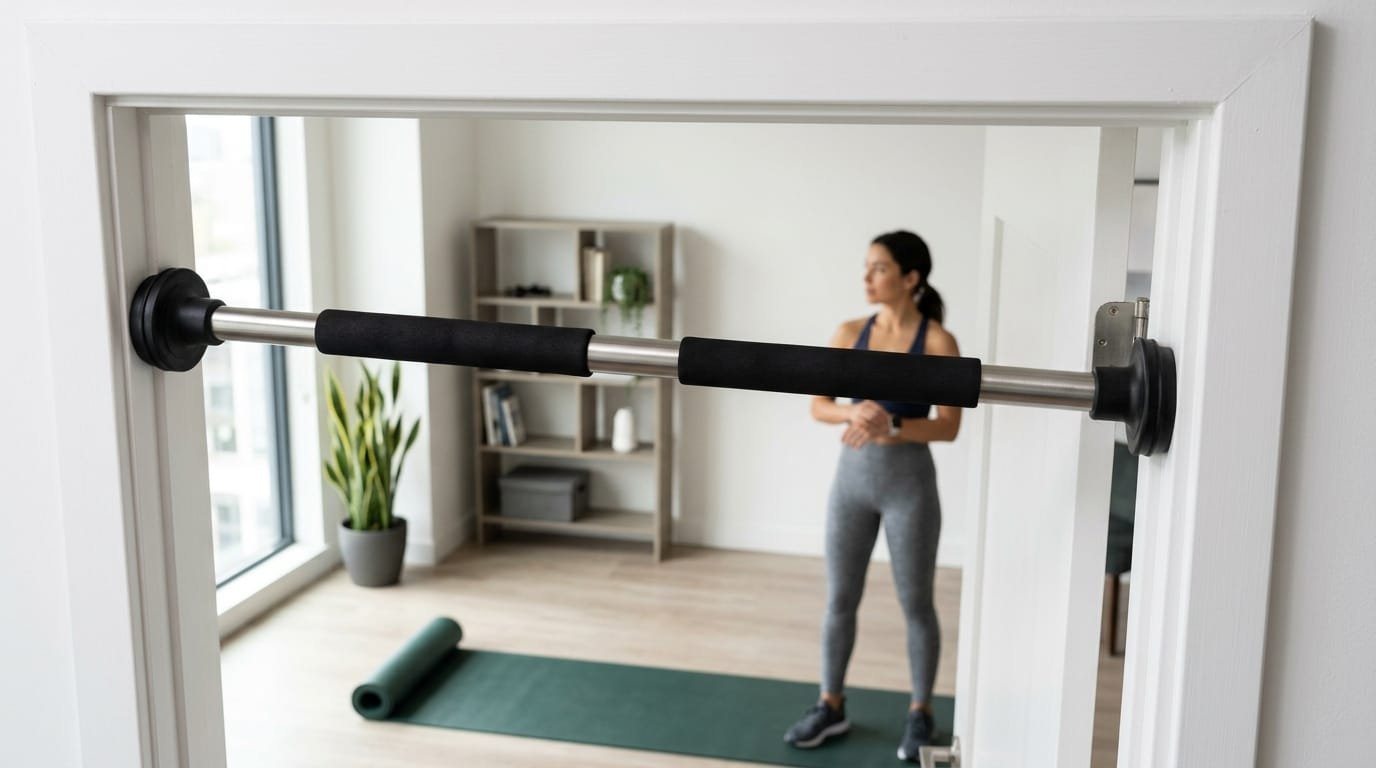
Modern doorway bars use leverage or telescoping pressure to lock into a standard door frame without screws. Quality models distribute force across the frame and include safety features such as extended grippy pads and secondary supports.
Key selection criteria
- Rated well above your bodyweight
- Compatible with your door frame width and trim style
- Non-slip contact surfaces
- Easy on/off design for shared doorways
Safety notes
Always test the bar with feet on the ground first. Avoid using on hollow-core doors or damaged frames. Perform controlled repetitions—no kipping or swinging until you are certain of stability. Many users successfully train weighted pull-ups on sturdy doorway bars once the setup is proven.
2. Freestanding Pull-Up Stations and Power Towers
These units stand on the floor and require no wall or ceiling attachment. They often include dip bars, knee-raise stations, and multiple grip positions.
Advantages
- Highest stability among non-permanent options
- No dependence on door frames or overhead structures
- Multi-function training (pull-ups, dips, core)
Disadvantages
- Significant floor space required
- Higher cost
- Less portable
They suit people who have a dedicated corner and want maximum security without installation.
3. Gymnastic Rings
Rings hung from a sturdy beam, tree, or temporary overhead anchor provide one of the most joint-friendly and progressive pull-up experiences. The instability increases core and stabiliser demand while allowing natural shoulder movement.
Setup options when permanent anchors are forbidden
- Heavy-duty door anchors (used carefully)
- Portable rack or freestanding frame
- Outdoor structures (trees, playground equipment) when available
Rings excel for long-term shoulder health and can be scaled from inverted rows all the way to advanced pull-up variations.
4. Band-Assisted and Regression Options
For beginners who cannot yet perform a full pull-up, non-permanent solutions still allow productive training:
- Resistance bands looped over a doorway bar or sturdy anchor for assistance
- Inverted rows under a solid table or with a suspension trainer
- Band-only pull-down patterns
- Scapular pulls and active hangs on any secure bar
These regressions build the exact strength and control needed for unassisted pull-ups while remaining completely equipment-light. Grip strength is a frequent limiting factor and can be trained directly (Do Hand Grippers Really Work?).
Shoulder Health and Technique Considerations
Pulling movements place demands on the scapulae, rotator cuff, and thoracic spine. Maintaining good scapular control and avoiding excessive shrugging or forward-shoulder posture improves both performance and longevity. Related upper-body technique principles appear in Bent Arms vs. Straight Arms in Lateral Raises, The Hidden Mistake in Lateral Raises, and 3 Lateral Raise Modifications.
Step-by-Step Guide to Choosing and Implementing a Solution
- Assess your living constraints (door frames, floor space, landlord rules, storage).
- Test your current pulling strength (can you perform a single controlled pull-up, inverted row, or active hang?).
- Select the primary solution that matches your constraints and strength level.
- Verify weight ratings and safety features.
- Perform a thorough stability test before full repetitions.
- Begin with regressions if needed (bands, inverted rows, scapular pulls).
- Progress volume and difficulty only while form stays clean.
- Incorporate grip and scapular work regularly.
- Re-evaluate every 4–6 weeks as strength improves.
- Maintain the equipment and inspect contact points before each session.
Progression Path When Equipment Is Limited
Phase 1 – Foundation
Active hangs, scapular pulls, inverted rows, band-assisted flex hangs.
Phase 2 – Assisted Pull-Ups
Band-assisted full range or feet-supported variations.
Phase 3 – Unassisted Pull-Ups
Eccentric-focused negatives, then full concentric repetitions.
Phase 4 – Advanced Overload
Slower tempos, paused reps, weighted variations (if the setup allows), or more challenging grips.
This path works with any of the non-permanent solutions listed above.
Safety Checklist for Non-Permanent Setups
- Confirm the anchor point or door frame can handle dynamic bodyweight loads
- Test with partial weight before full commitment
- Keep feet clear of obstacles for controlled dismounts
- Avoid swinging or kipping until the setup is proven rock-solid
- Inspect pads, levers, straps, and contact surfaces regularly
- Stop immediately if any shifting, creaking, or instability appears
Cost and Space Considerations
Doorway bars are usually the lowest-cost and lowest-space option. Freestanding stations cost more and require dedicated floor area but offer the highest security. Rings sit in the middle—inexpensive and highly portable once a suitable hanging point exists. Budget-conscious trainees often start with a doorway bar plus a set of bands and later add rings or a freestanding unit if needed. Practical home-gym guidance favours versatile, non-permanent tools that solve real constraints without overspending (home gym equipment prioritisation and budget home gym principles).
Strength training, including progressive pulling work, remains one of the most effective ways to build upper-body strength and muscle (strength training guidance).
Common Mistakes to Avoid
| Mistake | Risk | Better Approach |
|---|---|---|
| Buying the cheapest doorway bar without checking ratings | Failure under load | Choose certified, well-reviewed models |
| Skipping stability tests | Sudden collapse or fall | Always test gradually |
| Relying only on full pull-up attempts | Frustration and stalled progress | Use regressions systematically |
| Ignoring door frame condition | Damage or instability | Inspect frame and trim first |
| Neglecting scapular and grip strength | Plateau or shoulder irritation | Train them deliberately |
| Swinging on an unproven setup | Equipment shift or injury | Master strict form first |
Frequently Asked Questions
Are doorway pull-up bars safe for daily use?
Yes when the model is properly rated, the door frame is solid, and the bar is installed and tested correctly each session.
Can I do weighted pull-ups on a doorway bar?
Many people do, but only after extensive unweighted training and with a bar and frame clearly capable of handling the extra load.
What if my door frames are non-standard or weak?
Choose a freestanding station, rings with an alternative anchor, or focus on inverted rows and band work.
How long does it take to progress from assisted to unassisted pull-ups?
Typical ranges are 4–12 weeks of consistent training, depending on starting strength and frequency.
Do gymnastic rings require permanent installation?
No. They can hang from temporary straps, portable racks, or outdoor structures.
Is a freestanding power tower worth the space?
Yes if you have the floor area and want maximum stability plus additional exercises such as dips.
Can resistance bands alone build pull-up strength?
They are excellent for assistance and accessory work, but combining them with actual hanging and rowing patterns produces faster transfer to full pull-ups.
What is the best solution for complete travel?
A pair of gymnastic rings or a compact doorway bar that packs easily, plus a set of resistance bands.
Final Recommendation
When permanent installation is impossible, the best pull-up solution is the one that matches your specific constraints while still allowing progressive overload. For most renters and apartment dwellers a quality doorway pull-up bar combined with resistance bands provides the optimal balance of convenience, cost, and effectiveness. Where floor space allows, a freestanding station offers superior stability. Gymnastic rings deliver excellent long-term shoulder health and portability when a suitable temporary anchor exists.
Begin with regressions if needed, prioritise strict technique and scapular control, and progress systematically. Inspect the setup before every session and never sacrifice safety for convenience.
Choose the option that fits your living situation, test it thoroughly, and start building pulling strength immediately. Non-permanent equipment is no longer a barrier to effective pull-up training—select the right tool, use it consistently, and the results will follow.