Adjustable Dumbbells vs. Resistance Bands: Which Is Better for Muscle Growth?
Quick Answer
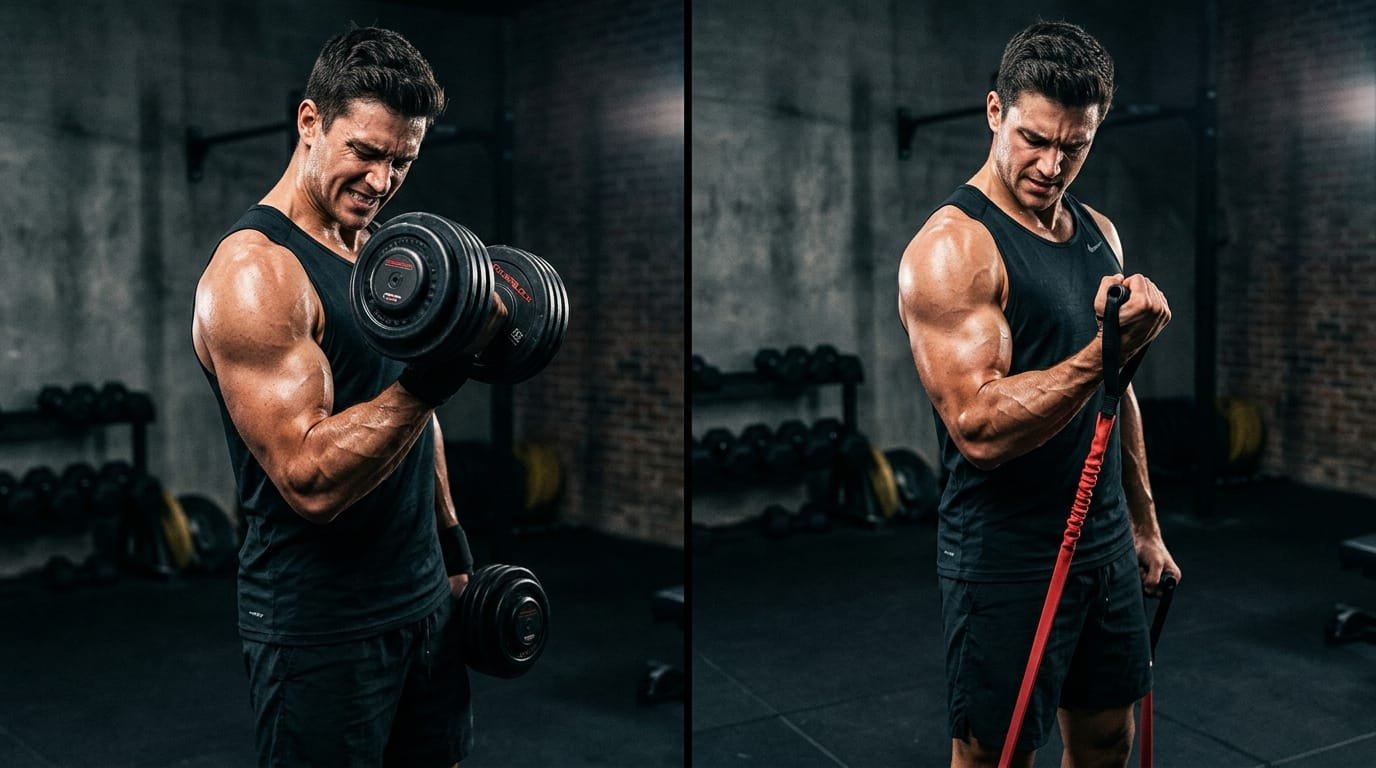
Adjustable dumbbells are generally superior for muscle growth (hypertrophy) compared with resistance bands because they provide constant mechanical tension through the entire range of motion, full eccentric loading, and precise progressive overload in small increments. Resistance bands can still build muscle effectively, particularly for beginners or when effort and volume are high, but their ascending resistance curve (lowest tension at the stretched muscle’s strongest point, highest at the weakest point) and less quantifiable progression make them less optimal as a standalone primary tool. For most home lifters whose main goal is maximal muscle growth, adjustable dumbbells should form the foundation; bands excel as a portable, joint-friendly, activation, and complementary tool.
Why Resistance Type Directly Affects Hypertrophy
Muscle hypertrophy is driven primarily by mechanical tension, metabolic stress, and muscle damage, with mechanical tension near failure being the dominant factor. Ideal loading challenges the muscle across a large range of motion and allows clear, repeatable increases in stress over weeks and months.
Adjustable dumbbells operate under constant gravity. A 22 kg dumbbell requires approximately 22 kg of force at the bottom, midpoint, and top of a movement (assuming controlled tempo). The eccentric phase remains fully loaded, and research consistently shows that eccentric stress contributes meaningfully to hypertrophy. Small weight increments (typically 2–5 lb / 1–2.5 kg per side) make progressive overload straightforward and measurable for years.
Resistance bands produce variable, ascending resistance. Tension is minimal when the band is slack (often where the muscle is strongest biomechanically) and peaks when the band is elongated (often where the muscle is weakest). During the eccentric phase the band shortens and tension drops, reducing one of the most growth-supportive portions of the repetition. Progression usually requires jumping to a thicker band, combining bands, altering leverage, or changing tempo — methods that work but are less precise than adding a small plate or turning a dial on adjustable dumbbells.
These mechanical differences explain why free weights and machines remain the gold standard for pure hypertrophy training, while bands are valued for convenience, joint comfort, warm-ups, and specific movement patterns.
Comprehensive Head-to-Head Comparison
| Factor | Adjustable Dumbbells | Resistance Bands | Advantage for Hypertrophy |
|---|---|---|---|
| Tension profile | Constant throughout ROM | Ascending (least at bottom, most at top) | Dumbbells |
| Eccentric loading | Fully loaded | Reduced as band shortens | Dumbbells |
| Progressive overload precision | Excellent (small, measurable jumps) | Moderate (band thickness, combinations, leverage) | Dumbbells |
| Loading at strongest joint angles | High and consistent | Often lowest tension | Dumbbells |
| Stability & stabiliser demand | High | Moderate to high | Similar / slight dumbbell edge |
| Joint stress at heavy loads | Higher | Lower and more accommodating | Bands (comfort) |
| Portability | Low to moderate | Excellent | Bands |
| Upfront cost | Higher | Low | Bands |
| Storage space | Moderate to high | Minimal | Bands |
| Long-term progression ceiling | Very high | Moderate without advanced techniques | Dumbbells |
| Beginner accessibility | Excellent | Excellent | Tie |
| Exercise versatility | Extremely high | High (with creativity) | Slight dumbbell edge |
Evidence and Practical Observations
Long-term head-to-head hypertrophy trials comparing exclusive band training versus free weights are relatively limited. Available research and expert consensus indicate:
- Both modalities can produce strength and muscle gains when volume is sufficient and sets are taken close to failure.
- Free weights allow more accurate loading and superior eccentric stress, which favours hypertrophy over time.
- Some short-term or athletic studies show bands matching or occasionally exceeding free weights on certain power or performance metrics, yet lean-mass advantages more frequently favour constant-resistance tools.
- Hypertrophy specialists generally recommend free weights or machines as the primary stimulus, with bands serving as an effective secondary or situational tool.
In real-world home training, many lifters achieve excellent physiques using adjustable dumbbells as the core implement and bands for warm-ups, lateral raises, face pulls, pull-aparts, and travel workouts.
Detailed Strengths and Limitations
Adjustable Dumbbells – Advantages for Muscle Growth
- Precise load selection and micro-loading support linear progression across beginner, intermediate, and advanced stages.
- Full eccentric overload on nearly every exercise.
- Simple tracking: write down the exact weight and reps.
- Suitable for compound movements (squats, hinges, presses, rows) and isolation work (curls, lateral raises, extensions).
- High ceiling — a good set of adjustables can take most trainees from novice to advanced levels of development.
Adjustable Dumbbells – Limitations
- Higher initial investment.
- Greater storage footprint.
- Less travel-friendly.
- Heavier loads can increase joint stress if technique or recovery is inadequate.
Resistance Bands – Advantages
- Extremely portable and inexpensive.
- Accommodating resistance feels joint-friendly for many users.
- Outstanding for activation drills, warm-ups, and high-repetition metabolic work.
- Easy to pair with bodyweight or dumbbells for accommodating-resistance hybrids.
- Excellent for lateral raises, pull-aparts, face pulls, monster walks, and shoulder-health work.
Resistance Bands – Limitations for Maximal Hypertrophy
- Progression is less granular and harder to quantify precisely.
- Eccentric tension decreases as the band shortens.
- Peak tension frequently occurs at biomechanically weaker joint angles.
- Elasticity degrades over time; bands can snap if worn or overstretched.
- Very advanced trainees may eventually outgrow pure band loading without creative intensity techniques.
Goal-Specific Recommendations
| Goal or Constraint | Primary Recommendation | Supporting Role | Rationale |
|---|---|---|---|
| Maximal muscle growth at home | Adjustable dumbbells | Bands for accessories & warm-ups | Superior tension profile and progression |
| Travel or ultra-minimal space | Resistance bands | Bodyweight progressions | Portability |
| Joint-sensitive training | Bands or lighter dumbbells | Focus on control and higher reps | Lower peak stress |
| Warm-ups, activation, prehab | Resistance bands | — | Ideal tension curve for pull-aparts, face pulls, external rotations |
| Beginners learning movement patterns | Either tool | — | Both teach patterns effectively |
| Intermediate to advanced progression | Dumbbells + bands | Bands as variety and deload option | Best long-term combination |
Sample Programming Approaches
Dumbbell-Primary Hypertrophy Template (3–4 days/week)
- Lower body: Goblet squat or Bulgarian split squat, Romanian deadlift or single-leg RDL
- Upper push: Dumbbell bench press or floor press, overhead press or lateral raise
- Upper pull: Single-arm row, optional rear-delt work
- Arms or accessories: Curls, triceps extensions, band pull-aparts
Progress by adding weight or repetitions while maintaining proximity to failure.
Band-Primary or Travel Template
- Lower: Banded squat or glute bridge, banded good morning or RDL variation
- Push: Band chest press or push-up variation, band overhead press or lateral raise
- Pull: Band row or face pull, pull-aparts
- Accessories: Band curls, pushdowns, monster walks
Progress by moving to a stronger band, slowing tempo, adding pauses, increasing range of motion, or elevating feet/hands for leverage changes.
Hybrid Approach (Recommended for Most Home Lifters)
Use adjustable dumbbells for the majority of compound and heavy isolation work. Use bands for warm-up activation, lateral raises, face pulls, pull-aparts, and any session where portability or joint comfort is prioritised.
Step-by-Step Implementation Guide
- Clarify your primary goal (maximum growth vs portability or joint comfort).
- If muscle growth is the priority and budget permits, purchase a quality adjustable dumbbell set first.
- Add a progressive set of resistance bands (light to strong) for warm-ups, activation, and variety.
- Log every working set — exact dumbbell weight or band tension/colour plus repetitions.
- Take most sets close to technical failure (0–3 reps in reserve).
- Attempt small progressions weekly (weight, reps, tempo, or band difficulty).
- Use bands regularly for lateral raises, pull-aparts, and face pulls to support shoulder balance.
- Occasionally combine tools (e.g., light band + dumbbell for accommodating resistance).
- Prioritise sleep, protein intake, and recovery so progressive overload remains effective.
- Reassess equipment balance every 8–12 weeks and adjust according to progress and constraints.
Integrating Both Tools Across Your Full Programme
Adjustable dumbbells and bands support balanced, long-term training. Apply them to lateral raises while following the form and safety principles in How to Perform Safe Lateral Raises if You Have Shoulder Impingement History and the complementary Shoulder Health Routine to Pair with Lateral Raise Training.
Kettlebells add powerful hip-hinge and conditioning options that pair well with both tools (kettlebell sizing guide). Grip strength becomes increasingly important as dumbbell loads rise and also improves band-handle control (grip strength guidance.
Band selection, types, and quality considerations are covered in Resistance Bands Buying Guide: Loop vs. Tube vs. Fabric – Which Wins?. Core training and ab-roller progressions work with either implement (ab roller for beginners). Conditioning sessions remain valuable for overall fitness and calorie expenditure (manual treadmill guidance and broader cardio comparisons).
Recovery practices allow consistent progressive overload (Best Post-Workout Recovery Tools for Home Lifters, Best Massage Gun for Post-Workout Recovery on a Budget, and Sleep and Recovery Strategies When Training with Heavy Home Weights). Systematic tracking is essential regardless of tool (Best Ways to Track Progress Without a Gym or Personal Trainer.
External analyses and practical reviews support the position that free weights generally hold advantages for hypertrophy due to constant tension and eccentric loading, while bands remain highly effective when used with high effort and progressive intent (dumbbells vs resistance bands for muscle growth).
Common Mistakes and Corrections
- Expecting bands alone to match long-term dumbbell progression without intensity techniques → Add tempo, pauses, partials, or band combinations.
- Using bands that are too light and never approaching failure → Choose tension that challenges the target 8–20 rep range near failure.
- Neglecting eccentric control with dumbbells → Lower the weight under control for 2–4 seconds.
- Failing to log band tension or dumbbell load → Track every session so progression is visible.
- Relying exclusively on one tool when a hybrid approach is superior → Use dumbbells for primary loading and bands for activation, variety, and travel.
- Ignoring shoulder-health work → Regularly include band pull-aparts, face pulls, and external rotations.
Frequently Asked Questions
Can I build significant muscle using only resistance bands?
Yes, particularly as a beginner or early intermediate, provided you train close to failure with adequate volume and find ways to progress difficulty. Results are typically easier to maximise and sustain with adjustable dumbbells as the main tool.
Are adjustable dumbbells worth the higher cost for home use?
For lifters focused on muscle growth, yes. The ability to micro-load and progress precisely for years delivers excellent long-term value compared with repeatedly buying new fixed-weight pairs or thicker bands.
Should I own both adjustable dumbbells and bands?
This is the optimal setup for most home trainees. Dumbbells handle the majority of progressive heavy and moderate work; bands cover warm-ups, activation, lateral raises, face pulls, and portable sessions.
Do bands stimulate the same muscle growth as dumbbells?
They can produce growth, but the constant tension and superior eccentric loading of dumbbells generally make them more efficient per unit of effort for hypertrophy.
Which tool is better for absolute beginners?
Both are effective. Bands are more forgiving on joints and cheaper to start; dumbbells teach free-weight control early and offer clearer progression.
How do I continue progressing once I outgrow my strongest bands?
Move to thicker bands, combine multiple bands, slow the eccentric, add pauses at the hardest point, increase range of motion, elevate the body for leverage changes, or introduce dumbbells.
Are bands better than dumbbells for lateral raises?
Many lifters find bands more joint-friendly and equally or more effective for lateral raises because tension peaks at the top. A combination or preference-based choice works well.
Can I combine bands and dumbbells on the same exercise?
Yes. Adding a light band to a dumbbell movement creates accommodating resistance (harder at the top), which some trainees find beneficial for certain lifts.
How important is training close to failure with either tool?
Very important. Mechanical tension near failure is a primary driver of hypertrophy regardless of whether the resistance comes from dumbbells or bands.
Final Recommendation
For pure muscle growth in a home setting, adjustable dumbbells hold the clear advantage due to constant tension, full eccentric loading, and precise, long-term progressive overload. Resistance bands remain an outstanding complementary tool — inexpensive, portable, joint-friendly, and highly effective for warm-ups, activation, lateral raises, face pulls, and travel training.
The most effective home solution for the majority of lifters is a quality pair of adjustable dumbbells paired with a progressive set of resistance bands. Use the dumbbells for the bulk of your compound and isolation loading, and use the bands to enhance shoulder health, add variety, and keep training possible when space or travel limits equipment. Track your work diligently, train close to failure, progress over time, and recover adequately. This combination delivers excellent hypertrophy results without requiring a commercial gym membership. Start with the tool that fits your current budget and space, add the second when possible, and focus on consistent progressive effort — muscle growth will follow.