Effective Core Routine Using Only a Medicine Ball and Floor Space
Quick Answer
An effective core routine using only a medicine ball and floor space builds strength, anti-extension stability, anti-rotation control, rotational power, and muscular endurance. The highest-value exercises include medicine-ball dead bugs, Russian twists, weighted sit-up and crunch variations, plank variations with the ball, woodchop patterns, rollouts, and toe-touch or V-up movements. Perform these 2–4 times per week with progressive overload (heavier ball, slower tempos, more reps/sets, or reduced rest). This minimal setup trains the entire core complex — rectus abdominis, internal and external obliques, transverse abdominis, and deeper stabilisers — without machines, cables, or large equipment.
Why the Medicine Ball Excels for Core Training
The medicine ball provides external resistance, introduces controlled instability, enables rotational and diagonal force vectors, and supports both slow strength work and higher-velocity power development. Unlike pure bodyweight exercises, it offers straightforward progressive overload simply by changing ball weight or lever length. Almost every high-value core pattern can be performed on the floor with no wall, partner, or additional tools required.
Structured core training improves trunk stability, force transfer between the lower and upper body, posture, and resilience. A 2023 systematic review and meta-analysis found that core training programmes lasting 6–8 weeks (performed 2–3 times per week) produced meaningful improvements in balance and related performance measures in healthy adults (evidence summary on core training benefits).
Core Functions and Matching Medicine-Ball Exercises
| Core Function | Training Goal | Best Medicine-Ball Exercises | Primary Muscles Targeted |
|---|---|---|---|
| Anti-extension | Resist lumbar extension / maintain neutral spine | Dead bug with ball, plank with ball roll, kneeling rollout | Transverse abdominis, rectus abdominis, deep stabilisers |
| Anti-rotation | Resist unwanted twisting | Single-arm ball holds, side-plank variations, Pallof-style presses | Obliques, transverse abdominis |
| Trunk flexion | Controlled spinal flexion under load | Weighted sit-ups, crunches, V-ups, toe touches | Rectus abdominis |
| Rotation & Diagonal | Dynamic rotational strength and control | Russian twists, woodchops, seated rotational passes | Internal & external obliques |
| Integrated hip-core | Hip flexion with trunk stability | Leg raises with ball, mountain-climber variations, reverse crunch with ball | Lower abs, hip flexors, stabilisers |
Detailed Exercise Library with Form Cues and Progressions
1. Medicine-Ball Dead Bug (Foundational Anti-Extension)
Lie on your back, knees bent at 90°, holding the ball over your chest. Slowly extend one arm and the opposite leg while pressing the lower back into the floor and keeping the ball stable. Return to the start and alternate.
Key cues: continuous lower-back contact with the floor, controlled breathing, no arching.
Progressions: heavier ball, slower tempo, longer pauses at extension, straight-leg variations, or holding the ball farther from the body.
2. Russian Twist
Sit with knees bent, lean the torso back to approximately 45°, and hold the ball at chest height. Rotate the shoulders and ball from side to side in a controlled manner. Feet may stay on the floor or be elevated for increased difficulty.
Key cues: chest tall, movement initiated from the trunk rather than the arms, constant tension.
Progressions: heavier ball, slower tempo with pause at each side, feet elevated, or arms extended.
3. Medicine-Ball Sit-Up / Crunch Variations
Hold the ball at the chest or fully overhead and perform sit-ups or crunches. Overhead positioning lengthens the lever and increases demand.
Key cues: controlled eccentric, avoid pulling on the neck, full but comfortable range.
Progressions: heavier ball, slower lowering phase, adding a press at the top, or single-arm variations.
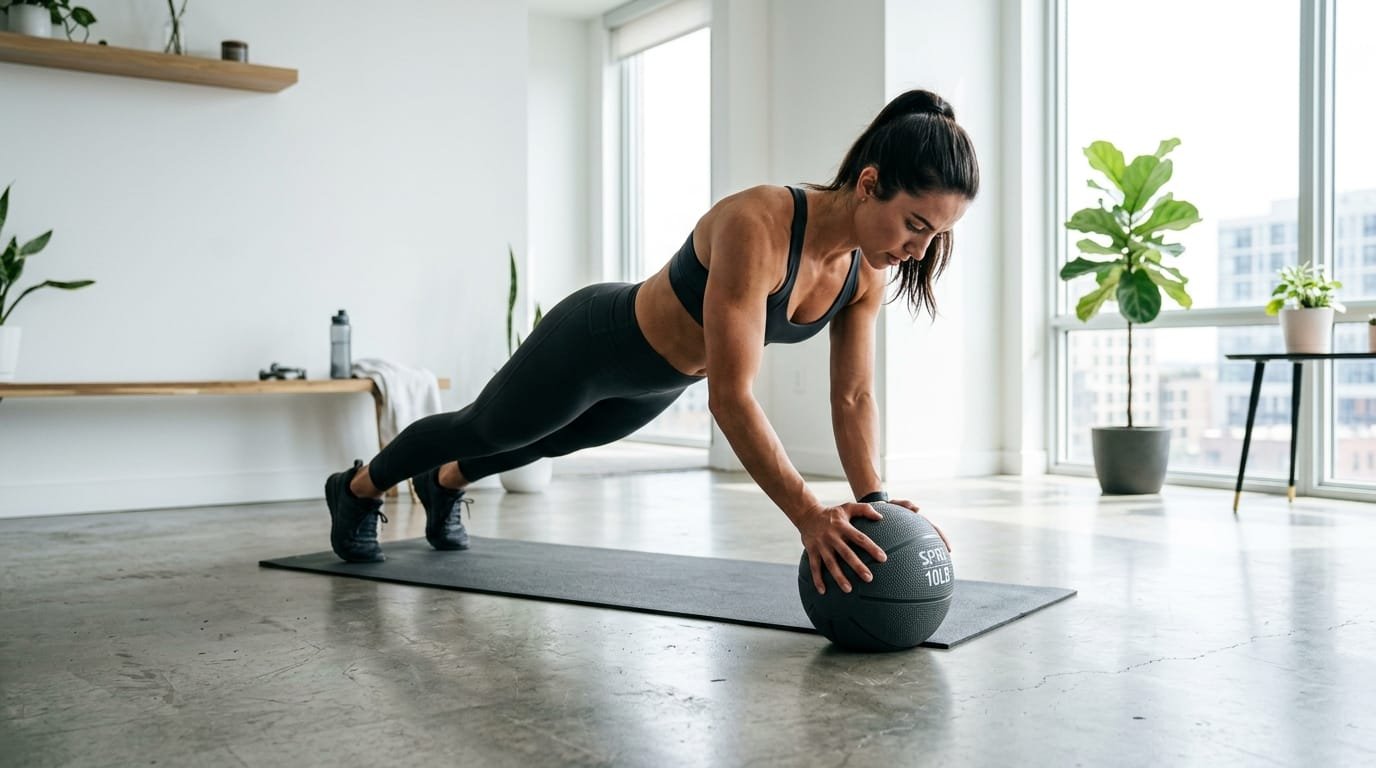
4. Plank with Medicine-Ball Variations
Place both hands on the ball in a plank position or perform shoulder taps / small rolls while minimising hip and torso rotation.
Key cues: rigid body line, braced core, steady breathing.
Progressions: single-arm support, larger rolls, longer holds, or moving the ball in controlled circles.
5. Medicine-Ball Woodchop
From a kneeling or staggered standing position, move the ball in a controlled diagonal path from high on one side to low on the opposite side, rotating through the hips and trunk. Reverse the direction.
Key cues: hips and shoulders move together, core braced throughout, avoid excessive lumbar twisting.
Progressions: heavier ball, faster controlled tempo, or full standing rotational patterns when space allows.
6. Kneeling Medicine-Ball Rollout
Kneel with both hands on the ball and roll it forward while maintaining a neutral spine and braced core, then pull back to the start.
Key cues: no lumbar sagging, constant tension, controlled range.
Progressions: greater distance, slower tempo, or progressing toward full ab-wheel-style range.
7. Side Plank with Ball Reach or Hold
In a side plank, hold the ball on the top hip or reach it underneath the torso and return. Builds lateral stability and oblique strength.
8. Toe Touches or V-Ups with Ball
Hold the ball in the hands or between the feet and perform controlled toe-touch or V-up movements, emphasising posterior pelvic tilt.
Sample Routines by Level
Beginner Routine (2–3 sessions per week)
- Medicine-ball dead bug – 3 sets of 6–8 per side
- Russian twist – 3 sets of 8–10 per side
- Medicine-ball crunch – 3 sets of 10–15
- Plank with hands on ball – 3 holds of 20–40 seconds
Rest 45–75 seconds between exercises.
Intermediate Routine
- Dead bug with pause – 3–4 sets of 8 per side
- Russian twist (feet elevated option) – 3–4 sets of 10–15 per side
- Overhead medicine-ball sit-up – 3 sets of 8–12
- Plank ball rollout or shoulder taps – 3 sets
- Woodchop – 3 sets of 8–10 per side
Advanced Circuit Finisher (2–3 rounds)
- Russian twist × 12–15 per side
- Medicine-ball V-up or toe touch × 10–12
- Side-plank reach-through × 8 per side
- Ball rollout × 8–10
Minimal rest between movements; 60–90 seconds between rounds.
Step-by-Step Implementation
- Select an appropriate ball weight (typically 4–10 kg / 8–20 lb for most trainees; lighter for speed-oriented work, heavier for slow strength).
- Master the dead bug and basic braced plank before adding significant load or complexity.
- Schedule core work 2–4 times per week — at the end of strength sessions or as short standalone sessions.
- Emphasise continuous tension and controlled movement rather than momentum.
- Progress systematically via heavier ball, slower tempos, added pauses, increased range, more volume, or reduced rest.
- Coordinate breathing with bracing (exhale on effort while maintaining tension).
- Log ball weight, reps, and sets to ensure progressive overload.
- Integrate with full-body strength training for optimal results.
- Allow recovery — the core is involved in nearly every compound movement.
- Reassess every 4–6 weeks and adjust exercise selection or volume.
Programming Variables and Overload Methods
- Strength focus: heavier ball, 6–10 reps, slower tempos
- Endurance focus: lighter ball, 12–20 reps or longer holds
- Power focus: moderate ball, controlled but faster rotational patterns (when technique is solid)
Practical weekly volume of 6–15 hard sets distributed across anti-extension, anti-rotation, flexion, and rotational work suits most trainees. Beginners should begin at the lower end. Medicine-ball throws and rotational power work are supported by NSCA guidance on core power development (rotational core training principles).
Integration with Broader Training
A strong, stable core improves performance and safety in almost every lift and athletic action. Maintain healthy shoulder mechanics during pressing and isolation work by applying the technique principles outlined in safe lateral-raise guidance. Grip strength enhances control when holding the ball — develop it with methods from grip strength guidance.
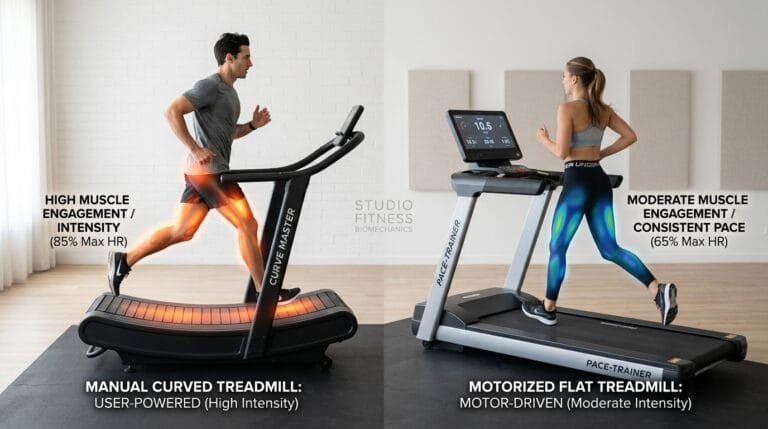
Kettlebell training pairs excellently with medicine-ball core work for posterior-chain and conditioning benefits (kettlebell sizing guide). Once floor-based control is solid, progress toward advanced tools such as the ab roller. Low-impact conditioning options discussed in manual treadmill guidance work well on recovery-oriented days. A budget massage gun can assist with residual trunk and hip tension.
Additional exercise libraries and programming ideas appear in practical medicine-ball core resources (medicine ball ab exercise collections).
Common Mistakes and Corrections
- Choosing a ball that is too heavy → reduce load until form is crisp.
- Using momentum on twists and chops → slow the tempo and focus on trunk rotation.
- Allowing lumbar extension on dead bugs or rollouts → reduce range and emphasise posterior pelvic tilt / bracing.
- Over-emphasising crunches while neglecting anti-extension and anti-rotation → balance the functions.
- Training core daily at high volume → allow recovery between harder sessions.
- Holding the breath excessively → practice braced breathing.
Frequently Asked Questions
What medicine-ball weight is best to start with?
Most beginners succeed with 4–6 kg (8–14 lb). Select a weight that permits controlled technique for the target repetitions. Heavier is not automatically better.
How frequently should I train core with a medicine ball?
2–4 times per week is effective for the majority of people. The core recovers relatively quickly but is also heavily involved in other training, so avoid excessive daily high-volume work.
Can a medicine-ball routine alone build visible abs?
Yes, when progressive overload, sufficient protein intake, and appropriate body-composition management are present. The ball supplies effective mechanical tension for hypertrophy.
Do I need to perform ball slams?
No. Controlled floor-based exercises (dead bugs, twists, sit-ups, rollouts, woodchops) deliver excellent strength and stability results. Slams are optional when ceiling height and flooring permit.
Is this sufficient for athletic performance?
It develops a robust foundation of strength, stability, and rotational capacity. Athletes can later incorporate higher-velocity throws against a wall for greater power specificity.
How soon will I notice results?
Improvements in control and muscular endurance often appear within 2–4 weeks. Visible changes and strength gains typically become noticeable after 6–12 weeks of consistent progressive training.
Is the routine safe for beginners?
Yes. Begin with lighter loads, master the dead bug and braced plank positions, and progress gradually while prioritising technique.
How does this compare to an ab wheel?
Both are excellent. The medicine ball offers greater variety (rotation, flexion, anti-rotation) and easier load progression, while the ab wheel provides a particularly strong anti-extension challenge. Many trainees benefit from using both over time.
Final Recommendation
Build an effective core with only a medicine ball and floor space by emphasising anti-extension (dead bugs and rollouts), anti-rotation, controlled flexion, and rotational patterns such as Russian twists and woodchops. Train 2–4 times per week and apply progressive overload through ball weight, tempo, volume, or exercise difficulty.
Master the foundational movements, prioritise controlled technique and continuous tension, and integrate the work into a balanced overall programme. When consistency and progression are present, a single medicine ball becomes a highly effective tool for developing a strong, stable, and resilient core — no machines or large space required. Start with the beginner routine, track your performance metrics, and advance systematically for lasting results.