Budget Home Gym Checklist for Strength + Cardio Without Breaking the Bank
Quick Answer A complete, effective home gym that covers both progressive strength training and meaningful cardio can be built for $300–$600 by following a strict priority checklist. The essential core is adjustable dumbbells, a stable bench, a doorway pull-up bar, a resistance-band set, a quality mat, and one high-value cardio tool (jump rope, used stationary bike, or compact rower). This combination supports full-body strength development, muscle growth, and cardiovascular conditioning without expensive machines, ongoing memberships, or wasted purchases. Buy in the exact order listed, train consistently for 8–12 weeks before any upgrades, and only add items that solve a proven limitation.
Why Most Budget Gyms Fail — and How a Checklist Prevents It
The two most common failures are under-equipping (leading to rapid plateaus) and over-buying single-purpose or low-use items (leading to clutter and abandoned equipment). A prioritised checklist forces every dollar toward tools that deliver progressive overload for strength and efficient conditioning for cardio. Independent 2026 budget analyses repeatedly show that adjustable dumbbells + bench + pull-up bar + bands + one simple cardio tool produce the highest long-term training return per dollar spent (practical staged examples available at Home Gym Foundry’s $500 builds).
The Complete Prioritised Checklist
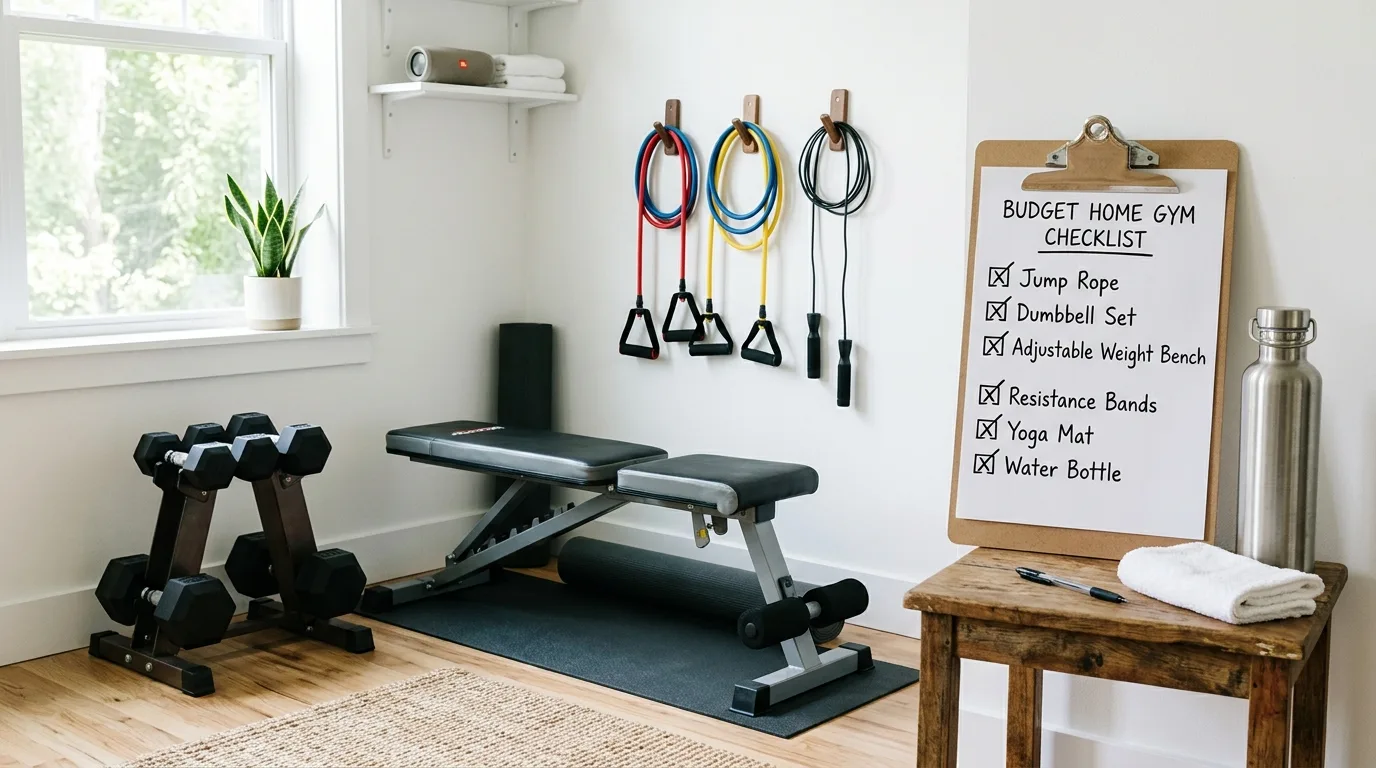
| Priority Rank | Item | Primary Strength Benefit | Primary Cardio / Conditioning Benefit | Realistic Budget Range | Why It Belongs Here |
|---|---|---|---|---|---|
| 1 | Adjustable dumbbells | Progressive loading for all major patterns | Metabolic complexes and finishers | $150–$280 | Highest overall training value |
| 2 | Stable bench | Horizontal & incline pressing, supported rows | — | $90–$150 | Multiplies dumbbell usefulness dramatically |
| 3 | Doorway pull-up bar | Vertical pulling and hanging core work | — | $25–$45 | Best strength-to-cost ratio available |
| 4 | Resistance band set | Assistance, face pulls, added resistance, mobility | Band complexes and warm-ups | $20–$40 | Fills gaps dumbbells cannot cover easily |
| 5 | Exercise mat / basic flooring | Floor exercises, joint protection, defined space | — | $20–$50 | Non-negotiable for safety and comfort |
| 6 | Cardio tool (choose one primary) | — | Dedicated conditioning | $15–$300 | Completes the strength + cardio equation |
| 7 (Optional) | Single kettlebell | Ballistic hinges and carries | High-value conditioning | $30–$70 | Excellent once core is solid |
| 8 (Optional) | Extra jump rope or recovery tool | — | Variety or recovery support | $10–$80 | Only after consistent use of core items |
Realistic total for a robust strength-plus-cardio gym: $350–$600. Aggressive used-market shopping for dumbbells and a basic jump rope can create a functional version under $300.
Strength Checklist – In-Depth Breakdown
1. Adjustable Dumbbells (Absolute Priority) These are the single most important purchase. One pair replaces an entire rack of fixed weights and enables precise progressive overload for squats, hinges, presses, rows, and carries. Aim for a range that supports at least 12–18 months of progress (commonly 5–50 lb or higher per hand).
Detailed selection criteria, adjustment mechanisms, durability factors, and common mistakes are covered in our full guide: How to Choose the Best Adjustable Dumbbells for Home Gyms in 2026.
2. Bench A stable bench transforms dumbbells from limited tools into a near-complete upper-body and lower-body station. It enables flat and incline presses, seated shoulder work, chest-supported rows, hip thrusts, and Bulgarian split squats. A good flat bench is sufficient for most beginners; an adjustable model adds incline options if the budget stretches.
3. Doorway Pull-Up Bar Vertical pulling is the pattern most often missing in pure dumbbell or bodyweight programmes. A simple doorway bar supplies pull-ups, chin-ups, neutral-grip variations, and hanging leg raises at very low cost. Multi-grip designs increase versatility.
4. Resistance Bands Bands provide assistance for pull-ups, accommodate resistance for shoulder health work (face pulls, pull-aparts), add tension to squats and presses, and enable effective warm-ups and mobility. A complete set of loops plus tubes with handles covers nearly every need. Full type comparison and buying advice: Resistance Bands Buying Guide: Loop vs. Tube vs. Fabric – Which Wins?.
5. Mat or Basic Flooring Protects floors, improves comfort for floor-based exercises, and creates a clear psychological training zone. This is not optional if you value joint health and equipment longevity.
Cardio Checklist – High-Value Options Ranked
| Cardio Option | Approx. Cost | Space Needed | Noise | Conditioning Quality | Best Use Case | Main Limitation |
|---|---|---|---|---|---|---|
| Speed or weighted jump rope | $10–$30 | Minimal | Low–moderate | Excellent for HIIT & coordination | Primary budget cardio | Skill acquisition & ceiling height |
| Used upright or spin bike | $50–$200 | Small | Low | Very good for steady-state & intervals | Low-impact indoor option | Finding quality used units |
| Compact magnetic rower | $200–$350 | Moderate (many fold) | Low | Outstanding full-body | Best overall indoor conditioning | Higher cost within tight budgets |
| Outdoor walking/running | Free | None | None | Excellent base aerobic | Daily movement | Weather & time dependence |
| Bodyweight + band circuits | Free | Training zone | Low | Good metabolic conditioning | No-equipment days | Harder to progress long-term |
For most budgets, a quality jump rope delivers the highest conditioning return per dollar and square foot. A used bike or compact rower becomes the better choice when low-impact, indoor, or joint-friendly options are priorities. Related low-impact discussions appear in Does a Manual Treadmill Burn Belly Fat?.
Step-by-Step Construction Order
- Fix a hard total budget and allocate 40–60% to adjustable dumbbells.
- Buy the dumbbells and mat first so training can begin immediately.
- Add the bench and pull-up bar.
- Purchase a complete resistance-band set.
- Select and add one primary cardio tool (start with a jump rope unless you have a clear preference for low-impact).
- Write a simple weekly strength + cardio template using only these tools.
- Train consistently for a minimum of 8–12 weeks while tracking loads, reps, and conditioning sessions.
- Evaluate real limitations (weight ceiling, desire for swings, need for low-impact cardio, etc.).
- Add a kettlebell or minor upgrade only if a clear need exists.
- Repeat the evaluation process every 3–6 months.
Sample Progressive Weekly Template
Day 1 – Upper Strength Dumbbell bench press – 3–4 sets of 8–12 Single-arm dumbbell row – 3 sets of 10–12 per side Dumbbell overhead press – 3 sets of 8–12 Pull-ups or band-assisted pull-ups – 3 sets near failure Band face pulls – 3 sets of 15–20 Optional 5–8 minutes jump-rope finisher
Day 2 – Cardio / Conditioning Jump-rope intervals (e.g., 30s work / 30s rest × 10–20) or 25–40 minutes steady bike/rower or mixed bodyweight + band circuit
Day 3 – Lower + Hinge Strength Goblet squat – 3–4 sets of 8–12 Dumbbell Romanian deadlift – 3 sets of 10–12 Reverse lunges or Bulgarian split squats – 3 sets of 8–10 per leg Optional kettlebell swings – 3 sets of 12–15 Core work (planks, hanging knee raises, or ab-wheel progressions)
Day 4 – Optional Active Recovery or Second Cardio Easy walking, light cycling, or mobility + band work
Progress strength by increasing weight or repetitions while maintaining form. Progress cardio by extending duration, increasing work density, or raising intensity.
Optional High-Value Add-Ons (Only After Core Mastery)
- Single kettlebell for ballistic work and carries — sizing guidance in How Heavy Should My Adjustable Kettlebell Be?
- Basic foam roller or budget massage gun once training frequency creates recovery needs
- Ab wheel for progressive core challenge — see Best Ab Roller or Wheel for Beginners Without Back Pain
- Dedicated grip tools to improve pull-up performance and carrying capacity — grip strength guidance
Always maintain healthy shoulder mechanics on pressing and isolation movements by applying the principles outlined in safe lateral-raise technique.
Smart Budget Allocation
- 40–60% of total budget → adjustable dumbbells
- 15–25% → bench
- 10–15% → pull-up bar + bands + mat
- 10–25% → primary cardio tool
- Remaining → optional kettlebell or recovery items
Used adjustable dumbbells and a second-hand bike or rower can reduce total cost dramatically while preserving function. Verify weight ratings, locking mechanisms, and overall condition before purchasing used strength equipment.
Frequent Budget Mistakes That Waste Money
- Buying a large multi-gym or cable machine before mastering free-weight progressive overload
- Prioritising a treadmill or elliptical before owning solid strength tools
- Collecting fixed dumbbells instead of one pair of adjustable dumbbells
- Skipping the pull-up bar and bands entirely
- Purchasing recovery gadgets or specialty bars before establishing consistent training
- Ignoring floor protection and creating noise or damage issues
- Upgrading equipment out of boredom rather than genuine loading limitations
Frequently Asked Questions
What is the absolute minimum viable strength + cardio setup? Adjustable dumbbells (or a usable fixed set), a pull-up bar, resistance bands, a mat, and a jump rope or consistent outdoor walking. Add a bench as soon as budget allows.
Is a jump rope genuinely enough for cardio? For a large percentage of people, yes. It provides excellent high-intensity conditioning, improves coordination, and requires almost no space or money. Combine it with strength complexes and walking for a complete picture.
Should I buy used cardio equipment? Yes, provided you can test resistance function, smoothness, stability, and noise level. Avoid machines with electronic failures or excessive wear on contact points.
How long will this budget checklist support progress? Most beginners and early intermediates make strong progress for 12–24 months before the available loading or exercise variety becomes a genuine limitation.
Can I build muscle and improve conditioning at the same time on a tight budget? Yes. Focus on progressive strength work as the priority and add 1–3 dedicated cardio or conditioning sessions per week. Nutrition, sleep, and consistency remain more important than additional equipment.
Where are the best places to buy? Major online retailers for new items (with return policies) and local used markets (Facebook Marketplace, Craigslist, community groups) for dumbbells, benches, and cardio machines. Always verify specifications and condition.
Do I need a power rack on a budget? No. A power rack becomes relevant only after you have maximised progressive overload with dumbbells and specifically want heavier barbell training with safety supports.
Final Recommendation
Follow this prioritised checklist to build a complete strength-plus-cardio home gym without overspending: secure adjustable dumbbells first, add a bench and pull-up bar, include resistance bands and a mat, then choose one efficient cardio tool (a jump rope is the highest-value starting point for most people). Allocate budget according to training impact, buy used where quality and safety can be confirmed, and run a simple progressive programme for at least 8–12 weeks before considering any upgrades.
This disciplined approach delivers real strength gains, effective conditioning, and long-term sustainability at a fraction of the cost of commercial memberships or high-end equipment collections. Stick to the order, track your performance, prioritise technique and recovery, and expand only when the current tools demonstrably limit further progress. When executed with consistency, the budget checklist produces a home gym that is both highly effective and genuinely affordable — without breaking the bank.