Does a Rowing Machine Burn Belly Fat Better Than a Treadmill?
Quick Answer No cardio machine can preferentially burn belly fat from the stubborn belly fat area. Spot reduction is a physiological myth—abdominal fat decreases only as overall body-fat percentage declines through a sustained calorie deficit. Both rowing machines and treadmills effectively support total fat loss (including visceral and subcutaneous abdominal fat) when used consistently alongside proper nutrition. Rowing engages roughly 80–86% of the body’s muscle mass and is markedly lower-impact, which often improves adherence and helps preserve lean tissue. Treadmill running frequently produces slightly higher calorie expenditure per minute at matched high intensities and has shown higher maximal fat-oxidation rates in controlled comparisons. The superior choice is the modality you will perform regularly with solid technique and progressive effort.
Spot Reduction Is a Myth—Here’s the Physiology
Fat loss is systemic. When energy expenditure exceeds energy intake over time, the body mobilises fatty acids from adipocytes throughout the body, including the abdomen. Neither the core engagement of rowing nor the higher impact of running forces the body to preferentially empty abdominal fat stores. Claims that one machine “targets belly fat” better than another are marketing language, not evidence-based physiology. Supporting explanations appear in resources such as those from Johns Hopkins Medicine and mainstream exercise-science summaries.
What does differ between the two machines is total energy cost, muscle recruitment pattern, joint loading, and long-term sustainability. These factors indirectly determine how much total fat—including abdominal fat—you ultimately lose.
Calorie Burn and Substrate Use: What the Data Show
Calorie estimates depend on body mass, intensity, technique efficiency, and individual economy. Approximate values for a 155 lb (70 kg) person, drawn from MET-based calculations and laboratory studies, include:
| Activity (30 minutes) | Approximate Calories |
|---|---|
| Treadmill walk 3.5 mph | ~150 |
| Rowing, moderate effort | ~210–260 |
| Treadmill run 5 mph | ~288 |
| Rowing, vigorous effort | ~300–370 |
| Treadmill run 6–7 mph | ~360–420+ |
At equivalent moderate efforts the modalities are often close. At higher running velocities the treadmill commonly leads in calories per minute. Vigorous rowing remains competitive and can exceed moderate running. Real-world gaps shrink because few people sustain true maximal effort for extended periods on either machine.
A peer-reviewed comparison of maximal fat oxidation (MFO) published in PMC found significantly higher peak fat-oxidation rates and Fat_max values during treadmill exercise than during rowing or elliptical work when intensity was expressed relative to VO₂peak (see Maximal Fat Oxidation: Comparison between Treadmill, Elliptical and Rowing Exercises). This indicates modality-specific differences in substrate utilisation at certain intensities; it does not prove long-term superiority for fat loss. Total weekly energy deficit and adherence remain the dominant variables.
Muscle Recruitment and Body-Composition Implications
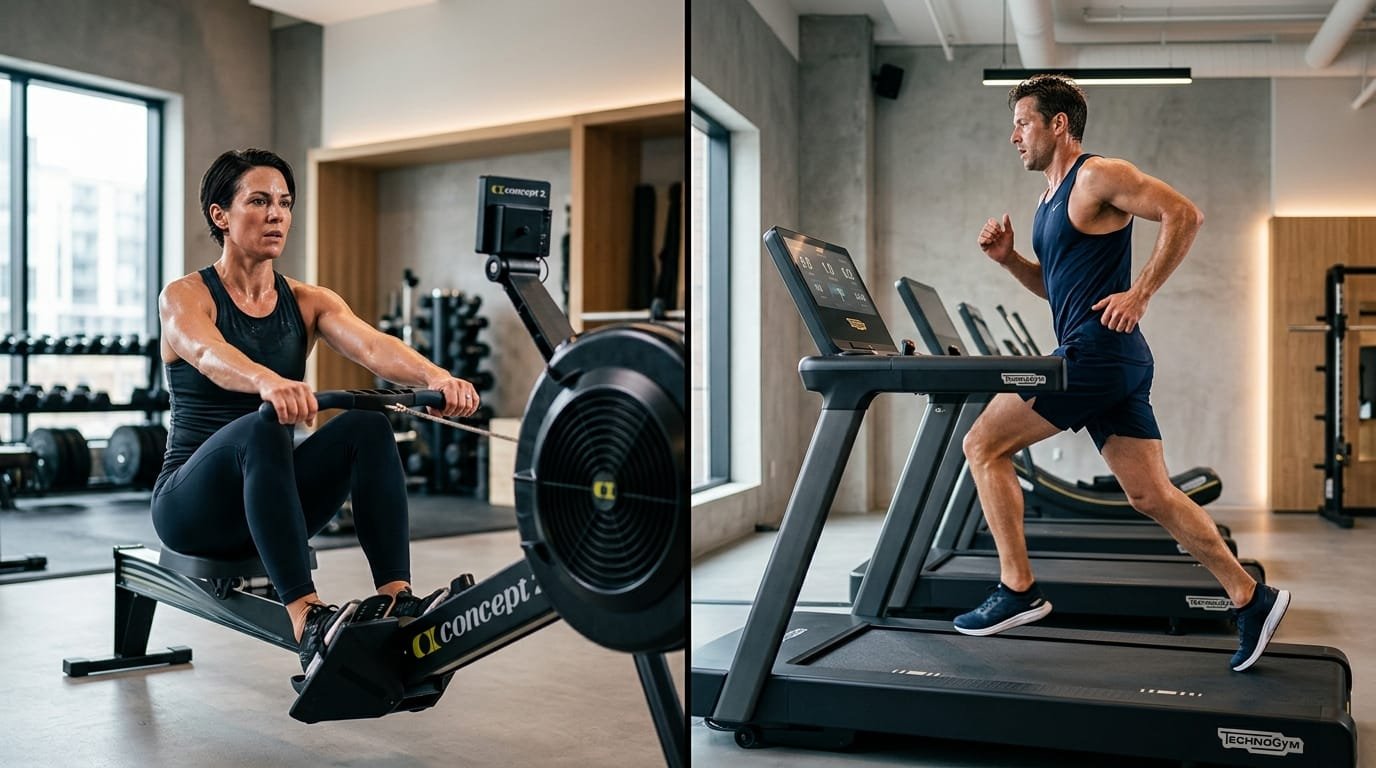
Rowing Every stroke sequentially loads the legs, glutes, core, back, shoulders, and arms. Estimates commonly cite activation of 80–86% of total muscle mass. The movement supplies a concurrent cardiovascular and resistance stimulus, which helps preserve (and in novices, build) lean mass during a calorie deficit—supporting resting metabolic rate and functional strength.
Treadmill The primary drivers are the lower-body extensors and flexors, with modest upper-body contribution from arm swing. It excels at developing running-specific endurance and provides a useful osteogenic (bone-loading) stimulus. Impact forces of approximately 2–2.5 times body weight per stride, however, can limit sustainable weekly volume for some individuals.
Because rowing distributes work across more muscle mass, it may generate a modestly higher excess post-exercise oxygen consumption (EPOC) and superior muscle-preserving effect during fat-loss phases. Over months this can improve body-composition outcomes even when session calorie counts are similar.
Joint Stress, Injury Risk, and Adherence
Rowing is seated and essentially non-impact; the feet remain fixed and the primary stress is muscular. Treadmill running repeatedly loads the knees, hips, and ankles. For individuals with prior lower-extremity injuries, higher body mass, or joint sensitivity, rowing frequently permits higher sustainable training volume. Consistency across months is the strongest predictor of fat-loss success; therefore the machine that can be used frequently without pain usually produces better real-world results.
Head-to-Head Comparison Table
| Factor | Rowing Machine | Treadmill | Practical Edge |
|---|---|---|---|
| Calorie burn (matched high effort) | High | Often slightly higher at running speeds | Slight treadmill |
| Total muscle mass engaged | ~80–86% (full body) | Primarily lower body | Rowing |
| Joint impact | Very low | Moderate to high | Rowing |
| Technique learning curve | Moderate | Low | Treadmill |
| Upper-body development | Significant | Minimal | Rowing |
| Bone-loading stimulus | Low | Higher | Treadmill |
| Suitability for high weekly volume | Excellent for most | Limited by impact for some | Rowing |
| Long-term fat-loss effectiveness | Excellent when consistent | Excellent when consistent | Adherence decides |
Step-by-Step Framework for Fat Loss on Either Machine
- Establish a moderate, sustainable calorie deficit (typically 300–500 kcal below estimated maintenance).
- Schedule 3–5 cardio sessions of 20–45 minutes weekly, blending steady-state and interval formats.
- Include 2–3 full-body or upper/lower strength sessions to protect lean mass.
- On the rower, master the drive sequence (legs → hip hinge/core → arms) and maintain consistent stroke rate and power.
- On the treadmill, utilise incline or structured intervals to raise energy cost without excessive speed.
- Monitor weekly average body weight and waist circumference rather than daily fluctuations.
- Prioritise protein intake (approximately 1.6–2.2 g per kg body weight) and 7–9 hours of sleep.
- Select the machine you can perform with good technique several times per week for months.
Sample Weekly Structure Supporting Abdominal Fat Reduction
- 3 rowing or treadmill sessions (mix of steady aerobic work and intervals)
- 2–3 progressive strength-training sessions
- Daily non-exercise activity (steps, walking)
- Protein-centred meals within a controlled calorie target
If both machines are available, alternating them reduces monotony and overuse risk while maintaining training stimulus.
Integrating Cardio with Strength, Mobility, and Recovery
Pair either cardio modality with progressive resistance training for optimal body-composition results. Adjustable dumbbells and kettlebell work help maintain muscle while in a deficit. Strong grip endurance improves rowing force application and pulling strength. Core stability developed through ab roller variations enhances posture and force transfer on both machines.
A manual treadmill provides a lower-cost, self-powered option for walking or jogging. Resistance bands supply joint-friendly strength stimulus on non-cardio days. Recovery tools such as a budget massage gun can reduce residual muscle tension. Continue applying sound shoulder-mechanics principles from your lateral raise guidance so upper-body accessory work remains productive and pain-free.
Frequently Asked Questions
Can rowing reduce belly fat faster than a treadmill? No machine preferentially targets abdominal fat. Both contribute to overall fat loss when a calorie deficit exists. Rowing’s greater muscle recruitment and lower impact may improve consistency and lean-mass retention for many users.
Which machine burns more calories? At matched high running speeds the treadmill often leads per minute. Vigorous rowing is competitive and can exceed moderate running. Effort, duration, and technique outweigh small modality differences.
Is rowing better for beginners focused on fat loss? Frequently yes, because it is low-impact and trains more muscle groups, allowing higher sustainable weekly volume with lower joint stress.
Do I need both a rower and a treadmill? No. Choose the machine you will use most consistently. Access to both allows useful variety.
How important is diet relative to the cardio machine? Diet is the primary driver of the calorie deficit required for fat loss. Cardio accelerates progress and improves health markers but cannot compensate for a large caloric surplus.
Does higher maximal fat oxidation on the treadmill mean faster belly-fat loss? Not necessarily. Acute substrate differences do not automatically translate into superior long-term fat-loss outcomes; total energy balance and adherence dominate.
Final Recommendation
Neither a rowing machine nor a treadmill burns belly fat preferentially. Both are effective tools for elevating energy expenditure and supporting whole-body fat loss when combined with a sustainable calorie deficit, progressive strength training, and adequate recovery. Rowing provides superior full-body muscle recruitment and minimal joint stress, often improving adherence and body-composition results. Treadmill running can deliver slightly higher calorie burn at higher intensities and supplies a valuable bone-loading stimulus.
Select the machine you can perform with good technique several times per week for months. Control nutrition, add resistance training, track weekly trends, and prioritise consistency. The modality you sustain is the one that ultimately reduces abdominal fat and improves health.