Common Kettlebell Swing Mistakes That Hurt Your Back
Quick Answer Most lower-back pain from kettlebell swings comes from technique errors rather than the exercise itself. The five most common mistakes are: squatting instead of hinging, rounding the lower back at the bottom, over-extending (leaning back) at the top, using the arms to lift the bell, and poor timing or going too heavy too soon. Correct these by mastering a true hip hinge, keeping a neutral braced spine, letting the hips drive the movement, and progressing load gradually. When performed correctly, the swing can actually strengthen the posterior chain and protect the back.
Why Kettlebell Swings Can Hurt the Back
The kettlebell swing is a powerful hip-hinge movement that loads the glutes, hamstrings, and core while the spine stays relatively neutral. When form breaks down, the lumbar spine is forced to absorb forces it is not designed to handle repeatedly—especially shear and compressive loads under speed.
Common pain drivers include excessive spinal flexion at the bottom of the swing, hyperextension at the top, and shifting the work from the hips to the erector spinae. These errors are well-documented in coaching and physiotherapy resources and explain why many people experience back discomfort even though the swing, done well, is often recommended for posterior-chain health.
Mistake 1: Squatting the Swing Instead of Hinging
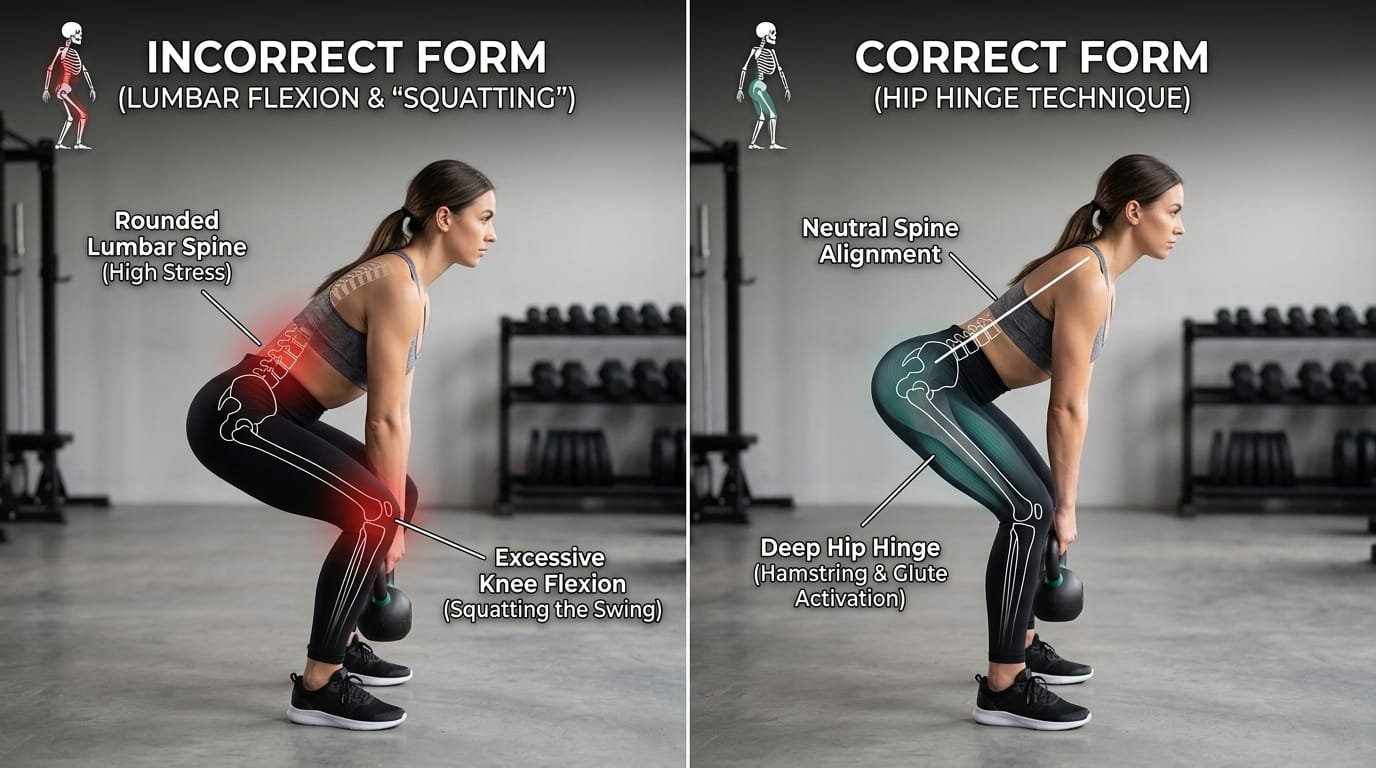
What it looks like The knees bend deeply and travel forward, the hips drop straight down, and the torso stays more upright. The movement becomes a squat with a front raise rather than a hip-driven swing.
Why it hurts the back The load shifts away from the glutes and hamstrings onto the lower back. The spine must generate more of the force that should come from the hips.
How to fix it
- Practice the hip hinge without a kettlebell: push the hips back as if closing a car door with your glutes while keeping the shins nearly vertical.
- Place a medicine ball or foam roller between your feet during practice swings—if you squat, you will hit it.
- Cue: “Hips back, not down.”
- Keep a soft bend in the knees only; the majority of the motion occurs at the hips.
This distinction is repeatedly emphasised in form guides such as those from NASM and experienced kettlebell coaches.
Mistake 2: Rounding the Lower Back at the Bottom
What it looks like The pelvis tucks under and the lumbar spine flexes as the kettlebell travels back between the legs. The back loses its neutral curve.
Why it hurts the back Rounding under load places high shear forces on the lumbar discs and ligaments. Fatigue or a weight that is too heavy often triggers this compensation.
How to fix it
- Shorten the backswing so you never lose the neutral spine.
- Brace the core before the hike pass and maintain that brace throughout.
- Think “chest proud, long spine.”
- If the back rounds even with light weight, reduce the load further and drill the hinge pattern until it is automatic.
Mistake 3: Over-Extending or Leaning Back at the Top
What it looks like At the top of the swing the hips thrust past neutral, the lower back arches aggressively, and the chest points toward the ceiling.
Why it hurts the back Hyperextension compresses the lumbar facet joints and can irritate the soft tissues. The glutes should finish the movement; the lumbar spine should not.
How to fix it
- Finish in a strong standing plank: ears, shoulders, hips, and ankles aligned.
- Squeeze the glutes hard and brace the abs as if preparing for a light punch to the stomach.
- Avoid the cue “thrust the hips”—instead think “open the hips and stand tall.”
- Russian swings (bell to chest or eye level) are generally safer for the back than American swings that go overhead.
Mistake 4: Using the Arms to Lift the Kettlebell
What it looks like The arms pull or raise the bell instead of simply guiding it. The shoulders shrug or the upper body does most of the work.
Why it hurts the back When the hips do not generate enough power, the spine and upper body compensate. This reduces efficiency and increases unwanted loading on the lower back and shoulders.
How to fix it
- Cue: “Arms are ropes.” The hips snap; the arms follow.
- Focus on a powerful hip extension that makes the bell float upward.
- Keep the shoulders packed and the lats lightly engaged to stabilise the spine without muscling the weight.
Mistake 5: Poor Timing, Excessive Depth, or Too Much Weight Too Soon
What it looks like Hinging too early on the way down, letting the bell drop too low between the legs, or choosing a kettlebell that forces form breakdown within a few reps.
Why it hurts the back Bad timing turns the movement into a less advantageous lever. Excessive depth or excessive load makes it harder to maintain neutral spine and hip dominance.
How to fix it
- Hike the bell high into the inner thighs rather than letting it drop toward the floor.
- Match the hinge timing to the bell’s arc so the hips are already moving back as the bell descends.
- Choose a weight that allows perfect form for the planned sets and reps. Progress load only after technique is consistent.
Comparison of Correct vs. Faulty Swing Mechanics
| Aspect | Correct Technique | Common Fault | Back Impact |
|---|---|---|---|
| Hip movement | Hinge – hips travel back | Squat – hips drop down | Shifts load to lumbar spine |
| Spine position (bottom) | Neutral, braced | Rounded / flexed | High shear forces |
| Spine position (top) | Tall standing plank | Hyperextended / leaning back | Facet joint compression |
| Power source | Glutes + hamstrings | Arms or lower back | Overloads erectors |
| Bell path | Close to body, high backswing | Far forward or too deep | Increases lever arm on spine |
| Finish position | Vertical, glutes squeezed | Over-arched | Repeated lumbar stress |
Step-by-Step Guide to a Back-Safe Kettlebell Swing
- Stand with feet roughly hip- to shoulder-width, kettlebell about a foot in front of you.
- Hinge at the hips, keep a long neutral spine, and grip the handle with both hands.
- Hike the bell back between the legs like a football snap, keeping it close and high.
- Drive the feet into the floor and explosively open the hips, standing tall.
- Let the bell float to roughly chest or eye level; arms remain relaxed.
- As the bell begins to descend, hinge the hips back again and guide it into the next hike pass.
- Maintain a braced core and neutral spine throughout every rep.
- Finish the set by gradually reducing power and safely parking the bell.
Film yourself from the side regularly. The body should look like a hinge, not a squat, and the spine should stay long from start to finish.
Programming Tips to Protect the Back
- Master the bodyweight hip hinge and light Romanian deadlifts before loading swings heavily.
- Begin with lower volume (e.g., 3–5 sets of 8–12) and perfect form.
- Prefer Russian-style swings (to chest height) over American-style overhead swings if you have any history of back irritation.
- Pair swing sessions with core bracing drills and glute activation work.
- Deload or regress to lighter weight or fewer reps at the first sign of form breakdown or lingering back discomfort.
Integrating Safe Swings with the Rest of Your Training
Proper kettlebell swings complement work with adjustable dumbbells for hinge-pattern variations and kettlebell selection guidance for appropriate loading. Strong grip endurance helps maintain control of the handle without excessive tension. Core stability from ab roller variations supports the braced trunk needed during ballistic swings.
Recovery tools such as a budget massage gun can help manage residual posterior-chain or upper-back tension. Light cardio on a manual treadmill or mobility flows with resistance bands aid recovery. Continue applying sound shoulder mechanics from your lateral raise guidance so upper-body positioning stays stable under fatigue.
Frequently Asked Questions
Why does my lower back hurt only after kettlebell swings? In most cases it is a technique issue—squatting the swing, rounding at the bottom, or hyperextending at the top. Review the common mistakes above and film your form. Persistent or sharp pain warrants professional assessment.
Are American swings (overhead) worse for the back? They place the lumbar spine in greater extension under load for many people. Russian swings to chest or eye level are generally more back-friendly while still delivering excellent hip-power benefits.
How heavy should I go? Only as heavy as you can control with perfect hinge mechanics and a neutral spine for the entire set. Technique always comes before load.
Can kettlebell swings actually help a weak back? Yes—when the hip hinge is solid and the spine stays braced. The swing strengthens the posterior chain and teaches the body to generate force from the hips rather than the lumbar spine.
How often should I practise swings while fixing form? Two to three focused technique sessions per week with lighter weight and full attention to the hinge is more productive than high-volume work with flawed mechanics.
Final Recommendation
Lower-back pain from kettlebell swings is almost always the result of fixable technique errors rather than an inherent problem with the exercise. Eliminate the squat pattern, keep the spine neutral and braced, finish tall without hyperextension, let the hips drive the movement, and progress load only when form is consistent.
Master the hip hinge first, film your swings, and treat every repetition as practice in safe force production. When the movement is clean, the kettlebell swing becomes one of the most effective tools for building powerful hips, resilient posterior-chain strength, and better movement quality—while protecting rather than stressing the lower back.
Start light, prioritise quality, and correct the mistakes outlined above. Your back, your performance, and your long-term training consistency will all improve.