Power Rack vs. Squat Stand: Which Should You Buy for a Small Space?
Quick Answer For most small-space home gyms in 2026, a quality squat stand is the smarter starting choice if floor space is truly limited (under roughly 8×8 feet of usable training area) and you train with moderate loads or have a reliable spotter. A full power rack offers superior safety and versatility for solo heavy lifting but demands more floor space and ceiling height. Measure your exact dimensions, prioritize safety for the way you actually train, and consider a half-rack or folding wall-mounted option as a middle ground. The right decision depends far more on your ceiling height, whether you train alone, and how heavy you plan to go than on marketing claims.
Understanding the Core Differences
A power rack (also called a power cage) is a four-post enclosed structure. You step inside the cage to lift. It typically includes adjustable J-hooks for the barbell, safety pins or straps that catch failed reps, and often a pull-up bar across the top. The enclosed design creates a highly stable platform and allows extensive attachment options (cable systems, landmines, dip bars, etc.).
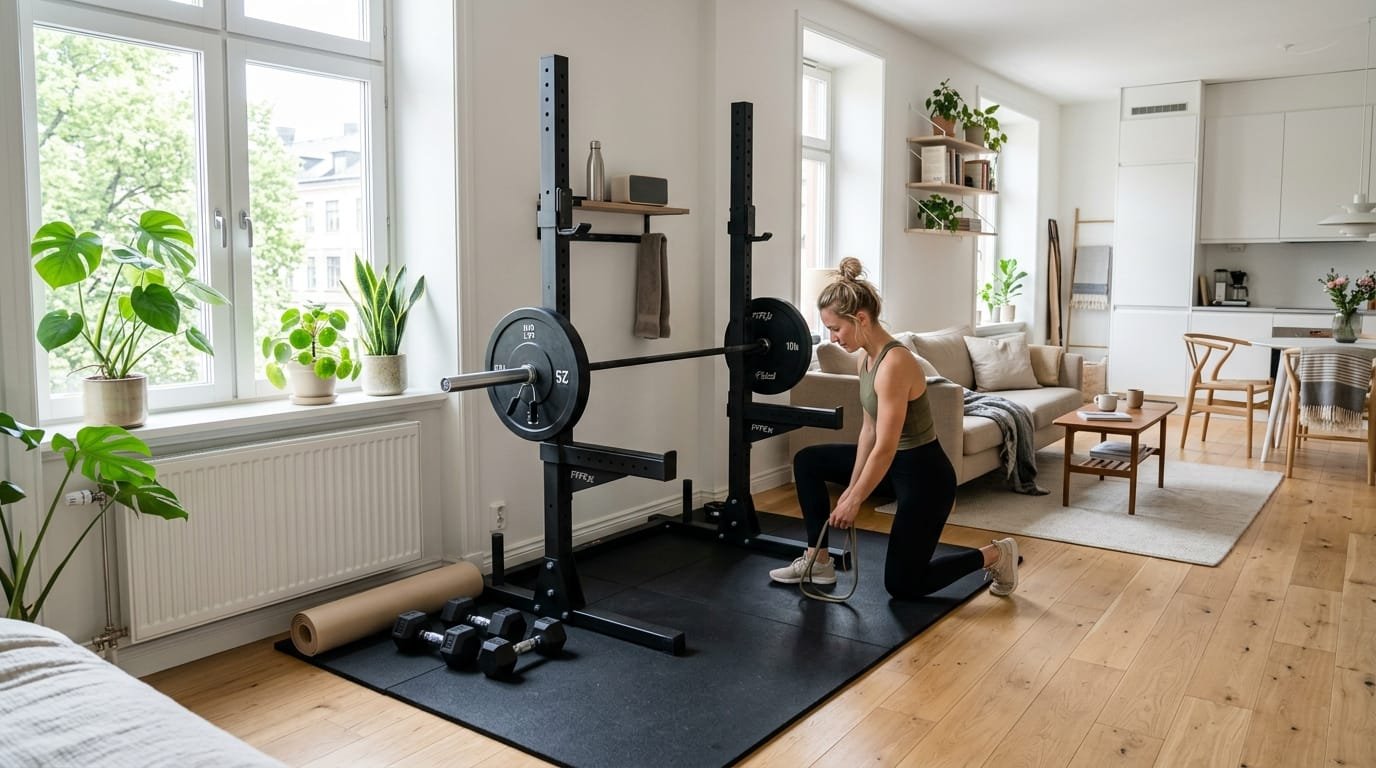
A squat stand (sometimes loosely called a squat rack) is usually a two-post open design. The uprights hold the barbell on J-hooks, and many models include optional spotter arms that extend forward. You lift in front of the structure rather than inside it. Squat stands are lighter, more portable, and occupy less floor space.
These distinctions matter most in constrained environments such as apartments, spare bedrooms, single-car garages, or shared living spaces. Independent comparisons from sources including Garage Gym Reviews consistently show that footprint and safety are the two deciding factors for small-space buyers.
Space Requirements: The Real Numbers
Accurate measurements beat generic advice.
Typical Power Rack Footprint
- Unit itself: roughly 48–55 inches wide by 48–60 inches deep
- Practical working space: often 8×8 feet or more once you account for loading plates, walking around the cage, and bench setup
- Height: many models exceed 85–90 inches; full pull-up clearance can require 96+ inches of ceiling height
Typical Squat Stand Footprint
- Unit itself: often 40–50 inches wide by 30–48 inches deep (sometimes less)
- Practical working space: can fit effectively in 6×6 to 7×7 feet for basic barbell work
- Height: frequently adjustable or lower overall profile, making them friendlier for standard 8-foot ceilings
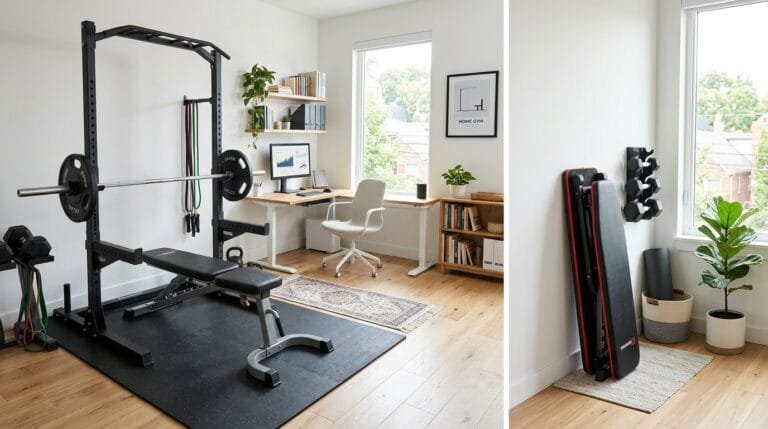
In real-world small spaces, the difference is meaningful. A squat stand leaves more open floor for a weight bench, adjustable dumbbells, or an adjustable kettlebell. A full power rack can dominate a compact room and make multi-use of the space difficult.
Low ceilings are a frequent deal-breaker for power racks. If your ceiling is under 8 feet 6 inches, many full cages become impractical for overhead work or even comfortable racking.
Safety Comparison: Solo Training Changes Everything
Safety is the strongest argument for a power rack.
Inside a power rack, adjustable safety pins or straps sit just below your lowest expected bar path. If you fail a squat or bench press, the bar lands on the safeties instead of on you. This feature allows confident solo training to near-failure—something most serious lifters eventually want.
A basic squat stand relies on optional forward-extending spotter arms. These work reasonably well for many lifters but generally provide less secure catch positions and less structural redundancy than a full cage. Some budget stands have minimal or no effective safeties. If you train alone and push heavy loads, this is a meaningful risk.
For beginners still learning form or intermediate lifters who rarely approach true maximums, a well-designed squat stand with solid spotter arms can be adequate—especially when combined with conservative loading and good technique. Pairing either option with strong grip work and shoulder stability practices (see our lateral raise form guides) further reduces injury risk.
Versatility and Long-Term Value
Power racks win decisively on versatility. The four-post structure supports:
- Pull-ups and chin-ups
- Band and chain attachments
- Landmine bases
- Dip stations
- Cable crossover or pulley systems
- Inverted rows and other bodyweight variations
Many modern racks function as the central hub of a complete home gym.
Squat stands are more limited. They excel at barbell squats, overhead presses, and some bench work (with a separate bench placed in front). Attachment ecosystems are usually smaller. If your training is primarily barbell compounds plus dumbbell and kettlebell work, a stand is often sufficient.
In a small space, the extra versatility of a power rack can actually become a liability if it crowds out other useful equipment or makes the room feel cramped.
Cost Reality in 2026
- Quality squat stands: typically $200–$500
- Entry-to-mid power racks: $400–$900
- Premium power racks with commercial steel and full attachment readiness: $1,000+
The price gap is real. A squat stand lets many people start training properly sooner. However, buying a stand and later upgrading to a rack means spending more overall. If your space and budget can support a power rack from the beginning and you train alone, the rack often delivers better long-term value.
Decision Framework for Small Spaces
Use this practical checklist:
- Measure exact floor dimensions and ceiling height (include light fixtures, garage door tracks, or ductwork).
- Determine whether you regularly train alone with heavy loads.
- List the primary lifts you will perform (squats and presses only vs. full attachment ecosystem).
- Decide if the unit must be movable or storeable.
- Set a realistic budget including shipping and any necessary flooring or bolting hardware.
Choose a squat stand if:
- Usable floor space is under ~8×8 feet
- Ceiling height is limited
- You need to move or store the unit periodically
- Budget is constrained
- You train with a partner or keep loads moderate
Choose a power rack if:
- You have adequate floor and ceiling clearance
- You train alone and want maximum safety
- You plan to expand with attachments
- The rack will serve as the permanent centerpiece of the gym
Consider a half-rack or folding/wall-mounted system if:
- You want better safety than a basic stand but less depth than a full cage
- The space is multi-use (garage that still parks a car, spare room that serves other purposes)
Step-by-Step Buying Process
- Clear and measure the intended area precisely.
- Note any height restrictions and floor surface (concrete, wood, etc.).
- Decide on steel gauge preference (11-gauge or thicker is preferred for longevity).
- Shortlist models that fit your measured envelope.
- Compare actual user feedback on stability when loaded, ease of J-hook and safety adjustment, and long-term durability.
- Factor in shipping costs and assembly difficulty.
- Confirm return policies and warranty coverage.
- Once installed, start with conservative loads and perfect your setup and bail-out procedures.
How Either Option Fits a Complete Small-Space Setup
Both a power rack and a squat stand work best when paired with complementary equipment that does not fight for the same footprint. A sturdy weight bench multiplies pressing and rowing options. Adjustable dumbbells and an adjustable kettlebell cover isolation and conditioning work. A manual treadmill or compact cardio tool can finish sessions without requiring permanent floor dedication.
Focus on movement quality—especially scapular control during pressing and pulling—using the form principles outlined in our shoulder and grip resources. Good technique reduces the absolute need for extreme safety hardware in the early stages.
Frequently Asked Questions
Is a squat stand safe enough for beginners? Yes, when loads remain moderate, form is prioritized, and spotter arms (if available) are used correctly. Beginners benefit more from learning proper technique than from maximal loads.
Can I put a power rack in an apartment? Sometimes, but ceiling height, floor load limits, noise/vibration transmission to neighbors, and landlord rules often make a squat stand or folding system more practical.
Do I need to bolt either one to the floor? For heavier use, bolting or using specialized platforms improves stability, especially with squat stands. Check manufacturer recommendations and your floor type.
What about half-racks? Half-racks offer a useful compromise: better safety and structure than most stands, smaller depth than full cages. They are worth serious consideration in many small-to-medium spaces.
Will I outgrow a squat stand? Many lifters do once they begin training near maximums alone. Others remain happy with a stand for years when their programming stays within its practical limits.
How important is steel gauge? Higher-gauge (thicker) steel generally means less flex and greater longevity under heavy use. For light-to-moderate training, mid-range steel is usually sufficient.
Final Recommendation
In a genuinely small space, start with the equipment that fits and gets used consistently. A well-chosen squat stand removes the biggest barrier—lack of a safe place to barbell squat and press—while leaving room for the rest of a functional gym. If your measurements and training style support a power rack, the added safety and future-proofing are usually worth the extra footprint and cost.
Measure twice, prioritize the way you actually train, and build around consistency rather than the most impressive-looking structure. Pair your rack or stand with solid programming, progressive overload, and attention to recovery. The best setup is the one that removes friction and keeps you training safely for years.
Ready to decide? Take accurate measurements of your space today, list your primary lifts and whether you train alone, then match those realities to the features above. A thoughtful choice here becomes the foundation of an effective small-space strength practice.