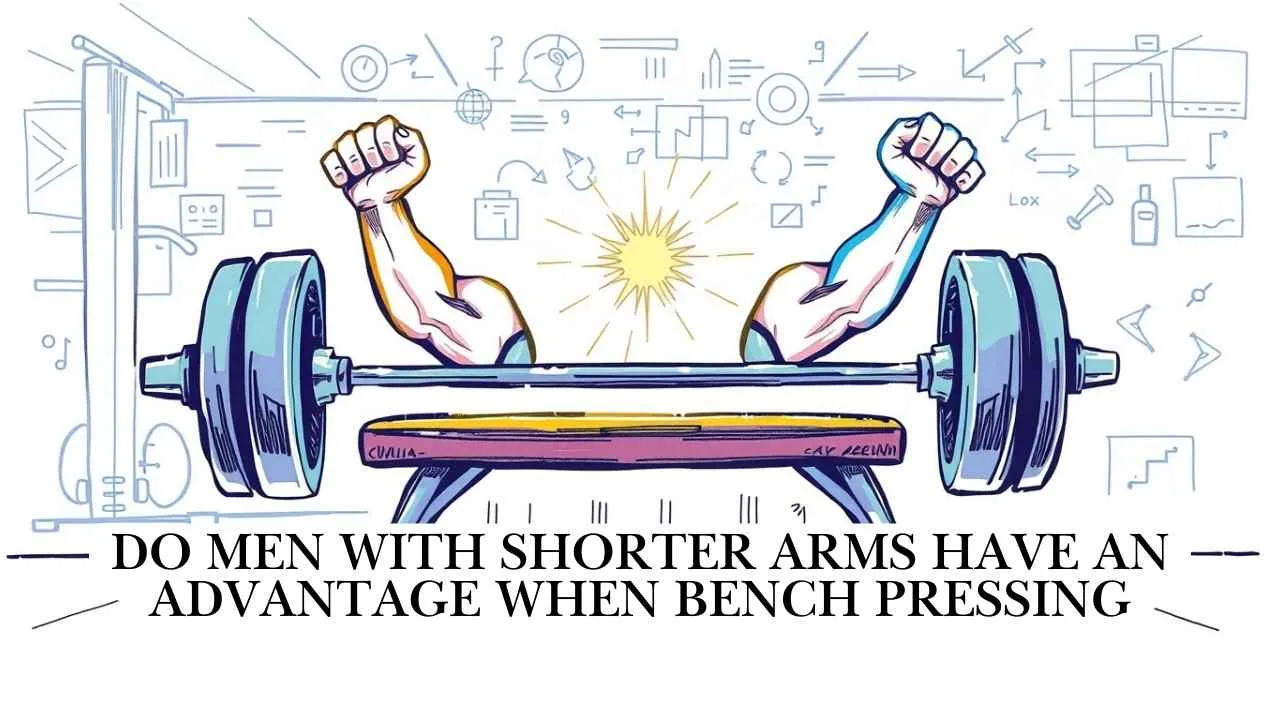
Do Men with Shorter Arms Have an Advantage when Bench Pressing?
Quick answer: Research on powerlifters generally supports this — shorter arms mean a shorter range of motion and a shorter lever arm for the same weight, which tends to translate into a genuine mechanical advantage for bench press performance. But arm length is just one factor among several, and research consistently shows muscle mass and technique matter more than limb length alone.
Researched and written by the GymGoodies team, fact-checked against manufacturer specs and current fitness guidance.
Watch enough powerlifting competitions and you’ll notice a pattern: many of the strongest bench pressers, relative to their size, tend to have comparatively shorter arms. This isn’t just an anecdotal observation — there’s real research behind it, though the full picture is more nuanced than “short arms equal automatic strength.”
Why Shorter Arms Create a Mechanical Advantage
The core mechanism is straightforward physics: bench press performance depends partly on how far the bar has to travel (range of motion) and the length of the lever arm your muscles have to work against. Shorter arms mean the bar travels a shorter distance from your chest to lockout, and the effective lever arm your chest, shoulders, and triceps have to overcome is reduced for the same absolute weight.
Research examining classic powerlifters found that shorter upper limbs, combined with a higher ratio of muscle mass to arm length, were associated with better bench press performance — a finding researchers attributed to both the reduced range of motion and the shorter effective resistance arm working together to favor lifters with more compact limbs.
What Controlled Research on Anthropometry Actually Found
A study published in the Journal of Strength and Conditioning Research measured body mass, total arm length, and shoulder width in 36 men, then tested their bench press performance at maximal and submaximal loads. The researchers found that body mass had the strongest correlation with 1RM and force-related measures, while total arm length was only moderately associated with 1RM performance, and specifically at the lightest tested load rather than across the board. Shoulder width (biacromial width) actually showed an inverse relationship with the number of reps performed at lighter loads.
This is an important nuance: arm length showed a real but modest, condition-specific association with performance — not an overwhelming, always-present advantage. Body mass and, in other research, muscle cross-sectional area, tend to be considerably stronger predictors of raw bench press strength than arm length alone.
Why Muscle Mass Matters More Than Limb Length
Separate research examining upper limb anthropometry in competitive powerlifters found that upper arm cross-sectional muscular area and fat-free mass were positively correlated with competition performance, while arm fat percentage was negatively correlated — reinforcing that how much functional muscle you’re carrying, and your overall body composition, plays a larger, more consistent role than limb proportions alone.
So Is the “Short Arms Advantage” Real or Not?
Both things are true simultaneously, and this is the honest, nuanced takeaway: shorter arms do appear to offer a genuine mechanical edge for bench press specifically, primarily by reducing range of motion and lever arm length — but this advantage is modest compared to the much larger role played by overall muscle mass, muscle cross-sectional area, and body composition. A shorter-armed lifter with less muscle mass will generally be outperformed by a longer-armed lifter with significantly more muscle mass; arm length is a modifying factor, not the dominant one.
What This Means If You Have Longer Arms
If you have proportionally longer arms, you’re not without options — you’re simply working with a different set of technical considerations:
- Grip width adjustments — a slightly wider grip can help reduce the effective range of motion for longer-armed lifters, though this should be balanced against shoulder comfort and stability.
- Leg drive and arch technique — proper leg drive and a stable, appropriately arched setup can help offset some of the range-of-motion disadvantage by improving overall bar path efficiency.
- Accepting a different strength curve — longer-armed lifters often find their “sticking point” (the hardest part of the lift) sits in a different position than shorter-armed lifters, and technique work specifically addressing that sticking point tends to help more than trying to fight your own proportions.
What This Means If You Have Shorter Arms
- You likely have a genuine mechanical head start on bench press specifically — but this doesn’t mean technique stops mattering; poor bar path, unstable setup, or inconsistent depth can still limit how much of that advantage you actually realize.
- This advantage is largely specific to the bench press — the same shorter-limb proportions that help here can work differently for other lifts; research on squatting, for instance, has found that muscle mass indicators are more strongly associated with squat performance than leg length specifically, suggesting the leverage story varies meaningfully by exercise.
Why This Doesn’t Mean Longer-Armed Lifters Can’t Excel
It’s worth being clear that anthropometric research finds correlations and modest associations, not deterministic rules. Plenty of accomplished lifters with longer arms have built exceptional bench press strength through consistent training, technique refinement, and building substantial muscle mass and strength over years — the research suggests they may need to work somewhat harder to reach the same absolute numbers as a proportionally shorter-armed lifter with similar muscle mass, not that strong performance is unavailable to them.
Practical Takeaways Regardless of Your Proportions
- Focus on what you can actually control — muscle mass, technique, and consistent progressive training have a larger, more reliable impact on your bench press than your fixed limb proportions.
- Don’t use arm length as an excuse or a ceiling — the research shows body composition and technique matter more, meaning there’s substantial room for improvement regardless of your specific proportions.
- Consider your grip width and setup based on your own leverage, rather than copying a setup that works well for someone with different proportions than you.
- If your goal is bench press-specific strength, dedicated technique work on bar path and stability tends to yield more consistent gains than anything related to changing your natural leverages, which obviously isn’t possible.
How This Fits Into Broader Training
The bench press is a foundational push movement — our Barbell Basics for Beginners guide covers proper technique fundamentals for this lift alongside the squat, deadlift, and overhead press, and our Push vs. Pull Exercises guide covers how the bench press fits into a broader, balanced training program. Understanding your own leverage tendencies is a useful refinement once these fundamentals are solid, not a replacement for them.
Frequently Asked Questions
Does arm length affect other lifts the same way it affects bench press?
Not necessarily — research on squatting has found muscle mass indicators more strongly associated with performance than leg length specifically, suggesting the relationship between limb length and lifting performance varies by exercise rather than being a single universal rule.
Can I do anything to change my arm length advantage or disadvantage?
No — your limb proportions are fixed, but technique adjustments (grip width, setup, addressing your specific sticking point) can help you work more efficiently within your own proportions.
Is this research relevant to casual lifters, or just competitive powerlifters?
The underlying biomechanics apply to anyone bench pressing, though the research specifically studied competitive or trained powerlifters — casual lifters are less likely to be pushing near their absolute strength ceiling, meaning technique and consistent training likely matter even more relative to limb-length considerations at that level.
Bottom Line
Shorter arms do appear to offer a genuine, research-supported mechanical advantage for bench press performance, primarily through reduced range of motion and a shorter effective lever arm. But this advantage is modest compared to the much larger roles played by overall muscle mass and consistent technique — meaning your specific arm length is a real but secondary factor, not something that should be treated as determining your ceiling in either direction.
Have you noticed how your own limb proportions affect your bench press technique or sticking point? Let us know in the comments what adjustments have worked for you.