How to Set Realistic Home Training Goals You Can Actually Hit
Quick Answer
Set realistic home training goals you can actually hit by focusing on process goals you fully control (sessions completed, progressive overload applied, recovery habits), limiting yourself to one to three primary targets, matching the goals to your real schedule and equipment, and building in minimum viable standards for difficult weeks. Outcome goals such as specific weight-loss numbers or strength milestones work best when paired with clear weekly process metrics. Review and adjust every four to six weeks so the targets remain challenging yet achievable.
Why Most Home Training Goals Fail
Home trainees frequently set goals that sound impressive but collapse under real-life conditions: irregular work hours, family demands, limited equipment, fluctuating motivation, and imperfect recovery. Goals fail when they are purely outcome-based, too numerous, disconnected from available time, or dependent on perfect conditions. Realistic goals reverse these errors. They emphasise controllable actions, fit the actual environment, and include built-in flexibility so that imperfect weeks still produce progress.
Core Principles for Goals You Can Hit
- Control over outcome – Prioritise actions you can perform regardless of external circumstances.
- Few targets – One to three primary goals outperform long lists.
- Environment match – Goals must fit available equipment, space, and schedule.
- Minimum viable standard – Define the lowest acceptable version for disrupted weeks.
- Built-in review – Goals are hypotheses that should be updated with evidence.
- Process metrics first – Weekly behaviours predict long-term outcomes better than daily scale or strength fluctuations.
Process Goals vs Outcome Goals
| Type | Definition | Example | Strength | Limitation |
|---|---|---|---|---|
| Process goal | Controllable action or behaviour | Complete 3 full-body sessions this week | Fully under your control | Does not guarantee specific outcomes |
| Outcome goal | Desired end result | Add 10 kg to goblet squat in 12 weeks | Provides direction and motivation | Influenced by recovery, stress, and other factors |
| Hybrid approach | Outcome supported by process metrics | Add 10 kg to goblet squat by completing ≥85 % of planned sessions and applying progressive overload | Combines motivation with controllability | Requires tracking both layers |
Shoulder-friendly technique supports sustainable upper-body progress toward any strength goal (Bent Arms vs. Straight Arms in Lateral Raises, The Hidden Mistake in Lateral Raises, and 3 Lateral Raise Modifications). Grip strength goals can be tracked with simple progressive work (Do Hand Grippers Really Work?).
Step-by-Step Method for Setting Realistic Home Training Goals
- Audit your real constraints
Available training days, session length, equipment, recovery capacity, and recurring schedule disruptions. - Choose one primary outcome (optional but useful)
Examples: improve strength on key lifts, complete a consistent training streak, or improve body composition. - Translate the outcome into process metrics
Identify the weekly behaviours that most strongly influence the outcome (sessions completed, progressive overload applied, protein intake, sleep hours). - Set the minimum viable standard
Define what still counts as success on a difficult week (e.g., two shortened sessions instead of three full ones). - Limit the total number of goals
One to three primary targets. Additional habits can be secondary. - Make the goals specific and time-bound
“Train full-body three times per week for the next eight weeks” is clearer than “train more.” - Build a simple tracking system
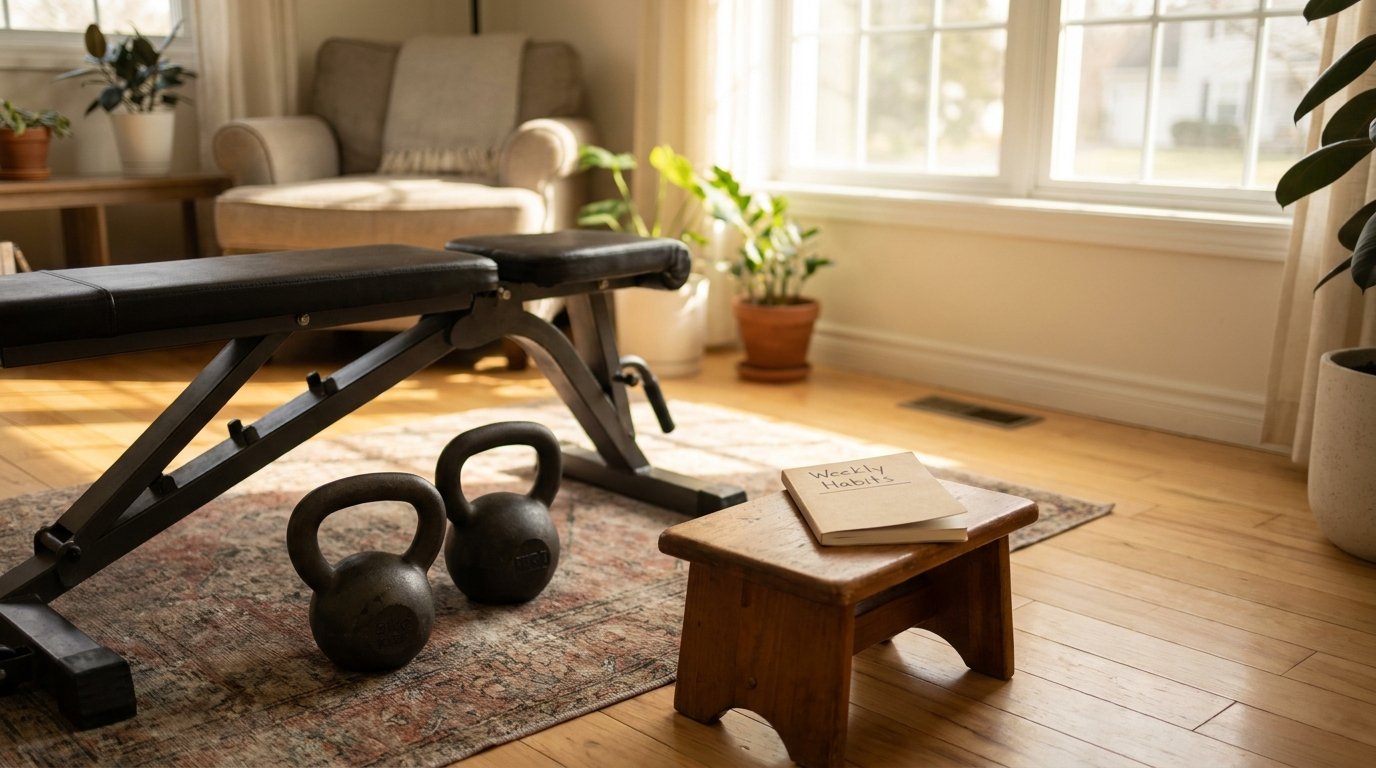
A notebook or phone note with weekly checkboxes is sufficient. - Schedule the first review date
Four to six weeks is a practical horizon for home training goals. - Plan the environment supports
Equipment layout, training time blocks, and recovery habits that make the process easier. - Start immediately with the process metrics
Outcome goals are achieved through repeated process execution.
Examples of Realistic vs Unrealistic Goals
| Unrealistic Goal | Why It Fails | Realistic Version |
|---|---|---|
| Lose 10 kg in 6 weeks | Aggressive rate, high restriction risk | Lose 0.5–1 % of body weight per week while completing ≥80 % of planned sessions |
| Train hard every day | Recovery and schedule conflicts | Train 3–4 times per week with planned rest days |
| Master advanced calisthenics skills in one month | Skill and strength timeline mismatch | Progress one specific variation (e.g., push-up or inverted row) over 8–12 weeks |
| Follow a complex program perfectly | Decision fatigue and all-or-nothing thinking | Use a simple full-body template and track adherence |
| Never miss a session | Life inevitably interferes | Hit the minimum viable standard on disrupted weeks |
Matching Goals to Common Home-Training Contexts
Limited Equipment
Focus on progressive overload via tempo, pauses, unilateral work, and density rather than load milestones that require more weights.
Irregular Schedule
Emphasise weekly session targets with flexible timing rather than fixed days and times.
Beginner Level
Prioritise consistency and technique mastery over performance numbers for the first 8–12 weeks.
Intermediate or Advanced
Combine strength or skill outcome goals with clear process metrics for volume and progression.
Fatigue or High Stress Periods
Shift to maintenance-style process goals (minimum frequency and movement quality) until capacity returns.
Tracking Without Overwhelm
Effective tracking for home trainees is minimal:
- Sessions completed versus planned
- Whether progressive overload was applied on key lifts
- Basic recovery markers (sleep range, energy)
Avoid tracking every variable. Excess data creates friction and reduces adherence.
Review and Adjustment Process
Every four to six weeks:
- Calculate adherence percentage
- Assess whether the process metrics are producing movement toward the outcome
- Decide to keep, raise, lower, or replace the goal
- Update the minimum viable standard if life circumstances have changed
Goals are working hypotheses. Adjusting them based on evidence is a strength, not a failure.
Common Goal-Setting Mistakes
| Mistake | Result | Better Approach |
|---|---|---|
| Too many simultaneous goals | Diluted focus and burnout | Limit to 1–3 primary targets |
| Purely outcome-based goals | Frustration when external factors interfere | Pair with process metrics |
| No minimum viable standard | All-or-nothing collapse on hard weeks | Define the lowest acceptable version in advance |
| Goals that ignore equipment limits | Repeated frustration | Align targets with available tools |
| No review date | Goals drift or become irrelevant | Schedule reviews every 4–6 weeks |
| Changing goals weekly | No cumulative progress | Commit for a full review cycle |
Building Environment Supports Around the Goals
Goals become easier to hit when the environment is designed to reduce friction:
- Equipment is organised and ready
- Training times are pre-blocked in the calendar
- A written minimum viable session exists for low-energy days
- Recovery habits (sleep window, protein sources) are pre-planned
These supports turn motivation into systems.
Strength training produces reliable long-term results when consistency and progressive overload are protected (strength training guidance). Practical home-gym approaches emphasise goals and systems that fit real life rather than ideal conditions (home gym equipment prioritisation and budget home gym principles).
Frequently Asked Questions
How many goals should I set at once?
One to three primary goals is optimal for most home trainees. Additional habits can be secondary and tracked more loosely.
Should I set strength goals or consistency goals?
Both can work. Consistency goals are usually more reliable early on. Strength goals become more useful once training frequency is stable.
What if I keep missing my process targets?
Lower the target to a level you can hit even on difficult weeks, then rebuild. Repeated failure on an overly ambitious process goal is a signal to adjust, not to push harder.
How long should a goal cycle last?
Four to twelve weeks works well for most home training goals. Shorter cycles suit beginners or high-variability schedules; longer cycles suit stable intermediate trainees.
Is it okay to change a goal mid-cycle?
Yes if circumstances have meaningfully changed (injury, schedule shift, equipment loss). Otherwise, finish the cycle to gather complete information.
Do I need to write goals down?
Yes. Written goals with clear process metrics and a review date are significantly more effective than mental intentions.
What is the most important single goal for most home trainees?
A consistency target such as “complete at least 10 of 12 planned sessions in the next four weeks” provides the foundation for almost every other outcome.
How do I handle outcome goals that depend partly on factors outside my control?
Keep the outcome as directional motivation and evaluate success primarily by the process metrics that influence it.
Final Recommendation
Realistic home training goals that you can actually hit are built around controllable process metrics, limited in number, matched to your real schedule and equipment, and equipped with a minimum viable standard for difficult weeks. Pair any outcome target with clear weekly behaviours, track adherence simply, and review every four to six weeks.
Audit your constraints today, choose one to three primary goals, define the process metrics and minimum standards that support them, and write the first review date in your calendar. Then execute the process metrics for the next four weeks. When goals are designed this way, they become achievable under ordinary conditions rather than only under perfect ones. Start with the next scheduled session—the goals you can repeatedly hit are the ones that compound into lasting results.