
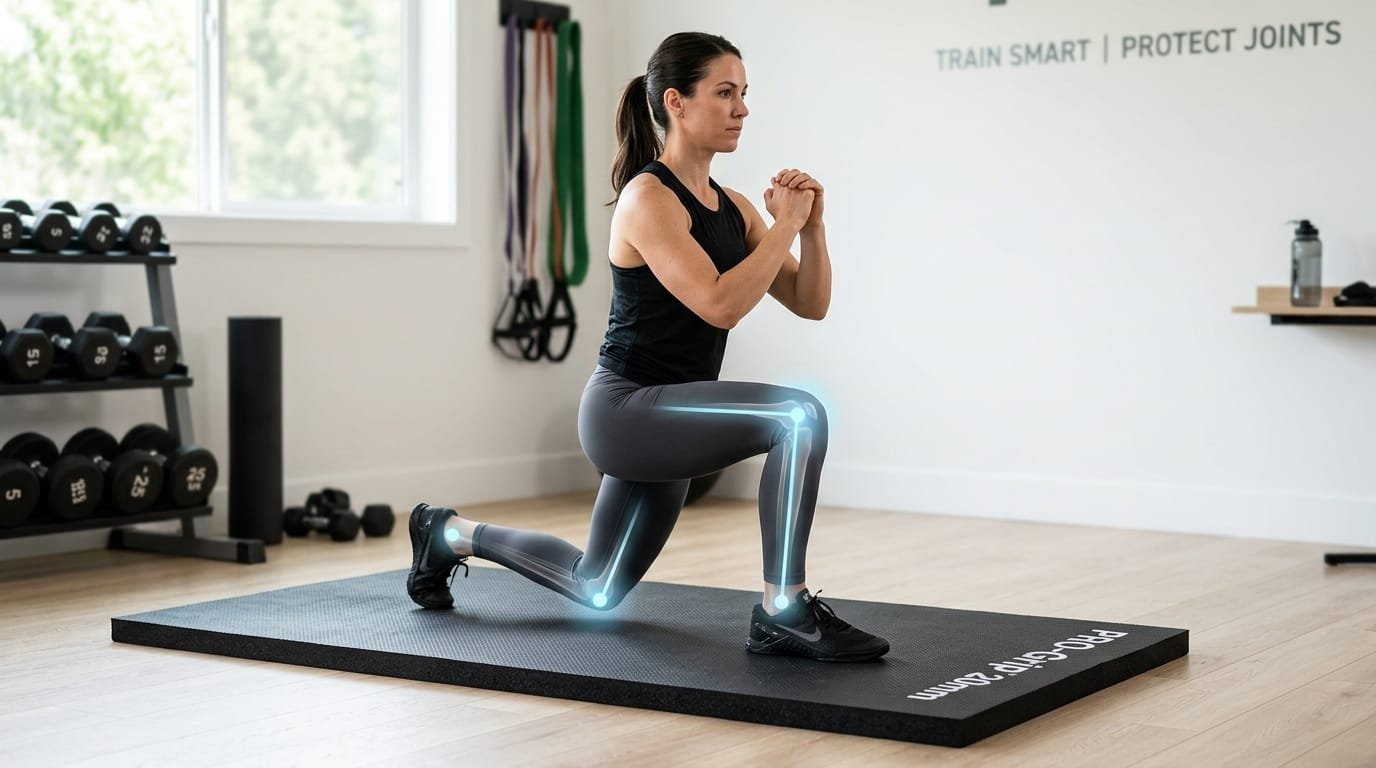
How to Protect Your Joints During High-Frequency Home Training
Quick Answer
Protect your joints during high-frequency home training by prioritising controlled tempos, full pain-free ranges, appropriate volume per session, joint-friendly exercise variations, balanced pushing and pulling, and regular deloads. Keep most sets 1–3 repetitions short of failure, rotate stressful movements, manage total weekly stress, and address early warning signs immediately. High frequency is sustainable when intensity and volume per session are moderated and recovery fundamentals (sleep, protein, stress management) are protected.
Why High-Frequency Training Challenges Joints
Training the same movement patterns four or more times per week increases cumulative stress on connective tissues. Tendons, ligaments, and joint cartilage adapt more slowly than muscle. When session volume or intensity stays high while frequency rises, microtrauma can accumulate faster than repair. Home trainees are especially prone to this because access is constant and external constraints (travel, gym hours) are absent. The solution is not to avoid high frequency—it is to adjust the other variables so joints can keep pace.
Core Principles of Joint Protection at High Frequency
- Moderate intensity most of the time – Leave 1–3 repetitions in reserve on the majority of sets.
- Control every repetition – Slow eccentrics and deliberate pauses reduce peak forces.
- Use joint-friendly variations – Prefer options that keep joints in stable, comfortable positions.
- Balance opposing patterns – Match pushing with pulling, and quad-dominant with hip-dominant work.
- Manage total weekly volume – Higher frequency requires lower volume per session.
- Schedule recovery – Deloads and easier days are mandatory, not optional.
- Monitor symptoms daily – Early regression prevents long layoffs.
Joint-Friendly Exercise Selection
| Pattern | Higher-Stress Options | Joint-Friendlier Alternatives | Why the Alternative Helps |
|---|---|---|---|
| Squat | Deep loaded back squat, walking lunges | Box squat, reverse lunge, goblet squat to comfortable depth | Reduces peak knee stress and forward translation |
| Hinge | Conventional deadlift from floor, heavy good-mornings | Romanian deadlift, single-leg RDL, hip thrust | Limits end-range spinal loading |
| Horizontal Push | Flat barbell bench, deep push-ups | Floor press, neutral-grip dumbbell press, elevated push-up | Shortens range and reduces shoulder horizontal abduction stress |
| Vertical Push | Strict overhead press behind neck | Landmine press, high-incline press, neutral-grip press | Avoids extreme elevation and internal rotation |
| Horizontal Pull | Heavy bent-over rows with momentum | Single-arm supported row, chest-supported row, face pulls | Improves scapular control and reduces lumbar stress |
| Isolation | Heavy upright rows, behind-neck work | Band pull-aparts, external rotations, scapular-plane raises | Lowers joint torque and improves muscle balance |
Shoulder health during frequent pressing and raising benefits from deliberate technique choices (Bent Arms vs. Straight Arms in Lateral Raises, The Hidden Mistake in Lateral Raises, and 3 Lateral Raise Modifications). Grip work can be included at low volume without adding joint stress (Do Hand Grippers Really Work?).
Step-by-Step Joint-Protection System
- Audit current frequency and volume
Write down how many times each major pattern is trained per week and the total hard sets. - Set intensity guidelines
Keep most sets at 1–3 repetitions in reserve. Reserve true failure for infrequent, low-risk movements. - Install controlled tempos
Use a 3-second eccentric as the default. Add pauses at the most challenging point when appropriate. - Choose the friendliest effective variation
Select the version of each pattern that allows progressive loading without symptoms. - Balance the programme
Ensure pulling volume meets or exceeds pushing volume. Include scapular and rotator-cuff work. - Limit per-session volume
At frequencies of 4+ days per week, 2–4 hard sets per pattern per session is often sufficient. - Schedule structured deloads
Every 4–8 weeks, reduce total sets by 40–60 % for 5–7 days while keeping loads moderate. - Monitor daily symptoms
Track joint feeling, resting discomfort, and performance. Regress at the first clear warning signs. - Protect recovery fundamentals
Prioritise sleep, protein intake, and stress management. - Reassess every 4–6 weeks
Adjust variations, volume, or frequency based on how joints and performance respond.
Volume and Frequency Guidelines
| Weekly Frequency per Pattern | Recommended Hard Sets per Session | Intensity Guideline | Notes |
|---|---|---|---|
| 2 sessions | 3–5 | 1–3 RIR | Standard progression |
| 3 sessions | 2–4 | 1–3 RIR | Common high-frequency sweet spot |
| 4 sessions | 2–3 | 2–3 RIR | Volume per session must drop |
| 5–6 sessions | 1–3 | 2–4 RIR | Advanced; monitor carefully |
Higher frequency is a tool, not a requirement. Many trainees make excellent progress on 3 well-recovered sessions per pattern.
Technique Details That Spare Joints
- Keep knees tracking in line with toes during squats and lunges.
- Maintain neutral spine and braced core on all hinges and loaded carries.
- Control scapular position on every push and pull; avoid excessive shrugging or winging.
- Use full pain-free range rather than forcing end ranges that provoke symptoms.
- Prefer neutral or scapular-plane shoulder positions when elevation is involved.
Recovery Practices That Support High Frequency
- 7–9 hours of quality sleep most nights
- Protein intake of approximately 1.6–2.2 g per kg of body weight
- Daily low-intensity mobility for hips, thoracic spine, and shoulders
- Short walks on off days or between sessions
- Immediate volume reduction when joint symptoms appear
Common High-Frequency Mistakes That Irritate Joints
| Mistake | Joint Impact | Better Approach |
|---|---|---|
| High intensity every session | Accumulated microtrauma | Keep most sets submaximal |
| Ignoring early warning signs | Escalation to injury | Regress volume or range immediately |
| Pushing volume up with frequency | Overuse | Drop sets per session as frequency rises |
| Neglecting opposing muscle groups | Imbalance and overload | Match push with pull, quad with hinge |
| No planned deloads | Residual fatigue | Schedule them every 4–8 weeks |
| Poor technique under fatigue | Peak stress on tissues | Stop sets before form breaks |
Strength training with intelligent joint protection remains highly effective for long-term progress (strength training guidance). Practical home-gym approaches emphasise sustainable systems that allow frequent training without breakdown (home gym equipment prioritisation and budget home gym principles).
Frequently Asked Questions
Is high-frequency training safe for joints?
Yes when volume per session is reduced, intensity is moderated, and recovery is prioritised. Unmanaged high frequency is the risk, not frequency itself.
How do I know if my joints are not recovering?
Rising resting discomfort, pain that increases during warm-up, performance drop lasting more than two sessions, or lingering stiffness are clear signals.
Should I use anti-inflammatory medication to keep training?
No. Masking symptoms allows further tissue stress. Address the underlying load and technique issues instead.
Can I train the same muscles every day?
Possible for short periods with very low volume and intensity, but most people do better with at least one recovery day for each major pattern.
Do I need special equipment for joint protection?
No. Controlled technique, appropriate variations, and volume management matter more than any specific tool.
How important is mobility work?
Useful for maintaining range and reducing stiffness, but it does not replace proper load management. Keep it short and low-intensity.
What is the fastest way to calm irritated joints?
Reduce volume and range immediately, emphasise slow tempos, improve sleep, and temporarily favour the friendliest variations.
Can older trainees use high-frequency approaches?
Yes, often with even greater emphasis on controlled tempos, joint-friendly variations, and recovery. Many older adults thrive on 3 moderate sessions per pattern per week.
Final Recommendation
High-frequency home training is joint-sustainable when intensity is moderated, volume per session is reduced, exercise variations are chosen carefully, and recovery fundamentals are protected. Default to controlled tempos, leave repetitions in reserve, balance pushing and pulling, and schedule regular deloads. Monitor symptoms daily and regress at the first clear warning signs.
Audit your current weekly volume and frequency today, install a 3-second eccentric on main lifts, and plan the next deload. When load management and technique are treated as seriously as the training itself, high frequency becomes a powerful tool rather than a source of breakdown. Protect the joints and the progress will continue for years.