Quiet Home Gym Options That Won’t Upset Neighbors or Family
Quick Answer
Quiet home gym options centre on low-impact, controlled movements and equipment that produces minimal noise or vibration: resistance bands, adjustable or fixed dumbbells used with deliberate control, bodyweight exercises, suspension trainers, and soft flooring. Avoid dropping weights, jumping, and ballistic movements. Focus on tempo, pauses, and unilateral variations for progressive overload. With proper technique and setup, you can train effectively in apartments or shared homes without disturbing others.
Why Noise Matters in Home Training
In apartments, townhouses, or family homes, sound travels through floors, walls, and ceilings. Dropping dumbbells, jumping, slamming bars, or using noisy machines quickly creates tension with neighbours or household members. A quiet approach prioritises controlled concentric and eccentric phases, soft contact with the floor, and equipment that does not require high-impact force. This constraint actually encourages better technique and joint-friendly training.
Core Principles of Quiet Home Training
- Control every repetition – Slow tempos and deliberate pauses eliminate most impact noise.
- Choose low-vibration equipment – Bands, dumbbells used carefully, and bodyweight produce far less disturbance than barbells or machines.
- Use soft flooring – Thick mats or rubber tiles absorb sound and protect surfaces.
- Avoid ballistic and dropping movements – No kipping, no dropping weights, no box jumps.
- Train at considerate times – Early morning or evening sessions should stay within controlled, quiet formats.
- Progress without impact – Use tempo, pauses, range of motion, unilateral work, and density instead of heavier drops or jumps.
Quiet Equipment Options Ranked by Noise Level
| Equipment | Noise Level | Vibration Risk | Best Uses | Notes |
|---|---|---|---|---|
| Resistance bands | Very low | None | Rows, presses, squats, pull-aparts | Ideal primary tool |
| Bodyweight | Very low | Low (if controlled) | Push-ups, lunges, hinges, core | Avoid jumping variations |
| Adjustable/fixed dumbbells | Low–moderate | Low if not dropped | Presses, rows, RDLs, squats | Controlled lowering is essential |
| Suspension trainer | Low | Low | Rows, face pulls, assisted movements | Door anchors must be secure |
| Soft medicine ball (no slam) | Low | Low | Controlled carries or rotational work | Avoid slamming |
| Kettlebell (controlled) | Moderate | Moderate | Swings only if technique is silent | Prefer RDLs and goblet work |
| Barbell or droppable plates | High | High | Generally avoid in shared housing | Not recommended for quiet training |
Quiet Exercise Selection by Movement Pattern
Squat / Lunge Pattern
- Goblet squat or bodyweight squat with slow eccentric
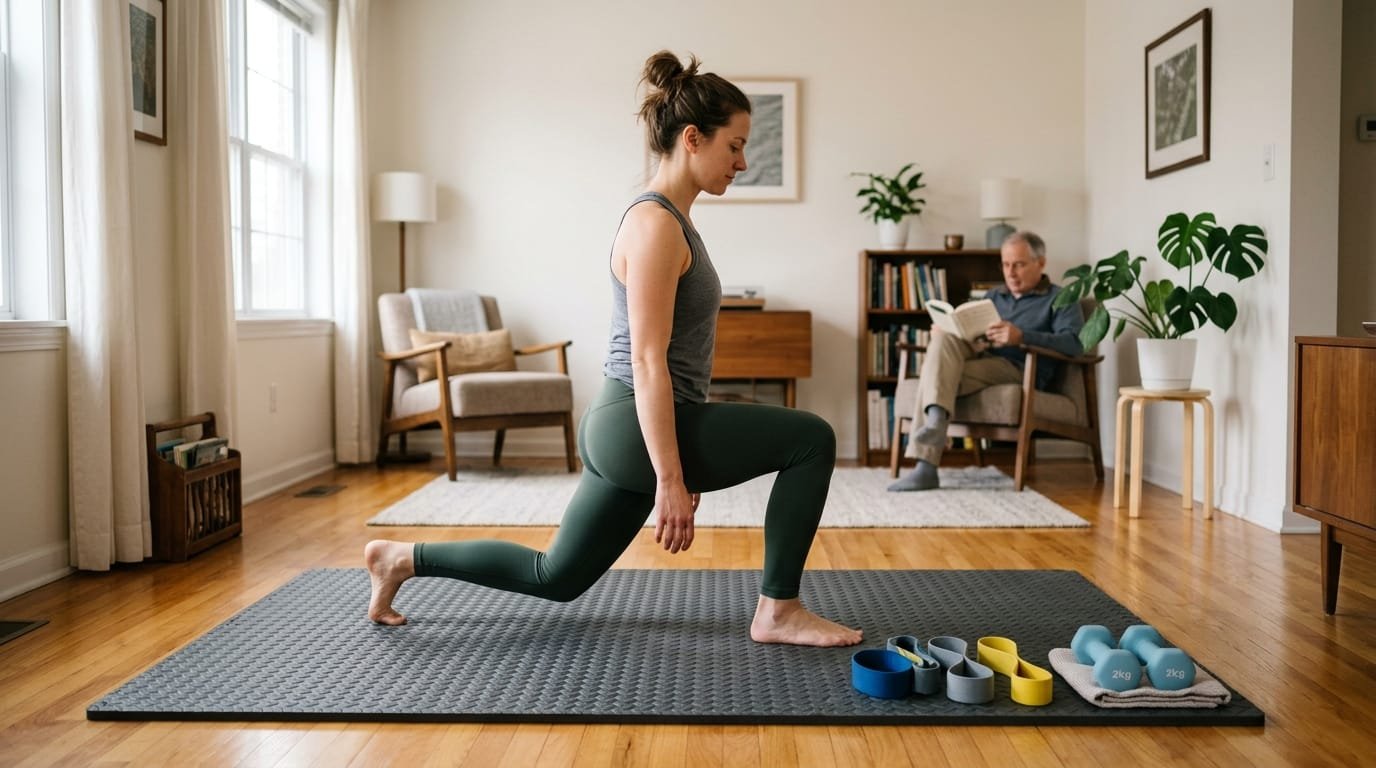
- Reverse lunge or walking lunge (short steps)
- Bulgarian split squat with rear foot on a stable chair or bed
- Tempo and paused variations for progression
Hinge Pattern
- Romanian deadlift with dumbbells or kettlebell (controlled)
- Single-leg Romanian deadlift
- Glute bridge and single-leg bridge
- Band good-morning
Horizontal Push
- Push-up variations (elevated, standard, decline with feet on bed)
- Floor press with dumbbells
- Band chest press
Horizontal Pull
- Single-arm dumbbell or band row
- Inverted row under a sturdy table
- Band face pulls or pull-aparts
- Door-anchored suspension rows
Core and Carries
- Plank variations, dead bugs, bird dogs
- Suitcase carry with a dumbbell or backpack
- Controlled dead bugs or hollow holds
Shoulder-friendly technique remains important even in quiet sessions (Bent Arms vs. Straight Arms in Lateral Raises, The Hidden Mistake in Lateral Raises, and 3 Lateral Raise Modifications). Grip strength can be trained quietly with towel holds or band work (Do Hand Grippers Really Work?).
Step-by-Step Quiet Session Setup
- Place a thick exercise mat or rubber tiles under the training area.
- Select 4–5 compound movements that cover the main patterns.
- Use controlled tempos (3–4 second lowering phases) as the default.
- Keep rest periods moderate so the session stays efficient but never rushed into noisy form.
- Avoid any exercise that requires jumping, kipping, or dropping.
- Progress difficulty through slower tempos, pauses, unilateral versions, or increased range.
- Schedule sessions at times that minimise household disruption.
- Communicate the plan to family members so expectations are clear.
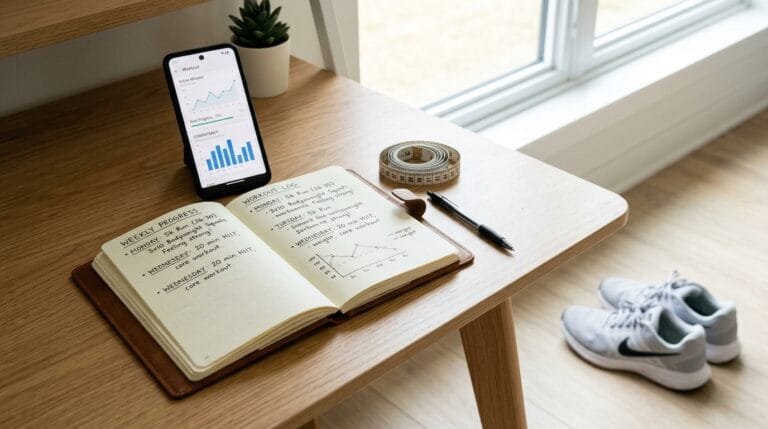
- Track sessions simply so progressive overload remains visible.
- Deload volume every 4–8 weeks to prevent residual fatigue that can lead to form breakdown and noise.
Sample Quiet 25–35 Minute Workouts
Band + Bodyweight Circuit
- Band or bodyweight squat – 3 × 10–15 (slow eccentric)
- Single-leg Romanian deadlift – 3 × 8–12 per leg
- Push-up variation – 3 × 8–15
- Band or table row – 3 × 10–15
- Plank or dead bug – 2 sets
Dumbbell-Focused Quiet Session
- Goblet squat – 3 × 8–12 (3-sec lower)
- Romanian deadlift – 3 × 8–12
- Floor press – 3 × 8–12
- Single-arm row – 3 × 8–12 per arm
- Optional suitcase carry – short, controlled distances
Density Option (Quiet Version)
Set a timer for 20–25 minutes. Rotate through the four main patterns with controlled repetitions and no impact. Rest only as needed to keep form and silence.
Progressive Overload Without Noise
- Slow the eccentric phase
- Add pauses at the hardest point
- Increase range of motion under control
- Move to unilateral variations
- Improve density while maintaining silence
- Add light band resistance where helpful
These methods create genuine progressive overload without requiring heavier drops or ballistic movements.
Flooring, Anchors, and Setup Tips
- Use thick interlocking mats or a dedicated rubber area to absorb sound.
- Test door anchors carefully and use proper attachment points.
- Place a towel or extra mat under dumbbells during floor presses or rows.
- Avoid training directly above sensitive rooms when possible.
- Keep sessions shorter rather than longer and louder.
Common Noise-Creating Mistakes and Fixes
| Mistake | Noise Impact | Quiet Solution |
|---|---|---|
| Dropping dumbbells | High | Controlled lowering every rep |
| Jumping or box-style movements | High | Remove impact variations |
| Fast, uncontrolled tempos | Moderate–high | Default to 3-sec eccentrics |
| Unstable furniture for support | Variable | Test stability before loading |
| Late-night high-intensity sessions | Social impact | Use quiet formats and considerate timing |
| Ignoring family feedback | Relationship stress | Communicate and adjust |
Strength training performed with controlled, joint-friendly methods remains highly effective for building and maintaining muscle and strength (strength training guidance). Practical home-gym approaches emphasise adaptable, low-disruption systems (home gym equipment prioritisation and budget home gym principles).
Frequently Asked Questions
Can I build real strength with quiet training methods?
Yes. Mechanical tension and progressive overload drive strength. Controlled tempos, pauses, and unilateral work provide both.
Are resistance bands enough for long-term progress?
They are excellent for maintenance and continued progress when combined with tempo, pauses, and harder variations. Many people use them successfully for extended periods.
What is the quietest way to train legs?
Slow goblet squats, reverse lunges, Bulgarian split squats, and single-leg Romanian deadlifts performed with controlled tempos.
How do I progress push-ups quietly?
Elevate feet, slow the eccentric, add pauses, or move to archer or one-arm progressions while keeping every rep controlled.
Is a treadmill or rowing machine quiet enough?
Most motorised treadmills and rowers produce noticeable noise and vibration. They are generally less suitable for shared housing than band and bodyweight options.
What flooring is best for noise reduction?
Thick rubber mats or interlocking foam/rubber tiles. Multiple layers help further.
Can I train early in the morning or late at night?
Yes, provided the format stays controlled and quiet. Avoid any impact or dropping.
How do I handle neighbours who are still sensitive?
Further reduce volume, emphasise even slower tempos, train at different times, and keep sessions shorter. Communication helps when appropriate.
A quiet home gym also benefits from deliberate session timing and household communication. Even the lowest-impact exercises can become a source of friction if they consistently occur during a partner’s work calls, a child’s nap, or a neighbour’s quiet hours. Establishing a small number of preferred training windows and sharing them in advance reduces surprises and builds goodwill. When the people around you understand that sessions are short, controlled, and finished by a predictable time, tolerance rises dramatically and the training habit becomes easier to protect.
Flooring and surface choices deserve more attention than most people give them. A single thin mat is often insufficient on hard floors or in apartments with sensitive ceilings below. Layering a thick rubber mat over interlocking tiles, or placing an extra dense mat under the primary working area, absorbs both impact and vibration. Testing the setup by performing a few controlled repetitions while someone listens from an adjacent room or the floor below provides immediate feedback and allows adjustments before a full session begins.
Progressive overload in a quiet environment rewards creativity more than load. Because dropping weight or adding explosive movements is off the table, the trainee who masters tempo manipulation, paused reps, unilateral variations, and density methods often develops superior control and joint resilience. These qualities transfer well when heavier equipment or a commercial gym becomes available later. In that sense, the constraints of quiet training can produce better long-term movers rather than limited ones.
Finally, consistency itself is quieter than intensity. A sustainable pattern of three moderate, controlled sessions each week creates far less cumulative disturbance than sporadic high-effort workouts that involve noise, frustration, or make-up sessions. When the routine is predictable in both timing and sound profile, it fades into the background of household life. That predictability is one of the strongest predictors that the quiet home gym will still be in use a year later rather than abandoned after the first complaint.
Final Recommendation
Quiet home gym training is entirely achievable with resistance bands, controlled dumbbell or bodyweight work, soft flooring, and deliberate technique. Focus on compound patterns performed with slow eccentrics, pauses, and unilateral progressions. Eliminate dropping, jumping, and ballistic movements. Prepare the space to absorb sound, schedule sessions considerately, and apply progressive overload through non-impact methods.
Design your first quiet full-body session today using the sample templates, prioritise control over load, and communicate the plan to household members. When noise is managed, home training becomes sustainable for both results and relationships. Start with the quietest effective options—you will build strength without the disturbance.