
How to Stay Consistent with Home Training When Motivation Drops
Quick Answer
When motivation drops, consistency is maintained by shifting from motivation-dependent training to systems and habits. Reduce the decision load with fixed training days and a minimum viable session (even 15–20 minutes), prepare the environment in advance, track adherence rather than perfection, lower the intensity or volume temporarily without stopping completely, and reconnect with clear, short-term reasons for training. Motivation fluctuates; reliable systems keep the habit alive until motivation returns.
Why Motivation Inevitably Drops
Motivation is an emotion, not a permanent state. It rises with novelty, visible progress, and low life stress, and falls with fatigue, plateaus, busy schedules, poor sleep, or simply the passage of time. Home training amplifies the problem because there is no external accountability, travel ritual, or social pressure to show up. Waiting for motivation to return often leads to weeks or months of inactivity. The solution is to design a training approach that functions even on low-motivation days.
Core Strategies for Low-Motivation Consistency
| Strategy | How It Helps | Practical Example |
|---|---|---|
| Minimum viable session | Removes the “all or nothing” barrier | 15–20 minute full-body circuit of 3–4 compounds |
| Fixed schedule | Reduces daily decision fatigue | Train Monday / Wednesday / Friday at the same time |
| Environment design | Makes starting easier than avoiding | Equipment laid out the night before |
| Habit stacking | Links training to an existing routine | Train immediately after morning coffee |
| Tracking adherence | Focuses on showing up, not perfect performance | Simple “completed / missed” log |
| Temporary volume reduction | Keeps the habit alive during hard periods | Cut sets in half but keep the sessions |
| Short-term goals | Provides immediate purpose | “Complete 12 sessions this month” |
Strategy 1: Define a Minimum Viable Workout
On low-motivation days the biggest obstacle is the perceived size of the session. Create a short, non-negotiable version that still covers the main movement patterns:
- One squat or lunge variation
- One hinge
- One push
- One pull
Perform 2 sets of each with solid effort. Total time stays under 20 minutes. Completing the minimum session preserves the habit and often leads to doing more once you have started. Never let the perfect full workout become the enemy of a short effective one.
Strategy 2: Reduce Friction Before the Session
Motivation is heavily influenced by how easy it is to begin. Reduce friction aggressively:
- Lay out equipment or clear the space the night before
- Prepare the exact workout in advance so no decisions are required
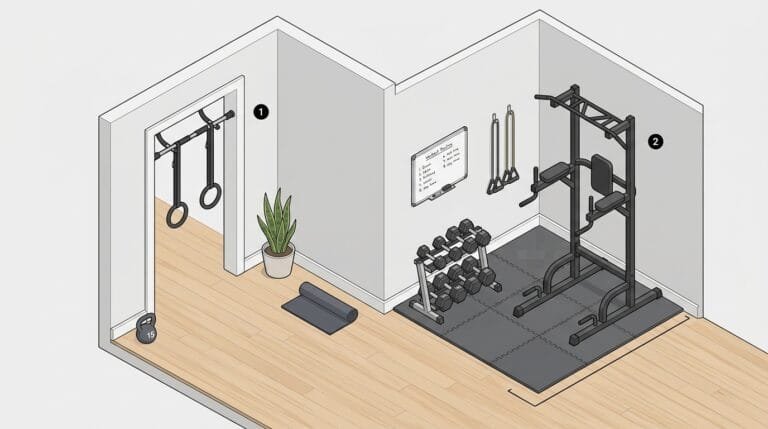
- Keep a dedicated training area if possible, even if small
- Remove competing distractions (phone in another room during the session)
The less willpower required to start, the more often you will train when motivation is low.
Strategy 3: Fix the Schedule and Protect It
Decide the training days and times in advance and treat them as appointments. A fixed schedule eliminates the daily negotiation of “should I train today?”. When life interferes, move the session rather than cancelling it. Consistency over months is built by protecting the calendar slots, not by waiting for ideal conditions.
Strategy 4: Track Adherence, Not Just Performance
During low-motivation periods, shift the primary metric from weight lifted or repetitions completed to simply completing the planned sessions. A simple calendar or notebook with a checkmark for each completed workout provides clear visual proof of consistency. Performance metrics can return once the habit is stable again.
Strategy 5: Use Temporary Reductions Instead of Stops
When energy or motivation is genuinely low, reduce volume or intensity rather than stopping. Cutting sets in half, using lighter loads, or performing only the minimum viable session keeps the habit and the movement patterns alive. Complete rest for more than a few days often makes restarting harder.
Strategy 6: Reconnect with Purpose and Short-Term Goals
Long-term goals lose power when motivation drops. Create short, concrete targets for the next 2–4 weeks:
- Complete a set number of sessions
- Improve one specific exercise by a small amount
- Maintain a current strength level during a busy period
Write the reason you train in one sentence and keep it visible. On difficult days, read it before starting.
Step-by-Step System for Low-Motivation Periods
- Write down your minimum viable workout (4 exercises, 2 sets each).
- Choose fixed training days and times for the next month.
- Prepare the training space and equipment the night before each session.
- Track every completed session with a simple checkmark or note.
- If energy is very low, perform only the minimum session without guilt.
- Review adherence at the end of each week and adjust friction points.
- Set one short-term process goal for the next 2–4 weeks.
- Protect sleep and basic nutrition as much as possible—these strongly influence motivation.
- After 2–3 weeks of consistent minimum sessions, gradually return to normal volume if energy allows.
- Treat low-motivation periods as expected events and apply the same system each time they appear.
Programming Adjustments During Low Motivation
- Favour full-body sessions so each pattern is hit even with fewer total workouts.
- Keep exercise selection familiar to reduce decision fatigue.
- Maintain joint-friendly technique even when effort is reduced (Bent Arms vs. Straight Arms in Lateral Raises, The Hidden Mistake in Lateral Raises, and 3 Lateral Raise Modifications).
- Include brief grip or carry work if it supports overall training quality without adding stress (Do Hand Grippers Really Work?).
Mindset Shifts That Support Consistency
- Identity over outcome: “I am someone who trains regularly” is more robust than “I must feel motivated.”
- Process over performance: Showing up is the win during low-motivation phases.
- Flexibility within structure: The schedule is fixed; the exact content can flex.
- Self-compassion without excuses: Acknowledge low motivation without using it as permission to stop entirely.
Common Mistakes That Destroy Consistency
| Mistake | Result | Better Approach |
|---|---|---|
| Waiting for motivation to return | Prolonged inactivity | Start with the minimum session |
| All-or-nothing thinking | Missed sessions become full stops | Accept short or easier sessions |
| Constantly changing the programme | Decision fatigue and loss of progress | Keep structure familiar |
| Ignoring sleep and stress | Deeper motivation drops | Address recovery basics first |
| Tracking only performance | Discouragement when numbers stall | Track adherence first |
| Isolating training from life | Easy to deprioritise | Habit-stack with existing routines |
Strength training remains one of the most effective ways to build long-term physical and mental resilience (strength training guidance). Practical home-gym approaches emphasise systems that survive real-life fluctuations in motivation and energy (home gym equipment prioritisation and budget home gym principles).
Frequently Asked Questions
How long do motivation drops usually last?
They vary widely—from a few days to several weeks. The system approach ensures training continues regardless of duration.
Is it better to take a full break or keep doing minimum sessions?
Minimum sessions are usually better for maintaining the habit and making restart easier. Complete breaks longer than a week often increase the psychological barrier to returning.
What if even the minimum workout feels impossible?
Reduce further to a 10-minute movement session or a short walk. The goal is to protect the identity of someone who moves regularly.
Should I change exercises when motivation is low?
Generally no. Familiar exercises reduce decision fatigue. Save variety for periods of higher energy.
How important is tracking during these periods?
Very. A simple adherence record provides proof of consistency and often becomes motivating in itself.
Can environment design really make that much difference?
Yes. Reducing the number of steps between “deciding to train” and “starting the first set” measurably increases follow-through.
What role does sleep play in motivation?
A major one. Chronic under-sleeping reliably lowers motivation and increases perceived effort. Protecting sleep is one of the highest-leverage actions.
How do I return to normal training after a low-motivation phase?
Increase volume gradually over 1–2 weeks. Do not jump straight back to previous maximums.
Final Recommendation
Motivation will drop—this is normal and expected. Consistency is preserved by building systems that function when motivation is absent: a minimum viable session, fixed training times, reduced friction, adherence tracking, and temporary volume reductions instead of complete stops. These tools keep the habit alive until energy and motivation return.
Define your minimum workout today, schedule the next three sessions, and prepare the training space in advance. When low motivation arrives, execute the system rather than negotiating with your feelings. Over time this approach produces far more total training sessions—and far better long-term results—than relying on motivation alone. Start building the system now; the next motivation dip is only a matter of time.