How to Fix Rounded Shoulders That Appear During Overhead Work
Quick Answer
Rounded shoulders that appear during overhead work are usually caused by a combination of tight pectoralis minor and major, limited thoracic extension, weak or under-active lower trapezius and serratus anterior, and poor motor control of the scapulae. The fix involves restoring thoracic mobility, releasing the anterior shoulder tissues, strengthening the scapular upward rotators and retractors, and practising overhead patterns with deliberate scapular positioning. Consistent daily mobility work plus targeted strengthening 3–4 times per week typically improves posture and overhead stability within 4–8 weeks.
Why Shoulders Round During Overhead Movements
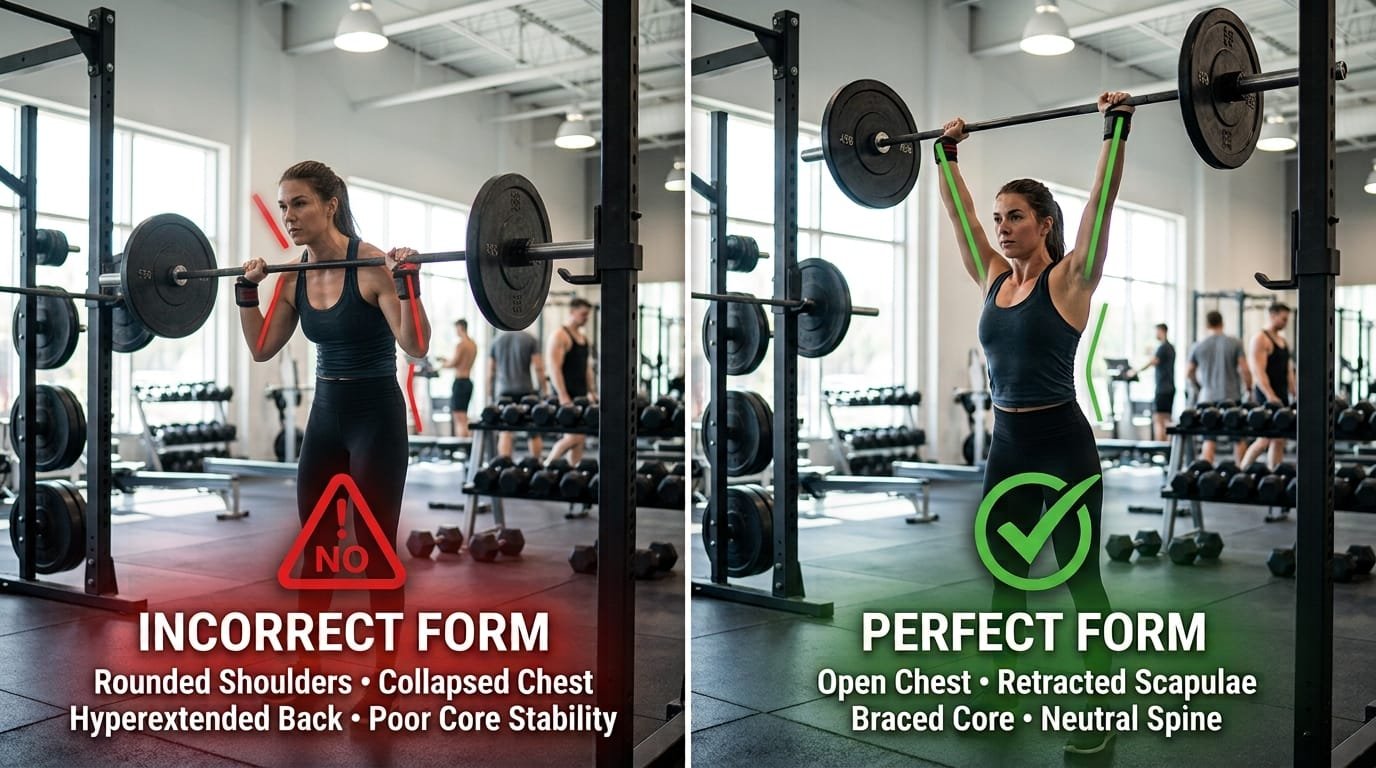
When the arms go overhead the scapulae must upwardly rotate, posteriorly tilt, and slightly protract in a coordinated sequence. If the tissues on the front of the shoulder and chest are short or overactive, or if the muscles that control the scapula are weak or poorly timed, the shoulder complex compensates by letting the scapulae tilt forward and the upper back round. This creates the visual appearance of rounded shoulders and often produces a feeling of instability or impingement at the top of the press or raise.
Common contributing factors include:
- Prolonged sitting and forward-shoulder posture in daily life
- Excessive pressing volume relative to pulling volume
- Limited thoracic spine extension
- Weak serratus anterior and lower trapezius
- Over-active upper trapezius and levator scapulae
- Poor awareness of scapular position under load
Assessment: How to Tell If This Is Your Issue
Wall test
Stand with your back against a wall, heels a few inches away, and try to press the lower back, upper back, and the backs of the hands against the wall while raising the arms overhead. Inability to keep the ribs down or the hands in contact while elevating the arms indicates limited thoracic extension or scapular control.
Overhead reach observation
Film yourself from the side and behind while performing a slow overhead press or raise. Look for the lower ribs flaring, the upper back rounding, or the scapulae winging or failing to rotate upward smoothly.
Pec minor length test
Lie on your back with arms resting at your sides. If the shoulders sit significantly forward off the floor, the anterior tissues are likely restricted.
Step-by-Step Correction Plan
Phase 1 – Mobility and Tissue Quality (Daily)
- Thoracic extension over a foam roller or rolled towel – 8–10 slow extensions.
- Open-book or thread-the-needle rotations for thoracic rotation.
- Doorway or corner pec stretches with gentle posterior pelvic tilt – 2 × 30–45 seconds each side.
- Lat and teres major soft-tissue work with a ball or gentle band stretch.
Phase 2 – Scapular Control and Strengthening (3–4 times per week)
- Scapular push-ups or serratus punches – 2–3 sets of 10–15.
- Prone Y-raises and T-raises on an incline bench or floor – 2–3 sets of 8–12.
- Band pull-aparts and face pulls with external rotation emphasis – 3 sets of 12–20.
- Wall slides or wall angels with controlled upward rotation – 2–3 sets of 8–10.
Phase 3 – Integration into Overhead Patterns
- Landmine press or single-arm dumbbell press with focus on keeping the ribs down and scapula rotating smoothly.
- Half-kneeling or tall-kneeling overhead press to reduce lower-back compensation.
- Controlled tempo overhead raises in the scapular plane using light loads.
Detailed guidance on joint-friendly raising patterns that reinforce good scapular mechanics can be found in Bent Arms vs. Straight Arms in Lateral Raises, The Hidden Mistake in Lateral Raises, and 3 Lateral Raise Modifications.
Comparison of Common Compensations and Fixes
| Compensation Observed | Likely Cause | Primary Fix |
|---|---|---|
| Upper back rounds as arms rise | Limited thoracic extension | Foam-roller extensions + wall slides |
| Shoulders shrug early | Over-active upper traps / weak lower traps | Y-raises, lower-trap focused work |
| Scapulae wing | Weak serratus anterior | Scapular push-ups, band serratus punches |
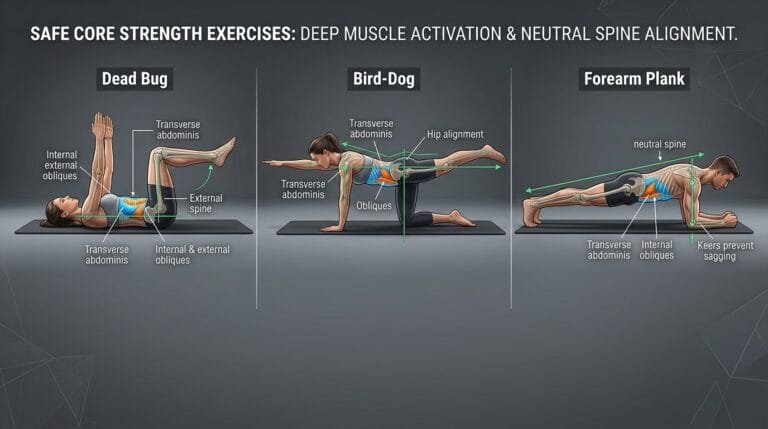
| Ribs flare | Poor core control / limited thoracic mobility | Dead bugs, half-kneeling presses |
| Arms drift forward | Tight pec minor / weak retractors | Pec stretching + face pulls |
Programming Template for Correction
Daily (5–8 minutes)
- Thoracic extensions
- Pec minor stretch
- 1–2 scapular control drills
Strength sessions (3–4 times per week)
- 2–3 scapular strengthening exercises early in the session or as warm-up
- Overhead pressing variations performed with reduced load and high focus on position
- Horizontal and vertical pulling volume that meets or exceeds pressing volume
- Optional farmer carries or suitcase carries for additional postural demand
Grip strength supports overall upper-limb stability during carries and loaded positions (Do Hand Grippers Really Work?).
Technique Cues for Overhead Work While Correcting Posture
- “Ribs down, reach long.”
- “Slide the shoulder blades around the ribcage as the arms go up.”
- “Finish with the biceps by the ears without shrugging.”
- “Keep the lower back neutral; do not turn the press into an upper-back extension.”
Use lighter loads until these cues feel automatic. Strength gains return quickly once position improves.
Supporting Lifestyle Factors
- Break up prolonged sitting with thoracic extension and scapular retraction every 30–60 minutes.
- Strengthen the mid-back and posterior chain in the broader programme.
- Ensure adequate pulling volume relative to pressing.
- Address sleep position if you spend long periods curled forward.
Progress Timeline and Expectations
- Weeks 1–2: Improved awareness and mobility; reduced tightness.
- Weeks 3–5: Noticeable improvement in scapular control during unloaded and lightly loaded overhead reaches.
- Weeks 6–8+: More stable overhead pressing with heavier loads and better carry-over to daily posture.
Individual results vary with consistency and the severity of the initial restrictions.
Common Mistakes During the Fixing Process
| Mistake | Consequence | Better Approach |
|---|---|---|
| Stretching only without strengthening | Temporary relief, no lasting change | Pair mobility with serratus and lower-trap work |
| Continuing heavy overhead pressing unchanged | Reinforces the rounded pattern | Reduce load and prioritise position |
| Over-stretching the shoulders aggressively | Potential irritation | Use gentle, consistent stretches |
| Ignoring thoracic spine | Limited improvement | Make thoracic mobility a daily priority |
| Expecting overnight posture change | Frustration | Commit to 4–8 weeks of consistent work |
Strength training performed with attention to scapular and thoracic position remains one of the most effective ways to build durable shoulders (strength training guidance). Practical home-gym methods favour controlled, high-quality movement over maximal loading when correcting imbalances (home gym equipment prioritisation and budget home gym principles).
Frequently Asked Questions
How long does it take to fix rounded shoulders during overhead work?
Most people see meaningful improvement in 4–8 weeks of consistent daily mobility and 3–4 strength sessions per week.
Can I still overhead press while fixing the problem?
Yes, but reduce the load, shorten the range if needed, and prioritise perfect scapular and rib position on every repetition.
Are resistance bands enough for the corrective work?
Yes. Bands are excellent for face pulls, pull-aparts, serratus punches, and assisted mobility drills.
Should I avoid all overhead pressing until posture improves?
Not usually. Modified, controlled overhead work often helps retrain the pattern, provided pain is absent and position is prioritised.
Is this the same as upper-crossed syndrome?
It overlaps significantly. The same combination of tight anterior tissues and weak posterior scapular muscles is involved.
Do I need a coach or therapist?
Self-guided work helps many people. If progress stalls, pain persists, or you have a significant injury history, professional assessment is recommended.
Will strengthening the upper traps make rounding worse?
Direct upper-trap isolation can, if the lower traps and serratus remain weak. Focus first on the upward rotators and retractors.
Can sleeping position affect this?
Yes. Side-sleeping in a tightly curled posture or stomach-sleeping can reinforce rounded shoulders. Experiment with supportive pillows that keep the spine more neutral.
A critical but often overlooked element is the interaction between rib position and scapular movement. When the lower ribs flare upward during an overhead press or raise, the scapulae are forced into a more anteriorly tilted orientation and the lumbar spine tends to hyperextend as compensation. Teaching the body to keep the ribs gently down and the pelvis neutral while the arms elevate creates a much more stable platform for the shoulder blades to rotate around. Practising this coordination in half-kneeling or tall-kneeling stances is especially effective because the positions limit the ability to cheat with the lower back and make the correct rib-scapula relationship easier to feel and own.
Another practical accelerator is the strategic use of tempo and pauses. Performing the final 30–40 degrees of an overhead reach or press with a deliberate two-second pause at the top, while actively reaching long through the arms and keeping the shoulders away from the ears, reinforces the upward-rotation and posterior-tilt actions that are missing when shoulders round. Light loads or even empty-bar work are ideal for this drill; the goal is motor learning rather than fatigue. Over a few weeks the improved timing carries over into heavier sets and daily overhead activities, reducing the tendency for the shoulders to roll forward under load.
Finally, consistency of pulling volume relative to pressing volume remains one of the highest-leverage long-term strategies. Many lifters who develop rounded shoulders during overhead work are simply performing far more horizontal and vertical pushing than pulling across the week. Ensuring that rowing and face-pull volume meets or slightly exceeds pressing volume supplies the mid-back and posterior shoulder strength needed to hold better scapular positions automatically. When this balance is maintained alongside the mobility and control drills already outlined, the corrective process becomes self-reinforcing and the improvements in overhead posture tend to last.
Final Recommendation
Rounded shoulders that appear during overhead work are a solvable combination of mobility restrictions, muscular imbalances, and motor-control habits. Restore thoracic extension, lengthen the pectoralis minor, strengthen the serratus anterior and lower trapezius, and practise overhead patterns with deliberate scapular upward rotation and rib control. Consistency across daily mobility and structured strengthening sessions produces reliable improvement within several weeks.
Begin the daily thoracic and pec work immediately, add the key scapular drills to every upper-body session, and reduce overhead loading just enough to maintain perfect position. Pair this approach with balanced pulling volume and attentive recovery.
The result is more stable, comfortable overhead pressing and better resting posture. Start the corrective sequence today—mobility first, control second, load third—and the rounded-shoulder compensation will progressively disappear.