Safer Alternatives to Upright Rows for Shoulder-Friendly Training
Quick Answer
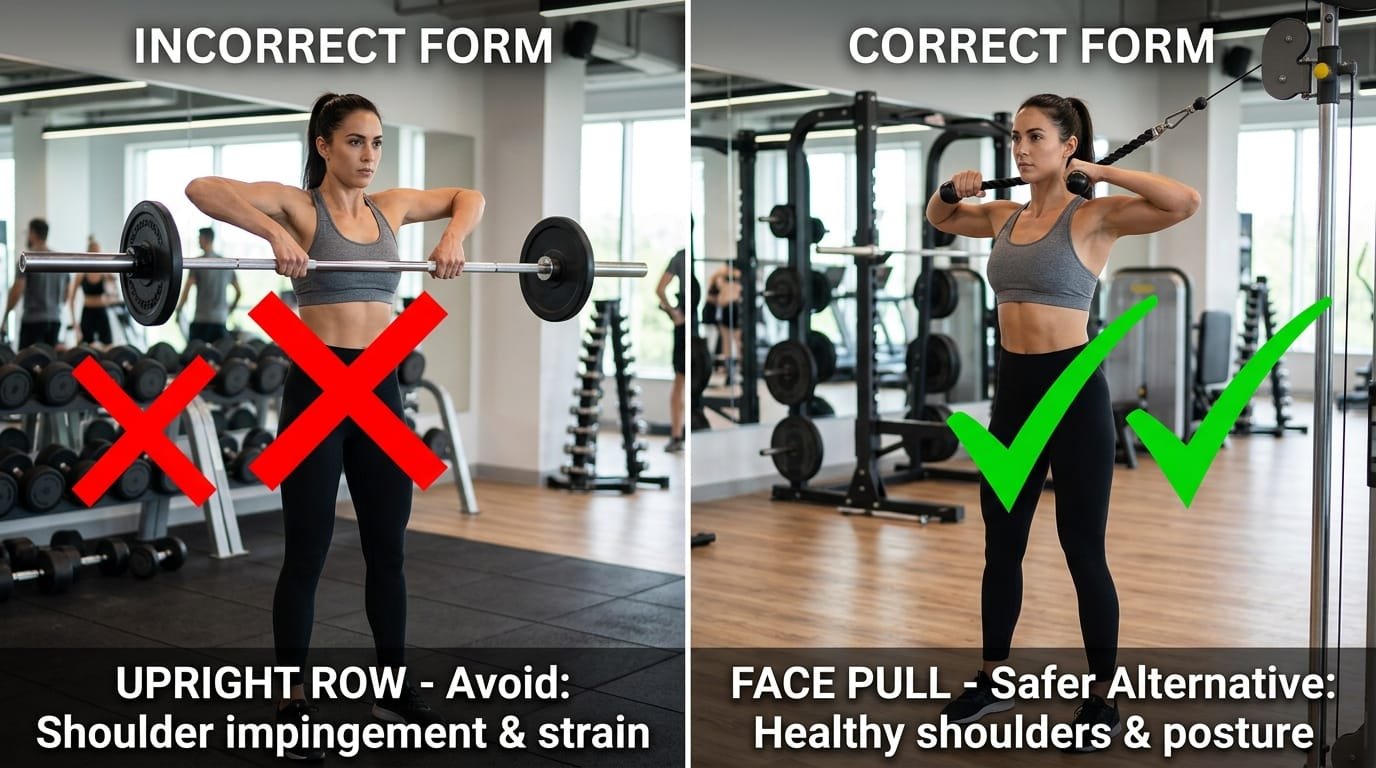
Upright rows place the shoulder in internal rotation while elevating the elbows high, a combination that narrows the subacromial space and can irritate the rotator cuff or biceps tendon in many lifters. Safer alternatives that train the same muscle groups (lateral deltoids, upper trapezius, and to a lesser extent the biceps and forearms) include face pulls, bent-arm lateral raises in the scapular plane, high-pull variations with external rotation bias, cable or band upright-row substitutes performed with a wider grip and lower elbow path, and farmer carries or shrugs for trap development. These options deliver comparable training stimulus with significantly lower joint stress when performed with controlled technique.
Why Traditional Upright Rows Can Be Problematic
The classic upright row involves pulling a barbell or dumbbells vertically along the body while the elbows travel high and the upper arms internally rotate. This movement repeatedly drives the greater tuberosity of the humerus toward the acromion, reducing subacromial space. For lifters with existing shoulder sensitivity, poor scapular control, or a history of impingement, the exercise frequently produces pinching, clicking, or lingering irritation.
Even in asymptomatic lifters the risk-to-benefit ratio is often unfavourable because several safer movements can target the same muscles without the same anatomical conflict. Replacing upright rows with joint-friendlier options is therefore one of the simplest ways to keep shoulder training productive long-term.
Key Muscles Targeted by Upright Rows
- Lateral (medial) deltoid
- Upper trapezius
- Supraspinatus (to a degree)
- Biceps brachii and brachialis
- Forearm flexors (grip)
Any suitable alternative should address most of these, especially the lateral deltoid and upper trapezius.
Best Shoulder-Friendly Alternatives
1. Face Pulls (Cable or Band)
One of the highest-value replacements. Face pulls train the rear delts, external rotators, and upper back while encouraging scapular retraction and external rotation—the opposite of the internal-rotation stress of upright rows.
Execution tips:
- Set the cable or band at upper-chest to face height.
- Pull toward the face or forehead while externally rotating the shoulders (thumbs pointing backward at the end).
- Emphasise the squeeze between the shoulder blades.
- Use moderate loads and higher repetitions (12–20).
2. Bent-Arm Scapular-Plane Lateral Raises
These directly target the lateral deltoid with far less joint stress than upright rows or straight-arm raises.
- Keep a 30–45 degree elbow bend.
- Raise in the scapular plane (slightly forward of pure lateral).
- Stop at or just below shoulder height.
- Focus on control rather than heavy loading.
Detailed technique and variation guidance appear in Bent Arms vs. Straight Arms in Lateral Raises, The Hidden Mistake in Lateral Raises, and 3 Lateral Raise Modifications.
3. High Pulls with External-Rotation Bias
A modified high-pull using dumbbells, kettlebells, or a cable while consciously leading with the elbows and keeping a neutral-to-externally rotated shoulder position. Keep the elbows from traveling excessively high and avoid internal rotation.
4. Cable or Band “Upright Row” with Wide Grip and Limited Elbow Height
If you want a similar movement pattern, use a rope or wide grip, pull only to lower-chest height, and keep the elbows from rising above the shoulders. This reduces the impingement risk while still loading the lateral delts and traps.
5. Farmer Carries and Loaded Shrugs
For upper-trapezius development, heavy farmer carries and controlled shrugs (dumbbell, barbell, or trap-bar) are excellent. They load the traps isometrically or dynamically without forcing the shoulder into the problematic upright-row position. Grip strength is also challenged productively (Do Hand Grippers Really Work?).
6. Incline or Prone Y-Raises and T-Raises
These target the lower and middle trapezius plus the deltoids in a supported position that minimises compensatory shrugging and internal rotation.
Comparison Table: Upright Rows vs Safer Alternatives
| Exercise | Lateral Delt Stimulus | Upper Trap Stimulus | Shoulder Stress | Scapular Benefit | Overall Recommendation |
|---|---|---|---|---|---|
| Traditional Upright Row | High | High | High | Low | Avoid or heavily modify |
| Face Pull | Moderate | Moderate | Low | High | Excellent primary replacement |
| Bent-Arm Scapular Lateral Raise | High | Low–Moderate | Low | Moderate | Excellent |
| Modified Wide-Grip High Pull | Moderate–High | Moderate | Low–Moderate | Moderate | Good |
| Farmer Carry / Shrug | Low | High | Very Low | Moderate | Excellent for traps |
| Y / T Raises | Moderate | Moderate | Very Low | High | Excellent accessory |
Step-by-Step Replacement Strategy
- Remove conventional upright rows from the program.
- Insert face pulls 2–3 times per week for rear-delt and external-rotator work.
- Add bent-arm scapular-plane lateral raises for direct lateral-delt stimulus.
- Include farmer carries or shrugs if upper-trap development is a priority.
- Use Y-raises or band pull-aparts in warm-ups to reinforce good scapular mechanics.
- Monitor shoulder comfort over 2–4 weeks and adjust volume as needed.
- Progress load and complexity only while movement remains pain-free.
- Maintain balanced horizontal and vertical pulling to support overall shoulder health.
- Film sets periodically to confirm elbow height and shoulder position stay within safe ranges.
- Reassess every 4–6 weeks; most lifters never need to return to traditional upright rows.
Programming Examples
Upper-body or shoulder-focused day
- Main press (bench or overhead variation)
- Horizontal row
- Face pulls – 3 × 12–20
- Bent-arm lateral raises – 3 × 12–15
- Optional farmer carries – 3 × 30–40 seconds
Full-body day
- Squat or hinge
- Push
- Pull
- Face pulls or band pull-aparts – 2–3 × 15
- Lateral-raise variation – 2–3 × 12–15
These templates keep the training stimulus high while removing the highest-risk movement.
Additional Technique and Recovery Considerations
- Prioritise scapular control and external rotation in every upper-body session.
- Warm up the rotator cuff and thoracic spine before pressing or raising patterns.
- Keep overall pressing volume reasonable relative to pulling volume.
- Address grip strength so carries and pulling movements are not limited by the hands.
- Allow adequate recovery between high-volume shoulder sessions.
Strength training performed with joint-friendly exercise selection remains one of the most effective ways to build muscle and resilience (strength training guidance). Practical home-gym approaches favour movements that deliver results without unnecessary risk (home gym equipment prioritisation and budget home gym principles).
Common Mistakes When Switching Away from Upright Rows
| Mistake | Result | Better Approach |
|---|---|---|
| Replacing upright rows with nothing | Loss of lateral-delt and trap stimulus | Insert face pulls + lateral raises |
| Performing face pulls with internal rotation | Misses the external-rotation benefit | Actively externally rotate at the end range |
| Using excessive weight on lateral raises | Reintroduces shoulder stress | Keep loads light and controlled |
| Neglecting upper-trap work entirely | Incomplete development | Add carries or shrugs |
| Returning to upright rows too soon | Recurrence of symptoms | Stay with proven alternatives long-term |
When selecting and progressing these alternatives, consistency of execution matters more than occasional heavy efforts. Face pulls, for example, deliver their full benefit only when the external-rotation component is deliberate and the scapulae retract fully at the end of each repetition; simply pulling the rope to the face without that finishing position turns the movement into a generic row and loses much of its shoulder-health value.
Likewise, bent-arm lateral raises require a controlled tempo and strict avoidance of momentum—if the weights are swinging or the elbows are straightening under load, the stress begins to creep back toward the patterns that made upright rows problematic. Treating every set as a chance to reinforce good scapular mechanics and external rotation builds the exact motor patterns that keep the shoulder joint centred and resilient over months and years of training.
A further practical advantage of dropping traditional upright rows is the reduction in cumulative fatigue on the anterior shoulder structures. Many lifters who remove the exercise notice that pressing movements feel smoother and that residual tightness after upper-body sessions decreases. This creates a positive feedback loop: better recovery allows higher-quality work on the safer alternatives, which in turn further improves scapular control and lateral-delt development. Over a training block the net result is usually stronger, more stable shoulders and continued progress in both aesthetics and performance without the recurring irritation that upright rows so often produce.
Frequently Asked Questions
Are upright rows ever safe?
Some lifters tolerate a modified version with limited elbow height and external-rotation focus. For many, however, the safer alternatives simply provide a better risk-to-benefit ratio.
Will I lose lateral-delt development without upright rows?
No. Bent-arm scapular-plane lateral raises and face pulls supply excellent lateral-delt stimulus when progressed properly.
How many times per week should I do face pulls?
Two to four times per week works well for most people, especially as a high-repetition, controlled movement.
Can I do these alternatives at home with minimal equipment?
Yes. Bands cover face pulls and lateral-raise patterns effectively. Dumbbells or kettlebells handle lateral raises and carries.
Do I still need direct trap work?
If upper-trap development is important for aesthetics or performance, yes—farmer carries and shrugs are safer and highly effective.
What if my shoulders still feel irritated?
Reduce volume, check technique on all raising and pulling movements, emphasise external rotation and scapular control, and consider a short period of lower-intensity shoulder work.
Is the upright row necessary for any specific goal?
No. Every muscle it trains can be targeted more safely with the alternatives listed above.
Final Recommendation
Traditional upright rows carry a higher risk of shoulder irritation for many lifters because of the combination of internal rotation and high elbow elevation. Safer alternatives—face pulls, bent-arm scapular-plane lateral raises, modified high pulls, farmer carries, shrugs, and Y/T raises—deliver comparable or better training effects for the lateral deltoids and upper trapezius while respecting shoulder anatomy.
Remove conventional upright rows, insert the recommended replacements, prioritise external rotation and scapular control, and progress the new movements consistently. Most lifters notice improved shoulder comfort within a few weeks while continuing to build strength and muscle.
Start by swapping upright rows for face pulls and bent-arm lateral raises in your next upper-body session. Master the technique, keep the loads controlled, and treat shoulder health as a long-term priority. The result is productive training that remains sustainable for years.