Safe Home Strength Training During and After Injury Recovery
Quick Answer
Safe home strength training during and after injury recovery focuses on training around the injured area, staying within a low pain threshold (generally 0–3/10), modifying range of motion, load, tempo, and exercise selection, and progressing only when symptoms remain stable or improve. Train uninjured body parts with normal progressive programming, use pain-free variations for the affected region, prioritise controlled movement, and rebuild capacity gradually over weeks to months. Never push through sharp, radiating, or worsening pain. Consistency with intelligent modifications preserves strength, maintains conditioning, and supports a safer return to full training.
Why Continued Training Matters During Recovery
Complete rest is rarely the optimal long-term strategy once acute inflammation has settled. Appropriate loading stimulates tissue adaptation, maintains muscle mass and strength in uninjured areas, preserves movement patterns, and supports mental well-being. The challenge is applying enough stimulus to drive positive adaptation without exceeding the current healing capacity of the injured structure.
Home training offers unique advantages during recovery: full control over exercise selection, immediate ability to stop or modify movements, no external pressure to “keep up,” and the freedom to train at the exact intensity your body tolerates on any given day.
Core Principles of Training Around Injury
- Pain is information, not automatically a stop sign
Mild discomfort rated 0–3/10 that does not increase during the set or the following 24 hours is often compatible with productive training. Pain at 4/10 or higher, or pain that worsens the next day, requires immediate regression. - Train everything you can
Uninjured muscles and joints can usually be trained with normal progressive overload. This maintains overall fitness, hormonal environment, and training momentum. - Modify rather than abandon
Nearly every exercise has a regression or alternative that continues to load the target muscle while protecting the injured tissue. - Progress by symptom tolerance, not by calendar or ego
Increase range of motion, load, volume, or complexity only after the current level has been well tolerated for multiple sessions. - Recovery processes remain essential
Sleep, protein intake, overall calorie balance, and stress management become even more important when the body is healing.
These principles align with practical rehabilitation and strength-training guidance for managing load around injuries.
Traffic-Light Decision System
| Symptom Response | Rating | Recommended Action | Training Approach |
|---|---|---|---|
| No pain or mild awareness that settles quickly | 0–3/10 | Green light | Continue current plan; consider small progressions |
| Moderate discomfort or symptoms lingering into next day | 4–5/10 | Yellow light | Reduce range, load, or volume; switch to easier variation |
| Sharp, radiating, unstable, or significantly worsening pain | 6+/10 | Red light | Stop the movement; train only unaffected areas; seek professional input if persistent |
Use this system in every session. Record both the performance numbers and the symptom response.
Comprehensive Modification Strategies
| Training Variable | How to Adjust | Practical Example |
|---|---|---|
| Range of motion | Limit to current pain-free zone | Box squat to a height that stays comfortable |
| External load | Reduce substantially | Bodyweight or very light dumbbells/bands |
| Tempo | Slow the movement, especially the eccentric | 3-second lowering phase on every repetition |
| Exercise selection | Choose more joint-friendly variations | Landmine press or neutral-grip floor press instead of overhead or wide-grip bench |
| Volume | Fewer sets or fewer repetitions | 2 sets of 8 instead of 4 sets of 12 |
| Density | Longer rest periods | 2–3 minutes between sets if needed |
| Support / stability | Add external support | Hold a wall or sturdy surface during single-leg work |
| Frequency | Maintain or slightly reduce | Keep the area active 2–3 times per week if tolerated |
Knee-Specific Modifications and Programming
Common scenarios include patellofemoral pain, patellar or quadriceps tendon irritation, meniscus sensitivity, or post-surgical recovery.
Preferred exercise options
- Box squats or chair sit-to-stands to a pain-free depth
- Reverse lunges or static split squats with controlled range
- Glute bridges, hip thrusts, and single-leg bridge variations
- Low step-ups with slow eccentric lowering
- Straight-leg raises and isometric quadriceps holds
- Cycling, elliptical, or incline walking for conditioning
Approaches to limit or avoid until symptoms improve
- Deep knee flexion under heavy load
- Forward lunges with excessive forward knee travel
- High-impact running, jumping, or plyometrics
- Walking lunges performed for high volume
Supporting work should emphasise glute and hip-abductor strength, ankle mobility, and quadriceps control in pain-free ranges.
Shoulder-Specific Modifications and Programming
Common scenarios include subacromial irritation, rotator-cuff tendinopathy, labral sensitivity, or post-dislocation recovery.
Preferred exercise options
- Landmine presses
- Neutral-grip dumbbell floor presses or elevated push-ups
- Neutral-grip rows and neutral-grip pull-up variations
- Band pull-aparts, face pulls, and external-rotation exercises
- Scapular-plane lateral raises performed with a slight elbow bend and controlled tempo
Approaches to limit or avoid when provocative
- Behind-the-neck pressing or pulling
- Wide-grip upright rows
- End-range overhead pressing if it reproduces symptoms
- Deep dips with excessive shoulder extension
Detailed guidance on safe lateral-raise technique and broader shoulder-health practices can be found in safe lateral-raise guidance and the shoulder health routine.
Step-by-Step Return-to-Training Process
- Obtain appropriate medical or physiotherapy clearance when the injury was significant or diagnosis is unclear.
- Establish a current baseline using bodyweight or very light resistance in pain-free ranges.
- Continue normal progressive training for all uninjured body parts.
- Select the most joint-friendly variation available for the affected region.
- Keep symptoms at 0–3/10 during exercise and ensure they settle within 24 hours.
- Progress only one variable at a time (range of motion → load → volume → exercise complexity).
- Monitor and record symptoms for 24–48 hours after every session.
- Immediately deload or regress if symptoms increase.
- Re-introduce previously provocative movements only when they can be performed fully and without symptom aggravation.
- Rebuild capacity over weeks and months rather than attempting rapid return to previous loads.
Sample Home Session Templates During Recovery
General Structure
- Warm-up: 5–8 minutes of light cardio, mobility for unaffected joints, and gentle activation of the injured region within pain-free range.
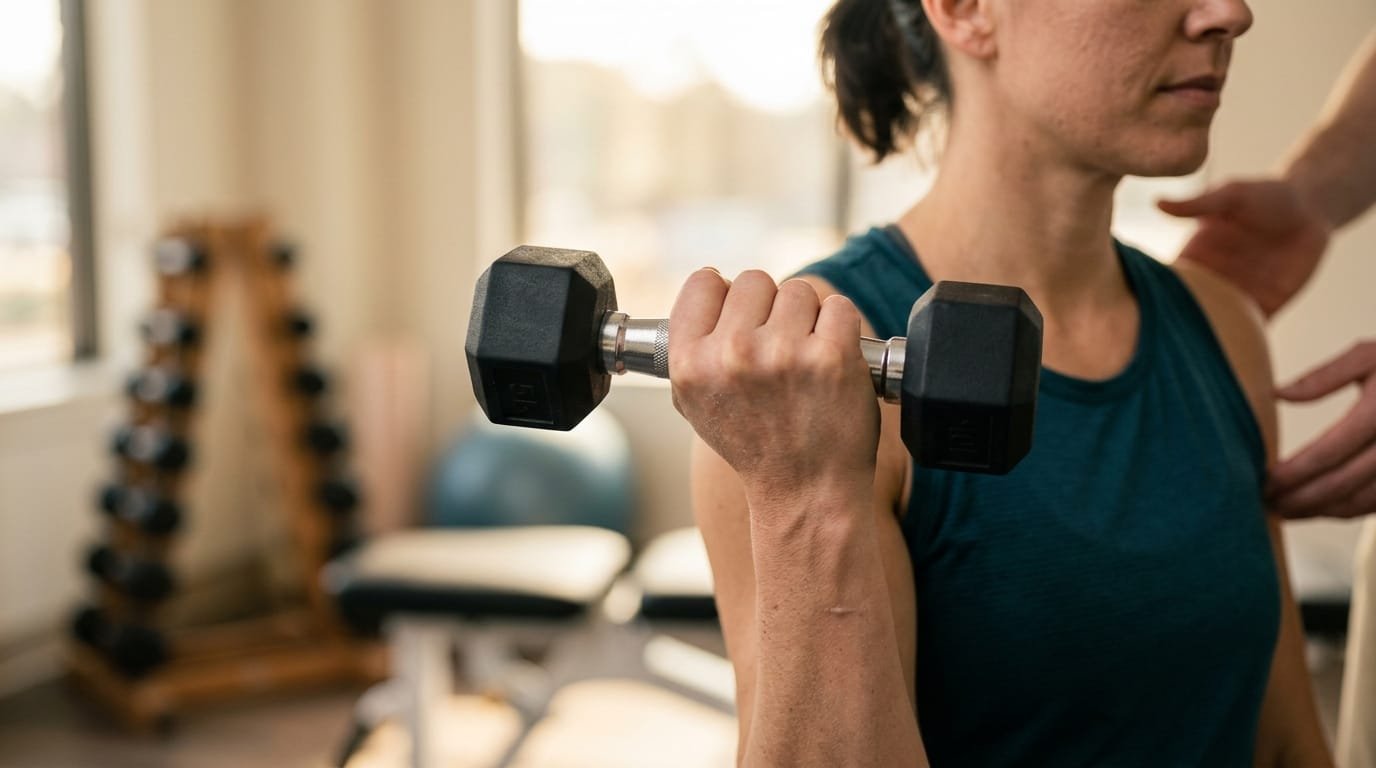
- Strength work: 2–4 movements for uninjured areas using normal progressive loading + 1–3 modified movements for the injured area.
- Core and low-impact conditioning as tolerated.
- Cool-down: gentle mobility and breathing.
Example Lower-Body Emphasis Session (Knee Limitation)
- Box Squat or Sit-to-Stand – 3 sets of 8–12 (pain-free depth)
- Glute Bridge or Hip Thrust – 3 sets of 10–15
- Reverse Lunge or Supported Split Squat – 2–3 sets of 6–10 per leg
- Upper-body pushing and pulling for uninjured areas – normal programming
- Optional low-impact conditioning – cycling or incline walking
Example Upper-Body Emphasis Session (Shoulder Limitation)
- Neutral-Grip Floor Press or Elevated Push-Up – 3 sets of 8–12
- Neutral-Grip Row – 3 sets of 8–12
- Landmine Press or Scapular-Plane Raise – 2–3 sets of 8–12
- Band Pull-Apart and External Rotation – 2–3 sets
- Lower-body work for uninjured areas – normal programming
Integrating Recovery Training with Existing Home Equipment
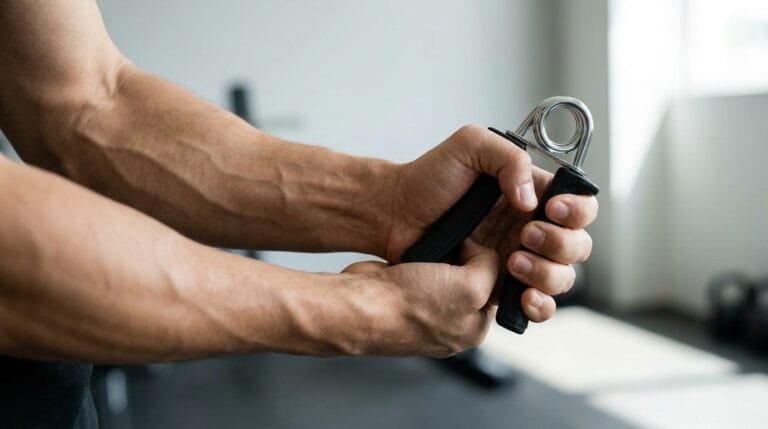
Kettlebell exercises can be modified by shortening range of motion or switching to single-arm versions (kettlebell sizing guide). Grip strength work is frequently trainable and supports overall upper-body function (grip strength guidance).
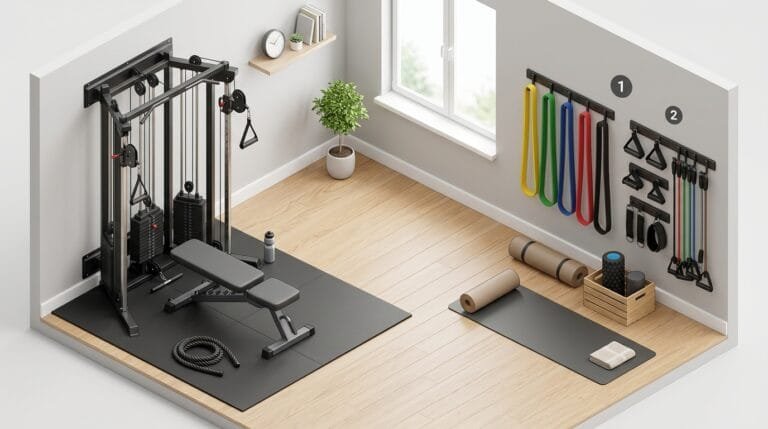
Resistance bands provide excellent low-load, controllable resistance for early-stage strengthening and activation (Resistance Bands Buying Guide). Core training can often continue with regressions of movements such as the ab roller. Low-impact conditioning options include incline treadmill walking or cycling (manual treadmill guidance).
Recovery tools and sleep quality directly influence healing rates (Best Post-Workout Recovery Tools, Best Massage Gun for Post-Workout Recovery on a Budget, and Sleep and Recovery Strategies). Tracking both performance metrics and symptom response is essential for safe progression (Best Ways to Track Progress Without a Gym or Personal Trainer.
External rehabilitation and strength resources emphasise careful load management, pain monitoring within a low threshold, and gradual reintroduction of movement as the foundation of safe return to training (training around injury principles).
Common Mistakes That Delay Recovery
- Attempting to return to pre-injury loads too quickly
- Pushing through sharp, radiating, or increasing pain
- Completely stopping all training instead of modifying intelligently
- Ignoring strength work for supporting muscle groups
- Neglecting sleep, protein intake, and overall recovery
- Constantly comparing current performance to pre-injury numbers
- Skipping professional assessment when symptoms are significant or unclear
- Changing too many variables at once so cause-and-effect becomes impossible to read
Frequently Asked Questions
Should I train at all while injured?
In the majority of cases, yes. Train uninjured areas normally and the injured area strictly within pain-free limits. Prolonged complete rest is rarely optimal after the acute phase.
How much pain is acceptable during exercise?
Generally 0–3/10 during the movement that fully settles within 24 hours. Higher levels or symptoms that worsen the next day require regression.
How long does return to normal training usually take?
Timelines vary widely according to injury severity, individual healing capacity, and consistency of rehabilitation. Expect anywhere from several weeks to several months for meaningful injuries.
Can muscle be built or maintained while recovering?
Yes. Uninjured muscles continue to adapt normally. The injured region can regain size and strength through progressive, well-tolerated loading.
When is professional medical or physiotherapy input necessary?
Seek assessment if pain is severe, worsening, accompanied by significant swelling, instability, marked weakness, numbness, or fails to improve with conservative management.
Are resistance bands safer than free weights during recovery?
Bands often allow finer control of tension and are useful in early stages, but both free weights and bands are appropriate when load and range are managed carefully.
Should I stretch the injured area aggressively?
Avoid aggressive stretching of irritable tissues. Gentle mobility work within pain-free ranges is usually more appropriate.
Is it normal to feel emotionally frustrated during recovery?
Yes. Maintaining training of uninjured body parts and tracking small objective improvements helps protect motivation.
Can I still do cardio?
Low-impact options such as cycling, swimming, elliptical, or incline walking are frequently well tolerated and beneficial for overall conditioning and mood.
Final Recommendation
Safe home strength training during and after injury recovery is built on intelligent load management: train everything you can, modify what you must, stay inside a low pain threshold, and progress only when symptoms remain stable or improve. Use the traffic-light system, shorten range of motion, reduce external load, slow tempos, and select joint-friendly exercise variations. Continue progressive training of uninjured body parts to preserve overall fitness and psychological momentum.
Apply the knee- and shoulder-specific modifications outlined above, maintain high-quality recovery practices, and track both performance and symptom response. Healing and the restoration of strength are gradual processes—respect the biological timeline, remain consistent with smart training decisions, and rebuild capacity one controlled step at a time. When uncertainty exists, choose the more conservative option and obtain professional guidance for persistent or severe issues. This approach protects long-term joint health while allowing you to keep moving forward productively.