Air Bike vs. Traditional Exercise Bike for Fat Loss and Conditioning
Quick Answer
An air bike (fan bike) generally burns more calories per minute and delivers superior full-body conditioning compared with a traditional upright or recumbent exercise bike because it combines lower-body pedaling with moving handlebars that engage the upper body, while resistance rises automatically with effort. Traditional exercise bikes excel at steady-state cardio, longer sessions, lower perceived effort for the same duration, and joint-friendly endurance work. For maximal calorie burn and HIIT-style conditioning in limited time, the air bike holds the edge; for sustainable daily cardio, recovery rides, or beginners, a traditional bike is often more practical. The best choice is the one you will use consistently at a challenging intensity.
Core Mechanical and Physiological Differences
Air Bike
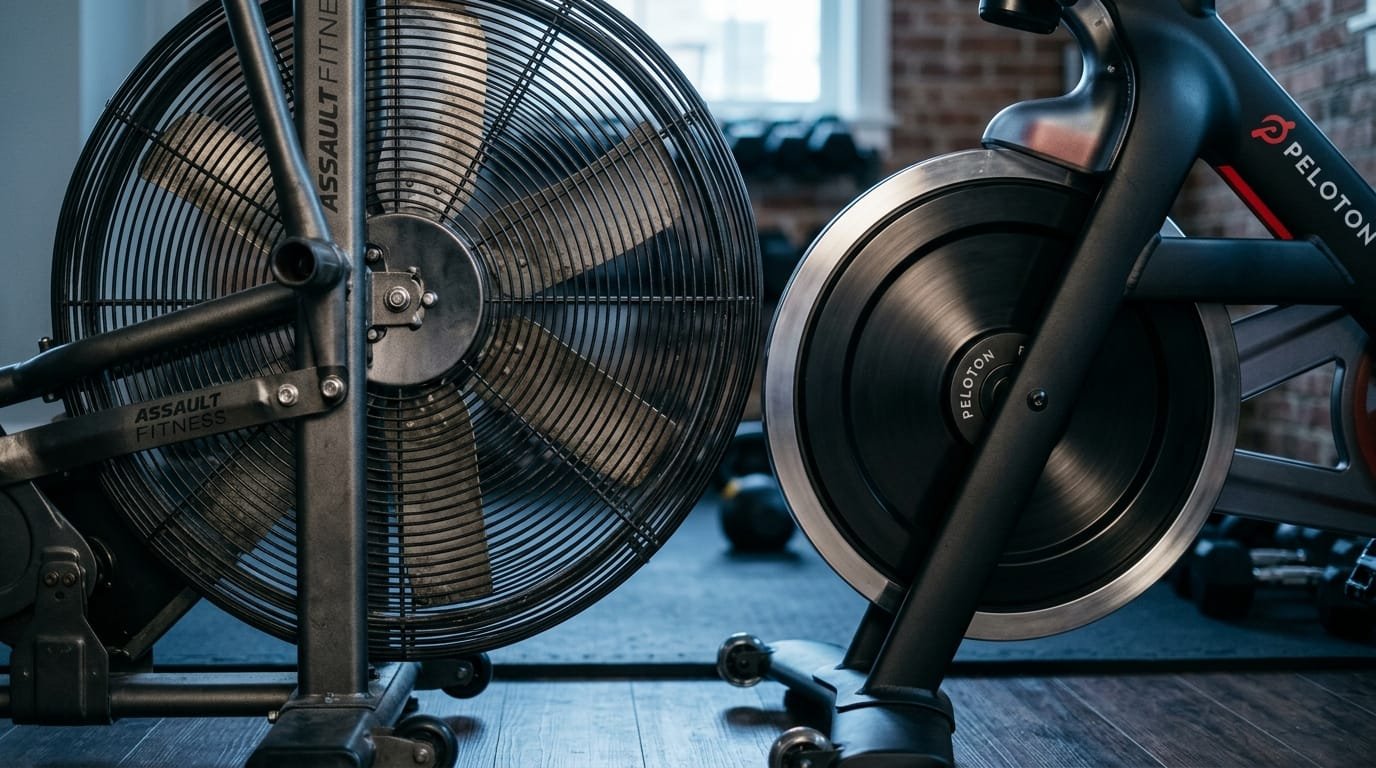
Resistance is created by a fan. The harder and faster you pedal and push/pull the handles, the greater the air resistance. Moving handlebars turn the movement into a full-body action involving legs, core, back, chest, shoulders, and arms. This produces rapid elevations in heart rate and oxygen demand.
Traditional Exercise Bike (Upright or Recumbent)
Resistance is usually magnetic or friction-based and set manually. The workload stays constant until you change it. Movement is almost entirely lower-body. Recumbent models further reduce upper-body and core demand while supporting the back.
These differences drive higher average calorie expenditure and greater metabolic stress on the air bike during hard efforts, while traditional bikes allow easier control of intensity for longer durations.
Calorie Burn and Fat-Loss Comparison
| Factor | Air Bike | Traditional Exercise Bike | Advantage for Fat Loss |
|---|---|---|---|
| Calories per minute (hard effort) | Often 20–30+ kcal/min (higher peaks possible) | Typically 8–15 kcal/min moderate to hard | Air bike |
| Muscle mass recruited | Full body (legs + upper body + core) | Primarily lower body | Air bike |
| HIIT suitability | Excellent – self-regulating resistance | Good with manual adjustments | Air bike |
| Steady-state sustainability | Moderate – high fatigue | Excellent | Traditional |
| Joint impact | Very low | Very low | Tie |
| Beginner accessibility | Moderate (can feel intense quickly) | High | Traditional |
| Session length comfort | Better for shorter, harder sessions | Better for longer rides | Context-dependent |
Because the air bike recruits more total muscle mass and scales resistance with effort, hard intervals produce some of the highest per-minute calorie burns available on indoor cardio equipment. Traditional bikes can still create a substantial weekly calorie deficit when used for longer or more frequent sessions.
Fat loss ultimately depends on total energy balance. A machine that enables higher intensity in less time (air bike) or higher sustainable volume (traditional bike) can both support fat loss when paired with appropriate nutrition.
Conditioning and Performance Benefits
Air Bike Strengths for Conditioning
- Rapid heart-rate elevation and high anaerobic demand
- Simultaneous upper- and lower-body endurance
- Excellent for short HIIT protocols, finishers, and metabolic conditioning
- Builds work capacity that transfers to other high-intensity efforts
Traditional Bike Strengths for Conditioning
- Precise control of steady-state zones
- Lower perceived effort for aerobic base building
- Easier to accumulate weekly volume
- Recumbent options ideal for those needing back support or very low impact
Both improve cardiovascular fitness. The air bike tends to develop broader work capacity and higher peak outputs; the traditional bike is superior for pure aerobic endurance and recovery-focused riding.
Practical Home-Gym Considerations
| Consideration | Air Bike | Traditional Exercise Bike |
|---|---|---|
| Footprint | Moderate to large | Varies (recumbent often larger) |
| Noise | Higher (fan noise) | Lower (especially magnetic) |
| Price range | Mid to high | Wide (budget to premium) |
| Learning curve | Low–moderate | Very low |
| Maintenance | Fan and moving parts | Generally simpler |
| Versatility | HIIT + full-body | Steady-state + endurance |
Air bikes are popular in functional-fitness and CrossFit-style home gyms precisely because of their conditioning density. Traditional bikes remain favourites for people who prefer longer, controlled cardio sessions or need a gentler entry point.
Step-by-Step Guidance for Each Machine
Maximising Fat Loss & Conditioning on an Air Bike
- Warm up 3–5 minutes at easy effort.
- Use short intervals (10–40 seconds hard, equal or longer recovery) or longer repeats (1–3 minutes).
- Drive through the legs while actively pushing and pulling the handles.
- Keep sessions 15–30 minutes for most HIIT work.
- Progress by increasing hard-interval intensity or reducing rest.
- Track calories, distance, or calories per minute for feedback.
- Pair with strength training on separate or concurrent days.
- Allow adequate recovery—sessions are systemically demanding.
Maximising Fat Loss & Conditioning on a Traditional Bike
- Set resistance so target heart-rate or RPE zones are achievable.
- Build aerobic base with longer steady rides (30–60+ minutes).
- Incorporate interval days (e.g., 4–8 × 2–5 minutes hard).
- Use incline simulation or higher resistance for climbing efforts.
- Progress duration or average power/resistance weekly.
- Recumbent models suit longer sessions or those with back sensitivity.
- Combine with strength work for better body-composition outcomes.
- Focus on consistency and sustainable weekly volume.
Integrating Bike Work with Complete Home Training
Both bikes complement strength training. Maintain shoulder health during any upper-body work with proper lateral-raise form and dedicated rear-delt training (safe lateral-raise technique and shoulder health routine.
Kettlebell swings, complexes, and carries provide additional metabolic stress that pairs well with bike intervals (kettlebell sizing guide. Grip strength supports better posture and handle control on the air bike (grip strength guidance.
Band work remains useful for activation and lateral stability (Resistance Bands Buying Guide. Core strength improves power transfer on both bikes (ab roller progressions.
Treadmill options provide variety in impact and movement pattern (manual treadmill guidance and broader cardio comparisons). Recovery, hydration, and sleep determine adaptation to high-intensity air-bike work or higher-volume traditional riding (Best Post-Workout Recovery Tools, Hydration and Electrolyte Needs for Intense Home Cardio Sessions, and Sleep and Recovery Strategies. Tracking ensures progressive overload (Best Ways to Track Progress Without a Gym or Personal Trainer.
External comparisons highlight the air bike’s higher per-minute calorie burn and full-body demand versus the traditional bike’s sustainability for steady-state work (air bike vs traditional bike analysis and calorie-efficiency discussions).
Common Myths
- “The air bike is always better for fat loss.” → It burns more per minute, but total weekly expenditure and nutrition matter more.
- “Traditional bikes are only for beginners.” → They remain excellent tools for aerobic development and active recovery at all levels.
- “Air-bike work replaces strength training.” → It is conditioning; progressive resistance training is still required for optimal muscle and strength.
- “More resistance is always better.” → Sustainable intensity and recovery determine long-term results.
Frequently Asked Questions
Which burns more calories in 20 minutes?
The air bike, when used at high effort, typically burns more calories in short sessions because of full-body recruitment and self-scaling resistance.
Is the air bike better for HIIT?
Yes. The fan resistance and moving handles make it one of the most effective indoor tools for high-intensity interval training.
Can a traditional bike still produce excellent fat-loss results?
Absolutely. Longer or more frequent sessions create substantial energy expenditure. Consistency often outweighs peak per-minute burn.
Which is easier on the joints?
Both are very low-impact. Recumbent traditional bikes are often the gentlest option for those with back or hip sensitivities.
Should beginners start with an air bike?
Many beginners find traditional bikes more approachable. Air bikes can be used from day one with shorter, controlled intervals.
Do I need both?
No. Choose the machine that matches your preferred training style and space. Many home gyms thrive with one well-used bike plus strength equipment.
How should I combine bike work with strength training?
Perform hard air-bike intervals on separate days or after strength sessions. Use traditional bike rides for aerobic work or active recovery.
Final Recommendation
For maximal calorie burn and full-body conditioning in limited time, the air bike holds a clear edge due to its self-scaling resistance and simultaneous upper- and lower-body demand. For sustainable steady-state cardio, longer sessions, lower entry barriers, and recovery-oriented riding, a traditional exercise bike is often the better practical choice.
Select the machine you will use hard and consistently. Pair it with progressive strength training, adequate protein and calorie control, solid recovery, and simple tracking. Whether you choose the intense, full-body stimulus of the air bike or the controllable endurance platform of a traditional bike, regular challenging sessions combined with proper nutrition will drive fat loss and conditioning improvements. Test the feel of both if possible, commit to the one that fits your style, and focus on progressive effort — results follow consistency.